Tibetan music is a unique and ancient music form, which retains the original music characteristics and humanistic connotation, has unique Tibetan regional characteristics and cultural factors, and has high artistic value and aesthetic interest. Because of the restriction of the traditional national structure and modern communication system, Tibetan music can not be developed effectively in modern society. One is how to spread and inherit Tibetan music culture in the present and future society, and the other is how to spread and propagate Tibetan culture through music to attract more people to the Tibetan area. This paper will study the visualization of Tibetan music and visual communication derived from Tibetan music. The modern communication system combined with the preferences of young people to experiment with pioneer music and visual arts to stimulate the vitality of Tibetan culture and iteration. Under the framework of China's traditional ethnic minorities, the cultural genes related to Tibetan arts and humanities are deeply excavated to promote multi-cultural dissemination in the future.
The purpose of this paper is to explore the possibility of visual design dri- ving the development of Tibetan music in the new era, hoping to provide forward-looking suggestions for the future development of Tibetan culture. In the long history, Tibetan people have created a rich and colorful music culture, but due to the serious lag in the economic development of Tibetan settlements, many Tibetan music cultures are not developed and stay in a self-perpetuating situation. Therefore, this paper attempts to study the visual expressions of Tibetan culture and then act on the dissemination and develo- pment of Tibetan music, so as to promote the thoughts, feelings, and values of Tibetan people. The paper is organized as follows: first, the visual design of Tibetan music based on Tibetan cultural elements and its analysis, and second, the study of visual communication of music in the new era. It also draws relevant conclusions and issues to be addressed.
RESEARCH BACKGROUND The interactive language of multimedia permeates all aspects of human soci- ety with a powerful force, and also has a great impact on the development
Tibetan Music Visualization and Visual Communication 123
of contemporary art (Kubelka, 2000). The current new media generated by combining computer science and art have penetrated into all aspects of people’s lives and become an indispensable and important part of social development (Jeong, 2016). With the advent of the information age, the inte- gration of computer science and art has led people to expect more from the information. The combination of digital technology and multimedia techno- logy, human-computer interaction, network technology, and other areas of development, visual visualization technology began to be applied to musical expression, creating a new world of cognition for people. These new technical means provide people with a new way of cognition, which not only enables people to obtain more information but also enables them to develop a stron- ger interest in art. To a certain extent, the visualization of music has become one of the most influential and promising tools in the information age. For example, Hans Richter’s music visualization short film, in which he tran- sforms music tunes, melodies, and rhythms into a series of geometric figures, following the changes of musical elements to set a series of dynamic effects such as rotation and scaling, is an early and simple mutual transformation.
In the preservation of Tibetan cultural heritage, music occupies an impor- tant position. Tibetan music not only plays an important role in cultural inheritance but also plays a great role in cultivating the talents of the next generation; not only has very rich content resources to be excavated and developed and utilized but also has unique artistic expressions and expressi- ons and other contents to be excavated and utilized. Tibetan music culture, as one of the most important and unique types of Chinese cultural diversity, has distinctive national characteristics and unique charm. Therefore, the develo- pment of Tibetan music culture in today’s society plays an important role in promoting traditional culture and national spirit.
In this context, Tibetan music visualization refers to the combination of ethnic art and computer media to produce a new form for dissemination and expression. It is a new form of communication that combines traditional media and computer technology. Applying it to modern visual communi- cation media not only enables people to obtain multi-dimensional sensory stimulation but also enables the public to form a more intuitive and deeper impression of Tibetan culture and art.
TIBETAN MUSIC VISUALIZATION DESIGN The integration of Tibetan culture and science and technology is a strategic choice for Tibetan culture to “go out”, which is to apply advanced scienti- fic and technological achievements in the production of traditional Tibetan cultural auspicious patterns and to promote the innovation of the content, means of communication and institutional mechanism of traditional Tibetan cultural auspicious patterns with high technology as the carrier (Cupchik, 2015). From the development trend of visual visualization of music, we can easily see that the form of combining visual and auditory with each other has endless progress space and application prospects in the future develo- pment of the times. With the development and progress of the times and the continuous improvement of human civilization, music visualization will
usher in a brand new era and further change people’s perspectives and ways of understanding the world. Meanwhile, the perfect combination between traditional ethnic culture and modern technology can achieve cultural revi- talization and prosperity. The following provides a design idea for Tibetan music visualization.
Inspiration Tibet is known as the “Pure Land of Goddess of Mercy” and the “Heaven of Buddha”. Most Tibetans living on the snowy plateau believe in Buddhism, and in the face of the harsh nature and heavy burden, they naturally think of finding spiritual solace beyond material things, and Shambhala is the paradise they long for. Tibetan music is also the spiritual home of the Tibetan people, as it expresses their aspiration for a better life through lyrics and melodies. The design elements are mainly extracted from the artworks and totems of Tibetan culture that are full of expectations for a better life.
The main visual elements are Tibetan Eight Treasures and Mani Stone, which convey auspicious symbolic meaning. The stylized shape and beauti- ful symbolic meaning of Tibetan Eight Treasures are suitable as subsequent visual design elements, which have the traditional Tibetan style and can be used as a visual symbol to convey the spirit of Tibetan music. Mani stones can be found almost everywhere in Tibet, mostly engraved with six-character truths. If Chinese characters can be engraved on mani stones, they can be used to spread the good meaning in a broader context. Similarly, the use of com- puter technology to create a more visually appealing virtual mani-stone form as a design presentation is also a new form of future prayers.
Visual Presentation In the Tibetan music visualization, this time touchdesigner combined with blender is used as the development platform and tool. Through the krani graphics, we are able to know that the different tones and amplitudes produ- ced on the music, can be visually corresponded one by one in a special way. When thinking about music visualization, different features of music are pro- cessed, such as volume, mood, melody, instruments, rhythm, etc., which can be extracted and analyzed from audio files. By numerically analyzing the nodes of Tibetan music and linking the Tibetan music with the floating par- ticles, a dynamic display of the effect of music visualization is derived. This is an objective and rational way of transformation. These features must be map- ped to the visual properties of the target presentation scene. Scenes usually consist of objects with different colors, positions, and other properties. One of the main problems of music visualization is how to map musical features onto the parameters of visual objects.
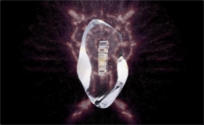
The visual interpretation is divided into two main parts (Figure 1): the first part is the floating state of the particles, inspired by the dense mist of the snowy mountains and the wind and horse flags scattered into the air, the feeling of drifting and the fading dynamics present the mystery of this people. By analyzing the ebb and flow of the sound in the Tibetan style song to control the floating of the particles, the various forms of the Tibetan eight
Tibetan Music Visualization and Visual Communication 125
Figure 1: Music visualization screen.
treasures are gradually changed in the process. The second part is the crystal stone in the foreground, inspired by the Tibetan Mani stone, on which the six characters are usually engraved. The design is a cross-cultural integration and innovation between ethnic groups, expressing both the Tibetan desire for good things and blessings and visual communication in a more popular context.
In the future, with the continuous development and progress of society, Tibetan music will have more innovations in form and content, and music visualization can cater to a wider and younger group of Tibetans (Wang, 2014). It not only enables us to understand the uniqueness of Tibetan music and its rich and diversified cultural connotation but also can better serve the general public and provide a more trendy and interesting user experience. With the economic progress and development of the times, art has become a way for people to pursue a quality of life, and music art is the easiest to achieve and the most infectious one. Music visualization art meets people’s dual sensory experience, enhances people’s sense of music integration from visual and auditory aspects, gives the music a variety of expressions, and can meet various requirements such as entertainment, emotional experience, and education, and realizes people’s It can meet the requirements of enter- tainment, emotional experience and education, and realize people’s beautiful aspirations for music.
TIBETAN MUSIC VISUALIZATION COMMUNICATION Because Tibetan music in the future should be oriented to a more popular market, and achieve value-added in both artistic aesthetic level and comme- rcial profit level, and the consumerism of Generation Z is willing to pay for art and better design, so the visual communication of Tibetan music in the future must capture their aesthetic orientation, so it should be more advanced in designing application scenes but can convey beautiful values to the youn- ger generation. The combination of virtual and reality is a more advanced way. The combination of virtual and reality is more in line with the chara- cteristics of the communication trend in the new era and can achieve a better combination of art and business (Yang Yang, 2019).
Virtual: Expanding the Application of Reality Technology Mobile devices are the most convenient and timely, so Tibetan music visuali- zation can be implanted in cell phones in the form of software or programs to show interactive animations while listening to Tibetan songs. AR techno- logy is implanted to present more three-dimensional effects, such as scanning mani stone souvenirs to appear random Tibetan songs and visualization inte- raction, this way can make the value of Tibetan souvenirs increase while passing more Tibetan culture to the public. In the rapid development of the Internet today, the mani stones that can be scanned by AR come with marke- ting hotspots and drive the tourism and cultural industry of ethnic minorities after fermenting and spreading on the network.
Head-mounted VR devices are gradually being used in today’s game, modeling, and painting fields and Tibetan music visualization can just as well use VR technology to establish a virtual immersive music space. The immersive mode of feeling music and images breaks the traditional screen and picture frame. The viewer completes the experience through his or her own “ideas”, constructing a certain time and space in a visual virtual space in a Tibetan music environment to express a certain “idea” or “spiritual realm”(Zhuo Ga, 2018). Nowadays, VR devices are gradually coming into the homes of ordinary people, especially in the post-epidemic era, people need an independent immersion place to provide spiritual healing, and Tibe- tan music with its ethereal and melodious melody can soothe people’s hearts, combined with VR technology can realize the future people can feel the inculcating experience from ethnic art at home.
Reality: Transmedia Art Exhibition The visual display of Tibetan music can be combined with dance as an inte- ractive video device to strengthen the visibility of Tibetan music through physical cooperation with dancers. In the theater space, the dancing body can form an interactive symbiosis with images and sounds through sensors, motion capture devices, and computer technology for motion tracking (Qu Ziyin, 2021). The art can be expressed by influencing the digital environ- ment through the dance performance, by projecting or lighting to render the art scene in the musical atmosphere. Three different types can be utilized: responsive (pre-programmed digital images in tune with the movement), real- time interactive (using tracking technology to enable the movement to disturb the digital images in order to change the sound and light levels and move- ment), and stereo mapping (projection on irregular media surfaces including the body).
The dialogue in traditional music art takes place between the audience and the live performers, and this dialogue is relatively abstract and limited. In the creation of video dance visualized by music, the “dialogue” includes not only the dialogue between the audience and the actors in the traditional sense, but also the dialogue between dance art and music, and the dialogue between music and visual projection and lighting. The multifaceted “dialogue” gives ethnic art more possibilities for interpretation and increases the possibility of its understanding. In a music art performance, although the audience can
Tibetan Music Visualization and Visual Communication 127
watch the music performance and appreciate the dance art intuitively and three-dimensionally, the stage without scenes and atmosphere rendering is monotonous and boring. If one pursues more diversified visual effects and appreciates Tibetan music art from a more multi-dimensional perspective, cross-media performance can obviously meet the audience’s needs better than traditional dance art.
The cross-media performance with digital technology support greatly expands the boundaries of Tibetan music art, making more emotional reso- nance possible, and allowing multiple artistic media and technologies to be integrated into the realistic creation of music art.
CONCLUSION
With the progress and development of the times, the way of music com- munication is also changing, and the development mode of science and art integration and discipline crossover is gradually promoted (Guo Yijun, 2019). Tibetan music can develop towards more diversified aspects under the pro- motion of design, and at the same time, it is also the practice of conforming to the trend of the times, so that the tradition can be renewed with more vitality under the role of new technology. This paper attempts to reveal the possibilities of Tibetan music development in the context of the multimedia interactive design era, taking Tibetan music and Tibetan culture as the cor- nerstone, combining the aesthetics and presentation of modern context and exploring more possible multimedia interactive art and plane extension.
In the future, on the basis of a comprehensive grasp of traditional Tibetan music and culture, we should boldly use the current more advanced tech- nological means and platforms to expand the influence of Tibetan music and culture, and in this way, we should push back the preservation of Tibe- tan music. Tibetan music visualization is the use of programming language and interactive processes to realize the communication between music and people in the Internet environment, attracting more people to pay attention to Tibetan music and understand Tibetan music. In this way, Tibetan cul- ture can be promoted, so that the niche is no longer niche, and more people will enter Tibet in the future, thus driving tourism and achieving the perfect combination of art and business.
Visual design can drive Tibetan music to spread and develop better, and traditional culture can present its charm in many ways in the new era. This paper and related designs only provide a perspective on the dissemination of ethnic culture, and future cultural heritage and development should integrate more disciplines and more ways to adapt to the current rapidly developing society.
ACKNOWLEDGMENT
I would like to thank my mentor Chao Zheng for all the time, effort, and guidance she gave me. Can’t do it without him. I would like to thank my classmates at the China Academy of Art, they helped me a lot. Finally, a special thanks to my family who have supported me in every possible way.
REFERENCES
Cupchik, J. W. (2015). Buddhism as performing art: Visualizing music in the Tibetan sacred ritual music liturgies. Yale Journal of Music & Religion, 1(1), 4. Guo Yijun. (2019). Discussion on the Development of Music Visualization Art.
Collection, 8. Jeong, D., & Nam, J. (2016, May). Visualizing music in its entirety using acoustic features: Music flowgram. In Proceedings of the International Conference on Technologies for Music Notation and Representation. Anglia Ruskin University (pp. 25–32). Kubelka, O. (2000). Interactive music visualization. In Central European Seminar on
Computer Graphics (Vol. 4). Qu Ziyin. (2021). A Brief Discussion on the Application Possibility of Music Visualization in Modern Times. Popular Literature and Art. Wang, G. (2014, September). Principles of visual design for computer music. In
ICMC. Yang Yang, & Liu Yi. (2019). A new path in the development and inheritance of Tibetan music culture. Journal of Normal University for Nationalities, Qinghai Normal University, 2. Zhuo Ga. (2018). Talking about the management innovation of Tibetan music mar-
ket under the background of the Internet. Modern Economic Information, (4), 442–442.
LISTED IN THE AHFE DIGITAL BOOKSTORE CATALOGUE
Explore the complete digital volume
Ergonomics In Design
Read this individual research paper free through the original publisher, or explore the full digital proceedings book.
ISBN 978-1-958651-53-7
Explore this ISBN in the AHFE Bookstore ↗Listed in the July 2026 bookstore catalogue; search by ISBN to confirm current availability · Digital book purchase optional