Xinhao Zhan, Chao Zheng, Bingkun Qiu, Li Cheng Xie, Xinlei Zhang, Yichen Zeng (2023). Sensory Virtual Interaction Design Based on the Impact of Microplastics on Ecosystem. In: Ergonomics In Design. AHFE Open Access, vol. 77, pp. 668–677. https://doi.org/10.54941/ahfe1003427
Virtual interaction can provide vivid interaction scenarios for the audience, and its operability greatly shortens the distance between the works and the audience. The key to building a complete set of virtual interaction works is to design aesthetic 3D video and logical interaction design. Micro plastic pollution is an environmental problem that has recently attracted much attention. Micro plastics widely exist in various media carriers all over the world. As far as plastic straws are concerned, on average, more than 30 plastic straws are used each year in China. A large number of micro plastics are produced in the process of processing and recycling, causing irreversible damage to the natural ecology. Therefore, from the point of view of design, the virtual interactive design of the micro plastic pollution theme is studied based on interactive devices. Let people know the harmfulness of micro plastics, and reduce the use of plastic products spontaneously. In this paper, the origin and influence of microplastics are briefly introduced. Secondly, to slow down the micro plastic pollution problem by design, we analyzed and learned the relevant cases of virtual interactive design works, learned from each other's strengths, and finally presented the design practice results.
The problem of micro-plastic pollution is one of the most serious pollution problems faced by human beings at present, and has been widely concerned by various countries and disciplines around the world. Humans will inevita- bly use plastics and coexist with plastics for a long time in the future (Luo, 2021). As a kind of plastics, microplastics has a wider spread, and its influe- nce covers humans, animals, oceans, soil and plants. In recent years, although China has launched many environmental protection policies, it is still weak in the face of such a large base of plastic users.
As a design student with the spirit of social care, when facing the incre- asingly serious problem of micro-plastic pollution, it is necessary to use its own discipline advantages to intervene from the design perspective to reveal, solve, improve or reveal the problem. The design method of virtual sensory interaction has operability and timely feedback. It connects the virtual world in the display screen with the senses of the interactive experience, so it has
Sensory Virtual Interaction Design Based on the Impact of Microplastics on Ecosystem 669
a stronger theme expression. So on the basis of reading a large number of recent scientific research results on the impact of microplastics on natural ecology, the excellent interactive works on the theme of environmental pro- tection were emphatically investigated, and the methods were summarized and applied to the creation of virtual sensory interaction. Finally, through two sets of virtual interaction design works, the relationship between the use of plants and plastics will be artistically displayed in a visual and tou- chable human-computer interaction way, so that the experience will have a sense of instant interaction and trigger profound thinking. The work aims to appeal to people to reduce the use of plastics, thus reducing the pollution of micro-plastics from the source.
SOURCES OF MICRO-PLASTICS The sources of microplastics can be divided into primary and secondary sources (Liu, 2021). Primary microplastics refer to plastic particles directly generated from the production process. This part of plastic does not need a long time to decompose from large to small, but is directly put into nature in the form of micro-particles; Secondary microplastics refer to plastic particles formed by large plastic fragments dissolved in the natural environment by a variety of factors, such as physical trampling or chemical decomposition, biodegradation, etc (Zhang, 2016). Compared with primary source, secon- dary source has a series of degradation steps. However, both primary and secondary sources produce a large number of microplastic particles.
THINKING ON THE TOPIC SELECTION BASED ON THE IMPACT OF MICROPLASTICS ON SOIL AND PLANTS Microplastics can migrate in many ways, such as entering rivers through sewage system, directly discharging into surface runoff, wind migration and deposition in the air, food chain, etc (Xu, 2022). Therefore, it will be captured and absorbed by plants in many ways. Microplastics with different par- ticle diameters and types will directly or indirectly affect plants and the environment in which they grow, causing toxicity and even genetic toxicity to themselves and the environment (Ji, 2021). Edible plants absorb micro- plastics, especially nano-plastics, and plastics may slowly accumulate in organisms and human bodies, thus threatening human and biological health.
There are few studies on the effects of microplastics on soil ecosystem. The main reason is that soil is different from the ocean, and soil is a complex complex with too many variables (Feng, 2021). Secondly, the harm of micro- plastics to plants is not immediate, but gradually accumulated. Therefore, the interactive design with the theme of micro-plastic pollution will choose more direct expression of objects, such as the ocean, land, animals, human and other angles. At the same time, it is found that there are few works that use plants to express plastic pollution.
To sum up, there are two reasons for choosing the impact of microplastics on soil and plants as the design direction. The first point is to make use of the uniqueness of the selected topic to increase the attractiveness of the design
works in content expression. Secondly, compared with other types of plastic pollution topics, the impact of plastics on plants is often ignored. We hope to make people pay attention to the micro plastic pollution itself through artistic expression.
CASE STUDY OF ENVIRONMENTAL PROTECTION THEME INTERACTION Many interactive design works with environmental protection as the theme have strong commonality, and the core is the impact of human behavior and plastic products on the environment. Therefore, in the case study, the interaction process and visual performance in these works are analyzed emphatically, which has important reference significance for me to design vir- tual sensory interaction works in the direction of “the impact of microplastics on ecosystem”.
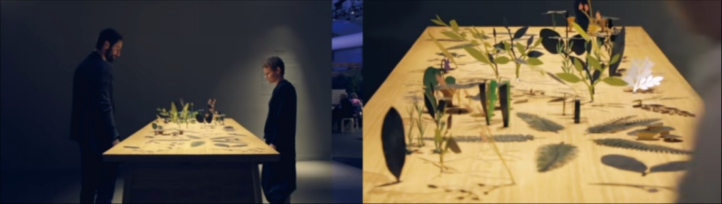
CONTACTLESS INTERACTIVE DEVICE UNDER THE RELATIONSHIP BETWEEN HUMAN AND NATURE Comes Alive’s work is a dynamic interactive device for perfume brand made by Mischer and Traxler at the 2014 Miami Design Exhibition. This device reflects that excessive human activities will have a negative impact on the gro- wth of natural plants. There are ultrasonic sensors around the table. When people are detected approaching, the plants on the table will fall down. When people keep a certain distance from the device, plants will reappear. The author said that “the species used on the table are all related to real spe- cies, and some of them have become extinct”. It implies that human activities have brought negative impacts on natural ecology, many of which are often irreversible. With the carrier of interactive devices, it is a subtle and subtle warning to human beings to reduce the pollution of nature (Figure 1).
Such inductive interaction is a good way to show the relationship with nature through human spontaneous interaction. The interactive form that directly explains the relationship between man and nature is also reflected in other design devices.
Figure 1: Comes Alive (2014) Mischer & Traxle.
Sensory Virtual Interaction Design Based on the Impact of Microplastics on Ecosystem 671
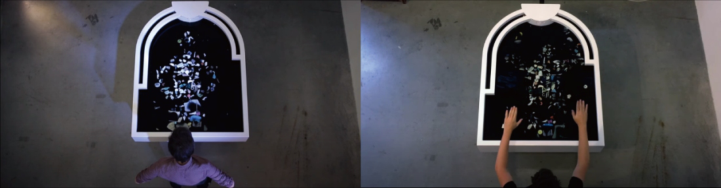
A DEVICE FOR FEEDING BACK THE HARM OF MICRO-PLASTICS TO HUMAN BODY THROUGH MARINE PLASTIC POLLUTION Plastic Reflectic is an interactive device written by Thijs Biersteker. The pur- pose of this design is to let the audience reflect on the growing problem of micro-plastic pollution in the sea. When the visitor approaches the water surface, the reflection that should have appeared in the water surface turns into plastic waste, implying that these micro-plastics enter the natural food chain from human waste plastic products, and slowly interweave with human muscle and adipose tissue, making human flesh slowly become plastic. As an interactive sensory experience, the device reflects the audience by reflecting the reflection of marine plastic waste from all over the world.
The interactive form of Case 2 and Case 1 is relevant, summarizing the complex relationship between plastic pollution and human beings, and using more direct expression to make the audience realize that the growing plastic problems will eventually affect human beings.
The way to achieve this work is to capture the changes in the shape of the silhouette of the interactive person in real time through the camera, and then control the rise and fall of the floating plastic in the water through the program. Because plastic can float on the water, the rise and fall of plastic can be controlled by a rope and the mechanical structure below (Figure 2.)
“Plastic Reflective” and “Comes Alive” are two excellent projects. The three authors use their design to convey their environmental protection ideas, let the visitors participate in the experience personally, while retaining the interest and arousing strong reflection. One is about the relationship betw- een microplastic pollution and marine ecology, and the other is about the relationship between human activities and natural plants. However, it is not difficult to find their commonalities. Both reflect the theme of environmental protection. In terms of interaction itself, “audience” is the key to the whole interaction process. In the case, they have achieved the unity of interactivity, interest and uniqueness. Because of this, their works received such positive feedback.
Summarize the inspiration of two excellent cases. First, in terms of theme. Case 1 relates the relationship between “human activities” and “plant growth” in a proper way, which is non-contact intera- ction based on ultrasonic sensors. This seems to be a technical discussion, but this kind of interaction is actually its theme - the impact of human activities.
Figure 2: Plastic reflectic interactive installation for plastic soup foundation.
So when I go to design, it is particularly important to choose a suitable carrier and interaction mode to carry this theme.
Secondly, in terms of interaction mode. In case 2, the visitor’s reflection is “replaced” with plastic, which shows that the visitor’s body is occupied by micro-plastics, which means the harm of micro-plastics to human body. This “replacement” method ingeniously transforms the interactive behavior of visitors into another kind of fresh visual feedback.
Third, in terms of technology. In the two cases, wireless motion attitude sensor and ultrasonic sensor are used respectively, so the information can be captured and converted into data by computer external sensors in the interactive works.
Fourth, optimize the whole interaction process and experience of the audie- nce. Optimizing the interaction process means making the interaction process interesting and easy to operate; Optimizing the sense of experience refers to achieving the richness and design of vision in virtual interaction.
After investigating and analyzing the above two cases, I started the sensory virtual interaction design practice under the influence of microplastics on the ecosystem.
SENSORY VIRTUAL INTERACTION PRACTICE The reason why plastic straws are selected as the main carrier of intera- ctive logic in practice cases is that in January 2021, the ban on plastic straws in China came into force. With this time node, two virtual sensory interaction design works on the impact of microplastics on plant growth with plastic straws as the carrier were produced in 2021. Second, there are serious problems of waste plastics and micro-plastics in the produ- ction, use and treatment of plastic straws. Because the volume of a single microplastic particle is too small, it is relatively abstract at the macro level. Therefore, plastic straw is used as the concrete carrier of the concept of microplastics.
PART I - THE APPEAL OF FLOWERS: DESIGN PROCESS AND THINKING The core idea is “human use of plastic makes beautiful flowers wither”. This work establishes a link between plastic straws and flowers. Plastic straws are used to refer to micro plastic pollution, and flowers are natural ecology. Excessive use of plastic products is irresponsible for nature. Participants will directly experience the harm of micro-plastic pollution to natural ecology. Finally, everyone watching this work is called upon to reduce the use of plastic products as much as possible.
In the interactive experience, the experimenter puts the prepared straw into or out of the container, and as the number of straws increases or decreases, the plants in the display will wither or grow accordingly. The insertion of straw implies the increase in the use of plastics, that is, the amount of micro- plastics in plants also increases accordingly. Indirectly affect the growth of plants, leading to the decline of plants. It is interesting that the straws can be
Sensory Virtual Interaction Design Based on the Impact of Microplastics on Ecosystem 673
taken out at any time during the process of putting them into the container one by one, and the flowers in the screen will also feedback in time, changing from the declining posture to the flowering state. The purpose of this design is to strengthen the negative correlation between the blooming degree of flo- wers and the number of straws, and highlight the theme; Secondly, make the interaction process more natural and the work more complete.
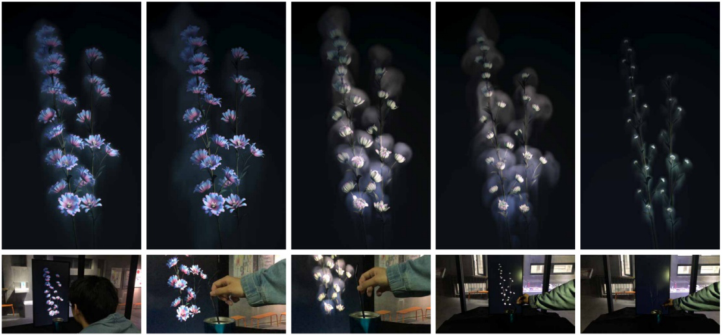
There are four plastic straws that can be put in, but I divide the whole interaction process into five sections. Four of them refer to the picture of gradually withering when the straw is put into the container, and another one refers to the time when there is no straw in the container. When the visitor chooses not to put in the straw but gently touch the container with his hand, the flowers will feel as if they were touched, the flowers will vibrate and emit smoke, presenting the most beautiful picture in the whole project.
At the beginning of the design, I divided it into two parts in the arran- gement of visual effects in the interaction process. It is the corresponding withering rate and color change of each stage.
From the first stage to the second stage, the withering rate is 15%, the color does not change, and the change is relatively small; From the second stage to the third stage, the withering rate is 30%, and the color changes from bright red and blue to relatively dark yellow and red, and the change in perception is increased;
From the third stage to the fourth stage, the withering rate was 40%, and the color did not change. Because the scope of flower closing became larger, the sensory change was only second to the second stage; From the fourth stage to the fifth stage, the withering rate is 15%, the color disappears, and the flower has completely disappeared, with the greatest visual impact;
From the bright and beautiful red and blue flowers to the nothingness gradually, this design shows that human beings often fail to notice at first in the process of destroying the natural ecology. With the rapid increase of pollution, it is difficult to control it after slowly realizing it.
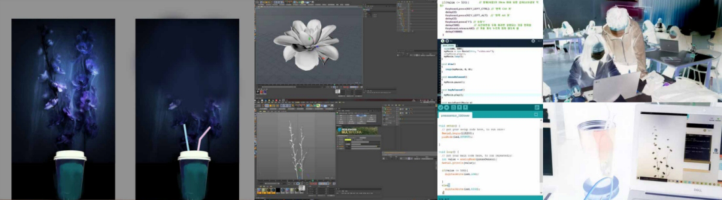
In the actual operation project, a pressure sensor is placed under the con- tainer, and the sensor can detect subtle weight changes. Arduino platform is used to connect the pressure sensor and 3D video, and the interaction betw- een human and virtual scene is realized through pressure sensing (Guo, 2022) (Figure 3). The function of plant shape change is essentially a cyclic video corresponding to different weights in programming. When the system dete- cts the weight increase, it can play the corresponding video in the next weight range.
In the process of realizing 3D vision, Cinema 4D software is selected to simulate the growth animation of flowers and plant branches, and Turbule- nce FD plug-in is used to simulate the smoke effect. When the flowers are in full bloom, the red and blue colors show a beautiful and quiet texture; The flowers gradually closed, and the color became implicit again, showing a withered and decadent trend; The flowers wither and emit green smoke, giving people a sense of desolation (Figure 4).
Figure 3: ”The appeal of flowers” includes concept sketch, design process, p5 and Arduino programming, and site photos.Figure 4: Interactive steps and visual effect demonstration of “The appeal of flowers”.
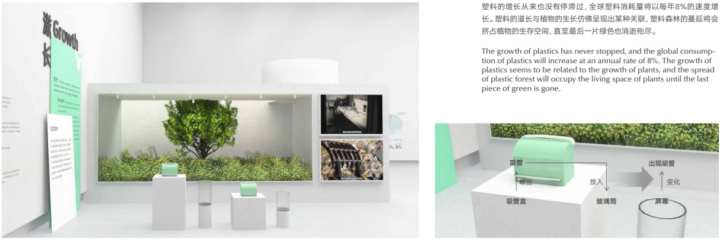
PART II - WHITE FOREST: FURTHER OPTIMIZATION AND IMPROVEMENT “White Forest” is an improved and improved version based on “Flower Appeal”. The field space on which the whole work is based is on an offline exhibition of the environmental protection theme that calls for reducing pla- stic pollution. The theme is still to call for reducing plastic pollution. The design concept and interaction logic of the first case - placing the straw into the container is retained (Figure 5).
It is the overall exhibition design, and video explanation is added to the interactive device. In terms of visual expression, the case makes up for the regret that the effect of Scheme I is poor due to the small interactive screen. The straw is stored in the common straw box in the restaurant to show the process of using straw in our daily life, making the interaction process more reasonable. The container for placing straws has changed from a simple cup to a more textured glass booth, and two interactive areas, one high and one low, have been set up to facilitate visitors of all ages to experience at the same time.
Sensory Virtual Interaction Design Based on the Impact of Microplastics on Ecosystem 675
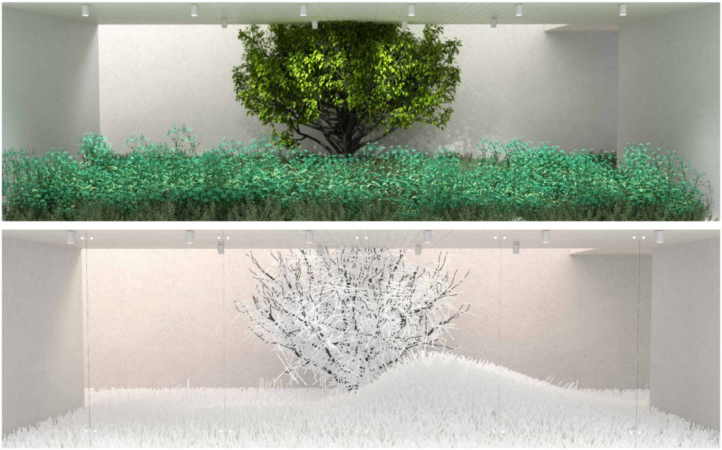
Figure 5: Venues and interactive logic of “white forest”.Figure 6: Visual effect demonstration of “white forest”.
The vision in the case is also the video rendered by Cinema 4D software, and then the pressure sensor is used to control and play the cyclic animation of the corresponding weight range (Figure 6).
CONCLUSION
First of all, from the perspective of the presentation effect of the work, alth- ough the way of virtual interaction has increased the number and difficulty of work, the feeling and interactivity it can bring to the experiencer is incom- parable with the performance of 3D video alone (Yang, 2019). Most of the participants said that this interactive way is more direct and more personally aware of the importance of protecting the environment. Secondly, in terms of content performance, this paper discusses how to draw on and develop the design and research results of “Plastic Reflectic” and “Comes Alive”, two
excellent projects, to explore the design artistry and the reasonable effecti- veness of three-dimensional video of microplastic environmental protection and plant natural ecology in design and interactive design. The purpose is to influence more people to reduce the use of plastics. At the same time, new ideas and methods in the field of environmental protection advocacy have been followed and developed to a certain extent. How to better integrate the virtual sensory interaction experience with the design theme, and make them produce better chemical reactions, so as to obtain better information transmission function, still needs to be further explored.
ACKNOWLEDGMENT
General Scientific Research Project Supported by Zhejiang Provincial Educa- tion Department (Project No. Y202250504).
REFERENCES
Bosker T, Bouwman L J, Brun N R, etc. Microplastic accumulates in the pores in the seed sac and delays the germination and root growth of the terrestrial vascular plant Lepidium sativum [J]. Chemosphere, 2019226: 774–781. Cheng Jilong, Wang Man, Li Hanbing, Yan Junyi, Liu Chenrui. Review of the sub-
stitution of plastic straws [J]. Anhui Chemical Industry, 2022, 48 (1): 17-19+23. Feng Xueying, Sun Yuhuan, Zhang Shuwu, Wang Fayuan. Ecological effect of microplastics on soil-plant system [J]. Journal of Soil Science, 2021, 58 (2): 299–313. Folds, Dennis. Gardner, Douglas and Deal, Steve. (2008). Building Up to the Human
Systems Integration Demonstration, INCOSE INSIGHT Volume 11 No. 2. Guo Tao. Interactive Design in Virtual Reality [J]. Electronic Technology and Software Engineering, 2022 (2): 189–192. Han Jie. Research on virtual interaction technology in digital display [J]. Digital
Communication World, 2020 (3): 88–88. Ji Hong, Chen Xiuwen, Zhao Hongli, Yue Maofeng. Research progress on the effects of micro-plastics on the growth and development of higher plants [J]. Science and Technology and Engineering, 2021, 21 (18): 7415-7424. Li Mingyuan, Chen Qiqing, Liu Xuemin, Shi Huahong. Research progress in adsor-
ption of organic pollutants by microplastics [J]. Environmental Chemistry, 2022, 41 (4): 1101–1113. Liu F F, Wang S C, ZHU Z L, etc. Research progress of marine microplastics pollution: a review of pollution occurrence, detection and environmental impact [J]. Water, 2021, 13 (12): 1713–1739. Liu Lili, Ling Yutao, Wang Yanfeng. Research on building 3D animation resou-
rces and interactive design in virtual learning environment [J]. China Audio-visual Education, 2014 (2): 123–128. Luo Yongming, Shi Huahong, Tu Chen, Zhou Qian, Ji Rong, Pan resounding, Xu Xiangrong, Wu Chenxi, An Lihui, Sun Xiaoxia, He Defu, Li Yanfang, Ma Yiyi, Li Lianzhen. Progress and prospects on microplastics in the environment [J]. Scientific Bulletin, 2021, 66 (13): 1547–1562. Xu Zhi, Yang Yuming, Jiang Zhiqiang, Li Xuan, Xiong Yun, Xu Lili. Research pro-
gress on the impact of microplastics on the ecological environment [J]. Journal of Wuhan University of Engineering, 2022, 44 (4): 363–370.
Sensory Virtual Interaction Design Based on the Impact of Microplastics on Ecosystem 677
Yang Zihang. Analysis of advantages and application of virtual interactive technology system [J]. Science and Technology Communication, 2019, 11 (23): 98–99. Zhang B, Yang X, Chen L, etc. Microplastics in soil: review of possible sources,
analytical methods and ecological impacts [J]. Journal of Chemical Technology and Biotechnology, 2020, 95 (8): 2052–2068.
LISTED IN THE AHFE DIGITAL BOOKSTORE CATALOGUE
Explore the complete digital volume
Ergonomics In Design
Read this individual research paper free through the original publisher, or explore the full digital proceedings book.
ISBN 978-1-958651-53-7
Explore this ISBN in the AHFE Bookstore ↗Listed in the July 2026 bookstore catalogue; search by ISBN to confirm current availability · Digital book purchase optional