Bingkun Qiu, Chao Zheng, Zihao Wang, Li Cheng Xie, Xinhao Zhan, Yichen Zeng, Xinlei Zhang (2023). Innovative Strategies for Generative Art in the NFT Market: A Case Study of the Art Blocks. In: Ergonomics In Design. AHFE Open Access, vol. 77, pp. 129–138. https://doi.org/10.54941/ahfe1003370
Since the 1960s, generative art, which uses code, has existed as a form of art, but in recent years it has emerged as a distinct art form. We face once again a critical moment to redefine artwork as new on-chain generative art platforms create a new ecosystem for trading artworks using digital currencies. As part of this study, existing websites will be systematically reviewed as well as literature on generative art. This will enable us to identify novel strategies for generating art for the NFT market. Based on the study, generative art that stands out in the NFT market is characterized by its scale, precision, randomness, variability, and reuse. As a result of the unique business model, the curatorial classification of works, and the online presence of NFT for generative art, Art Blocks has a significant share of the NFT platform sales volume. Specifically, the research and analysis of the innovative strategies offered by Art Blocks provide a possible direction for the future development of the art market and digital art design and display.
In October 2018, Christie’s New York auctioned Edmond de Belamy, a por- trait painting created algorithmically by the French art organization Obvious, for $432,500 (Public, 2022). This price had never previously been exhibited or auctioned. The cryptographic artwork Everyday: The First 5000 Days by American artist Mike Winkelman fetched $69,346,000 at Christie’s in an auction that raised the question of ownership of block art for the first time. Through the auction, the issue of ownership of artworks on the blockch- ain was raised for the first time. Cryptoart was recognized as an established art form by the mainstream art establishment for the first time. As a result of this auction, a new ecosystem has been established for the trading of art using digital currency (Gallaga, 2021). The combination of blockchain tech- nology and art is known as crypto art. Decentralizing technology enables an entirely reimagined approach to the creation of art. This is because it prote- cts the uniqueness of art creation, improves the openness of art creation, and introduces smart contract technology to the process of creating art.
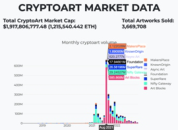
In November 2020, Art Blocks was launched by founder Erick Calde- ron as the first platform to connect artists with users in order to exhibit and sell generative art. Art Blocks is a platform where artists upload cre- ative code. This code must be professionally vetted by the curatorial team and modified during the development process before it is available for sale or distribution. By purchasing a piece, a collector triggers a never-before- seen version of the artist’s project in the form of NFT artwork. It is evident from the CRYPTOART MARKET DATA that Art Blocks’ crypto art has maintained a significant share of sales since January 2021 (Figure 1). As of November 7, 2022, Art Blocks had 6,399 7-day sales and 226,692 total sales, according to the crypto art data section of the Tokenview browser moni- toring. As a generative art platform, Art Blocks has captured a significant portion of the market despite fierce competition from a wide variety of cry- ptographic artworks in major categories, in comparison to other full-category NFT selling platforms. In addition to having positive sales figures, the plat- form continues to maintain a high level of professionalism and theoreticality. Aside from publishing an artist’s column on its website, crypto-generated art is also discussed in an e-zine published in conjunction with the platform’s explorations and research (Yang, 2021).
Figure 1: Crypto art data and tokenview browser monitoring.
A HISTORICAL RETROSPECTIVE OF GENERATIVE ART Before the emergence of encrypted art, Generative Art, a product of the combination of computer technology and art, gradually developed into an independent art genre. More artists conceptually accepted generative art as a method of artistic expression, and more people tried to enter the creative field. NFT technology further enhanced autonomous systems of generative art in 2013, especially those using blockchain or Ethereum (Delaplaine, 2022). These algorithms generate cryptographic artworks randomly with specific hashes. This brought a new era of generative art innovation. With the deve- lopment of blockchain technology in recent years, this innovative technology has opened a possible pathway for the development of generative art, and crypto art with NFT as the main carrier has become an influential branch of generative art and a brand-new artistic expression resulting from the fusion of blockchain and artists’ ideology in the digital era (Yang, 2021).
CHARACTERISTICS OF GENERATIVE ART---- SCALE, PRECISION, RANDOMNESS, VARIABILITY, AND REUSABILITY Art created using a combination of random and planned code is the most distinctive feature of generative art. In the creative process, the artist must
Innovative Strategies for Generative Art in the NFT Market: A Case Study of Art Blocks 131
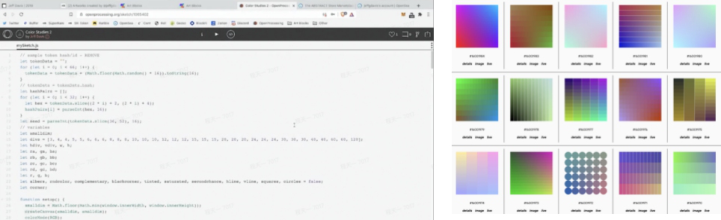
set about finding aesthetic interest and inspiration, while the computer is responsible for scaling the inspiration into a visible work of art. The code below (Figure 2) is from Jeff Davis, Chief Creative Officer of Art Blocks, and when executed, the code can generate a theoretically infinite number of images of color, with controlled randomness forming an element of aesthetic interest for this type of art, allowing the artist to retain some control over the work by controlling the size and placement of the randomness.
Among many creators, Tyler Hobbs, who is highly theoretically conscious and whose cumulative total of generated crypto artworks has reached $110 million, provides a more comprehensive overview of the idea of generative art in crypto art (Zhang, 2022).
Figure 2: The code and works by Jeff Davis.
He proposes that generative art brings deeper changes to artwork: scale, precision, randomness, variability, and reusability. Among them, the precise method of procedural art creation is one of the most significant advantages of generative art. Randomness is what forms the basis of image composition, and the control of randomness provides the possibility of this revolutionary process of art creation. Variability and iterability means that when changes to the artwork are needed, only the code needs to be changed and the program re-run. Reusability allows the artist to reuse code related to color schemes, composition strategies, techniques, textures, themes, etc. Scale refers to the ability of artwork to iterate for large sizes and to make it easier to manipulate images as they repeat a single pattern or concept. Scale is an expression of the deeper changes that programming brings to encrypted artwork. And genera- tive art methods have fundamentally changed the entire process of selling artwork in ways that cannot be ignored (Zhang, 2022).
THE BIRTH OF ART BLOCKS HAS LEFT THE LATEST TECHNOLOGICAL MARK ON CRYPTO ART Founded in 2018, Super Rare is dedicated to providing a better marketplace for artists to create, sell, and collect rare crypto art collections with ease. Trading platforms like SuperRare have increased the market reach of gene- rative artists to some extent. However, they have not brought generative art itself close to the blockchain. The emergence of Art Blocks has changed that. According to Texas Monthly, Erick Calderon’s original idea was to deve- lop digitally rendered models of sculptures in real-world art museums that
could be scanned to view and purchase digital models of crypto during visits. Instead, the epidemic led him to create an online platform for artists called Art Blocks.
NFT creators must pre-tune and deploy their generative art scripts on Art Blocks and store them on the Ethereum chain via Art Blocks to ensure that the output is related to the input hash. For generative artists, Art Blocks also represents a revolutionary creative model, as mentioned by Jeff Davis, Chief Creative Officer of Art Blocks: “Publishing work on SuperRare is similar to the distribution of prints - it is created by an algorithm that runs and generates many pairs of artworks, from which you pick the ones you like to cast.” Art Blocks is different in that it’s like a vending machine. People can come in and produce art on demand. The scripts that artists give the platform to host are run by users, and which pieces get broadcast are, to some extent, randomly determined by users. At the same time controlled randomness remains the key for artists to tweak their scripts to ensure that the randomly obtained pieces are distinct and aesthetically pleasing when cast by thousands of users, so that the overall quality of the work is consistent across the board, and so that the rarer hashes correspond to the more aesthetically pleasing pieces.
For collectors, when a collector buys a series of works, they essentially get a random hash and then execute a piece of generated art that corresponds to that hash. This is a model that allows the collector to participate in the creation of generated art as well. The content of the work is ultimately deter- mined by the original artist’s style, the generative algorithm, and your casting time. The tool, the creator, and the buyer have jointly completed this work, and this emerging model of crypto art creation gives this artwork a more monumental value, leaving the mark of the latest technology of the day.”
GENERATIVE ART IN THE NFT MARKET - ART BLOCKS AS AN EXAMPLEICONIC Works on Art Blocks
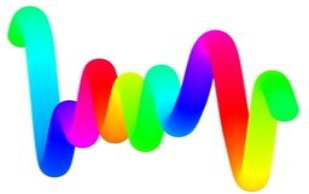
On Black Friday morning, Erick Calderon and Jeff Davis debuted their work - Chromie Squiggle, Construction Token, and Daniel’s “Genesis by DCA”, a series of crypto artworks, became live at the same time. Prior to the sale, Art Blocks did not do any marketing, just social media, and sold 500 pieces in two hours. Chromie Squiggle’s iconic graffiti has since become synonymous with the Art Blocks logo and platform (Figure 3).
Figure 3: Chromie Squiggle #1981 by Erick Calderon.
Innovative Strategies for Generative Art in the NFT Market: A Case Study of Art Blocks 133
Canadian artist Dmitri Cherniak created the Ringers series that allowed Art Blocks to quickly expand to a mass market, validating the fit between Art Blocks and generative artworks. He produced 1,000 pieces showing how to wrap rope around pegs, each with a different transactional hash value, and generated in a browser via JavaScript. The number of pegs, their size, layout, order of arrangement, and brightly colored decorations all change with the hash value, and Dmitri Cherniak describes the series as a realization of his artistic vision, where everything is generated automatically during the sale of the work: the sale is made through a smart contract that uses a unique hash value to randomly produce the artwork, and finally sends “The Art Blocks platform ensures that people can get interesting but unique crypto artwork without interacting with the artist (Munster, 2021).
The aforementioned artist Tyler Hobbs’ first offering, Fidenza, is a fusion of order and chaos. It proves for the first time that working on Art Blocks can result in consistent and high quality output. Over the years, he has continued to explore the logic of this flow-field-based operation, maintaining a logical structure while naturally adding a sense of unpredictability. The artist transla- tes his artistic intuition into clear code instructions, bringing this surprise-less generative system back to life.
Linking Artists and Blockchain Until November 2022, the Art Blocks platform will be segmented into col- lections that help balance the creative energy of the artist, the quality of the work, the threshold of the platform, and the expectations of collectors. The crypto art on the platform consists of three sections of work: Curated Col- lection, Playground Collection, and Factory Collections, with the Curated Collection consisting of projects contracted by Art Blocks’ curatorial com- mittee for its world-class innovation, technical rigor, and aesthetic standards. The Curated Collection consists of projects signed by Art Blocks’ curato- rial committee based on its world-class standards of innovation, technical rigor, and aesthetics; once an artist is selected for Curated, they can post their work under the Playground Collection. Art Blocks thus created Factory Collections, where artists can post their work faster, without waiting for the curator board to review it, and where emerging creators can participate. And the segmentation continued after November 2022, when Druid said on Medium that the platform launched an updated version of Art Blocks 2.0, with a repositioned product, branded website, and visual identity. The plat- form merged the original Factory and Playground into Presents. It launched a new series called Art Blocks Explorations, a section that contains commis- sioned projects conceived and developed collaboratively by the Art Blocks team. Native crypto art, such as Generative Art, creates crypto art IP and gives infinite possibilities for the development of crypto art through smart contracts. Therefore, native crypto art would be the future of crypto art.
Art Blocks offers artists a full chain of ownership, permanent storage rights on the Ethereum blockchain and access to lifetime royalty benefits. A brand- new ERC-721 smart contract was recently released as open source to the
public. ArtBlocks is a successful blend of traditional art auctions and blo- ckchain, with exciting sales methods such as Dutch auctions to enhance the entire buying experience. The Art Blocks platform retains 10% of the purch- ase price as commission. Due to the perpetual nature of NFT, both the artist and the platform also receive 5% from each re-sale. On secondary digital collections marketplaces like OpenSea, Art Blocks works have soared from hundreds of dollars to tens of thousands or even millions of dollars. Through smart contracts, the artist and Art Blocks can charge a fee for each resale. This confirms the core values of transparency and decentralization they uphold.
Art Blocks also has a thriving community, with some collectors driven by the market or spontaneously creating websites and supporting tools for the platform, such as Artblock.wiki, Rarity.guide, Degendata.io, Art.eyesfi.com, and a host of other applications and websites to disseminate information about the platform and help people understand and buy crypto-generated art.
NATIVE PRESENTATION OF NFT FOR GENERATING ART In Art Blocks the generated crypto art is classified into the following catego- ries: Static, Animated, Interactive 2D, Interactive 3D, Functional, Audio/Vi- sual, Gaming, Virtual Reality (VR), which more comprehensively summarizes the current possibilities of generative art in crypto art in terms of expression and interaction. But in the future, as artists continue to write creative codes to push the limits of generative art, the future of computational crypto art will have even more types of art forms and experiences.
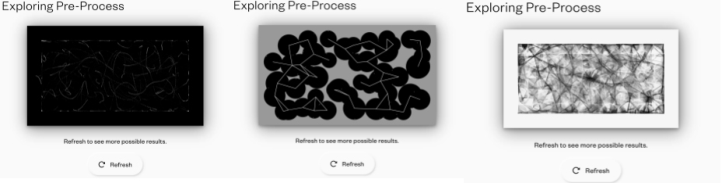
Today, after nearly fifty years of neglect, crypto art provides a new plat- form for generative artists and a significant audience. While it is still very early days for the presentation of generative art, Art Blocks offers us the most suitable online presentation of crypto artworks for generative art at this stage. The idea for “Pre-Process” was developed in 2003 (Figure 4). It has been said in an official interview with Art Blocks that the series isn’t a finished work of art, but rather a collection of software sketches. This is because Art Blocks offers a novel way to publish software art, allowing a fresh vision of the work. There are 120 versions of the series, and the platform features an “Explore Possibilities” button that allows buyers to recreate new possibilities for the artist’s work within the framework of the code according to their own aesth- etic. This again amplifies the random and variable nature of generative art, making Art Blocks itself distinct from other art selling platforms.
Figure 4: Pre-process by Casey REAS.
Innovative Strategies for Generative Art in the NFT Market: A Case Study of Art Blocks 135
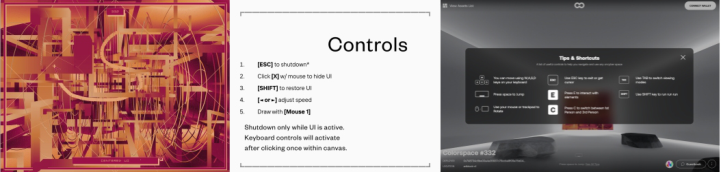
Artist Tabor Robak’s encrypted artwork Colorspace shows the unique advantage of the platform’s interactivity with sellers (Figure 5). In the intro- ductory section, the artist includes a section on the interactive operation of the work where the player can control the rate of motion of the generated anima- tion. Also, the player can interact with the canvas, and recreate the animation in different ways with a few buttons, making the work extremely engaging and playable. In addition, the platform also provides a very native metaverse experience - an online virtual experience space that restores the visual effe- cts of the virtual space of the metaverse, and provides buyers with interactive functions such as viewing works from multiple angles and commenting in real time in the virtual exhibition space. After making a bitcoin purchase, most people enjoy seeing cryptocurrency artwork on a computer screen. Despite this, crypto art can only be enjoyed as a conventional painting if a brea- kthrough in standard printing is achieved. However, anyone can access the website and OpenSea marketplace to print the images, and the paper medium of crypto art loses its interactivity. Hopefully, in the future, the gradual inte- gration of the hardware industry and crypto art may solve the problem of differentiating crypto art from traditional artworks in the real world. Unlike traditional artwork, the collector can directly or indirectly influence the work he purchases, giving the piece more possibilities. For the collector himself, crypto-generated art will be more collectible than other crypto-art.
Figure 5: Colorspace by Tabor Robak.
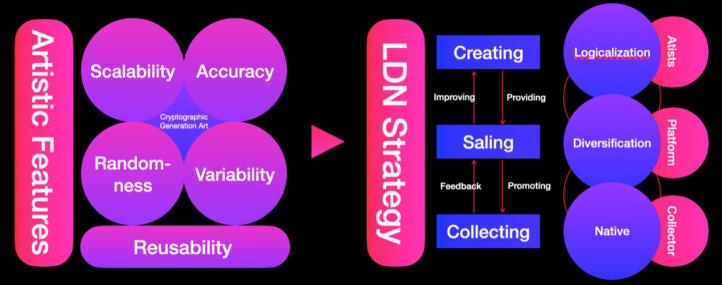
ANALYSIS OF APPLICATION STRATEGIES FOR GENERATING NFT ART In crypto art, generative art is characterized by scale, precision, randomness, variability and reuse. By combining the three chronologically sequential steps of “creation”, “online exhibition” and “collection and holding”, we pro- pose a “LDN” strategy that promotes the cross-fertilization between art and design. Using the LDN strategy, the creation layer is logical, the online exhibition layer is diversified, and the collection layer is native.
Rationality and Sensibility, Building a Logical Encryption Generation Art Generative art provides a novel path of implementation for cryptographic art. Here, the input variables can produce a variety of dynamic versions of the work, at which point the variables become a representation of meaning (Figure 6). With the help of algorithms, variables can be transformed into gra- phics. This visual information can not only explain a clear semantic, but also
show the dynamic changes in that semantic. In other words, we cannot limit ourselves to the surface phenomenal changes when observing and designing. Instead, we have to embed deep logic into our cryptogenesis procedure. In essence, computer programming is not a neutral, malleable medium. In order to create, artists must consciously engage their perceptual minds and use the medium to rationally encode the impressions in their minds.
Figure 6: LCD strategy.
Experience and Category Build a Diversified Platform for Generating Art Sales Art Blocks has an outstanding track record of exhibiting and selling gene- rated art. The platform reduces the work of artists and further enriches the experience of collectors in the selling process. In addition, Art Blocks tries to outline the contours of crypto-generated art, exploring the possibilities of this new category of art, expressions and interactions. As an intermediary, the selling platform needs to accommodate the sale and exhibition of works with different forms of expression and interaction. It also needs to give visi- tors the opportunity to interact with collectors in conjunction with the works themselves. At the same time, it is also necessary to surprise collectors in the process of developing artworks and give them surprises in the purch- ase process. This is done by continuously enriching the experience of buyers in shopping, and building a generative art selling platform with diversified categories and experiences.
Digital and Physical Construction of a Biochemical Encryption Generation Art Display The three main ways of displaying crypto-generated art so far are metavoxels, print and screen displays. The three main platforms for presenting crypto- generated art digital collections are CryptoVoxels.com, Kunstmatrix.com, and Oncyber.io, which allow collectors to create and curate unique experie- nces in the metaverse space, but require the purchase of additional metaverse assets, which are also more expensive. In reality, displaying digital collecti- ons can be done with printed entities as well as different configurations of
Innovative Strategies for Generative Art in the NFT Market: A Case Study of Art Blocks 137
screens (some of which maintain the interactive capabilities of generative art) allowing the work to resemble traditional paintings but maintaining a dyna- mic display and interactive format. This is currently the most effective way to demonstrate the advantages and characteristics of generative encrypted artw- orks. How to integrate computer-generated virtual images into the display of daily life, break the boundary between digital and virtual while retaining more of the advantages and features of encrypted digital art, and maximize a more native collecting experience for collectors, is the direction that future technology needs to explore and break through.
CONCLUSION
The current study explores the relationship between generative art and crypto art in more detail, by examining and researching the Art Blocks platform in a more comprehensive manner, by understanding the characteristics of genera- tive art, analysing the relationship between artists, platforms, and collectors, identifying landmark pieces in generative art, and exploring the unique pre- sentation of crypto generative art, with the expectation that it will develop into a distinct art form at the beginning of its development. We hope to sum- marize the innovative development strategies of this type of art in the early stages of its formation as an art genre. In terms of innovation, computer assistance does allow generative art design to far surpass traditional artw- ork creation capabilities. This helps the designer or artist to explore the most satisfying artistic presentation in a more efficient manner. Generative art bre- aks the path of art production in the traditional sense. In terms of artistry, the aesthetic design and expression of ideas done by rules set by the artist through computer programming gives a whole new possibility of artistic expression. The use of NFT and blockchain has gradually become an increasingly signifi- cant force in mainstream art trading. There has been a gradual development of NFT art ecology. On-chain art generation will be integrated into blockch- ain ecology in the future, and the generation of art will become an influential art genre in the future.
ACKNOWLEDGMENT
General Scientific Research Project Supported by Zhejiang Provincial Educa- tion Department (Project No. Y202250504).
REFERENCES
Delaplaine, S. (2022). ‘The Brave New Virtual Art World The Evolution of Digital Art: NFTs and their Effects on the Art Market in 2021’ (Doctoral dissertation, Sotheby’s Institute of Art-New York). Gallaga, O. L. (2021) ‘Art Blocks Brings Big Money to Artists Who Paint With Code’.
Available at: https://www.texasmonthly.com/arts-entertainment/art-blocks-gener ative-artists/ (Accessed: 14 July 2021). Munster, B. (2022) ‘What Is a Generative Art NFT? Inside the Algorithmic Art Revolution’. Available at: https://decrypt.co/resources/what-is-a-generative-art-nft-in side-the-algorithmic-art-revolution (Accessed: 8 October 2022).
Public. (2022) ‘Art Blocks: A Guide to the Generative Art Platform’. Available at: https://public.com/learn/art-blocks-generative-art-guide. Yang, G. (2021) ‘Encrypted Art: A “Ferryman” for the Migration of Digital Art to
the Metaverse’. Art Observation. 11, pp. 81–88. Yang, G. (2022) ‘Observations, Reflections and Lookouts of Encrypted Art’. Shanghai Culture.08, pp. 95–100. Zhang, H. Z. (2022). ‘NFT Generated Artworks and the Controversies of Art Ethics
Derived from Them: The Case of Tyler Hobbs’ Creation’, Shanghai Culture. 08, pp. 83–89.
LISTED IN THE AHFE DIGITAL BOOKSTORE CATALOGUE
Explore the complete digital volume
Ergonomics In Design
Read this individual research paper free through the original publisher, or explore the full digital proceedings book.
ISBN 978-1-958651-53-7
Explore this ISBN in the AHFE Bookstore ↗Listed in the July 2026 bookstore catalogue; search by ISBN to confirm current availability · Digital book purchase optional