Florian Reichelt, Daniel Holder, Thomas Maier (2023). Optimisation Approach for the Convergence Process of Design and Technology in Automotive Development. In: Interdisciplinary Practice in Industrial Design. AHFE Open Access, vol. 100, pp. 109–118. https://doi.org/10.54941/ahfe1002977
Institute for Engineering Design and Industrial Design, Department of Industrial Design, Engineering, University of Stuttgart, 70569 Stuttgart, Germany ↗
Technical product development (PD) is becoming increasingly complex. New adaptations have to be carried out constantly in order to meet the process-related, but also product-related challenges. In order to be able to effectively optimize a development process, a precise understanding of the process, i.e. on the process steps and correlations, is necessary. The fundamental decisions during automotive development are made in the early phase as part of the Design-Technology Convergence process (DTC). For this reason, the convergence process is of great importance for automotive development and yet there is very little valid knowledge about it. In addition to the ambiguity of the cause-effect relationships in this phase, no specific approaches exist to initiate necessary changes in a holistic way, taking into account the prevailing characteristics in this important phase, in order to make PD fit for the current challenges. Therefore, the aim of this paper is to elaborate approaches for optimizing PD in the early phase, especially DTC from everyday practical experiences.A systematic literature review was used to identify the basic needs and current approaches for optimizing development processes. Since no approaches exist for DTC, we have conducted expert workshops specifically on this topic area. The experts were professionals from the automotive industry who contributed their experience of daily work in DTC in order to ultimately derive optimization potential. Based on these results, various approaches were formulated that can be used to address the current challenges facing PD.Through the interviews, it was possible to create an up-to-date depiction of the practice in the early phases of automotive development. In particular, this describes the current challenges that need to be taken into account in these crucial phases. These challenges include the current trend toward sustainable PD, as well as the general shortening of development times and better integration of interdisciplinary development teams. Furthermore, potential were also mentioned as to how the convergence process can be made fit to master these challenges. With the help of the results, four approaches were derived that can be used to raise the potential. These approaches can be divided into a method-based, process-based, tools-based and skills-based approach. These different approaches can be used to address the current challenges in a targeted manner. On main focus is on supporting specific collaboration between designers and engineers, as this is seen as a core factor for success in DTC.Based on our investigations, we were able to generate a valid image of real-life practice in the early phases of the automotive development process. On the basis of this image, we identified both the current challenges as well as the potential that ultimately describe the need for optimization of the DTC. Thus, on the other hand, specific approaches could be derived as to how an optimization of the DTC can be accomplished so that the identified potential can be effectively raised. Furthermore, the results also serve as requirements for the targeted implementation of changes in the DTC. Ultimately, the combined application of the various approaches results in a holistic strategy for the implementation of optimizations in the early phases of PD in the automotive industry. This will be further elaborated and evaluated in subsequent studies.
The automotive industry is currently facing a variety of new challenges. These global core challenges can be classified in terms of their process-related and product-oriented impacts. As far as process is concerned, Bennett & Lemoine (2014) define the challenges as an increase in volatility, uncertainty, comple- xity and ambiguity (VUCA). According to a study conducted by consulting firm PriceWaterhouseCoopers, challenges related to the technological deve- lopment of vehicles are characterised as electrified, autonomous, shared, connected, yearly updated (eascy) (Kuhnert et al., 2017).
In a previous study, Reichelt et al. (2021) found that these challenges also apply to the early stages of vehicle development, particularly the convergence between design and technology (DTC). In addition to these external challen- ges, internal challenges were also identified to be considered in the necessary adaptation of DTC. These challenges were based on a systematic literature review and expert interviews with project leaders and managers from pra- ctice. As a result of this work, an approach was developed how the early
phases of the design development can be mastered with regard to the current challenges by means of conscious and situation-adapted process modelling.
In our current contribution, we expand on the interviews as an immedi- ate link. We extend the interviews to practitioners from the DTC in order to gain specific insights into the processes and thus enable targeted optimisation, which Cross (2007) argues is a key element for the efficient and effective tran- sformation of processes. Therefore, in the following, we present the results from these interviews with designers, ergonomists and engineers, whose kno- wledge from their everyday work in the early phases was thus collected, in order to obtain a more detailed picture of the process, as well as the needs and optimisation requirements. Based on the results, we derive not only current challenges and optimisation potential for improvements in the DTC, but also specific approaches for implementing continuous improvement of the DTC. Compared to well-known approaches, these approaches focus on the speci- fic characteristics of DTC. In particular, the prevailing conflicting goals are comprehensively addressed by the different approaches so that sustainable change can be made possible.
METHODS
As already mentioned, the research conducted by Reichelt et al. (2021) forms the essential basis for this paper. In order to complete the picture of challenges and requirements, specific input from the areas of DTC was required. Since this area is one of the most important in the automotive industry, this bra- nch was used as a guiding example. The experts were professionals from the automotive industry who contributed their experience of daily work in the development of design, ergonomics and/or technologies in the early phases of vehicle development.
The interviews took place between July and November 2021. Experts were chosen who offered at least one of the required areas of expertise as a result of their education/professional training or their occupation. In total 21 work- shops were held. All the experts could be assigned to one of the three focal points of the study (design – ergonomics – technological development). Due to incomplete data only 19 datasets were suitable for evaluation.
Each interview took the form of an individual meeting in Microsoft Teams. The questionnaire for the interview was completed with each expert using the screen-sharing functionality. Notes of the expert’s statements were made by the interviewer, so the expert was able to follow what was being written directly. All interviews were hosted by the same investigator with compulsory guidelines to ensure they were all staged in a consistent, comparable form.
The interview was a structured interview (Döring et al., 2016) during which set open-ended and closed-ended questions were asked. A five-point Likert scale was used for the closed questions ranging from ‘definitely’ to ‘absolutely not’. At first demographic data and appraising personal expertise with regard to vehicle development or, more specifically, the areas of design, ergonomics and technological development were recorded. The experts were then asked questions about their knowledge and understanding of project management. With regard to evolution of the design process, particularly in
Optimisation Approach for the Convergence Process of Design and Technology 111
terms of design-technology convergence (DTC), targeted questions were put to the interviewees to derive potential for optimisation.
Four open-ended questions were asked with the ultimate aim of deriving this potential for optimisation from the answers given: Q1: What impact do the industry’s core challenges have on the design process?
Q2: What will definitely change in the design process over the coming years?
Q3: Where do you see a need for optimisation in the design process?
Q4: What need for optimisation do you see in the design-technology convergence?
Evaluation of the interview questionnaires was purely descriptive (Kosfeld et al., 2016). The results of the closed-ended questions are depicted by means of frequency distributions. The answers to the open-ended questions were analysed using the qualitative content analysis method of Mayring (2020) and are also depicted in the form of frequency distributions. Four of the 19 experts were female (21%). All experts had at least five years of professional experience in their specialist area.
In order to realize the identified potential, approaches from practice and science were investigated as to how optimisations can be carried out in the DTC. Since no approaches could be identified that were specifically tailored to the unique circumstances of DTC, we defined a holistic approach, which is designed for the purposes of continuous improvement of DTC.
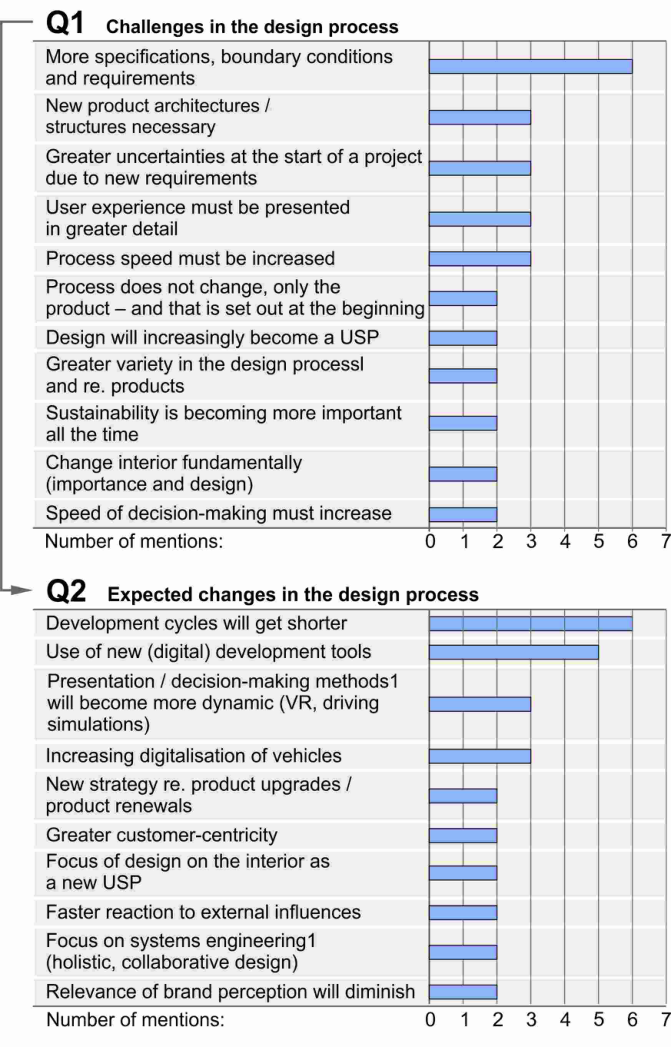
INTERVIEW RESULTS In order to identify the challenges for the early phases of vehicle development specifically, the experts were asked to name the challenges they encounter in their day-to-day work, with open answer options (Q1). Central challen- ges in the design process were identified as: more specifications; boundary conditions and requirements; the need for higher process speed; the increa- sed focusing on user experience (UX); greater uncertainties at the start of a project and the need for new product architectures and structures.
In order to respond to these new challenges, changes in the design process are unavoidable. To identify significant changes in the design process over the next few years, the experts were again presented with an open-ended question (Q2). The key changes the experts envisage over the next few years are: a shortening of development cycles; greater use of digital tools; presentation / development methods becoming more dynamic; increasing digitalisation of the product (the proportions of software and hardware will alter).
The results and other aspects mentioned by the experts regarding the challenges and changes are shown in Figure 1.
As well as giving their assessments on the challenges and changes in the design process, the experts were also asked about the potential for opti- misation in the design process. They were asked to give their thoughts on the available potential both in the design process in general and specifically
Figure 1: Key challenges in the design process (above) and related changes (below).
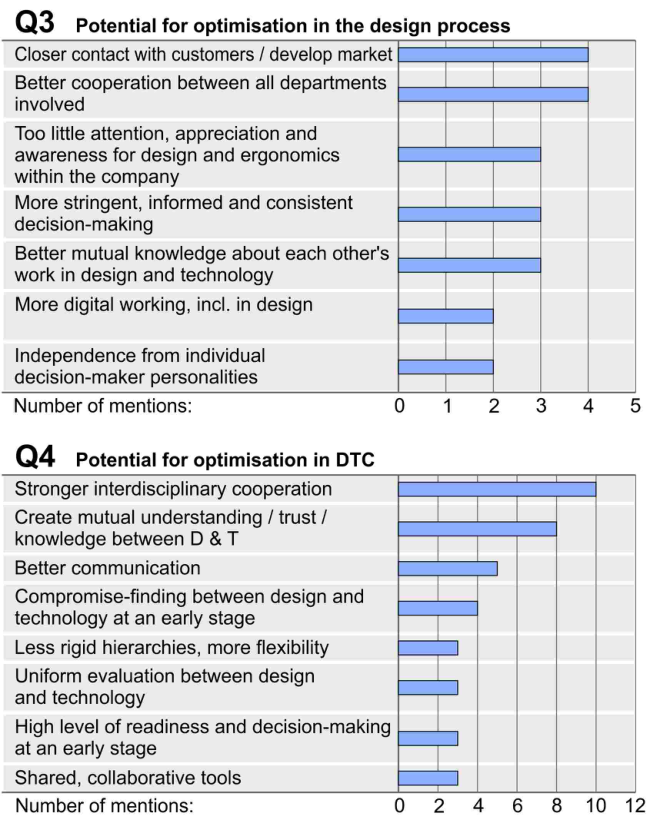
in terms of design-technology convergence. The questions were again asked openly. The results are shown in Figure 2.
For the design process, the following were identified as key areas of potential: better cooperation between the departments (DTC); closer contact
Optimisation Approach for the Convergence Process of Design and Technology 113
Figure 2: Results of the open-ended questions on the potential for optimisation in the design process in general (above) and in design-technology convergence (below).
with customers; greater appreciation for and awareness of design and ergo- nomics within the company; better and more transparent decision-making and the improvement of mutual knowledge, specifically between design and engineering.
In terms of the potential regarding DTC, the following aspects were identi- fied as important areas of potential for optimisation: greater interdisciplinary cooperation in the teams; creating mutual knowledge / trust with the other disciplines; better communication between the departments and starting DTC at an early stage.
With regard to the prevailing study, there is on the one site a certain overlap between the statements found with experts of project management
(Reichelt et al., 2021) and the results above: the need for a closer contact with customers, greater interdisciplinary cooperation in the teams; creating mutual knowledge / trust with the other disciplines; better and more transpa- rent decision-making; better communication between the departments and starting DTC at an early stage are similar high ranked potential for the DTC in the findings of Reichelt et al. (2021). On the other side with the specific insights of practitioners in the DTC detailed information and requirements could be derived.
APPROACH FOR OPTIMISING DESIGN TECHNOLOGY CONVERGENCE In order to be able to adequately address the identified challenges and poten- tial, the results of a systematic literature research regarding optimisation approaches for continuous improvement in product development are pre- sented below. Since there are no suitable approaches for DTC that cover the entire range of challenges identified, new approaches for optimising DTC are then derived. Finally, these are compared with the identified challenges and potentials.
For the operationalisation of continuous improvement of development processes, there are mainly theoretical-abstract models in the literature: The most common approach is the PDCA cycle according to Deming (1986) (Lodgaard & Aasland, 2011). This approach is considered universal for the change of processes of any kind, but has no concrete implementation stra- tegies or procedures. Especially for technical product development there are approaches such as Lean Development (cf. Dombrowski, 2015) and Value Management (cf. DIN EN 12973). These provide principles on how proces- ses (Lean Development) or products (Value Management) can be improved. Implementation possibilities are described, but these are mainly on a structu- ral or procedure-based level and thus only focus on a certain part of product development. Both approaches can therefore only be applied to parts of the applicable requirements of the DTC; for example, the further development of the developers and the task-specific tool and method use remain unaddressed. For a more practical implementation of improvements, there are approaches that can have an influence, for example, through modelling, simulation and adaptation of processes (cf. Wynn, 2007) or knowledge management (cf. Lau- kemann, 2021). However, these approaches have in common that they focus on the general development process, but not on the early phases of product development.
Since there are special circumstances in these early phases, especially due to the strong interdisciplinarity, the previous approaches are not suitable for use in DTC.
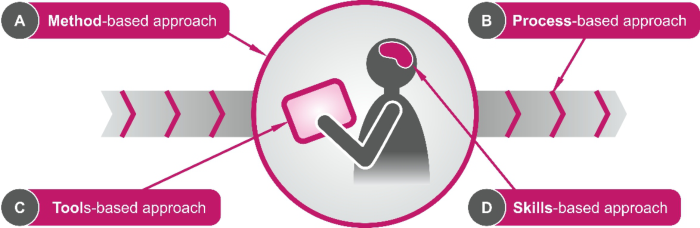
Based on the assessment of potential shown above, clusters can be synth- esised looking at how certain challenges and changes (see Q1 & Q2) can be addressed and how the potential identified in the design process overall and DTC specifically (see Q3 & Q4) can be utilised. In principle, these can be divided into method-based, structural / process-based, tools-based and skills- based approaches. Figure 3 shows the different approaches for optimising the design processes.
Optimisation Approach for the Convergence Process of Design and Technology 115
Figure 3: Visualisation of the approaches.
The method-based approach focuses on the adapted and therefore targeted use of methods in project management. This allows the procedure for hand- ling the relevant activities of the respective development phases to be aligned efficiently to the development situation at hand. This enables the developers to carry out the required work on an operative level more effectively and effi- ciently. For example, the Agile Systems Approach – ASD developed by Albers et al. (2019) or the reflection and modelling approach using a Method-DNA based on Reichelt et al. (2023) can be mentioned as implementation concepts.
With the structural / process-based approach, solutions for making work steps and methods more flexible are created by adapting the project stru- ctures and the sub-processes at module or component level. For example, flexible (re)scheduling of intermediate milestones or deliberately carrying out activities in parallel can allow short-term acceleration and therefore a sui- table response to external influencing factors. The mentioned approach by Reichelt et al. (2021) as a situation-adapted process modelling or the funda- mentally new structure of a technology-driven development process described by Reichelt et al. (2022) can be mentioned as possible concepts.
The further development of tools and the use of new tools such as VR / AR (cf. Oberhofer, 2022) or rapid prototyping (cf. Hein, 2021) enables tools-based influence over development activities.
The skills-based approach takes the form of training and further education for project employees, e.g. on new methods, processes and interface activi- ties. Added to which, training in soft skills and tools can also influence the development process.
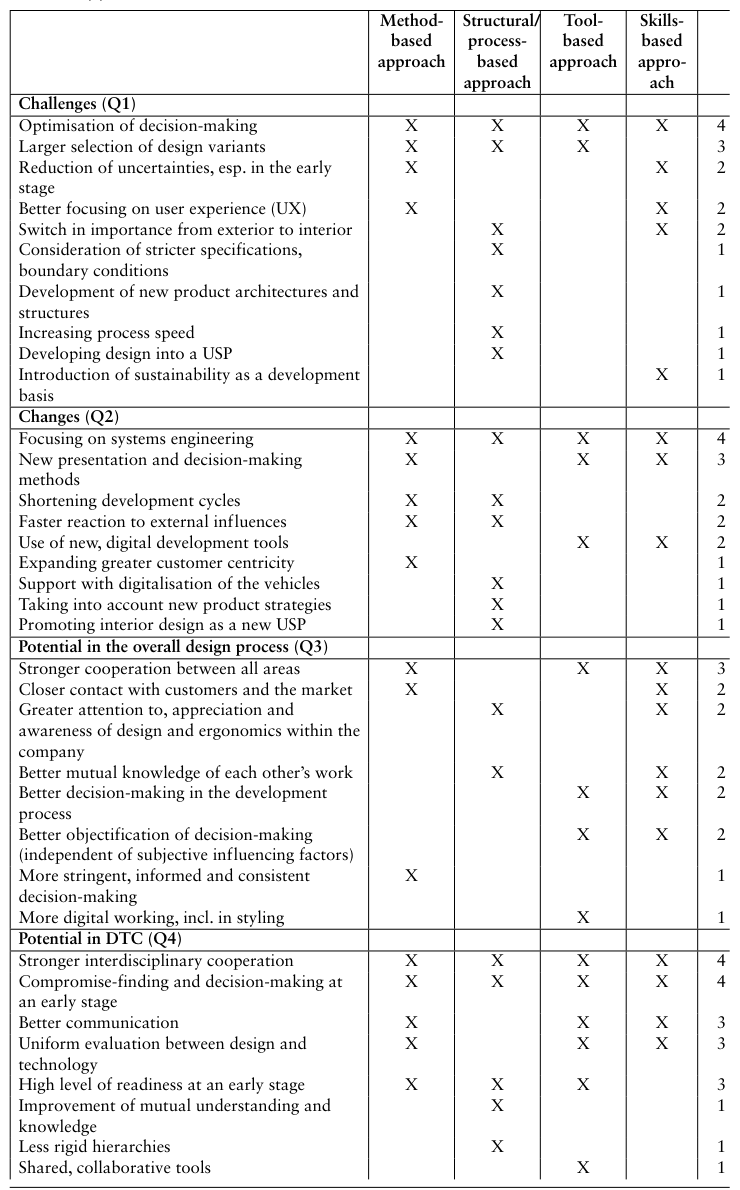
By implementing the four approaches, the challenges, changes and areas of potential identified by the experts can be addressed in different ways. In Table 1, the aforementioned comments on questions Q1-Q4 are listed and paired with the approaches which can be used to turn this potential into results.
Parallel application of approaches therefore allows the challenges to be countered through optimisation of decision-making and a larger selection of design variants. The expected changes in the process – focusing on systems engineering and new presentation and decision-making methods – can be implemented. In terms of potential for optimisation in general, the main area of focus is greater cooperation between all areas. Looking at DTC
Table 1. Overview of the optimisation opportunities in the application of the four approaches.
Optimisation Approach for the Convergence Process of Design and Technology 117
specifically, most potential can be found in the parallel application of vari- ous optimisation approaches: stronger interdisciplinary cooperation, early compromise-finding and decision-making, better communication, consistent evaluation between design and technology, and a high level of readiness at an early stage.
CONCLUSION AND OUTLOOK Based on our investigations, we were able to generate a valid image of real- life practice in the early phases of the automotive development process. On the basis of this image, we identified both the current challenges as well as the potential that ultimately describe the need for optimisation of the DTC. Thus, on the other hand, specific approaches could be derived as to how an optimisation of the DTC can be accomplished so that the identified potential can be effectively raised. Furthermore, the results also serve as requirements for the targeted implementation of changes in the DTC. Ultimately, the com- bined application of the various approaches results in a holistic strategy for the implementation of optimisations in the early phases of PD in the automo- tive industry. This strategy is characterised by the fact that it addresses the different design levels and brings together a method-based, process-based, tool-based and skills-based approach. The focus going forward is primarily on the implementation of methodological, process-based/structural and tool- based approaches. The skills-based approach is of great relevance for initial and further training in design and therefore also for university teaching and employee development in companies.
The approaches presented here provide initial indications for optimising the cooperation between industrial and engineering design. For implementing these approaches, the influence of the approaches on one another, resulting through a certain lack of clarity, must be taken into account. For example, the use of methods is directly dependent on the use of tools. In particular, the skills-based approach depends directly on the individual skills of the deve- lopers, which can lead to very different initial scenarios depending on the company.
Therefore, we will focus on future work specifically on the method-based and process-based/structural approach. Here the influences for project mana- gement to monitor and control are the highest. Ultimately, this will be the first step towards adapting consistent processes in the DTC to meet the current challenges.
REFERENCES
Albers, A., Heimicke, J., Spadinger, M., Reiss, N., Breitschuh, J., Richter, T., Bursac, N., & Marthaler, F. (2019). A systematic approach to situation-adequate mech- atronic system development by ASD - Agile Systems Design. Procedia CIRP, 84, 1015–1022. https://doi.org/10.1016/j.procir.2019.03.312. Bennett, N. and Lemoine, G. J. (2014) “What a difference a word makes: Under-
standing threats to performance in a VUCA world”, in: Business Horizons, 57(3), pp. 311–317. https://doi.org/10.1016/j.bushor.2014.01.001. Cross, N. (2007). Designerly ways of knowing, Birkhäuser.
Döring, N., Bortz, J., & Pöschl, S. (2016). Forschungsmethoden und Evaluation in den Sozial- und Humanwissenschaften (5., Ed). Springer. Deming, W. E. (1986), “Out of the Crisis”, Cambridge, MA, Massachusetts Institute
of Technology. DIN EN 12973:2020-05, Value Management; EN_12973:2020. Berlin. Beuth Verlag GmbH. Dombrowski, U. (2015). Lean development. Springer Berlin Heidelberg. Hein, A. (2021). Auslegung und Entwurf adaptiver Strukturen und Systeme mit
Formgedächtnislegierungen [Dissertation, University of Stuttgart, Stuttgart]. Kosfeld, R., Eckey, H. F., & Türck, M. (2016). Deskriptive Statistik. Springer Fachmedien Wiesbaden. https://doi.org/10.1007/978-3-658-13640-6. Kuhnert, F., Stürmer, C. and Koster, A. (2017), eascy – Die fünf Dimensionen der Transformation der Automobilindustrie, Pricewate- rhouseCooper GmbH, Available at: https://www.pwc.de/de%2%20- Fautomobilindustrie%20/pwc_automotive_eascy-studie.pdf (accessed 05.02.2023). Laukemann, A. (2021). Produktentwicklungsspezifisches Wissensmanagement- Verfahren für kleine und mittlere Unternehmen [Dissertation, University of Stuttgart, Stuttgart], Lodgaard, E., & Aasland, K. E. (2011), “An examination of the application of
plan-do-check-act cycle in product development”, In: Proceedings of the 18th International Conference on Engineering Design (ICED 11), Im-pacting Society through Engineering Design, Lyngby/Copenhagen, Denmark, 15.-19.08. 2011, pp. 47–55. Mayring, P. (2020). “Qualitative Inhaltsanalyse”, In G. Mey & K. Mruck (Eds.), Handbuch Qualitative Forschung in der Psychologie - Band 2: Designs und Ver- fahren (pp.495–511). Springer Fachmedien Wiesbaden. https://doi.org/10.1007/ 978-3-658-26887-9_52. Oberhofer, F. (2022). Untersuchung von Modellen und Werkzeugen der Produkt-
gestaltung und deren adaptive Einbindung [Dissertation, University of Stuttgart, Stuttgart]. Reichelt, F., Blank, D., Holder, D., & Maier, T. (2022) “New Holistic Approach Towards a Technology-Driven Development-Model in Automotive”, Proceedings of the Design Society, 2022, pp. 241–252. Reichelt, F., Holder, D. and Maier, T. (2021). “Entwicklung einer situativen Entwi-
cklungsmethodik – ein hybrider Ansatz zur agilen Transformation im Technischen Design”, in Binz, H., Bertsche, B., Bauer, W., Spath, D. and Roth, D. (Eds.), Stutt- garter Symposium für Produktentwicklung SSP 2021 Stuttgart, 20. May 2021, University of Stuttgart, pp. 1–12. Reichelt, F.; Traub, D. & Maier, T. (2023 in press). “Derivation of a Method DNA for the unified Description of Methodical Procedures in Product Development”, In: Proceedings of the 24th International Conference on Engineering Design (ICED 23), Bordeaux, France. Wynn, D. C. (2007). Model-based approaches to support process improvement
in complex product development [Dissertation]. https://doi.org/10.17863/CAM. 13990.
LISTED IN THE AHFE DIGITAL BOOKSTORE CATALOGUE
Explore the complete digital volume
Interdisciplinary Practice in Industrial Design
Read this individual research paper free through the original publisher, or explore the full digital proceedings book.
ISBN 978-1-958651-76-6
Explore this ISBN in the AHFE Bookstore ↗Listed in the July 2026 bookstore catalogue; search by ISBN to confirm current availability · Digital book purchase optional