Liliana Soares, Ermanno Aparo, Rita Almendra (2023). Design and creativeness for a three-act session. In: Human Dynamics and Design for the Development of Contemporary Societies. AHFE Open Access, vol. 81, pp. 95–101. https://doi.org/10.54941/ahfe1003537
CIAUD, Research Centre for Architecture, Urbanism and Design, Lisbon School of Architecture, Universidade de Lisboa, Rua Sá Nogueira, Polo Universitário do Alto da Ajuda, 1349–063 Lisboa, Portugal ↗
This paper presents the bases of a documentary about the conversion of the business sector and the performing arts in the North of Portugal, during the pandemic. The documentary intends to prove that the introduction of innovative procedures can be important to all sectors involved in society. Liquid reality (Bauman, 2005) demands constant exploration; therefore, it challenges designers to create sustainable products. Knowing that spectacle is about human connection, a process disconnected from visual culture can contribute to the public ignoring the participation of design as an area of knowledge. Between 2021 and 2022 a territorial network system was developed consisting of researchers, a lighting company, a raw materials industry, a municipality, company, a theatre, entertainment companies and a school of music of the North of Portugal. It was possible to develop systemic lighting products at the prototype level, bearing new semantic paths, performance, and interaction with people. The prototypes were developed by a lighting company. In theatre, the prototypes were joined by musicians to interpret pieces by Debussy and Dvořák. This group was joined by an actor who declaimed Mallarmé and Longfellow. The result was recorded on video by technicians and disseminated on YouTube and Instagram.The study investigates the dynamics of a creative process and its impact on the different areas involved, bringing together the testimony of the various actors in the process, challenging assumptions and bringing a new view to reality events. The golden age of documentaries happened in the 80’s (Rosenthal, Corner, 2005), and today the dissemination of documentaries happens through internet. As the documentary film never had a precise definition (Nichols, 2017), this study contributes to the autonomy of this typology of artistic production. The documentary methodology combined with the use of social networks manages to achieve a broader societal impact and in an effective way. An experimental theme related to different areas of knowledge attends a design-driven innovation (Verganti, 2009) and not a market-oriented process that could compromise the experimental factor. The documentary can become an occasion to promote discussion between the notions of science and art, fiction and non-fiction, business and art, teaching, and profession. It is intended to demonstrate that the process of cooperation between different areas is a sustainable choice that respects and values the project partners, assuming a social commitment. The film interprets the current reality, dealing with what happened before, during and after filming and conveying social interest and debate about the role of creative processes in transforming reality.The research already includes a post-doctoral, the publication of a book, a video, a promotional teaser, 2 prototypes and interviews with some stakeholders, so that it can expand its potential to a larger project with the aim of generating innovation, producing mutual sustainability between the manufacturing and the culture industries of the same region. The study could be the basis for consolidating a proposal for a future project, explaining how a design process is developed in the various stages and using a visual document that can have a strong impact on today's society.
Reality is full of evolving, limitless, ineffable scenarios that are yet to be deciphered (Lauda, 2021), which requires constant exploration, challenging designers to create holistic and sustainable products. On the other hand, enti- ties in the show business were forced to exclude disciplines from the creative process. Knowing that spectacle is something about human connection, and that people encounter things in search of experiences, a process disconnected from visual culture can contribute to the public ignoring the participation of design as an area of knowledge. The relationship that a spectator establishes with culture also includes the connection with the scenic space, the props, the scenography, the lighting.
THE PROCESS Between 2021 and 2022 a territorial network system was developed con- sisting of researchers, a lighting company, a raw materials industry, a municipality, a professional theatre company, a theatre, entertainment com- panies and a school of music of the North of Portugal. It was possible to develop systemic lighting products at the prototype level, bearing new seman- tic paths, performance, and interaction with people. On stage, lighting is as an essential component for any event and light design is an example of synergy that conceives reality.
The prototypes were developed by a lighting company with the support, in terms of raw material, from another company. In theatre, the prototypes were joined by musicians to interpret pieces by Debussy and Dvoˇrák. This group was joined by an actor who declaimed Mallarmé and Longfellow. The result was recorded on video by technicians and disseminated on YouTube and Instagram.
The study intends to develop a documentary and book edition that aims to investigate the dynamics of a multidisciplinary creative process and its impact on the different areas involved as well as on the community itself, brin- ging together the testimony of the various actors in the process, challenging assumptions and bringing a new view to reality events.
THE DOCUMENTARY The golden age of documentaries happened in the 80’s (Rosenthal, Corner, 2005), and today the dissemination of documentaries happens through inter- net. As the documentary film never had a precise definition (Nichols, 2017), this study contributes to the autonomy of this typology of artistic production. The documentary methodology combined with the use of social networks manages to achieve a broader societal impact and in an effective way. An experimental theme related to different areas of knowledge attends a design- driven innovation (Verganti, 2009) and not a market-oriented process that could compromise the experimental factor.
The documentary can become an occasion to promote discussion between the notions of science and art, fiction and non-fiction, business and art, tea- ching and profession. Also, the production of a book is necessary because it is another way of disseminating and cataloguing the project in relation to its ideational evolution rather than productive, transmitting experience and methodologies applied during the project (Branzi, 2010). It is intended to demonstrate that the process of cooperation between different areas is a sustainable choice that respects and values the project partners, assuming a social commitment. The film is committed to interpreting the current reality, dealing with what happened before, during and after filming and conveying social interest and debate about the role of creative processes in transforming reality.
OBJECTIVES
To legitimize the documentary as a typology of artistic production that transmits knowledge.
Design and Creativeness for a Three-Act session 97
To prove that the documentary can become an area of experimenta- tion, sharing, adaptation and validation of the creative process, through discussion between disciplines.
Contribute so that cooperation between different areas of knowledge helps to reflect and test new ways of using and enjoying innovative products in lighting.
To legitimize the action of design for the entertainment sector and for the business scope.
Validate the stage as a design laboratory for design and companies.
Emphasize the impact that business innovation has when applied to the entertainment sector.
Produce and structure a project dissemination.
Produce a documentary and a book.
Favor the creation of a creative platform that involves entities of a different nature.
METHODOLOGY
The methodology is exploratory, generative, and evaluative.
The exploratory part will explore what exists and has been done (contex- tualization) to achieve a study about the process of producing a documentary, starting with the verification and validation of the recorded material before and during the realization of prototypes and tests. of the show Dryas with the musicians, the actor, the technicians, the managers.
The generate phase will produce new information and knowledge. Defini- tion of a briefing with the interested parties to develop processes that can determine the evolution of the theme and create links between all those involved. This task will include recording the interviews.
The evaluative part will calculate the research process and the results. Namely, the editing, production and finalization of the documentary. In a second phase, it will be the edition of a book. Finally, this work will serve for a possible application for a competition for audiovisual products.
THE RESEARCH PLAN Based on the problems of the study and the proposed objectives, it was con- sidered possible to state the following research hypothesis: The production of a visual documentary and book edition about the creation of new ligh- ting products for a show can create inputs for the business sector and the entertainment entities involved, generating innovation and knowledge for the Alto-Minho region and, consequently, giving rise to a more substan- tive investigation into the relationship between design and the entertainment industry.
In the current post-pandemic context, important design magazines and trend setter agencies show that, in the future, product development will depend on the intrinsic guarantee of aspects such as sustainability, good story- telling and objective qualities. These inputs make it possible to develop the
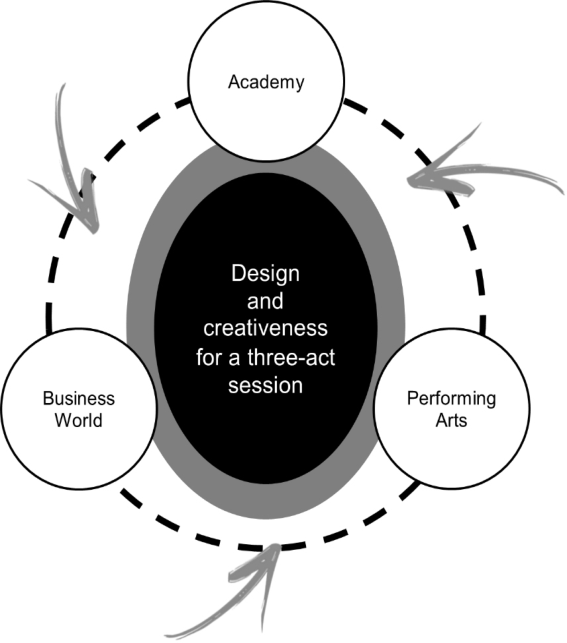
Figure 1: Creative process between Academy, Business World and Performing Arts. (Photo: The authors, 2022).
product of a documentary that transmits values and culture. The project nar- rates the creative process (see Figure 1) of entities of a different nature that have worked continuously in previous projects with the research team in the definition of innovative products. On the one hand, in academic projects such as master’s theses in design from the Polytechnic Institute of Viana do Castelo - IPVC, academic projects with undergraduate classes in product design and environment design and the master’s degree in integrated design from IPVC. On the other hand, in research projects that allowed the development of prototypes of musical instruments such as the ‘Almada Trumpet’ trumpet (2018) and the ‘Shatron’ trumpet mute (2019) and the ‘Dryas’ lighting system project’ (2021).
In the case of the Dryas project, “still in progress” the lighting solutions were tested by entrepreneurs, academics, musicians, sound, image, and video technicians, validating design as a strategic discipline. The lighting prototy- pes were developed by the company FURNOR with the support (in terms of raw material) from the company Amorim Compósitos. The lighting company experimented with new solutions and acquired new machinery, transforming itself and facing the lighting market where it operates. The materials company
Design and Creativeness for a Three-Act session 99
was able to test raw materials in new product typologies. The entertainment industry has proved to be an experimental laboratory for lighting design and the business world, using a methodology that promotes a direct link between theatre culture, local producers, and designers. The project gene- rated new knowledge as it determined that two apparently distant worlds would build new development models whose benefit is mutual and the public, simultaneously, know products, acquiring culture.
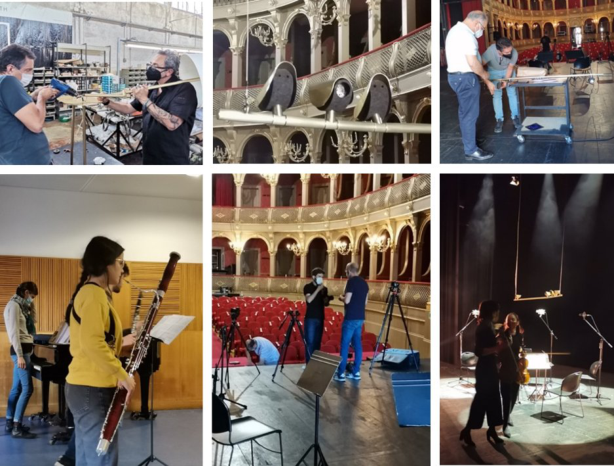
This project (see Figure 2) created development and cooperation models by integrating partners in events and offering them different perspectives. First, the promotion of a business product in an intimate space such as a theatre can become an opportunity to give visibility to both cultural partners and companies. Second, the show can become an occasion to rethink the entertainment industry. Finally, this show transformed into an audio-visual documentary gains a status of cultural memory of a region, contributing to its sustainability.
Figure 2: Creative process between Academy, Business World and Performing Arts. (Photo: Liliana Soares, 2021).
The research brings together three researchers and a film director. The documentary will include interviews with the different actors involved, directly or indirectly, in the Dryas project.
CONCLUSION
In this article, the authors intend to demonstrate that Based on the identified problems and the proposed methodology, it is hoped to discover through the documentary and the book edition if the creative process that links the
business environment to the entertainment sector exists, promising social and economic gains and generating innovation for the region.
The design of lighting product systems is an opportunity for partner com- panies to present new products in an environment that only the performing arts can offer. The use of a documentary in design is an effective response, in the sense that it allows broader access to a wider audience, making the project’s result more effective. This also happens in the case of a pandemic situation that prevented other types of solutions.
The research contributes to the scientific knowledge of creative proces- ses, namely, in the development of connections between the business world and the entertainment sector. The methodological approach based on coo- peration, creativity, resilience, and survival proves to be a responsible and sustainable process for productive and cultural development of society. This approach is useful for the design discipline, as it demonstrates the designer’s competence in creating solutions suited to the circumstances, ensuring inno- vation and sustainability. The academy can benefit from this methodology, building possible teaching models, constituting a model for collaboration and innovation platforms. The experiences be used as case studies to be used in future teaching/learning initiatives. It is considered the creating a new curri- cular unit of multidisciplinary creative processes. The study can contribute to the autonomy and valorisation of the audio-visual documentary as an artistic production.
For society, the stage becomes an experimental laboratory, forcing it to assume the impacts of the pandemic as conditions that belong to the pro- cess. The Internet phenomenon strengthens the propagation of knowledge in symbiosis with project methodologies, building discussion and critical analy- sis. On one side, for the lighting industry, it is an occasion to experiment with new methodologies, acquire new partners, new technologies and eva- luate the impact of the product on the market. On the other side, for the raw material company, this can be a moment to validate new applications of materials. A documentary inscribes the identity of a new product. Finally, for the entertainment sector, it is a change to review schedules, overcoming issues of funding and lack of audience. This is an opportunity to design creative and sustainable strategies from the stage. For live presentations, it suggests pos- sibilities for establishing new partnerships and new ways of financing and profitability.
ACKNOWLEDGMENT
The authors would like to acknowledge the CIAUD, Research Centre for Architecture, Urbanism and Design, Lisbon School of Architecture, Univer- sidade de Lisboa, Rua Sá Nogueira, Polo Universitário do Alto da Ajuda, 1349–063 Lisboa, Portugal.
REFERENCES
AA. Branzi, A. (2010). Ritratti e autoritratti di Design. Venezia: Marsilio Editori. Lauda, G. (2021). Il Design è come un Panda? – Il Design Italiano 1980-2020.
Siracusa: Lettera Ventidue.
Design and Creativeness for a Three-Act session 101
Nichols, B. (2017). Introduction to Documentary. Bloomington: Indiana University Press. Rosenthal, A.; Corner, J. (2005). New Challenges for Documentary. Manchester
University Press. Verganti, R. (2009). Design Driven Innovation: Changing the Rules of Competition by Radically Innovating What Things Mean, Harvard Business School, Cambridge, MA.
LISTED IN THE AHFE DIGITAL BOOKSTORE CATALOGUE
Explore the complete digital volume
Human Dynamics and Design for the Development of Contemporary Societies
Read this individual research paper free through the original publisher, or explore the full digital proceedings book.
ISBN 978-1-958651-57-5
Explore this ISBN in the AHFE Bookstore ↗Listed in the July 2026 bookstore catalogue; search by ISBN to confirm current availability · Digital book purchase optional