Liliana Soares, Ermanno Aparo, Rita Aparo (2026). In search of lost design: cross-pollination in designing a musical instrument. In: Human Factors and Ergonomics In Design. AHFE Open Access, vol. 210, pp. 185–194. https://doi.org/10.54941/ahfe1007439
The paper investigates divergent thinking as a competence to generate creativity and new ideas by exploring multiple options and connections, contrasting with convergent thinking which focusses to a single solution. In this case, the design of a musical instrument is a chance to understand how things become together, testing and developing an organism, joining the need for semantic and aesthetical qualities with high performance potentials, and linking handmade production with cutting-edge technologies and materials. Creativity and innovation are emphasized with the 2030 Innovation Agenda, which comprises society and culture. Methodologically, the study is exploratory based on qualitative research methods, and it comprises academy and productive sectors. The paper highlights other research pro-jects that demonstrate this team's ability to create connections with design, music, culture, and social issues. The study explores new possibilities for systemic design, activating a network of all entities. It is intended that this research may be instigator for reflection on cross-pollination between design research and society.
Cross-pollination is a creative union of ideas from diverse subjects, activities or natural sources to catalyst innovation, an approach of co-design developed in 2013, understood as a flexible framework that can be adapted to fit different situations. This creative process highlights peoples’ values and empathy to shared collaborative work (Alexiou et al., 2025). It is the strategic, creative process of combining ideas, techniques, and perspectives from unrelated fields, industries, or disciplines to spark innovation and solve complex problems. Cross-pollination is a bidirectional relationship between research and profession to understand and describe the ways research support profession as well as the modes profession feeds research, having in attention the different actor’ and correlations (Almendra & Da Silva, 2021).
In other words, in this study it is the outcome of a cross disciplinary endeavour that links handmade context to industrial sector, suggesting forming models for other production facilities, linking it with research. It
is an alliance between persons from distinct fields, which develop models of development, comprehending symbiosis and cooperation and, promoting innovation and sustainability across all entities, assuming investigation as a founder of a reflection on cross-pollination between research, practical work (industrial and artisanal) and society.
In designing a musical instrument, cross-pollination is also an approach from the 1970 that sustains that music has a commitment in society and culture, because society and culture have an important role in music, as evidenced by the book “How Musical is man?” by John Blacking (1973). For instance, African music is no less complex than European music and it is possible to find many of the essential processes of music in the constitution of the human body and in the patterns of interaction of human bodies in society (Blacking, 1973). The qualitative fieldwork methods employed by John Blacking to record his fieldwork data provided him with plenty ethnographic data that has been involved in academic discussions and arguments in many areas outside ethnomusicology (Reily, 2006), such as, in design. In this context, musical does not mean musical agility or talent, but rather the human capacity to create, act, react emotionally, intellectually, and physically, and the ability to interpret music - defined as an organization of sounds by humans (Rice, 2014). In other words, an arrangements of sounds from nature and noise.
RESEARCH CONTEXT Ethnomusicology Within its Social and Cultural Contexts
Described as an anthropology of music, Ethnomusicology seeks to understand not only sound as itself, but what music means to the people who create and use it. Unlike traditional historical musicology, which often focuses on the aesthetic analysis of scores and specific composers, ethnomusicologists use fieldwork to observe music as a universal human phenomenon (Rice, 2014). As Thimoty Rice (2014) states, in a cultural context, ethnomusicology analyses how music reflects the identity, values, and way of life of different peoples. For oral traditions, historically, the topic has focused on the study of musical cultures with oral traditions and folklore, although today it encompasses all types of music. As a social function, ethnomusicology examines the role of music in rituals, education, politics, and the construction of collective identities. Finally, methodologically, ethnomusicology has an interdisciplinary approach, combining methods from musicology, anthropology, sociology, and linguistics.
Ethnomusicology emerged in the late 19th and early 20th centuries, evolving from the discipline of comparative musicology (Vergleichende Musikwissenschaft). Its genesis is linked to the development of field methods and the use of new technologies, such as the phonograph, to record music from oral and non-Western traditions (Reily, 2006). The proposal for systematizing musical sciences, presented by Guido Adler in 1885 in his article ‘Umfang, Methode und Ziel der Musikwissenschaft’ (Scope, Method and Aim of Musicology), is considered the founding moment of modern
In Search of Lost Design: Cross-Pollination in Designing a Musical Instrument 187 musicology (Mugglestone & Adler, 1981). Guido Adler divided the subject into two main areas and a third approach: Historical Musicology, Systematic Musicology and Comparative Musicology (see Table 1).
Areas of Ethnomusicology Description Historical Musicology It focuses on European music as an art form and its evolution over time. It includes sub-areas such as musical palaeography, the history of music theory, and the history of musical instruments. The preferred object of study is the notated text (the musical score).
Systematic Musicology It studies music from a cross-cutting and theoretical perspective, without historical or geographical limitations. It includes areas such as acoustics, the physiology and psychology of music, logic, musical grammar, metrics, and aesthetics.
Comparative Musicology It compares the music, particularly songs, of different non-Western cultures, initially focusing on acoustic and formal aspects of sound.
During the 1960s and 1970s, ethnomusicological perspectives in the United States proposed the deconstruction of the concept of the universality of music. As Thimoty Rice (2014) claims, the Western school approached the universality of music not as a single, global sound system, but through a methodological and practical concept, such, as the challenge of bi-musicality. Music is universal because it is a human activity present in all cultures, and the ethnomusicologist must seek to understand it from within that culture. The universality of music resides in its presence in all societies and in the human capacity to create and experience it, requiring an empathetic and practical approach from the researcher to be fully understood. For the Eastern school of thought, the universality of music lies in the fact that all human societies, without exception, possess something that can be categorized as music, even though they may not have a specific term for the word ‘music’ itself (Rice, 2014). In addition, during this period Word Music emerged to promote intercultural understanding through the arts, encompassing traditional music from diverse cultures. It represents music created by artists from different cultures, often mixing styles and promoting musical globalization, although the term is debated due to its Eurocentric origin.
The 1980s brought a shift in perspective with the new post-colonial social realities, which led to the beginning of studies on urban communities.
One of the most significant contributions to ethnomusicology is ‘How Musical Is Man?’ (Blacking, 1973). John Blacking challenged the distinctions between classical, popular, and primitive music, arguing that these designations merely reflect class structures rather than intrinsic musical differences. John Blacking’s main contribution to ethnomusicology was his defence of the universal musicality of all human beings and the definition of music as
humanly organized sound. He believed that the capacity to make music is an innate characteristic of the human species and that its development depends on culture and society, not on Western musical standards (Rice, 2014).
Nowadays, there are organizations such as the Society for Ethnomusicology (SEM) and the International Council for Traditional Music (ICTM) that defend and legitimize the autonomy of ethnomusicology as a subject that understands what music means to the people who create and use music. In this context the World Music emerged as a more recent category for non- Western or ethnic music, often blending traditions, with its classification and authenticity being debated. It emphasizes cultural diversity, but can be a market construct for classifying the “exotic.” Some examples of world music are African, Latin, and Celtic music, fusing traditional and contemporary elements. In Portugal, the concept of World Music applies to Fado and reflects its rise as a symbol of Portuguese identity on the global musical scene. Fado stands out as a genre that, despite its popular and urban roots in Lisbon (19th century), has evolved into an element of cultural exchange, recognized by UNESCO as Intangible Cultural Heritage of Humanity in 2011, expressing universal feelings of love, longing, and destiny. This message is communicated through a unique sound of voice, Portuguese guitar, and classical guitar, adapting to contemporary times without losing its essence. Today, Portuguese guitar is a pollinating element in a creative process, therefore it is important to legitimize and study it today, considering not only human beings, but also the environment, materials, process, habitats, and inorganic elements. In other words, in means thinking about economic, social, ambiance, ethical and cultural sustainability impact.
In fact, sound and music discussion is not only involved in academic debate in ethnomusicology, but also outside this area of study (Reily, 2006), such as literature or design.
In Search of Lost Design: The Designer as an Interpreter The role of music has often been studied in Marcel Proust’s work as a catalytic element (Nattiez, 1989) and whose taste for classic music and popular music has also been mentioned, but the acoustic universe of Proust is actually much broader and more diverse (Penesco, 2022). Many pages bear the imprint of the sounds of nature and noises. As Anne Penesco states (2022), it seems Marcel Proust (1871-1922) joins certain musicians of his time, such as, Claude Debussy (1862-1918) or Maurice Ravel (1875- 1937)’s interest in nature and, also the Italian Futurists regarding noise. For instance, Claude Debussy maintained a strong relationship with Nature, which led him to stroll through Parisian parks like the Bois de Boulogne, finding inspiration for his works in the trees, true nymphs for artists (Nectoux, 1989). In Futurism, in an Umberto Boccioni’s painting, it is possible to see specific reference to urban experience of sound (Gasiorek et al., 2013). In fact, in Marcel Proust’s ‘In search of lost time’, nature and noise acts as a crucial catalyst for involuntary memory, bringing the past into the present. Marcel Proust utilized musical structure as a model for literature, defending that music constitutes a crucial, structural, and
In Search of Lost Design: Cross-Pollination in Designing a Musical Instrument 189 thematic element in his famous book (Nattiez, 1989). The soundscape in the original text is more than the sum of all audible sounds that surround an entity (being or a creature) and in which the entity is immersed. In other word, the landscape is not merely an expanse offered to the eye and sounds are a constitutive element of it. The symbiosis system create in ‘In search of lost time’ declares geography of noises and sounds, so this study will claim all parts as part of an holistic analyse. To understand this thought, it is necessary to delve into the methodological action of Walter Benjamin (2003), whose proposal was based on the act of someone knowing how to tell a story and not on the story itself. For him, oral transmission depended on memory, which is fluid, but also on writing and the alteration of the medium, introducing the possibility of correction in everything that was considered fixed and definitive. In other words, since the cognitive capacities of memory are limited and inevitably give rise to forgetting, distortion, but also innovation. “A story does not aim to convey an event per se, which is the purpose of information; rather, it embeds the event in the life of the story-teller in order to pass it on as experience to those listening. I thus bear the trace of the story-teller, much the way an earthen vessel bears the trace of the potter’s hand” (Benjamin, 2003: 316).
Thus, in search of lost design’s investigation, it refers to the designer’s effort to recapture the essence of the musical instrument through memory, transforming the handmade aspect into the object’s current quality. It also means exploring involuntary memories and sensations, like the sound of the sound of the fishmonger selling fish in the city or the smell and shadow of an extinct tree as a forgotten experiences in a new singular event. Lost design can be recovered and activated by unexpected sensory stimuli. The only way to recover and give new life to an iconic instrument like the Portuguese guitar is to design it with stakeholders from the past and present. By transforming the guitar’s past, using sustainable materials and processes, the designer rescues the past from obscurity and gives it lasting meaning.
OBJECTIVES First, the goal of this research is to understand how urban experience of noises and sounds in the city of Lisbon, since the biggening of 20th century developed and galvanized the design of Portuguese guitar. Secondly, the investigation also analyse the potential of biobased composites in the design of a Portuguese guitar, which is functional, acoustical and cultural perceptible. It is intended to reduce the dependence on valuable woods without compromising the material and acoustic identity, co-working with luthiers and micro-enterprises. Cross-pollination places support integrative civic leadership and co-design.
The research objectives align with the goals of the 2030 Agenda for Innovation, which highlights the role of the creative process, sustainability, and innovation in local strategy. To this end, it proposes the involvement of entities with solid objectives. Therefore, it is urgent to consider the 17 Sustainable Development Goals (SDGs) to improve the lives of people in their respective countries by 2030, as declared by the United Nations.
METHODOLOGY
This investigation, part of a major study, methodologically is explorative and based on qualitative methods. The explorative phase of this paper comprises defining objectives and the analysis of current data, such as, concepts, partners and findings. In other words, the research project will join, in cooperation, the Academy (3 universities and 4 research centres), de industry sector, the handicraft field, 3 luthiers and musicians and 1 filmemaker.
FINDINGS Modernity as a Light for Development
In the beginning of 20th century intensive changes transformed urban life in the city of Lisbon, developing entertainment sector. Taverns, cafes, shops and music stores that sold instruments and sheet music transformed music itself as, for example, opera arias originally sung in theatres were also delivered as sheet music for domestic use. There was an ability to adapted music between private and public as it happened abroad (Silva, 2017). João Silva (2017) also states that the opening of the Avenida da Liberdade (1879), the Teatro Nacional Maria II (1846) and the Teatro Ginásio (1845), the construction of funiculars and elevators changed the system and urban flows, transforming people, materials, and communication movement, including music. The changes including electric light, putting sites such as shops, theatres and cafes visible. In other words, the showbusiness business increased and came up to change the city acoustic landscape, because de songs were speedily performed in the streets.
Lisbon’s older districts, such as Alfama, Bairro Alto, Madragoa and Mouraria stand out as examples of forced socialization imposed by people’s ability of sociability, poverty, migration and improvisation (Silva, 2017). In this scenario, taverns and brothels played a relevant role for the performance of Fado, put together aristocrats, drivers, prostitutes, artists, journalists and bullfighters (Silva, 2017). In fact, historically, the Portuguese guitar is a mixed product that linked English guitar with the European zither (Morais & Vieira, 2010) and the voices os Fado singers, luthiers and artisans based in the city. This social, cultural and economic context from the past was the bases and the intuition to think the design and development of a new Portuguese guitar, a string instrument that converge persons, processes, technologies, culture and, for this reason, is a sustainable project.
Urban Noises and Sounds in Liquid Modernity to Design a Portuguese Guitar Today’s reality call for responsible and sustainable answers and a commitment with living beings and nature. As sociologist Zygmunt Bauman (2001) argues, the transition to post-industrial society is a shift from a ‘solid’ modernity based on physical, tangible material content to a ‘liquid’ modernity based on immaterial content. The acceleration of life and its history corresponds to this superabundance of events and information, so excessive that it alters human
In Search of Lost Design: Cross-Pollination in Designing a Musical Instrument 191 behaviour. For this reason, this study is interested in the idea of the stage as a stage of liquid modernity in which bodies, like a river, accommodate and adapt to the spaces they encounter along their course, something transitory and diffuse that, in order to survive, needs to connect with everything it finds in its path, without interest in its genesis or its end. Perhaps the performing arts and music need to associate themselves with new and improbable participants, starting with the very appearance of space in which musical staging takes place, when we are experiencing the phenomenon of mixed reality (digital and physical).
In other words, in the design of a Portuguese guitar it means to find possible solutions that justify the allegiance to the environment and people. The design of the Portuguese guitar blends tradition and innovation, as it is a musical instrument produced with woods specifically selected for their technical characteristics that guarantee high-quality and acoustic performance.
In light of new Ambiental and social changes, such as environmental disasters or the aging of the population, this research asks for ecological materials and local labour. For one side, Ambiental disasters such as, the Storm Kristin that happened in January 2026, caused 1,500 incidents in Portugal, felled thousands of trees, causing damage and even deaths, revealing flawed urban and landscape planning solutions that have been maintained for years. For instance, in the town of Sintra, near Lisbon, several iconic trees were identified as having succumbed to the storm. Therefore, there will be a need for replanting in this historical garden from the Romantic period. For the other side, considering the aging of the population, Portugal is facing an intense demographic shift, ranking among the top three oldest populations in the European Union. But, crafts can be an example of active and productive aging, fostering intergenerational craft transmission, cultural heritage preservation and sustainability.
Designing a musical instrument from urban noise bridges the gap between industrial soundscapes and melodic expression. This concept follows the tradition of Musique concrète, where recorded “real-world” sounds are used as raw musical material.
Cross-Pollination in Designing a Portuguese Guitar Driving innovation is based on the cross-pollination of ideas, adaptation of best practices, integration of new technologies,, and the creation of resilience, pioneering organizational culture and ethics (Abburi, 2025). The research will combine qualitative and quantitative methods. On the one hand, it includes the study of concepts, the history of music in Portugal within an urban context, and an analysis of the artisanal process. On the other hand, the research includes meetings with luthiers and musicians, conducting experiments to characterize composite materials, and performing mechanical and vibroacoustic tests. Finally, functional prototyping will be carried out. The prototypes will be evaluated using acoustic measurements and performance tests with instrumental musicians. Cross-pollination emphasizes asset bases development, values-based, collaborative economy,
adaptability, experimentation, creativity and playfulness, as it precedent experience over results (Alexiou et al., 2025). According with the authors, The process is divided into four stages: sharing, connecting, framing and cascading (Alexiou et al., 2025).
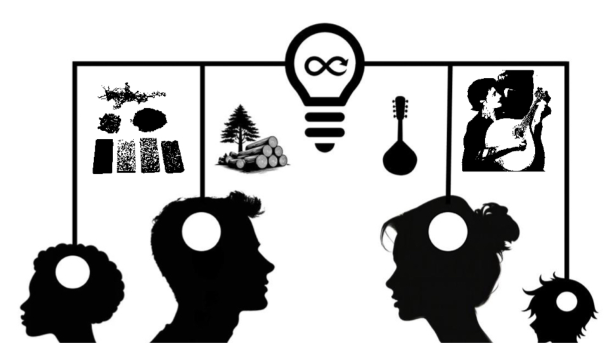
In the first stage all participants - such as, designers, academics, luthiers, artisans, businesspeople, members of urban public services – share their personal and profession knowledge, experience, desires and proposes. During the second phase, participants organize themselves, identifying common or complementary values, themes, and objectives related with music, Portuguese guitar development, sustainability, culture and ethics. This set of resources continues to grow throughout the process. In the third stage, participants explore how they can leverage the previously identified resources. This is a phase where divergent thinking is the dominant thought process. In the fourth stage, participants share their ideas and networks, involving more stakeholders such as the media, other artisans, museums, banks, and even funders. This phase will include the application of the cross-pollination process.
Figure 1: Cross-pollination in designing a Portuguese guitar. (The authors).
CONCLUSION
This paper demonstrates that divergent thinking reaffirms itself as the essential engine of creativity, freeing the cognitive process from the search for a single correct answer. By exploring multiple perspectives and generating a continuous flow of new ideas, this approach allows for breaking conventional patterns and achieving innovative solutions that linear reasoning would hardly reach. Thus, the ability to diverge is not just a phase of ideation, but the fundamental basis for transforming complex challenges into opportunities for disruptive innovation.
In a first moment, the research content defends the phenomenon of ethnomusicology to reflect on the design and development of a Portuguese guitar in the 21st century. The research focuses on historical analysis from the 21st century to the present day, identifying the variations that ethnomusicology has undergone in relation to variations in causality and circumstances.
In Search of Lost Design: Cross-Pollination in Designing a Musical Instrument 193 The second moment appropriates Marcel Proust’s work ‘In Search of Lost Time’ to propose the designer as an interpreter of their reality, space and time. In other words, it means that the designer brings together different types of knowledge in the creative process. These range from more scholarly knowledge, such as that found in an academic context, to more urban skills, or even more popular knowledge. This paper delves into the reality of Marcel Proust and the approach he and his contemporaries took in interpreting reality, acknowledge that music comprise a critical, systemic, and topical element in his famous work. The symbiosis system create announced the role of noises and sounds in a concrete place, defining it as a crucial and singular part.
In its findings, the research analysed the urban context of the city of Lisbon since the 19th century and anticipates the dynamics of urban flows in defining Fado songs and their environment. Specifically, it examines the development of the Portuguese guitar as an integral element of this systemic system.
For academia, this paper contributes to the development of new teaching and research models that are closer to the local community. For craft workshops and luthiers, this paper provides development and business opportunities, with the promise of making them self-sustainable. The introduction of alternative materials and processes to traditional ones is also a strategic and sustainable element, considering current changes related to climate catastrophes or the aging population, especially artisans and luthiers. Cross-pollination is understood as a malleable structure with guiding ideas and steps that can be adapted to fit diverse environments and conditions. For society, the transmission of knowledge from artisans and luthiers to designers is an important factor in the survival of cultural elements that define a people’s identity. With this paper, the authors intend to prove that cross-pollination can be a solution to solve problems that are poorly defined at the beginning and that change over time.
ACKNOWLEDGMENT
The authors would like to thank Instituto Politécnico Viana do Castelo and CIAUD, Research Centre for Architecture, Urbanism and Design, Lisbon School of Architecture, Universidade de Lisboa.
New Jersy: John Wiley & Sons, Incorporated. Alexiou, Katerina. Hale, Vera. Sousa, Sophia de and Zamenopoulos, Theodore. (2025). The Cross-pollination Approach: Conditions for Incubating and Cascading Collaborative Civic Design Initiatives, She Ji: The Journal of Design, Economics, and Innovation, Volume 11, Issue 1, (pp. 76–98) https://doi.org/10.1016/j.sheji.2025.01.004 Almendra, R.A., & da Silva, F.M. (2021). It Takes Two to Tango—Research and
Education Cross Pollination at Design Higher Education. Springer Series in Design and Innovation, vol 14. Springer, Cham. https://doi.org/10.1007/978-3- 030-75867-7_10 Bauman, Zygmunt (2005) Modernità liquida. Bari: Laterza. Benjamin, Walter (2003) Selected papers, 1938-1940: volume 4. New York. Harvard College.
Blacking, John. (1973). Humanly Organized Sound. How Musical is Man? (pp. 3–31).
University of Washington Press. Gasiorek, Andrzej; Waddell, Nathan; Reeve-Tucker, Alice. (2013). Wyndham Lewis and the Cultures of Modernity. Burningham: University of Burningham. Morais, M.; Vieira Nery, R. (2010). Guitarra. Enciclopédia da Música em Portugal
no século XX (C – L), (pp. 591–604). Lisboa: inet/Círculo de leitores. Mugglestone, Erica., & Adler, Guido. (1981). Guido Adler’s “The Scope, Method, and Aim of Musicology” (1885): An English Translation with an Historico- Analytical Commentary. Yearbook for Traditional Music, 13, 1–21. https://doi. org/10.2307/768355 Nattiez, Jean-Jacques. (1989). Proust as Musician. Cambridge: University Press. Nectoux, Jean-Michel. (1989). L’après-midi d’un faune: Mallarmé, Debussy, Nijinsky.
Paris: Réunion des musées nationaux - Grand Palais. Réédition numérique FeniXX. Penesco, Anne. (2022). Proust et les « paysages sonores ». Marcel Proust Aujourd’hui, 17, 130–144. https://www.jstor.org/stable/48746734 Reily, Suzel Ana. (2006). The Musical Human: John Blakings Ethnomusicology in
the Twenty-First Century. Aldershot, Wants, Ashgate. Rice, Thimoty. (2014). Ethnomusicology. A Very Short Introduction. London: Oxford University Press. Silva, João. (2017). Porosity and Modernity: Lisbon’s Auditory Landscape from 1864
to 1908. Cultural Histories of Noise, Sound and Listening in Europe, 1300–1918. Ian Biddle & Kirsten Gibson (Ed.). New York: Rouledge. (pp. 235–252). Soares, Liliana; Aparo, Ermanno; Almendra, Rita. (2025). “Eyes Wide Design: Reflecting and Reformulating Dissemination Methodologies”. In: Raposo, D., Neves, J., Silva, R. (eds) Perspectives on Design IV. Springer Series in Design and Innovation, vol 59. Springer, Cham. https://doi.org/10.1007/978-3-032-00733- 9_18 (pp. 267–275).
LISTED IN THE AHFE DIGITAL BOOKSTORE CATALOGUE
Explore the complete digital volume
Human Factors and Ergonomics In Design
Read this individual research paper free through the original publisher, or explore the full digital proceedings book.
ISBN 978-1-964867-86-1
Explore this ISBN in the AHFE Bookstore ↗Listed in the July 2026 bookstore catalogue; search by ISBN to confirm current availability · Digital book purchase optional