Liliana Soares, Ermanno Aparo (2022). The Concept of Tantra as Meta-Design to Create Sustainability. In: Human Dynamics and Design for the Development of Contemporary Societies. AHFE Open Access, vol. 25, pp. 466–472. https://doi.org/10.54941/ahfe1001422
Instituto Politécnico de Viana do Castelo, Portugal & CIAUD, Research Centre for Architecture, Urbanism and Design, Lisbon School of Architecture, Universidade de Lisboa, Portugal ↗
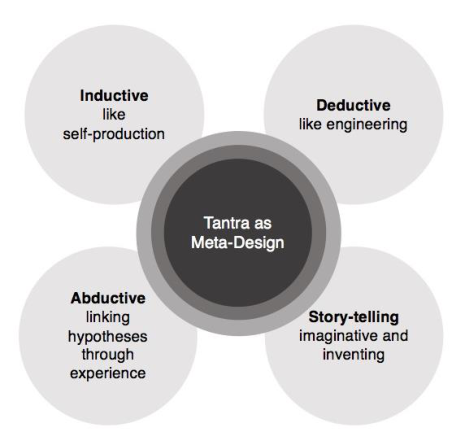
This article is an ongoing research and takes Tantra (Saraswati, 1981) to present an academic project that refers to the expansion of knowledge, understanding the body of an object through as a supreme shelter link. On the one hand, the female element represents the a whole as the beginning of everything and the supreme power of creation. On the other hand, the male element is associated with transcendence.Similar to designing, from the perspective of tantrism, the union of the two energies - feminine and masculine – is crucial and for this reason, the care of the object's body is essential.Phenomenologically, as Feuerstein (2005) states the tantric point of view does not deny the world of experiences, but views positively the culture of potential intrinsic psychophysical body and mind. This thesis comprises not only time and space, but also the external factors that cross-fertilize reality and, for this reason, enter into design process. In this sense, objects’ body is full of organs, but visible only to designers, requiring guidance from a master.In art, in early 20th century, there were similarities between the abstractions of Paul Klee, Piet Mondrian or Robert Delaunay. After that, Neo Tantrism emerged in the 1960s with the indian artist K. C.S. Paniker (1911-1977).In design, it seems Tantra contest divisions between opposites by teaching that everything is respected and incorporated, which includes the concept of marginal in society. For instance, Bauhaus (Germany, 20’s), Memphis (Italy, 60’s), Droog Design (Netherlands, 90’s) seem to represent it, as this is more about change in the world, via the body, rather than transcendence of it. In design Tantra can be understood as a moment of reflection on the nature of design and an occasion to continually think and get to know design, for instance, a process-oriented process. A reality that enhances scenario hypotheses, but without reaching a productive result.This ongoing research is non-interventionist and interventionist. The non-interventionist phase consists of the analysis and interpretation of concepts, contents from the past as well as visual imagery of Tantra. The interventionist phase resides on a pilot project.Thus, thinking about method in design means thinking about a phenomenological process such as interpretation. A path that is inductive like self-production, deductive like engineering, abductive intelligently linking hypotheses through experience, and also intuitive, imaginative, inventing, telling the story of material culture in another way. An alternative that needs to die and to live again, a process that, between analysis, intuition and experience, appeals to the dialectical reflection of design as an interlocutor between the individual and material culture in order to create sustainability.
In this paper, Tantra is an historical and semantic concept from the past wondering to become something meaningful in present reality. The concept of Tantra seems to have originated around the middle of the first millen- nium, and today survives mainly as a practice relevant to all who seek to cultivate self-understanding and are involved in the task of spiritual self- transformation. Tantra is also something that always relate feminine energy and masculine energy as a whole. On the one hand, the female element repre- sents the whole as the beginning of everything and the supreme power of creation. On the other hand, the male element is associated with transcende- nce. Similar to designing, from the perspective of tantrism, the union of the two energies – feminine and masculine – is crucial and for this reason, the care of the object’s body is essential. It means one has to start at the beginning, looked at it as a whole like building a house [Guenther & Trungpa 2001]. First we identify the problem, subsequently we create the foundation, then we build the first story and, then the second level and, so on. Then, the concept of Tantra enable one to experience something, with practice, time and circum- stances and, with no interest in theories. The main objective is to sacrifice conscience, that has nothing to do with command but with essence. “Con- sciousness, having veiled itself, transforms itself into insentient things, and, in its veiled-unveiled form, into (all the various phenomenizations that go)
The Concept of Tantra as Meta-Design to Create Sustainability 467
from the Gods to the plants” [Abhinavagupta 1999]. It is a free and revealing process for achieving knowledge.
In art, in early 20th century, the look for consciousness ant its veiled- unveiled form have similarities in the paintings of some Europeans artist, such as, Paul Klee (1879-1940), Piet Mondrian (1872–1944) or Robert Delaunay (1885-1941). As Paul Klee claims “in a forest, I have felt many times over that it was not I who looked at the forest. Some days I felt that the trees were looking at me, were speaking to me . . . . I was there, listening . . .. I think that the painter must be penetrated by the universe and not want to penetrate it” [Klee cit in Merleau-Ponty 1993]. After that, Neo Tantrism emerged in the 1960s with the Indian metaphysical and abstract painter K. C.S. Paniker (1911–1977).
For design, it may means the training at the end of the practice, each time one exercise as an habit and, not the pre conceived idea about design pra- ctice [Vessantara 2013]. Phenomenologically, as Georg Feuerstein [Feuerstein 1998] states, the tantric point of view does not deny the world of experie- nces, but views positively the culture of potential intrinsic psychophysical body and mind. This thesis comprises not only time and space, but also the external factors that cross and fertilize reality and, for this reason, enter into design process. In this sense, design objects’ body is full of organs, but visible only to creators, requiring the guidance from a designer as its own master to sacrifice its conscience. This action is also sustainable and an hermeneu- tic process as one aspire to survive to the uncertain and transitory current reality. Therefore, behind the former reflections, the following research que- stion was considered: To what extent can Tantra concept contribute to design method?
BACKGROUND
In design, it seems Tantra claim divisions between opposites by teaching that everything is respected and incorporated, which includes the concept of bor- derline in society and a process that always start as an ever ending story. In Europe, during the last century, some European design schools, designers and artists seemed to represent it, as this is more about change in the world, via the body, rather than transcendence of it. Therefore, in design, the concept of Tantra can be understood as a moment for reflection about the nature of design and an occasion to - continually - think and get to know design. For instance, thinking about design as a process-oriented process.
Having this idea in mind, in the Bauhaus of Weimer, Gerrit Rietveld develops the ‘Red-Blue’ chair [Kant 2007]. He started choosing colors as the first moment of the judgment of taste to provoke an intuitive feeling in the user, followed the choice of the universal theme of Piet Mondrian’s movement as the second moment. The third moment was defined accor- ding to the objectives that were taken into account. That is, judging the object according to the representation of a rule. Thus, the ‘Red-Blue’ pro- ject is a system of components based on a reticulated structure in which opposites always attract, establishing the will of an order like the concept of Tantra. The fourth moment of the judgment of taste is reached when the three
468 Soares and Aparo
moments - developed above - are added to the idea of a common sense based on cognitive power and the communication of a universal message. In the case of the ‘Red-Blue’ chair, it is the modality of satisfaction in the object associated with change, achieved with the help of the spatial-temporal con- nection. The ‘Red-Blue’ chair allows the user/viewer to first assess the image and the appearance of the object before reaching the essence of the referent. In this case, the message intended to convey to the spectator/user is the sublime notion of knowing the world freely using a transparent message. As if the spe- ctator/user reads Gerrit Rietveld’s work from the outside in order to enter into his soul, an idea that reflects not only Kant’s thought, but the concept of Tan- tra. “The German trend toward expressionism in art had received its sanction with Kant and the idea that neither reason nor material reality has absolute values, only appearances are accessible to us, and the judgment of taste is not cognitive judgement; hence it is not logical but aesthetic, that is, the principle that determines it is purely subjective” [King 1996]. So, the way to reveal this subjectivity was achieved through interpretation as a process-oriented process, that is a meta-design.
In Portugal, the approach to meta-design - in the sense of transfiguring the image of a reality that is continually changing - takes place during the period of the Carnation Revolution in 1974. Everything that had been smothered for nearly half a century, now had the opportunity to manifest itself on the surface, a phenomenon that was equally reflected in material culture and in design, namely in the field of graphic design. From the poster to graffiti, which emerged mainly at the service of political parties, the Portuguese rea- lity was an ideal place for the idealistic creation process [Royal 2005]. It was a procedure that crossed art with popular culture. The surface of the buil- dings became a support for a political message in which everyone took part, daily, recording emotions and thoughts, as if the wall were an opportunity to cure the ills of the Portuguese world, at that time strongly cyclical, changing and narrative. In 1985, Tomás Taveira starts the ‘Transfigurated Chairs’ - a process that will last until the 90’s and which reflects both the influence of Robert Venturi’s Post-Modernism and the ascendancy of his relationship with designers Italians like Alessandro Mendini. Tomás Taveira “(...) uses naive abstract shapes and an appealing surface decoration in order to pro- voke the viewer, suggestive of the variability and mobility of the post-modern world and capable of giving rise to new meanings that stimulate spontaneous communication (...).” [Santos 2013] The project ‘Transfigured Chairs’ was an exercise of continuous variations looking like a revisiting of the concept of Tantra.
THE RESEARCH The development of a product will only have a contemporary result if it is thought in harmony with the new functions and the new rituals of the liquid reality. Otherwise, there is a risk of living in a deplorable rea- lity [Bauman 2005]. In other words, the process-oriented methodological approach, which considers time, space and circumstances, proved to be the alternative for solving the problems of people and the environment. It is the
The Concept of Tantra as Meta-Design to Create Sustainability 469
solution of design that declines the proposal of the industrialized city in favor of the city of liquid modernity. Nevertheless, it is a proposal that crosses everything to achieve a personalized, unique and appropriate response to the present moment. Therefore, what is the contribute of design? And how should designer act with the concept of Tantra? In this study the authors assume that design is a process-oriented process like the concept of Tantra interpreted as meta-design that can, also, be understood as an interdisci- plinarity and strategic activity, that intends is to rule the transition process between the analysis phase and the collection of information and data, and the formalization and synthesis phase of the results that one will notify in the development. A reality that enhances scenario hypotheses, but without reaching a productive result. It is possible to say that “a meta-design consist of a system, a network of relations that make the thing the thing without actually designing it” [Spuybroek 2008]. In design it means looking for what is old in other disciplines, transforming it into something that can not only survive, but mainly compete in an extremely competitive market, bringing innovation. Then, nowadays, thinking about method in design means thin- king about a phenomenological process such as interpretation. An alternative that needs to die to live again, a process that, between analysis, intuition and experience, appeals to the dialectical reflection of design as an interlocutor between the individual and material culture.
Thus, present research considers four authors’ judgements. The choice of these four authors is limited to the western context and different temporal moments in history. First, considering reality that enhances scenario hypoth- eses, but without reaching a productive result, as Alessandro Mendini states [Ferrari 2005], while declaring meta-design exercise as a tool for reflection and promoting dialectics between persons and things. Secondly, pondering something like coordinating, integrating and articulating all those factors that, in one way or another, participate in the constitutive process of the shape of a product as Tomas Maldonado [Maldonado 1999] declares. Third, reflecting Clino Trini Castelli’s [Castelli 2009] thinking when he claims that designers must include the immaterial aspects of the city, while designing a product. Finally, considering Dijon De Moraes’ [Moraes 2010] rationality when he propose to discuss design, comprising a renew methodology and several topics in the structuring of a product. Then, a design that is always a starting project adopts the concept of Tantra as a meta-design, defining criteria, methodological approaches and cognitive procedures.
METHODS
This study is an ongoing research, non-interventionist and interventionist. The non-interventionist phase consists of the analysis and interpretation of concepts, such as the concepts of Tantra and Meta, historical contents from the past as well as visual imagery of Tantra. The interventionist phase resi- des on a pilot project. Consequently, thinking about method in design means thinking about interpretation. A path that is inductive like self-production, deductive like engineering, abductive intelligently linking hypotheses through experience and, also intuitive, imaginative, inventing, telling the story of
470 Soares and Aparo
Table 1. The concept of Tantra as meta-design to create sustainability (Soares & Aparo 2021).
First, design is a problem of reproducibility program;
Secondly a problem of drawing. Tomas Maldonado (1999)
Aspects
Functional, symbolic or cultural factors (factors relating to the use, the enjoyment and the indivi- dual or the social; consumption of the product);
Production factors (technical-economic, technical-constructive, technical-systemic, technical-productive and distributive technicians). Clino Trini Castelli (2009)
Aspects
Urban light;
The green zone as the lung of the city;
Energy interpreted as competence of the surroun- ding scenario. Dijon de Moraes (2010)
Aspects
Productive technology and materials;
Typological and ergonomic aspects;
Marketing factors;
Sociocultural influences;
Product/design system;
Social and environmental sustainability
Figure 1: The concept of Tantra as meta-design to create sustainability. Source: The authors.
material culture in another way like meta design (see Figure 1). An alter- native that needs to die and to live again, between analysis, intuition and experience, appeals to the dialectical reflection of design as an interlocutor between the individual and material culture to create sustainability.
The Concept of Tantra as Meta-Design to Create Sustainability 471
META-DESIGN APPLICATION Considering the research problem, the study takes the concepts of Tantra and Meta, and Immanuel Kant’s [Kant 2007] rationality as an order to think meta-design. In the future the authors aims to: 1) Choose light-shaping action and visual attributes of the shape of objects - as a feeling of pleasure and enjoyment - as the first moment of the judgment of taste to provoke an intui- tive feeling in the user or a social group. 2) Select an universal theme of the western society as the second moment of the judgment of taste. 3) Judge the system according to the representation of a rule created by the designer that relate persons, fields, materials, culture, knowledge. 4) Link the first three moments of the judgment of taste to the idea of a common sense, based on cognitive power and the communication of universal message.
CONCLUSION
This paper proves that interpretation as a method in design that considers time, space and circumstances is an action that renews old concepts in sea- rch of new meanings with meaning for human life, and the environment. Today, benefiting from the notion of Tantra is an opportunity to reflect on the concepts of ephemerality, speed and the importance of the image as intrin- sic characteristics of current reality. The 20th century case studies analyzed in this article demonstrate that the Tantra technique is a methodological pro- posal close to the notion of meta-design. That is, a process-oriented process that change the image of reality that is continually changing, which constitu- tes a technique that explains design method as a regenerative and sustainable methodology. In addition this principles are connected with Immanuel Kant’s. Liquid reality ask for meta-project as a new practice that relate different elements, an instrument for thinking and encouraging dialectics between per- sons and things. Therefore, while designing a product, it should be taken into account, not only the immaterial characteristics of the place, but also diffe- rent factors - productive technologic, materials, typological and ergonomic aspects; marketing; social, cultural, sustainable. Finally, with this new philo- sophy in mind, the authors will develop a pilot project in order to prove that design is a dialectical and sustainable process.
REFERENCES
Abhinavagupta (1999). Luce dei Tantra. Milano: Adelphi Eidizione. Bauman, Z. (2005). Modernità liquida, Bari: Laterza. Castelli, C.T. (2009) La Citta’ decostruita. Glossario in dieci voci per Milano 2015.
The Emilio Battisti Website: http://www.emiliobattisti.com/expodiffusa/pdf/trini _castelli.pdf De Moraes, D. (2010). Metaprojeto: o design do design. Blucher: São Paulo. Ferrari, M. (2005). Il progetto urbano in italia: 1940-1990. Firenza: Alinea. Feuerstein, G. (1998). Tantra: Path of Ecstasy. London: Shambhala Publications. Guenther, H. Trungpa, C. (2001). The Dawn of Tantra. London: Shambhala Publications. Kant, I. (2007). Critique of Judgement. Oxford: Forgoten Books.
472 Soares and Aparo
King, R. (1996). Emancipating space: geography, architecture, and urban design.
New York: Guilford Press. Maldonado, T. (1999). Design Industrial. Lisboa: Edições 70. Merleau-Ponty, M. (1993) “Eye and Mind”, in: The Merleau-Ponty Aesthetics Reader: Philosophy and Painting, Johnson, Galen A. (Ed.). pp. 35-56 Royal, L. (2005). Dimensão com dimenssão: 40 anos de design em Portugal. Lisboa:
ASA. Santos, R.A. (2003) “A cadeira contemporãnea em Portugal”, in: Cadeiras Portuguesas Contemporãneas, Neves, J. M. (coord.). pp. 105–133. Spuybroek, L. (2008). The architecture of continuity: essays and conversations.
Rotterdam: Stichting V2_Organisatie. Vessantara (2013). Guide to the Deities of the Tantra. Cambridge: Windhorse Publications.
LISTED IN THE AHFE DIGITAL BOOKSTORE CATALOGUE
Explore the complete digital volume
Human Dynamics and Design for the Development of Contemporary Societies
Read this individual research paper free through the original publisher, or explore the full digital proceedings book.
ISBN 978-1-958651-01-8
Explore this ISBN in the AHFE Bookstore ↗Listed in the July 2026 bookstore catalogue; search by ISBN to confirm current availability · Digital book purchase optional