Liliana Soares, Ermanno Aparo, Rita Almendra (2022). Design and the appropriation of 3D printing techniques in the management of an innovative product system in the field of wind musical instruments. In: Intelligent Human Systems Integration (IHSI 2022): Integrating People and Intelligent Systems. AHFE Open Access, vol. 22. https://doi.org/10.54941/ahfe100980
This paper aims to contribute to the innovation of the musical instruments sector of the wind family, including historical and semantic references from the past and the present, unites signs in a chain of logical associations and qualifies old concepts with a renewed identity. The uncertainty, ephemerality and complexity that characterize current reality call for a permanent research of production, opting for alternative, symbolic and process paths, which instigate the development of innovative and sustainable products. Music exalts the symbiosis between the musician and his instrument, so the quality of the performance is subordinated to this relationship and to the confidence that the instrumentalist exercises in the handling and in the domain of the artifact that becomes a true extension of his body. Mass production and the consequent monopolization of the market by major international brands have contributed to a standardization of the way of playing or even of sound. This phenomenon, in some specific areas of music, can correspond to a loss of quality. On the other hand, a critical analysis of the differences and particularities of each musician reveals that he may need to have a personalized instrument. The research validates a production and distribution system that can effectively respond to requests for customized products. For this reason, it is a revealing, revolutionary proposal and an alternative to the solutions that are on the market, following the needs of each client. This study aims to demonstrate the role of design in the management of rapid production technologies for the creation of niche products with a high degree of customization. The development and diffusion of fast production technologies - such as 3d printers - and the implementation in the music industry in the creation of components - such as mouthpieces and mouthpieces for wind instruments - can be an opportunity to propose a new scenario for the creation and product distribution. An action that will directly benefit from the possibility of customization. Today, there are some international brands that, for example, in the case of instruments from the saxophone and clarinet families, are producing mouthpieces with 3d printing technologies, using filaments or biocompatible resins that compete with current mouthpieces produced in plastic or in ebonite. However, it seems that the issues of distribution and commercialization of these products have not reached the evolution and the potential that these ways of producing provide. The experience of the research team accumulated in previous projects - Almada trumpet project (2019) Shatron mute project (2020) - allow to understand the importance of the scope of music as an experimentation laboratory, validating principles, processes and methodologies that can later be applied to other fields of action of products and services. In Portugal, currently the sector of the production of musical instruments is essentially focused on the restoration of components and objects, so this proposal may reveal new values and a concrete business possibility for a sector in crisis and which is an integral part. of the country's memory. This action may be a response to the indisputable improvement of the wind musical products and, consequently, of the lutherie sector in Portugal. Following the foregoing considerations, the following research question was considered: To what extent can design contribute to the effective improvement and innovation of the musical instruments sector in the wind family? Considering the research problem, this study aims to: 1) Producing a component like a mouthpiece for a wind musical instrument can offer important advantages for a distributor. 2) Increase the possibilities of product customization and bringing the qualities of the component closer to the most specific needs of each customer. 3) Reduce storage and stock requirements, making it possible to print only the components that can be sold. 4) Reverse the entire sales service much more personalized and close to the Customers. 5) Create a pilot model as a reference to be adapted to other realities. Based on the study's problems, the research question and the proposed objectives, it was considered possible to state the following hypothesis of this study: The modus operandi that crosses 3d printing techniques and the entrepreneurial initiative presents a methodological and operative singularity that confers a creative, experimental and innovative role in the customization and distribution of musical instruments. As this is a co-design project, the intellectual property belongs to all members of the team. The eventual adaptation of the model should be negotiated with all the intervening institutions.
This study contributes to the innovation of the musical instruments sector of the wind family in a proposal that includes historical and semantic references from the past and the present, mixes signs in an archeological process (Foucault, 1998), qualifying old concepts with a renewed identity. The uncertainty, ephemerality and complexity that characterize the current reality (Bauman, 2005), call for a permanent investigation of production, opting for alternative, symbolic, intermediate and not origin and/or end trails. An option that prompts the development of innovative and sustainable products. Concerning this study, music exalts the symbiosis between the musician and his instrument. Therefore, the quality of the performance is subordinated to this relationship and to the confidence that the instrumentalist exercises handling and controlling the artifact that becomes a true extension of his/her body. Mass production and the consequent monopolization of the market, by major international brands, have contributed to a standardization of musician interpretation. This phenomenon, in some specific areas of music, can correspond to a loss of quality. On the other hand, a critical analysis of the differences and particularities of each musician reveals that he/she may need to have a personalized instrument.
In this research, the proposal validates the production and distribution system that can, effectively, respond to the requests for customized products. For this reason, it is a revealing, revolutionary and alternative proposal to the solutions present in the market, following the needs of each client. Thus, this study is based on design-driven innovation (Vernanti, 2001), strategy and aims to demonstrate the role of design in the management of rapid pro-duction technologies for the creation of niche products with a high degree of customization. The development and the diffusion of fast production technologies - such as 3d printers - and the implementation in the music industry in the creation of components - such as mouthpieces and mouthpieces for wind instruments - can be an opportunity to propose a new scenario for the creation and product distribution. An action that will directly benefit from the possibility of customization. Today, there are some international brands that, for instance in the case of saxophones and/or clarinets, are producing mouthpieces with 3d printing technologies, using filaments or biocompatible resins that compete with current mouthpieces produced in plastic or in ebonite. However, it seems that the issues of distribution and commercialization of these products have not reached the evolution and the potential provide by these ways of producing.
Intelligent Human Systems Integration (IHSI 2022): Integrating People and Intelligent Systems https://openaccess.cms-conferences.org/#/publications/book/978-1-7923-8988-7
The experience of the research team accumulated in previous projects, namely, with the Almada trumpet project (Çobanli, 2019), and the Shatron mute project (Çobanli, 2020), allowed the authors to understand the importance of the scope of music as an experimentation laboratory. An action to validate principles, processes and methodologies that can later be applied to other fields of action of products/services. Currently, in Portugal, the sector of the pro-duction of musical instruments is essentially focused on the restoration of components and/or objects. Therefore, this proposal may reveal new values and a concrete business possibility for a sector in crisis and which is an integral part of the country's memory. This action may be a response to the indisputable improvement of the wind musical products and, consequently, of the lutherie sector in Portugal. Following the foregoing considerations, the subsequent research question was considered: To what extent can design contribute to the effective improvement and innovation of the musical instruments sector in the wind family?
BACKGROUND
The 3D printing process is a major step forward in the production of objects and product components. With an important participation in the expansion of the market, additive manufacturing manifests itself not only in laboratories, schools or design offices, but also at home as if it was a new household appliance. Unlike traditional manufacturing, additive production processes result in less raw material consumption and greater democratic pro- duction processes. Namely, through Open Access programs and cheaper machinery prices, reaching a large number of people and, for these reasons, revealing themselves as inclusive solutions. The use of these technologies has evolved with the parallel creation of digital communities and has offered the opportunity to witness not only a great evolution and diffusion of this technology, but also strong changes in other sectors, such as the business environment. These machines can deter-mine the arrival of a new industrial revolution, more democratic and on a global scale (Anderson, 2016). Some authors (Tripodi, 2016), (Striukova, 2014), (Anderson and Sherman, 2007) emphasize that these technologies can also be important to reconfigure the industry, in terms of production, distributive and use perspective. It is an action that provides new business models and that is capable to improve customer service. Specifically, this research uses co-design (Kleinsmann and Valkenburg, 2008) as a sustainable and common learning process. A system of entities with different natures that, continuously, operate on joint ventures to define innovative products or research processes. Hence, it seems important to explain the previous research the experiences carried out by the by design team. Although this field of research is new, there are already numerous examples in the business sector and in the academic field. In the musical field, over the past few years the Research Centre for Architecture, Urbanism and Design at the Faculty of Architecture, University of Lisbon and, in particular, the researchers Ermanno Aparo and Liliana Soares developed a vast academic, research and development work that is reflected in the production of scientific articles, books and the creation of Master's theses. The research produced in the scope of the Post-Doctorate in Design by Ermanno Aparo and published in a book (Aparo, 2020) testifies how it may be important to resort to 3d printing, checking the introduction of new components or other parts of instruments. This action reduces time and costs to the process. On the other hand, the creation of the innovative mute Sha-tron project - which
Intelligent Human Systems Integration (IHSI 2022): Integrating People and Intelligent Systems https://openaccess.cms-conferences.org/#/publications/book/978-1-7923-8988-7 involved both Ermanno Aparo and Liliana Soares - demonstrates the usefulness of the productive technique with the 3d printer. This process combines an innovative material used with a 3d printer - a PLA enriched with 25% carbon fiber - with wood scraps from furniture companies. It should be noted that the Almada Trumpet and the Shatron projects were awarded the A 'Design Award, respectively in 2019 and 2020. These projects contributed to the development of innovative products, combining different areas of production and knowledge, creating systems of territorial networks characterized by presence of partners from different areas. The contribution of the School Music of Viana do Castelo, in the North of Portugal, stands out. In the commercial aspect there are already brands scattered around the world that sell saxophone and/or clarinet mouthpieces produced with 3d printing technologies. Among these, the French brand Syos, the North American Sugal, the Dutch Dequelery or the Italian WBS stand out. Considering the scientific production, the argument of the manufacture of musical components with additive technologies is approached by several authors, in particular in the choice of mouthpieces for wind instruments such as the saxophone. About this argument, the authors A. Kantaros and O. Diegel (Kantaros and Diegel, 2018) in an article published in the scientific journal Rapid Prototyping Journal, the additive manufactures used in the creation of instruments as they are a concrete opportunity to produce something that, normally, the conventional production of instruments can't do. 3D printing technologies make it possible to create components - in the specific case these are saxophone mouthpieces - that help musicians achieve a more personalized sound (Lorenzoni et al. 2013). The article testifies to an exhaustive work developed at the laboratory level and validated by a series of musicians from the Royal Conservatoire of The Hague and musicians who performed at the North Sea Jazz Festival. Likewise, the reference scenario presented in an scientific article (Cottrell and Howell, 2019), which demonstrates that 3d printing techniques, as they are non-invasive, allows to present and analyze the performance of old components and evaluate projects that were never carried out and were only on paper. These researchers present a series of mouthpieces for saxophone and clarinet, based on technical drawings of projects carried out with 3d printers and experienced by professional musicians. As in the previous article, other authors (Celentano, et al. 2016) point out that through the new survey techniques - 3d scanner - and realization - 3d printers - it is possible, not only to replicate old components of vintage instruments, but also to create new elements, following the needs of each musician. This study culminated with the comparison between saxophone mouthpieces produced with additive technology ma-chines and those that exist on the market. The literature review proves that there are premises to develop an exploratory research project that combines the innovative aspect of additive machines and the commercialization of specific and technical objects such as mouthpieces for wind instruments.
RESEARCH OBJECTIVES Considering the research problem, this study aims to:
Produce a component like a mouthpiece for a wind musical instrument can offer important advantages for a distributor.
Increase the possibilities of product customization and bringing the qualities of the
Intelligent Human Systems Integration (IHSI 2022): Integrating People and Intelligent Systems https://openaccess.cms-conferences.org/#/publications/book/978-1-7923-8988-7 component closer to the most specific needs of each customer.
Reduce storage and stock requirements, making it possible to print only the components that can be sold.
Reverse the entire sales service much more personalized and close to the Customers.
Create a pilot model as a reference to be adapted to other realities.
Based on the study's problems, the research question and the proposed objectives, it was considered possible to state the following hypothesis of this study: The modus operandi that crosses 3d printing techniques and the entrepreneurial initiative presents a methodological and opera-tive singularity that confers a creative, experimental and innovative role in the customiza-tion and distribution of musical instruments. As this is a co-design project, the intellectu-al property belongs to all members of the team. The eventual adaptation of the model should be negotiated with all the intervening institutions.
METHODS
This research is based on a mixed, non-interventionist and interventionist methodology with a quantitative and qualitative basis. In the non-interventionist phase, the study is based on the collection and analysis of theoretical concepts and literary revision and the construction of case studies that support the theme. This phase makes it possible to state the research hypotheses and trigger multidisciplinary brainstorming, so that the partners produce mutual processes in a holistic strategy. The experiences with projects “Almada trumpet” and “Shatron mute for trumpet” and other developed works allow the construction of effective routes. With this new idea in mind, this methodology aims to demonstrate that 3d printing processes can be more advantageous, also, in a business sector. Thus, it will be essential to compare the rapport between products produced with three-dimensional printing technology (additive) with products made with the most traditional technologies (subtractive). This comparative analysis will determine the level of competitiveness of these products and the forecast of their entry into a wider market as an alternative to traditional products, namely, responding to specific requirements.
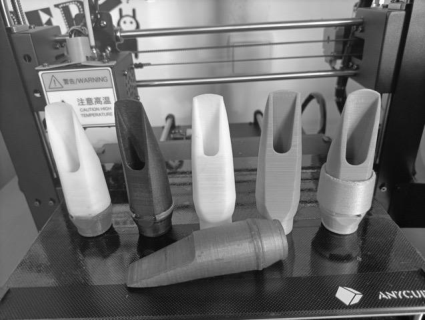
THE RESEARCH The design process starts with the creation of the co-design system, relating four different partners. The system is constituting by the music instruments company AMADEUS, the Music School - Escola Profissional Artística do Alto Minho, the Research Centre for Architecture, Urbanism and Design and, the Instituto Politécnico de Viana do Caste-lo. The first task started with the configuration of machines and the first experiments with materials. Then, there was an activity focus on the analysis and surveys of the products that exist on the market in order to create the foundations for the preparation of the first basic configuration of the product. The task will end with the first basic con-figuration exercises (standard mouthpieces). This second task was characterized by two distinct moments that advance, side
Intelligent Human Systems Integration (IHSI 2022): Integrating People and Intelligent Systems https://openaccess.cms-conferences.org/#/publications/book/978-1-7923-8988-7 by side, and without hierarchy. As this is an ongoing research project, the research project is fixed at this stage. On the one hand, it was intended to test project proposals, validating them immediately with the help of musicians of different ages and backgrounds. On the other hand, it is expected the consultancy of a luthier related to the specific area of the project and the need to verify and analyze the processes and prototypes executed during the process. In the future, it is expected to design and develop first satisfactory hypotheses and the generation of ideas. This phase will make it possible to identify strengths and weaknesses, as well as future opportunities and threats to the project.
Figure 1. First experiments with materials and 3D printing and, mouthpieces tried by a young musician. (Source: Liliana Soares).
CONCLUSIONS
This paper demonstrates that the research mixed design-driven innovation and co-design is an occasion to produce unconventional design projects in the field of wind musical instruments. The case studies prove that the production and distribution system can respond to the requests for customized products. The impact of 3d printing in the crea-tion of mouthpieces for wind instruments was a proposition to create singular objects and product dissemination. The articulation of these parameters determined the creation of models, based on a management system carried out with the company’s partner to verify the potential of the project. This project was an opportunity to predict product’s life cycle and its impact on the environment.
REFERENCES
A’ Design Award Competition (2019). “Almada Trumpet by Ermanno Aparo”. In Çobanli, O. M. (Coord.) A’ Design Award & Competition Winner Designs 2018/2019. Como: Hardcopy Edition, Designer Press OMC.
Intelligent Human Systems Integration (IHSI 2022): Integrating People and Intelligent Systems https://openaccess.cms-conferences.org/#/publications/book/978-1-7923-8988-7
A’ Design Award Competition (2020). “Shatron Mute for Trumpet by Altempo Design Researh Group. In Çobanli, O. M. (Coord.) A’ Design Award & Competition Winner Designs 2019-2020. Como: Hardcopy Edition, Designer Press OMC. Anderson, Chris. (2012). Makers: The new Industrial Revolution. New York: Crown Pub.
Group. Anderson, Phil, Sherman, Cherie A. (2007). A discussion of new business models for 3D printing, Int. J. Technol, Mark. Aparo, Ermanno (2020). O Projeto Almada Trumpet: Uma estratégia de Design para a
criação de um instrumento musical, Mauritius: Novas Edições Acadêmicas. Bauman, Zygmunt (2005). Modernità Liquida, Bari: Laterza. Celentano, Frank, May, Nicholas, Simoneau, Edward, Di Pasquale, Richard, Shahbazi, Zahra, Shahbazmohamadi, Sina (2016). “3D Printing for Manufacturing Antique and Modern Musical Instrument Parts.” Proceedings of the ASME 2016 International Mechanical Engineering Congress and Exposition. Volume 14: Emerging Technologies; Materials: Genetics to Structures; Safety Engineering and Risk Analysis. Phoenix, Arizona, USA. November 11–17, 2016. V014T07A003. ASME. https://doi.org/10.1115/IMECE2016-66652 Cottrell, Stephen, Howell, Jocelyn (2019) Reproducing musical instrument components from manufacturers’ technical drawings using 3D printing: Boosey & Hawkes as a case study, Journal of New Music Research, 48:5, 449-457, https://doi.org/10.1080/09298215.2019.1642362 Foucault, Michel (1998). Das coisas nascem coisas. Lisboa: Edições 70. Kantaros, Antreas, Diegel, Olaf (2018). "3D printing technology in musical instrument
research: reviewing the potential", Rapid Prototyping Journal, Vol. 24 No. 9, pp. 1511- 1523. https://doi.org/10.1108/RPJ-05-2017-0095 Kleinsmann, Maaike, Valkenburg, Rianne (2008). Barriers and enablers for creating shared understanding in co-design projects. Design Studies, 29(4), 369-386. https://doi.org/10.1016/j.destud.2008.03.003 Lorenzoni Valerio, Doubrovski, E. L., Verlinden, J. C. (2013) Embracing the digital in
instrument making: Towards a musician-tailored mouthpiece by 3D printing. In Proceedings of the Stockholm Musical Acoustics Conference 2013, SMAC 2013, Stockholm (Sweden), pp. 419-424. Rayna Thierry, Striukova Ludmila (2014). The Impact of 3D Printing Technologies on Business Model Innovation. In: Benghozi P., Krob D., Lonjon A., Panetto H. (eds) Digital Enterprise Design & Management. Advances in Intelligent Systems and Computing, vol 261. Springer, Cham. https://doi.org/10.1007/978-3-319-04313-5_11 Tripodi, Enzo M. (2016). Digital Revolution. 5 lezioni per la riqualificazione delle imprese
italiane. Lecce: Youcanprint. Verganti, Roberto (2001) Le nuove sfide per l’innovazione di prodotti e servizi. Milano: Dipartimento di Ingegneria Gestionale-Politecnico di Milano.
Intelligent Human Systems Integration (IHSI 2022): Integrating People and Intelligent Systems https://openaccess.cms-conferences.org/#/publications/book/978-1-7923-8988-7
LISTED IN THE AHFE DIGITAL BOOKSTORE CATALOGUE
Explore the complete digital volume
Intelligent Human Systems Integration (IHSI 2022): Integrating People and Intelligent Systems
Read this individual research paper free through the original publisher, or explore the full digital proceedings book.
ISBN 978-1-7923-8988-7
Explore this ISBN in the AHFE Bookstore ↗Listed in the July 2026 bookstore catalogue; search by ISBN to confirm current availability · Digital book purchase optional