Fabian Noriega, Mireya Zapata (2022). Augmented Reality in Robotics Learning. In: Intelligent Human Systems Integration (IHSI 2022): Integrating People and Intelligent Systems. AHFE Open Access, vol. 22. https://doi.org/10.54941/ahfe1001033
1 Maestría en Educación mención en Pedagogía en Entornos Digitales 2 Centro de Mecatrónica y Sistemas Interactivos – MIST Universidad Tecnológica Indoamérica, Machala y Sabanilla Quito, Ecuador
The objective of the manuscript is to determine the impact of an application with augmented reality, through a quasi-experimental study to improve the robotics-oriented teaching-learning process in students of the Mechatronics technical area at the Dayuma Kento Educational Unit - Ecuador. This research has a quantitative and exploratory, descriptive and explanatory approach. The study population was made up of 30 students subdivided into two groups: experimental and control. A pre-test was applied to all study participants as a starting point, to later carry out the intervention with the application of augmented reality for the experimental group, and for the control group with pedagogical cards. A comparative analysis was carried out with the results of a knowledge post-test applied to both groups. The study topic covered in the five sessions was the same for both groups, and they were designed following the ERCA methodology, under a constructivist approach where students must build their own knowledge in a favorable learning environment. The results of the pretest and posttest were analyzed to verify the hypothesis, showing that there are positive and statistically significant results, which affirm that the use of a technological tool with augmented reality has a favorable impact on the teaching-learning process of Robotics. It was also observed that the group of students who used the app were motivated and developed their research skills, achieving significant learning.
Intelligent Human Systems Integration (IHSI 2022): Integrating People and Intelligent Systems https://openaccess.cms-conferences.org/#/publications/book/978-1-7923-8988-7
INTRODUCTION
At present, education and society demand entities with creative and entrepreneurial skills with the implementation of the use of technological tools in the teaching- learning process such as in (Zapata, M and Polo-Mantuano, 2021). For proper learning, a methodological process that links theory and practice must be considered, developing, in this way, in the student, knowing-how, that is, with the application of techniques and knowledge that allow them to undertake an activity in which their skills are reflected (Pillajo and Zapata, 2021).
In this context, ICTs (Information and Communication Technologies) allow the development of thinking skills, collaborative, cooperative and communicative learning spaces, which contribute to the transformation in different ways of teaching and learning. Thus, the development of ICTs has driven the need for changes in the curricular and pedagogical design that motivates teachers to acquire new skills, allowing them to create didactic materials in digital environments that improve the quality of student learning, including Augmented Reality (AR) and Virtual Reality (VR) applications. These immersion systems have been shown to stir up teaching- learning processes in classrooms, making it easier for students to manipulate 3D objects (Teneda et al. 2021). In the field of industrial technical study, virtual environments allow users to operate industrial plants allowing the administration, training, production systems animation (Rivera et al. 2021), simulating environments that can hardly be obtained in real media such as robotic and mechanical systems, machine handling simulators, etc. (Andaluz et al. 2019).
Industrial Robotics achieves the future for the development of industries in auto-matic processes, therefore, emphasis is given to its study at secondary levels in tech-nical specialties (Herrera et al. 2019). In certain cases, their study is limited due to the lack of financial resources that imply the acquisition of a manipulator, so the use of simulators or immersive systems that allow interaction through three-dimensional models, facilitate the teaching-learning process in students (Rivera et al. 2020).
In accordance with what has been described, the development of an application of AR is proposed as a support to the teaching-learning process in the subject of Indus- trial Robotics in high school students, allowing a brief introduction to Robotics and its applications using immersive ICT tools (Yugcha, 2019).
APPLICATION DEVELOPMENT This section details the creation of an AR application using Unity 3D that consists of the following stages: i) Image Target, ii) Importing the 3D Model, iii) User Interface and iv) Virtual Animation.
Intelligent Human Systems Integration (IHSI 2022): Integrating People and Intelligent Systems https://openaccess.cms-conferences.org/#/publications/book/978-1-7923-8988-7
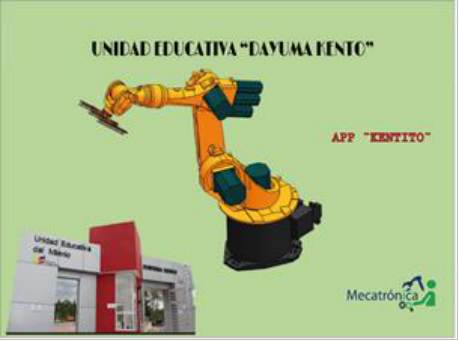
Image Target To perform the recognition of the pattern that triggers the AR in the developed app, the image shown in Figure 1 was modeled, which will serve as Image Target. The de- sign was made in Photoshop, to later be imported to Vuforia. The Unity engine de- tects and tracks the image by comparing the natural features extracted from the im- age through the camera against a known target resource database.
Figure 1. App image target
Importing the 3D Model The 3D model is a KUKA Robot Arm. It was exported in the SolidWorks software to modify parameters that fit the needs of the app, including making the parts of the Robot separately (see Figure 2). The 3D model is saved in IGIS format to later import it into the 3DS Max program, which allows to save the design as an object with an FBX extension to use it in Unity.
Intelligent Human Systems Integration (IHSI 2022): Integrating People and Intelligent Systems https://openaccess.cms-conferences.org/#/publications/book/978-1-7923-8988-7
Figure 2. Importing the 3D model
Figure available in the original PDF paper.
User Interface
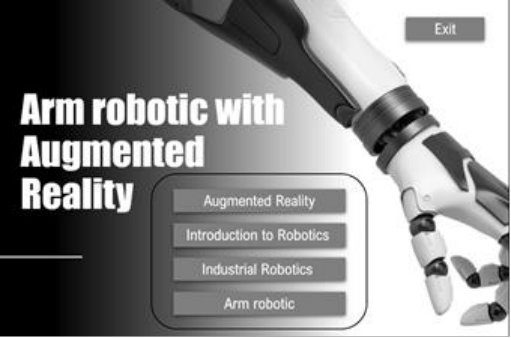
Figure 3. Main menu
The design of the app is intuitive and easy to use to improve the functionality degree and the user experience. Therefore, scenes were developed to contribute to the teaching of Industrial Robotics and its practical applications. In Figure 3, the main menu of the app is shown. The interface of the scenes from the main menu contains the different characteristics and contents based on the level of instruction for the subjects of the specialty of Mechatronics of high school; among them are concepts related to AR and VR, antecedents, definitions, and applications of robotics. The AR training scene is oriented to the teaching of characteristic, morphology of the manipu- lator, parts and components, as well as their classification, explosion / implosion of parts and applications of an industrial robotic arm.
Virtual Animation To enhance the realistic experience with the 3D model; animation clips linked by the Animator Controller are used, which allows to organize and maintain a set of anima- tion clips by associating transitions for the virtual manipulator. This property is used in the submenu components; where it will be possible to visualize the components of the robotic arm in 3D, unfolding the base, rotating column, oscillation arm, arm, wrist, actuators as an explosion and implosion of the arm. In the submenu applications will find 3D scenes of welding, suction pad, vehicle assembly and tracked undercarriage.
Intelligent Human Systems Integration (IHSI 2022): Integrating People and Intelligent Systems https://openaccess.cms-conferences.org/#/publications/book/978-1-7923-8988-7
CLASSROOM EXPERIMENTS WITH AR With the goal high school students work through a collaborative environment and additionally; contribute with their creativity through the management of tools with AR to improve the robotics teaching-learning process, a design and implementation of a mobile application called “Kentito” has been carried out. It takes advantage of the power of the Unity 3D and Vuforia software, which offer digital editions along with the option of being able to add objects and see them in 3D. The activities scheduled for the class sessions include: General indications of the class, installation instructions and access to the application, identify the components and subsystems of a robotic arm, perform a knowledge test on the main topics studied in augmented reality and robotics.
TEST APPLICATION This stage shows the experimental results obtained with the use of the app in a learn- ing process. The sample is determined by 30 students from the technical area in “Dayuma Kento” school - Ecuador, divided into two groups: a) Control group, made up of students who do not have connectivity where their learning is through pedagog- ical cards, consists of 18 students; b) Experimental group, made up of students who have internet connection, where learning is through the use of the application and is made up of 12 students.
A pre-test evaluation was developed for both groups before the intervention, and a post-test after the 7 learning stages ended. The evaluations made possible to assess the difference respecting to the academic performance of the control group learning with traditional techniques based on pedagogical cards and the control group that used the app developed in this proposal.
Intelligent Human Systems Integration (IHSI 2022): Integrating People and Intelligent Systems https://openaccess.cms-conferences.org/#/publications/book/978-1-7923-8988-7
Figure 4. Result of academic performance of the control and experimental groups According to the data presented in Figure 4, the control group obtained a difference respecting to the academic performance mean between pretest and posttest of 1.7. which represents an increase of 24%. In contrast, the difference in means with the experimental group is 4.2, representing an improvement of 42%. The results show that there is better academic learning using the proposed application based on aug- mented reality.
Figure available in the original PDF paper.
CONCLUSIONS
The implementation and use of digital ICT tools in the teaching-learning process im- plied an interaction through immersive environments using 3D models, motivating technological innovation in improvements in learning processes.
This digital tool will help students to achieve meaningful learning by complement- ing their basic digital skills in the development of their training modules related to Industrial Robotics such as: servomechanisms, micro-controlled systems, control interfaces, digital electronics, electrical engineering, and general electronics
REFERENCES
Zapata, M., & Polo-Mantuano, J. (2021, julio). Entornos virtuales de aprendizaje como herramientas de formación: una experiencia con NEO LMS en la enseñanza de la física. En Conferencia Internacional sobre Ergonomía y Factores Humanos Aplicados (págs. 319-326). Springer, Cham. Pillajo-Yugcha, M., & Zapata, M. (2021, julio). Los Entornos Virtuales en los
Procesos de Enseñanza-Aprendizaje de las Matemáticas en la Educación Secundaria. En Conferencia Internacional sobre Ergonomía y Factores Humanos Aplicados (págs. 335-339). Springer, Cham. Teneda, FI, Villacís, JI, Espinosa, EG, & Andaluz, VH (2021, marzo). Agente conversacional de procesos industriales a través de entornos virtuales. En Conferencia Mundial sobre Sistemas y Tecnologías de la Información (págs. 218-229). Springer, Cham. Rivera, E. F., Morales, E. E., Florez, C. C., & Toasa, R. M. (2021, September).
Development of an Augmented Reality System to Support the Teaching- Learning Process in Automotive Mechatronics. In International Conference on Augmented Reality, Virtual Reality and Computer Graphics (pp. 451-461). Springer, Cham. Andaluz, VH, Pérez, JA, Carvajal, CP, & Ortiz, JS (2019, junio). Entorno Virtual para la Enseñanza y el Aprendizaje de la Robótica Aplicada a Procesos Industriales. En Congreso Internacional de Realidad Aumentada, Realidad Virtual e Infografía (pp. 442-455). Springer, Cham. Herrera, K. A., Rocha, J. A., Silva, F. M., & Andaluz, V. H. (2020, June). Training
Systems for Control of Mobile Manipulator Robots in Augmented Reality. In
Intelligent Human Systems Integration (IHSI 2022): Integrating People and Intelligent Systems https://openaccess.cms-conferences.org/#/publications/book/978-1-7923-8988-7
2020 15th Iberian Conference on Information Systems and Technologies (CISTI) (pp. 1-7). IEEE. Rivera, E. F., Pilco, M. V., Espinoza, P. S., Morales, E. E., & Ortiz, J. S. (2020, June).
Training System for Hybrid Vehicles Through Augmented Reality. In 2020 15th Iberian Conference on Information Systems and Technologies (CISTI) (pp. 1- 6). IEEE. Yugcha, E. P., Ubilluz, J. I., & Andaluz, V. H. (2019, June). Virtual Training for Industrial Process: Pumping System. In International Conference on Augment- ed Reality, Virtual Reality and Computer Graphics (pp. 393-409). Springer, Cham.
Intelligent Human Systems Integration (IHSI 2022): Integrating People and Intelligent Systems https://openaccess.cms-conferences.org/#/publications/book/978-1-7923-8988-7
LISTED IN THE AHFE DIGITAL BOOKSTORE CATALOGUE
Explore the complete digital volume
Intelligent Human Systems Integration (IHSI 2022): Integrating People and Intelligent Systems
Read this individual research paper free through the original publisher, or explore the full digital proceedings book.
ISBN 978-1-7923-8988-7
Explore this ISBN in the AHFE Bookstore ↗Listed in the July 2026 bookstore catalogue; search by ISBN to confirm current availability · Digital book purchase optional