Wilmer Quishpe, Mireya Zapata (2022). Digital Environments for Biology Learning in High School. In: Intelligent Human Systems Integration (IHSI 2022): Integrating People and Intelligent Systems. AHFE Open Access, vol. 22. https://doi.org/10.54941/ahfe100974
1 Maestría en Educación mención en Pedagogía en Entornos Digitales Universidad Tecnológica Indoamérica, Machala y Sabanilla Quito, Ecuador 2 Centro de Mecatrónica y Sistemas Interactivos – MIST Universidad Tecnológica Indoamérica, Machala y Sabanilla Quito – Ecuador ↗
Currently, due to the Covid-19 pandemic, education has had to change the way of imparting knowledge to students, since the use of digital environments has been promoted, supported by digital tools that allow reaching meaningful learning. Therefore, the present investigation is carried out to know if using digital environments in Biology learning favors the teaching-learning process of First High School students, through the application of a quasi-experimental design in which two groups intervened: experimental and control. At the beginning of the intervention, a pre-test was carried out on the two groups, where it was found that there were no significant differences with respect to the marks obtained. Next, the digital environments were applied on the Gnomio platform supported by several digital tools such as: PowToon, Genially, Edpuzzle, Forums, where innovative methodologies were applied, the same that allowed promoting different learning styles in students. At the end of the course, the post-test was performed on both groups under study, identifying that there is a significant difference of 6.85 points between them, for which the alternative hypothesis was accepted, demonstrating that digital environments fostered the academic development of the participants. favoring their concentration and learning, which is reflected in the results of the evaluations.
Intelligent Human Systems Integration (IHSI 2022): Integrating People and Intelligent Systems https://openaccess.cms-conferences.org/#/publications/book/978-1-7923-8988-7
INTRODUCTION
At present, it is increasingly common to observe the use of digital environments by some teachers, since it is intended to capture attention and achieve the necessary learning. The new generations of students are digital natives, and are ready to use various digital tools in their academic training (García et al. 2020). Therefore, it is essential to get out of traditionalist models that generate boredom and inattention in students.
The change of scenario from face-to-face to virtual due to the Covid 19 pandemic has meant the use of various digital tools that allow students to achieve meaningful learning. Thus, virtual education is aimed at linking the academic field with technology to achieve an interaction between the student and the educational institution (Palacios et al. 2020).
There are several cases of technology application in education such as the use of different methodological strategies such as: use of virtual classrooms supported by the flipped classroom methodology or flipped classroom to enhance collaborative and autonomous learning in students as in (Zapata et al. 2021). In (Valenzuela, 2021), the implementation of gamification is shown as an innovative methodology that allowed the teacher to generate greater interest in students to know and learn more about the topic addressed.
In Ecuador, policies have been created that allow the development of the educational sector for the benefit of the country, such as the one described in the Organic Law of Intercultural Education (OLIE), 2015, Article 347 which refers to “Incorporate information and communication technologies in the educational process and promote the link between teaching and productive or social activities” (Pillajo et al 2021).
Thus, the use of digital environments supported by ICTs allows to generate learning in students, since students are attracted to know more about the subject by applying various technologies that allow development at an academic level (MINEDUC, 2015).
METHODOLOGICAL DESIGN The research worked from the quantitative paradigm, since statistical analyzes and descriptive values were used, based on a quasi-experimental design regarding the use of digital environments for learning Biology. In the same way, the type of research was applied, since the results obtained between the two groups under study were compared once the intervention was finished, and in this way, it was sought to determine if the use of digital environments allows to overcome the problems found in the Biology subject by the students. For this study the following hypotheses were raised:
H1: With the application of digital environments in the teaching - learning process, the academic performance of the students of the first-grade high school in "Juan Montalvo" school, Quito-Ecuador, will be improved in the subject of Biology in the experimental group.
In this research, a quasi-experimental design was applied because it allows flexibility
Intelligent Human Systems Integration (IHSI 2022): Integrating People and Intelligent Systems https://openaccess.cms-conferences.org/#/publications/book/978-1-7923-8988-7 regarding the assignment of members in the study groups. For the intervention it was not possible to distribute the members randomly, since the courses are already established from the beginning of the 2020-2021 school year, in the same way not all students had the technological resource and internet, this criterion was considered for select participants of the control group.
Population description The population is considered as a group with similar characteristics (Galindo, 2020), For the development of the research, we worked with 40 students, so for the application of the innovative proposal, an experimental group made up of 20 students was considered: 8 women and 12 men with whom we worked on the LMS platform in the cloud, designed based on the application of different methodologies, learning styles and digital tools.
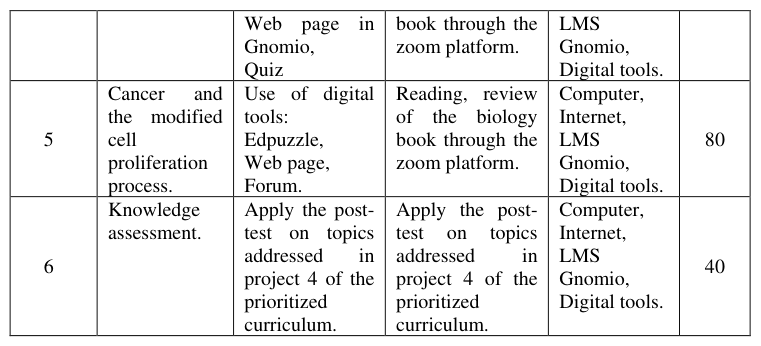
Proposal intervention Data were collected by applying an initial and a final evaluation (pre-test and post-test) to the experimental and control groups. The intervention was developed in six work sessions with the two study groups as detailed in Table 1. In the first session, the Biology knowledge pre- test was carried out on the Microsoft Forms platform, which was applied to all the study participants. From the second to the fifth session, terms, essential concepts and curricular contents that had to be studied at the level of the first year of baccalaureate as part of the teaching-learning process were reviewed and evaluated.
Table 1 Intervention description
Intelligent Human Systems Integration (IHSI 2022): Integrating People and Intelligent Systems https://openaccess.cms-conferences.org/#/publications/book/978-1-7923-8988-7 book through the zoom platform.
RESULTS
In Table 2, a synthesis of the main descriptive statistics of the pre and post test results of the experimental group is presented. In the pretest, a mean of 2.15 was obtained, with a standard error of 0.25. Similarly, a 95% confidence interval was used. It is identified that the students have shortcomings in the topics addressed in Biology.
In the case of the post-test, after applying the digital environments, a mean of 8.65 was obtained, with a standard error of 0.19; likewise, a 95% confidence interval was used. The results show that by applying new methodologies and learning styles supported by various digital tools in the teaching of Biology, a better academic performance was achieved by the students.
Table 2. Pre and post knowledge test application statistical values Appropriateness Statistical error Standard error Pre-test Mean 2,15 0,25 Average 2,00 Deviation 1,14 Minimum 0,00 Maximum 5,00 Post-test Mean 8,65 0,19 Average 9,00 Deviation 0,82 Minimum 7,00 Maximum 10,00
Intelligent Human Systems Integration (IHSI 2022): Integrating People and Intelligent Systems https://openaccess.cms-conferences.org/#/publications/book/978-1-7923-8988-7
Table 3. Pre and post knowledge test application statistical values Appropriateness Statistical error Standard error Pre-test Mean 1,95 0,38 Average 2,00 Deviation 1,73 Minimum 0,00 Maximum 7,00 Post-test Mean 3,95 0,33 Average 4,00 Deviation 1,50 Minimum 1,00 Maximum 7,00 In Table 3, a synthesis of the main descriptive statistics of the results obtained in the pre and post-test of the control group is presented. In the pretest, a mean of 1.95 and a standard error of 0.38 were obtained, a 95% confidence interval was used. Therefore, it is evident that before the intervention, the academic performance of the topics evaluated in this group is low.
Table available in the original PDF paper.
In the case of the post-test applied to the control group, after having applied a traditional and repetitive methodology, a minimum score of 1 was obtained, a maximum of 7 with a mean of 3.95 and with a standard error of 0.33. Similarly, the 95% confidence interval was used. The results obtained show that applying traditionalist methodologies contributes to the lack of attention and new knowledge acquisition, which is reflected in a lower academic performance than that obtained with the application of active methodologies.
At the beginning of the research, the mean pre-test score of the experimental group was 2.15; once the course was over, the post-test was performed, obtaining a mean of 8.65, with a notable difference of 4.70, which shows that there was better learning and training by the students in this group. Regarding the control group, when applying the knowledge pre-test, a mean of 1.95 was obtained and after finishing the activities, a mean of 3.95 was obtained, with a difference of 2. The results obtained show that when using outdated methodologies, the academic level improved, but in a proportion 2.35 times lower than that obtained by the group that used active methodologies in their teaching-learning process.
To demonstrate the hypothesis, the statistical test T students was carried out and thus determine if there is a significant difference between means of the evaluations carried out with the control and experimental groups. As can be seen in Table 4, the t-value obtained with two tails is less than 0.05, that is why the hypothesis is accepted and states that the academic performance of the students in the control group improved when applying digital environments.
Intelligent Human Systems Integration (IHSI 2022): Integrating People and Intelligent Systems https://openaccess.cms-conferences.org/#/publications/book/978-1-7923-8988-7
Table 4. Independent sample knowledge test Pre-test Post-test Mean 2,15 8,6005 Variance 1,2921 0,6755 Observations 20 20 t statistic -23,913 P(T<=t) two-tailed 0,0000 Critical value of t (two-tailed) 2,0930
Table available in the original PDF paper.
CONCLUSIONS
The application of digital environments supported by various digital tools significantly improves student learning, favoring the understanding of the various topics and terminologies used in the Biology subject.
Using digital resources such as Genially, PowToon, Edpuzzle, forums and Gnomio evaluation, allows students to be more concentrated and avoid distractions, which facilitates developing their learning skills, due to the activation of various types of intelligences, empowering them to get and learn biology terminology and concepts. In the development of the course, the tool that gave the best results was Genially based on gamification, specifically Escape Room, because it was an innovative and new way for students to learn Biology. Likewise, LMS provide various advantages such as managing and controlling academic progress, allowing access to resources whenever they want, designing and downloading academic reports for students, integrating various digital tools, promoting different learning styles.
At the end of the course in which the digital environments were applied through the application of knowledge post-test, it is evident that academic performance improved, demonstrating that learning becomes significant, improving the academic performance of students.
Finally, it is concluded that integrating the technological field in the development of the Biology subject enhances the various learning styles in the students, since being considered digital natives it is feasible to incorporate digital environments for a more dynamic and playful learning.
Intelligent Human Systems Integration (IHSI 2022): Integrating People and Intelligent Systems https://openaccess.cms-conferences.org/#/publications/book/978-1-7923-8988-7
ACKNOWLEDGMENTS
This work was supported in part by the Universidad Tecnológica Indoamérica under the Project HEENS 152.098.2017. We are grateful to the Juan Montalvo Educational Unit for their collaboration in carrying out the research work in their facilities.
REFERENCES
García, J.S., García, X.L., y Toural, C.B. (2020). Opportunities for content co-creation in digital native newspapers.. Information professional. 29(4). Palacios, A.E, Loor, J,M. Macias, K,M. y Ortega, W.R. (2020). Incidence of technology in
the educational environment of Ecuador in the face of the covid-19 pandemic. Knowledge Pole. 5(10), 754-773. Zapata M., Polo-Mantuano J. A. (2021). Virtual Learning Environments as Training Tools: An Experience with NEO LMS in Physics Teaching. vol 275. Springer. Valenzuela, M, A. (2021). Gamification for learning. A theoretical approach to the social
importance of games in education. Revista Educación las Americas. 11(1). Pillajo-Yugcha M., Zapata M. (2021). Virtual Environments in the Mathematics Teaching- Learning Processes in High School. Lecture Notes in Networks and Systems, vol 275. Springer, Cham. Ministerio de Educación. Ley Orgánica De Educación Intercultural. (2015). https://educacion.gob.ec/wpcontent/uploads/downloads/2017/02/Ley_Organica_de_Ed ucacion_Intercultural_LOEI_codificado.pdf Galindo, H. (2020). Statistics for non-statisticians. https://www.3ciencias.com/wp-
Intelligent Human Systems Integration (IHSI 2022): Integrating People and Intelligent Systems https://openaccess.cms-conferences.org/#/publications/book/978-1-7923-8988-7
LISTED IN THE AHFE DIGITAL BOOKSTORE CATALOGUE
Explore the complete digital volume
Intelligent Human Systems Integration (IHSI 2022): Integrating People and Intelligent Systems
Read this individual research paper free through the original publisher, or explore the full digital proceedings book.
ISBN 978-1-7923-8988-7
Explore this ISBN in the AHFE Bookstore ↗Listed in the July 2026 bookstore catalogue; search by ISBN to confirm current availability · Digital book purchase optional