Stephanie Fussell, Summer Rebensky, Stephen Mcgee (2025). Human Factors Challenges for Extended Reality Aviation Training Simulation. In: Human Factors and Simulation. AHFE Open Access, vol. 180, pp. 32–42. https://doi.org/10.54941/ahfe1006386
Extended reality (XR) technologies, encompassing augmented, mixed, and virtual reality (AR/MR/VR), hold immense potential for flight training, offering immersive and cost-effective training solutions. However, these systems face several technological challenges, as well as issues related to human factors and ergonomics, that hinder their full integration into aviation training programs, especially for military pilots. These issues must be addressed to ensure an XR-equipped flight simulator provides a realistic and reliable training environment. This requires iterative refinement of XR technologies through a multidisciplinary design approach. To meet these demands, the US Air Force Research Lab's Gaming Research Integration for Learning Laboratory® (GRILL®) conducts research that integrates human factors principles, game-based technology, and rigorous experimental design to increase operational efficiency and effectiveness. Incorporating human factors and ergonomic principles into XR flight training environments can lead to effective, reliable tools for flight training. These takeaways can be utilized across other industries. GRILL scientists are researching these issues, focusing on areas such as adapting simulation training based on biometric data, selecting technology that meets human factors requirements, and establishing best practices for optimizing dynamic XR training environments for intuitive interaction.
The U.S. armed forces utilize a variety of immersive simulation technologies to train pilots. These include part-task trainers for practicing aerial refueling and flight simulators that emulate real-world environments. In 2020, virtual reality (VR), a component of extended reality (XR) technologies, was integrated into the U.S. Air Force’s Pilot Training Next and Pilot Training Transformation programs (Urban and Pritchard, 2024). The initiatives have positively impacted student performance, likely influenced by VR’s high level of immersion. However, there are many challenges associated with integrating VR and other XR technologies into dynamic training programs while also incorporating human factors and ergonomics (HF/E) principles. The confluence of HF/E principles, technical requirements, and training outcomes represents a complex and challenging area of research. This
HF Challenges for Extended Reality Aviation Training Simulation 33
research is crucial for impacting the transfer of knowledge, skills, and attitudes (KSAs) between the training and real-world task environments.
The U.S. Air Force Research Lab’s (AFRL) Gaming Research Integration for Learning Laboratory® (GRILL®) is meeting this challenge by researching game-based technology to increase the operational efficiency and effectiveness of USAF officers and personnel. As a Department of Defense (DoD) facility and a part of AFRL, GRILL personnel research, evaluate, and utilize existing commercial off-the-shelf (COTS) hardware and software technologies to develop rapid prototypes, testbeds, and virtual environments (VEs). Researchers, computer scientists, and USAF officers and personnel collaborate to create personalized training applications with the goal of improving Warfighter capabilities while shortening the timeline to operational readiness. This includes examining XR technologies in training applications from a variety of perspectives, ensuring that airmen, as well as other military personnel, receive enhanced training opportunities.
XR is an umbrella term for technologies that vary in their levels of immersion, fidelity, and physical footprint. Augmented reality (AR) represents a technology that superimposes virtual content onto the real world, while still allowing users to see and interact with their physical environment. VR involves full-body immersion into a three-dimensional (3-D), digitally created VE that may elicit realistic interactions with virtual objects. Mixed reality (MR), on the other hand, merges the real and virtual worlds, overlaying much of the real world with a computer-generated environment that allows for interaction with both physical objects and virtual interfaces. Torrence and Dressel (2022) note that XR in aviation training has several demonstrated advantages, including realistic (embodied) interaction with objects, improved communication of procedures with augmented support tools, immersive environments that are safe and cost- effective, and customizable software that can be adapted for individual learners. However, these benefits may be lost if there is incorrect integration of learning objectives, if cognitive load is too high, if movements and learning do not map to the real world, or if the trainee experiences cybersickness, discomfort, or fatigue that negatively impacts learning.
The concepts of human factors and ergonomics (HF/E) are critical in Warfighter and aviation training, dynamic paradigms where safety and performance standards are paramount. Similarly, XR technologies offer immersive tools that are useful for a variety of training purposes and may be applied to other training environments. This report discusses the projects and initiatives of the GRILL and how they align with HF/E principles, address cognitive load and physiological concerns, and navigate the technical requirements and limitations of dynamic training environments. It also includes best practices for optimizing dynamic XR training environments to facilitate intuitive interaction in similar contexts.
HF/E XR CONSIDERATIONS Usability
Human factors principles can guide system characteristics regarding user experience, safety, and productivity by considering human abilities, limitations, and behaviours (Lee et al., 2017). In any training simulator, the way trainees perceive, process, and interpret information, as well
as how they interact with an XR learning environment, impacts their learning capacity, performance, and safety. This necessitates the design and development of XR training environments that prioritize usability. Nielsen (2012) notes that usability design may be assessed along five quality aspects: learnability, how easy a first-time user can accomplish tasks; efficiency, how quickly a learned task can be performed; memorability, how easily proficiency can be reestablished after disuse; errors, the amount, severity, and recoverability from mistakes; and satisfaction, how pleasant a design is (Nielsen, 2012). Using validated measures like the System Usability Scale (SUS; Brooke, 1996) and the NASA Task Load Index (TLX; Hart and Staveland, 1988), GRILL software developers, researchers, and user experience experts collaborate with customers, who often represent end users, to develop training tools and applications. By testing usability with representative users, the XR system’s design can be iteratively refined, resulting in a design with high usability that also meets training and learning objectives.
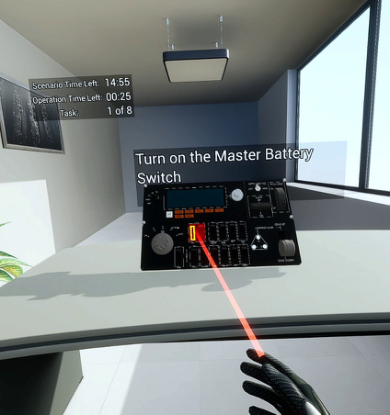
To understand how input modalities (also known as interaction methods) impact KSA acquisition, mastery, and transference to the real world, the GRILL has created a VR Input Modality testbed to test Nielsen’s five usability aspects (Fussell et al., 2024). Users complete a procedural training task using flight deck panels and three out of seven different input modalities, such as eye or head tracking, with selection confirmed either by clicking a controller button or by dwelling on the object. Ongoing research will compare the efficiency with which users can complete the virtual task, the number of errors made, and user satisfaction and preference, using a comparative VR methodology (Fussell, 2023). Flight decks often have numerous small toggles, switches, and other controls that pilots must interact with. Understanding how users interact with virtual representations of these controls will inform the design and development of XR flight training simulators. Figure 1 shows the VE, task information, and an input modality.
Figure 1: The VR input modality testbed, featuring an input modality with a laser pointer.
HF Challenges for Extended Reality Aviation Training Simulation 35
Ergonomics The International Ergonomics & Human Factors Association (IEA) defines ergonomics as the scientific discipline concerned with the interaction of humans and elements of a system, and encompasses domains such as physical activity, cognitive processes, and organizational systems and processes (IEA, n.d.). XR head-mounted displays (HMDs) can introduce significant ergonomic challenges in these domains. Extended use can result in physical discomfort due to the weight and fit of the devices, particularly during prolonged training sessions. This discomfort may lead to distractions or reduced focus, undermining the effectiveness of the training. In an aviation training simulator, the XR components should not result in incorrect physical behaviours due to the size and weight of the headset, nor should users be encumbered by the XR device (e.g., a tethered HMD, holding a mobile device). Object placement should promote natural interaction without excessive range of motion from the head, neck, arms, or torso. In general, elements in the virtual training environment should be central, easily visible, and accessible to mimic the real-world training environment, promoting system learnability and memorability. Testing the XR system should include closely observing the user to ensure they are not straining to reach interaction elements or moving in unnatural ways because of the XR HMD. Users can also provide feedback on ergonomics, discomfort, and symptoms of sickness. Observers can use a modified Ergonomic Assessment Checklist from OSHA (n.d.) to assess the ergonomic aspects of an XR training system, user interaction, potential ergonomic issues, and solicit feedback about user comfort or discomfort.
Sickness Aside from physical discomfort, visual fatigue is a common issue stemming from prolonged exposure to high-resolution displays and mismatched focal depths between virtual and physical environments. The technical specifications of the XR system—such as field of view, depth of field, latency, and frame rates—can all be affected by both the design of the VE and the XR equipment. These factors can cause nausea, eye strain, headaches, or cybersickness (also referred to as simulator sickness): symptoms that are detrimental to engagement and effective skill acquisition. Cybersickness has many causes and just as many mitigation strategies. It can be caused by a mismatch between visual and physical cues, such as when locomotion and acceleration in the virtual and physical environments are not aligned, or when there is simulated movement in the VE without corresponding physical movement (Porcino et al., 2021). For example, when executing a turn in a flight manoeuvre, a pilot expects a corresponding physical feeling due to gravitational forces. The lack of these feelings within a VE, and the mismatch between the visual and vestibular senses, can result in cybersickness due to sensory conflict theory. Individual differences can also lead to cybersickness, such as whether the HMD can accommodate varying interpupillary distances, and the user’s general susceptibility to motion sickness. Any combination of these issues can cause various symptoms and severity levels of cybersickness, which may negatively impact learning and performance.
The user can provide feedback related to cybersickness symptoms using the Simulator Sickness Questionnaire (SSQ; Kennedy et al., 1993), the VR Sickness Questionnaire (VRSQ; Kim et al., 2018), or similar questionnaires. Physiological measures that correlate with cybersickness, such as respiration, heart rate, pupil dilation, blink count, and forehead skin conductance, can also be used (Halbig and Latoschik, 2021). Researchers and developers at the GRILL have long considered mitigation techniques and have contributed to the North Atlantic Treaty Organization (NATO) technical report, Guidelines for Mitigating Cybersickness in Virtual Reality Systems (2021). Researchers at the GRILL will evaluate the ability of galvanic vestibular stimulation (GVS) to reduce cybersickness and enhance learning objectives in VEs with motion, using flight training as a use case. Participants will wear a GVS device and physiological sensors while performing flight manoeuvres and cognitive tasks in a VE. This will allow participants to receive real- time feedback based on their performance and physiological measures, enabling behavioural adaptations and responses. The goal is to confirm GVS’s effectiveness in reducing cybersickness symptoms and enhancing performance and educational outcomes in a VE.
COGNITIVE CONSIDERATIONS Another challenge for flight training with XR is cognitive overload. XR simulations can overwhelm pilots with excessive visual and auditory stimuli, reducing their ability to focus on critical tasks. Poorly designed interfaces or unrealistic environmental cues exacerbate this issue, leading to reduced training effectiveness. Many in aviation emphasize the importance of high fidelity in XR flight training simulators across three aspects: physical fidelity, or the realism of the simulation’s appearance and feel; conceptual fidelity, or the accuracy with which the real world is reflected in the simulation; and psychological fidelity, or the extent to which mental processes are engaged (Carey and Rossler, 2023). However, Carey and Rossler (2023) warn against the ‘fidelity trap,’ noting that trainees do not learn in direct proportion to the level of realism. Higher fidelity can lead to increased cognitive load, which negatively impacts learning, retention, and schema creation. A study by Oberhauser et al. (2018) found that pilots in a VR flight simulator experienced significantly higher levels of mental, physical, and temporal demand, as well as greater frustration and effort, compared to pilots in a conventional flight simulator. The NASA TLX was utilized to measure perceived workload in this comparison. Given the range of flight simulation training devices, from flat-screen trainers to full-motion simulators, aiming for medium-fidelity may be key to creating a low-cost, reliable, and effective XR flight training simulator. Oberhauser et al. (2018) echo this sentiment, concluding that despite worse performance in a VR flight simulator, pilots could still safely and reliably complete flight tasks.
In addition to subjective assessments of workload (i.e., NASA TLX), King, Carmody, and Deaton (2024) note that biometric instruments can be used to monitor heart rate, blood pressure, and stress levels to assess user engagement and optimize training scenarios. These data inform the development of an
HF Challenges for Extended Reality Aviation Training Simulation 37
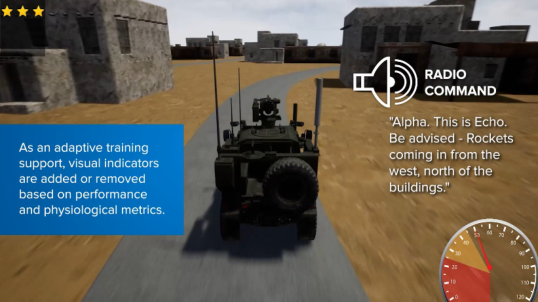
experimental testbed called the Driving-based Adaptive Research Testbed (DART; Stalker et al., 2024a, 2024b). DART adjusts the difficulty of driving tasks and secondary cognitive tasks based on the user’s physiological state, for example, by using functional near-infrared spectroscopy (fNIRS) and heart rate monitoring, as well as their performance, such as their ability to maintain driving speed, navigate a changing track, and respond to auditory cues. The testbed is an excellent example of how adaptive training methods can enable individualized learning and keep users in the Zone of Proximal Development (Stalker et al., 2024b). Figure 2 shows a screenshot from a simulation with information about the audio cue.
Figure 2: A screenshot of DART with information on what the user would hear.
TECHNICAL CONSIDERATIONS Technological challenges also impact the adoption of XR in flight training. For example, the performance of pass-through cameras integrated into headsets is essential for enabling MR environments. High latency can disrupt the pilot’s spatial awareness and ability to respond to simulated scenarios. Additionally, inadequate resolution can limit the clarity of instrument panels, controls, and external views—elements that are critical for accurate training. Misaligned depth perception can also lead to inaccuracies in performing spatially dependent tasks, such as simulating landings or manoeuvring through complex airspaces. Some XR devices are hard-wired or tethered to a computer or electrical outlet, requiring a review of mounting, wireless, and wearable options to ensure safe use and to avoid tripping hazards. Tracking systems for both head movements and hand gestures can be implemented to allow precise and natural interactions within the VE if pass-through cameras are used. If possible, the simulator should be designed with scalability in mind so that it can be updated and expanded easily.
Developing the VE requires a powerful gaming engine that can render high- quality, realistic environments. This engine should accurately represent the cockpit, terrain, weather conditions, and other aircraft. The development also involves designing spatial audio to simulate realistic sounds within the
cockpit and external environment, which is critical for situational awareness. Gaming engines and similar development tools necessitate hardware with sufficient processing power to run these programs effectively. To ensure a realistic and dynamic training experience, developers should use a physics engine that accurately simulates the aerodynamics and flight characteristics of the specific aircraft used in training.
Developers at the GRILL follow best practices related to technical considerations to design XR applications that mitigate the risks of cybersickness and physical discomfort. These best practices are detailed in Table 1.
Table 1: System aspect recommendations.
Table available in the original PDF paper.
Aspect Recommendation Field of view (FOV) and field of regard (FOR)
Horizontal placement: Place content between 30 and 50 degrees of the viewer for AR. Place content between 90 and 110 degrees of the viewer for MR and VR (may depend on headset specifications).
Vertical placement: Place content within 10 degrees upward and 40 degrees downward from the horizon line.
User interface: A user interface should not be placed directly in front of the user. It should be placed such that the user can look away from it, so as not to distract from the main world space.
Distance placement: Place content at an optimal distance for interaction and viewing, between 1.25 and 5 meters from the viewer in AR and MR. Content in VR should conform to realistic layouts and representation as applicable. Resolution Minimum pixels per degree (PPD) monocular density of 30, although 60 better matches the resolution capacity of the average human retina. Higher resolution means clearer, sharper images. Frames per second (fps) Greater than 60 fps, although minimum of 90 fps is
preferred. Lower FPS can cause recognized rendering latency causing cybersickness. Latency Below a 20 ms threshold; lower latency translates to a faster response from the system to user interaction/input. Colours and sounds Provide accurate visual and audio cues that are
representative of the real world and training simulations. Instrumentation Provide realistic instruments, interfaces, and controls to promote near transfer of learning. Layout Ensure that the design of the virtual and physical
environments closely match the layout of the real-world environment to promote near transfer of learning.
Continued
HF Challenges for Extended Reality Aviation Training Simulation 39
Table 1: Continued Aspect Recommendation
Table available in the original PDF paper.
Movement methods In VR, avoid using the joystick to “slide” as a movement; use teleportation as a movement mechanism. Black the screen for a few milliseconds during teleportation to aid transition and mitigate cybersickness. Avoid scenarios that could lead to the user colliding with virtual objects as this may cause cybersickness due to the mental expectation of a physical collision that does not occur.
BEST PRACTICES Developing an XR simulator for dynamic training involves a multidisciplinary approach that combines expertise in technology, instructional design, human factors, and domain-specific knowledge. Researchers and developers at GRILL use a technical evaluation template to identify how a given technology can enhance the development and use of modeling and simulation solutions, document the extent to which the technology can be integrated with other modeling and simulation tools, and explore user experience and integration with other training tools. The template assesses technical compatibility, research and design flexibility, strengths and opportunities for improvement, comparison to alternative solutions, usability, cost, long-term sustainment, and security and compliance considerations. Some best practices to consider when developing an XR flight training simulator are described.
Define Clear Learning/Training Objectives: Before development begins, identify and define clear learning or training objectives. What skills, knowledge, or competencies should the trainee acquire? What do they already have? Ensure that the XR environment is designed to meet these objectives.
Cross-Disciplinary Collaboration: Work closely with subject matter experts, instructional designers, software developers, and human factors specialists to create a comprehensive and effective training tool.
Focus on User Experience: Design intuitive interfaces and interactions. The user should be able to navigate the VE and perform tasks without confusion or frustration. When errors occur, the user should know and be able to recover.
Integrate Human Factors and Ergonomics: Consider the physical and cognitive ergonomics of the user to prevent discomfort, fatigue, and cybersickness. This includes optimizing the weight and fit of HMDs, ensuring clear visuals without causing eye strain, and designing interactions that do not lead to cognitive overload.
Incorporate Adaptive Learning: If possible, use adaptive algorithms that adjust the difficulty of tasks based on the user’s performance. This keeps users in their Zone of Proximal Development, where they are challenged but not overwhelmed.
Ensure High Fidelity Where it Counts: High fidelity in every aspect of the simulator can also be costly and may lead to increased cognitive load. Focus on high fidelity in areas critical to the learning objectives. Consider where medium fidelity might be more appropriate.
Iterative Design and Testing: Use an iterative design process that includes prototyping, user testing, and feedback at each stage. This allows for the refinement of the simulator based on actual user experiences.
Use Validated Measures for Evaluation: Employ tools like the NASA TLX to measure cognitive load, the SUS to analyse usability, and the SSQ to assess cybersickness. These validated measures can help evaluate the effectiveness of the training and the user’s comfort level.
Prepare for Hardware and Software Limitations: Be aware of the limitations of current XR technology, such as field of view, resolution, and tracking accuracy, and design the simulator to work within these constraints. Table 1 details technical considerations.
CONCLUSION
As the pace of technological advancement accelerates, the aviation industry faces the imperative to adapt and innovate. Immersive XR environments, once considered futuristic, are now actively reshaping training methodologies. These advanced simulations offer unparalleled opportunities for pilots to hone their skills in safe, cost-effective, and highly realistic settings. However, the integration of XR technology in aviation training is not without its challenges. As we have discussed, issues such as cognitive overload, cybersickness, and technological limitations must be carefully managed to ensure the efficacy and safety of training programs.
By adhering to HF/E principles, developers can design XR training solutions that account for human abilities and limitations, thereby enhancing learning outcomes and reducing potential risks. Iterative design evaluations allow for the refinement of these simulators through continuous feedback and improvement, ensuring that each iteration addresses the nuanced needs of trainees and the high-stakes nature of aviation. Robust testing, including both subjective assessments and objective biometric measures, provides a comprehensive understanding of the trainee’s experience and the simulator’s performance.
Collaboration is key in this endeavour. Developers and researchers must work closely with government agencies, industry partners, and other stakeholders to establish standards, share best practices, and drive innovation. Together, they can create XR training simulators that not only meet current training demands but are also agile enough to adapt to future changes in technology and training requirements.
Looking ahead, the thoughtful application of XR technology in aviation training has the potential to significantly enhance pilot proficiency, reduce training costs, and improve overall flight safety. As these technologies continue to evolve, the aviation industry must remain committed to leveraging them in ways that prioritize human-centred design and effective learning. In doing so, we can ensure that XR training simulators serve as
HF Challenges for Extended Reality Aviation Training Simulation 41
a cornerstone of aviation education, equipping pilots with the skills and confidence needed to excel in an increasingly complex and dynamic airspace.
ACKNOWLEDGMENT
The authors would like to acknowledge the GRILL personnel and collaborators who have made this work possible.
CLEARANCE This article has been cleared for publication. Case Number: AFRL-2025- 0950. The views, opinions, and/or findings contained in this journal article are those of the authors and should not be interpreted as representing the official views or policies, either expressed or implied, of the Air Force Research Laboratory, Department of the Air Force, or the Department of Defense.
REFERENCES
Brooke, J. (1996) ‘SUS-A quick and dirty usability scale’, Usability Evaluation in Industry, 189(194), pp. 4–7. Carey, J. M. and Rossler, K., (2020) The how when why of high fidelity simulation.
In: StatPearls [online]. Treasure Island (FL): StatPearls Publishing. Available at https://www.ncbi.nlm.nih.gov/books/NBK559313/ (accessed 28 Jan 2025). Cross, J., Boag-Hodgson, C., Ryley, T., Mavin, T. J. and Potter, L. E. (2022) ‘Using extended reality in flight simulators: A literature review’, IEEE Transactions on Visualization and Computer Graphics, 29(9), pp. 3961–3975. Fussell, S. G. (2023). ‘A review of user experience requirements for a procedural
training task in virtual reality’, Proceedings of the Human Factors and Ergonomics Society Annual Meeting, 67(1), 1472–1477. doi: 10.1177/21695067231192437. Fussell, S. G., Oliver, Q., and Kwasa, B. (2024). ‘Development and testing of extended reality input modalities for a virtual learning/training task’, Proceedings of the Interservice/Industry Training, Simulation, and Education Conference (I/ITSEC). Halbig, A., and Latoschik, M. E. (2021) ‘A systematic review of physiological
measurements, factors, methods, and applications in virtual reality’, Frontiers in Virtual Reality, 2, 694567. Hart, S. G., and Staveland, L. E. (1988) ‘Development of NASA-TLX (task load index): results of empirical and theoretical research’, Advances in Psychology, 52, pp. 139–183. doi: 10.1016/S0166-4115(08)62386-9. IEA. (no date) What is ergonomics (HFE)? Available at: https://iea.cc/about/what-is-
ergonomics/ (accessed 24 Jan 2025). Kennedy, R. S., Lane, N. E., Berbaum, K. S., and Lilienthal, M. G. (1993) ‘Simulator sickness questionnaire: An enhanced method for quantifying simulator sickness’, Int. J. Aviat. Psychol. 3, 203–220. doi: 10.1207/s15327108ijap0303_3. Kim, H. K., Park, J., Choi, Y., and Choe, M. (2018) ‘Virtual reality sickness
questionnaire (VRSQ): Motion sickness measurement index in a virtual reality environment’, Applied Ergonomics, 69, 66–73. King, G., Carmody, K., and Deaton, J. (2024) ‘The influences of new realities: How virtual, augmented, and mixed reality advance training methods in aviation’, in Vincenzi, D. et al. (eds.) Human Factors in Simulation and Training. Boca Raton, FL: CRC Press, pp. 317–330.
Lee, J. D., Wickens, C. D., Liu, Y., and Ng Boyle, L. (2017) Designing for people: An introduction to human factors engineering, 3rd edition. Charleston, SC: CreateSpace. Milgram, P. and Kishino, F. (1994) ‘A taxonomy of mixed reality visual displays’,
IEICE Trans. Inform. Syst., (77), pp. 1321–1329. NATO. (2021) Guidelines for mitigating cybersickness in virtual reality systems.
STO-TR-HFM-MSG-323. doi: 10.14339/STO-TR-HFM-MSG-323. Nielsen, J. (2012) Usability 101: Introduction to usability. Available at https:// www.nngroup.com/articles/usability-101-introduction-to-usability/ (accessed 28 Jan 2025). Oberhauser, M., Dreyer, D., Braunstingl, R. and Koglbauer, I., (2018) ‘What’s real
about virtual reality flight simulation?’, Aviation Psychology and Applied Human Factors, 8(1), pp. 22–34. doi: 10.1027/2192-0923/a000134. OSHA (n.d.) Ergonomic assessment checklist. Available at www.osha.gov/sites/ default/files/2018-12/fy14_sh-26336-sh4_Ergonomic-Assessment-Checklist.pdf (accessed 28 Jan 2025). Porcino, T., Trevisan, D. and Clua, E. (2021) ‘A cybersickness review: Causes,
strategies, and classification methods’, Journal on Interactive Systems, 12(1), pp. 269–282. Stalker, W., Rebensky, S., Turk, S., Perry, S., and McGee, S., (2024a). ‘From lab to battlefield: Exploring the relationship between military and basic science tasks for measuring competencies’, Proceedings of the Interservice/Industry Training, Simulation, and Education Conference (I/ITSEC). Stalker, W., Rebensky, S., Knight, R., Perry, S., and Bennett, W. (2024b). ‘The
power of performance and physiological state: Approaches and considerations in adaptive game-based simulations’, In International Conference on Human- Computer Interaction (pp. 204-215). Cham: Springer Nature Switzerland. Torrence, B. and Dressel, J. (2022) ‘Critical review of extended reality applications in aviation’, Proceedings of the International Conference on Human-Computer Interaction (HCII 2022) (pp.270–288). Cham: Springer International Publishing. Urban, D. and Pritchard, R. (2024) ‘Beyond illusions: Navigating VR fidelity in
undergraduate pilot training - A 3-year data analysis’, Proceedings of the 2024 Interservice/Industry Training, Simulation, and Education Conference. 2 – 5 Dec. Orlando, FL.
LISTED IN THE AHFE DIGITAL BOOKSTORE CATALOGUE
Explore the complete digital volume
Human Factors and Simulation
Read this individual research paper free through the original publisher, or explore the full digital proceedings book.
ISBN 978-1-964867-56-4
Explore this ISBN in the AHFE Bookstore ↗Listed in the July 2026 bookstore catalogue; search by ISBN to confirm current availability · Digital book purchase optional