Jorge Guadalupe-Lanas, Jorge Cruz-Cárdenas, Hugo Arias-Flores, Mireya Zapata (2022). The Impact of Covid-19 on Students. A Multi-correspondence Analysis. In: Human Factors, Business Management and Society. AHFE Open Access, vol. 56, pp. 345–348. https://doi.org/10.54941/ahfe1002287
The present paper has the aim of analyze the effects of Coronavirus disease 2019 on students’ lives. With that objective we carry out a multiple correspondence analysis which seeks to account for the existing structures in the relationships between variables included in that study. It also allows us to look at the relationships from the sublevels of the categories of each variable. The key areas where negative effects on household income have affected students are related to the number of household members receiving income, the type of income the head of household receives, and the amount of money received by the household. The main results are related to a significant correlation in the purchases of food before COVID-19 and the purchase of clothing before and after COVID-19. This finding is important because it shows a close relationship between the purchases of goods and services (food and clothing) among the respondents. Additionally, the variables related to the type of income of the head of the household before and after COVID-19 are highly correlated. Likewise, the amount of income before and after COVID-19 and income recipients before and after the pandemic are also correlated, but less significantly. Finally, the labor stability has changed drastically for some students and family workers.
Most investigations have been oriented to measuring the effect of COVID- 19 on students, focusing mainly on the analysis of academic performance (Kuhfeld et al., 2020; Wiswall et al., 2020) or psychological problems (Cha- turvedi et al., 2021; Zhu et al., 2021). Additionally, research related to COVID-19 has shown that the expectations of students about their future employment, careers, and family have been seriously affected (Wiswall, 2020) because of the increase in delayed graduation, job loss, salary reduction, and school closures (Kuhfeld et al., 2020). According to these studies, university students were likely to return in fall 2020, with approximately 63–68% of the learning gains in reading relative to a typical school year and 37–50% of the learning gains in math. The effects of learning gains were not equal because of differences in income and gender (Del Boca, 2020).
In this respect, this paper focuses on the impact of COVID-19 on the eco- nomic lives of students and their families, which caused significant losses at three levels: a) economic situation, b) income conditions, and c) employment conditions.
METHOD
To analyze the impact of COVID-19 on students, a survey was carried out on a sample of undergraduate students from a single university at Quito in Ecuador. A sample of 288 students, including both men and women, from 1600 attending in-person classes modality, were surveyed. The instrument used for that survey was the Microsoft Forms tool. A period of three weeks in October was chosen for the survey.
Multiple correspondence analysis of the post-COVID-19 findings was per- formed to detect underlying structures in the results and to analyze the pattern of relationships of several categorical dependent variables. As such, it can be seen as a generalization of principal component analysis when the variables to be analyzed are categorical instead of quantitative.
RESULTS AND DISCUSSION
Before reporting the results of a multiple correspondence analysis, where the objective is to account for existing structures in the relationships between variables and their categories, it is necessary to understand some important aspects of that kind of analysis. Correspondence analysis seeks to account for existing structures in the relationships between variables. It also allows us to look at relationships from the sub-levels of the categories of each variable. Therefore, it provides information about the categories and their explanatory importance in two dimensions.
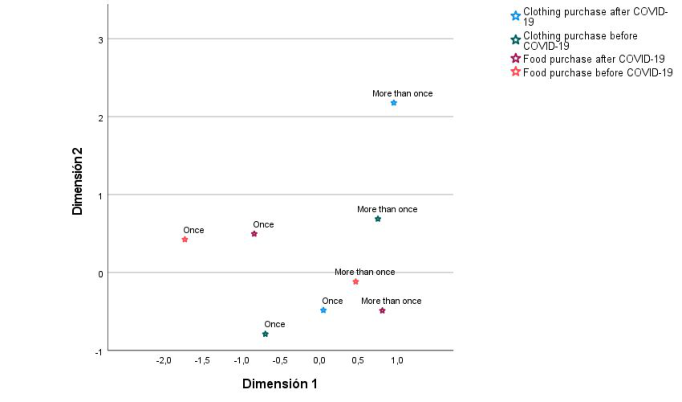
ECONOMIC SITUATION Looking at the breakdown of the correspondence of the variables and their categories (Figure 1), it can be seen that the categories “more than once” and “once” in the case of clothing, whether buying or selling, are close to each other. However, the category “once”in the purchase and sale of food is distant from the other categories, possibly indicating distance in the interpretative sense of the importance of the categories.
INCOME CONDITIONS When dealing with income conditions, it can be observed in Table 1 that the variables related to the type of income of the head of the household before and after COVID-19 are highly correlated. Likewise, the amount of income before and after COVID-19 and income recipients before and after the pandemic were also correlated but less significantly. In addition, looking at the discriminant measures for dimensions 1 and 2, the type of income of the household head before and after the pandemic explains these factors in
The Impact of COVID-19 on Students: A Multicorrespondence Analysis 347
Figure 1: Chart set of category points for economic situation.Table 1. Transformed variables of correlations.
TIAC is the type of income head of the household before COVID-19. TIBC is the type of income head of household after COVID-19. ABC is the amount of household members’ income before COVID-19. AAC is the amount of household members’ income after COVID-19. RBC is the recipient’s household income before COVID-19. RAC is the recipients’ household income after COVID-19.
an important way. However, the category of income recipients is no longer meaningful for the explanation of this second dimension.
EMPLOYMENT CONDITIONS To conclude the correspondence analysis, we focused on the results at the employment level. As can be seen in the correlation table (Table 2), for dimen- sion 1, the variables that are most closely linked are the type of employment of the head of household and the student before and after COVID-19. This implies that the pandemic perpetuated the condition of vulnerability among those who had no work or whose work was precarious (i.e., hourly). In con- trast, for dimension 2, the type of employment of students before and after the pandemic lost importance, marking low correlation indices. Although the type of income of the head of the household before and after the pandemic
TEBC is the type of employment of the household head before COVID-19. TEAC is the type of employment of the household head after COVID-19. SEBC is the type of student employment before COVID-19. SEAC is the type of student employment after COVID-19. AIBC is the amount of household members’ income before COVID-19. AIAC is the amount of household members’ income after COVID-19.
is important, it is only minimally so. For this dimension, no other variable appears to have notable importance.
CONCLUSION
First, the pandemic outbreak negatively affected the income received by stu- dents and their family members. In fact, before the eruption of COVID-19, over 90% of the respondents (and their families) received at least a minimum wage per month. Before the pandemic, less than 68% of respondents received more than a minimum wage per month.
Second, labor stability changed drastically for some students and family workers. Thirty-three respondents reported that the situation they had been in before COVID-19 had deteriorated because they had stopped receiving a fixed salary and started receiving a variable salary.
REFERENCES
Chaturvedi, K. and Vishwakarma, D. K. (2021) ‘COVID-19 and its impact on education, social life and mental health of students: A survey’, Children and Youth Services Review, 121. Del Boca, D., Oggero, N., Profeta, P. and Rossi, M. (2020) ‘Women’s and men’s work,
housework and childcare, before and during COVID-19’, Review of Economics of the Household, 18(4), 1001–1017. Kuhfeld, M., Soland, J., Tarasawa, B., Johnson, A., Ruzek, E. and Liu, J. (2020) ‘Projecting the potential impacts of COVID-19 school closures on academic achievement’, Educational Researcher, 49(8), 549–565. Wiswall, M. and Zafar, B. (in press) ‘Human capital investments and expectations
about career and family’, Journal of Public Economics. Zhu, Y., Zhang, L., Zhou, X., Li, C. and Yang, D. (2021) ‘The impact of social distancing during COVID-19: A conditional process model of negative emoti- ons, alienation, affective disorders, and post-traumatic stress disorder’, Journal of Affective Disorders, 281, 131–137.
LISTED IN THE AHFE DIGITAL BOOKSTORE CATALOGUE
Explore the complete digital volume
Human Factors, Business Management and Society
Read this individual research paper free through the original publisher, or explore the full digital proceedings book.
ISBN 978-1-958651-32-2
Explore this ISBN in the AHFE Bookstore ↗Listed in the July 2026 bookstore catalogue; search by ISBN to confirm current availability · Digital book purchase optional