Jorge Cruz-Cárdenas, Nora Oleas, Carlos Ramos, Sonia Cueva-Ortiz, Jorge Guadalupe-Lanas (2022). Bibliometric analysis of the existing literature on Covid-19 and its impact on higher education. In: Training, Education, and Learning Sciences. AHFE Open Access, vol. 59, pp. 15–21. https://doi.org/10.54941/ahfe1002379
Covid-19 has been among the most disruptive events in recent decades. At the time of writing, it has caused more than 5 million deaths worldwide and considerable economic losses. However, it has also sped up the process of technological development and technology adoption. One sector that has been deeply affected by the impact of the pandemic is higher education, which mainly includes universities. The higher education sector is a key sector in all types of societies. This strategic role lies in its mission to create and transmit knowledge. Given the universal importance of the higher education sector and the high impact that the Covid-19 pandemic has had on it, this study seeks to focus on this area by identifying the characteristics of the literature generated on this topic through the use of bibliometric techniques in the Scopus database. The searches were carried out in November 2021. The search terms were: Covid-19 AND ({higher education} OR (universities)). In order to delimit the scope of analysis, the areas of social science, human science, psychology, business management, and economics were selected. Only documents in English were included. As a result, 1,856 documents were obtained.
COVID-19 has been one of the most disruptive global events in recent deca- des (Cruz-Cárdenas et al., 2021). It emerged at the end of 2019, and in the following months, it reached a global dimension, becoming a pandemic. As of January 2022, COVID-19 has caused more than 5 million deaths worldw- ide (World Health Organization [WHO], 2022) and considerable economic losses.
One of the sectors that the COVID-19 crisis affected strongly is higher education (Je˛drzejczyk and Brzezi´nski, 2021). Universities are strategic insti- tutions in most societies, as they play a vital role in the generation and transmission of knowledge. Furthermore, universities allow for individuals’ progress. As the COVID-19 pandemic began, universities went into emerge- ncy mode, rapidly changing their teaching approaches (Johnson et al., 2020) and adopting digital technologies (Skulmowski and Rey, 2020). However, these changes were not easy because universities have been characterized by strong and sometimes-inflexible organizational cultures (Pucciarelli and Kaplan, 2016).
(Johnson et al., 2020). For this reason, the present study seeks to contribute by presenting a general panorama of the state of said research using bibli- ometric techniques. This contribution is viewed as valuable to guide future research as the aforementioned field of study becomes more dynamic. Thus, the following research question guides the present study:
What bibliometric characteristics does the set of documents published on COVID-19 and its impact on higher education present?
THEORETICAL FRAMEWORK Several years before the pandemic, a series of disruptive technologies began to interact and push for digital transformation within organizations (Guo et al., 2019). The higher education sector also began to feel this pressure, alth- ough without great urgency to react (Pucciarelli and Kaplan, 2016). However, after COVID-19 escalated into a pandemic, one of the first measures that governments adopted was population lockdowns. Under these circumstances, universities had to change their teaching systems quickly and adopt distance education under the online modality as the dominant form of education deli- very (Johnson et al., 2020; Skulmowski & Rey, 2020). Many teachers with no online education experience had to improvise on the fly (Johnson et al., 2020). In turn, many students without experience in online learning also had to adapt.
Both the threat of COVID-19 and this rapid adaptation to education systems based on digital technologies are making a great impact on university students and professors. In addition to the same fear of contagion (Cruz- Cárdenas et al., 2021), members of the university community have had to face other concerns and fears. For example, university students were concerned about the new study environment (online) and their future careers (Aristo- vnik et al., 2020). Due to the COVID-19 pandemic, students experienced graduation delays and loss of jobs or internship opportunities (Aucejo et al., 2020). Furthermore, both students and teachers reported anxiety, stress, and depression at levels higher than those observed before the pandemic (Li et al., 2020; Rodríguez-Hidalgo et al., 2020). The transition from an in-person education system to an online one has affected careers and programs differently. Although these technologi- cal advances allowed for delivery of higher education to continue, students and professors in careers such as those related to medicine and health sciences reported problems in teaching-learning, including the loss of teacher- student closeness, contact with patients, and a lack of access to laboratories, equipment, and records (Wilcha, 2020).
In this way, it can be concluded that although COVID-19 accelerated uni- versities’ digital transformation, this rapidity of change also generated impor- tant problems with students and teachers’ mental health and well-being, and in some careers, lower learning levels.
METHODOLOGY
The present study, which took a bibliometric approach, followed the process commonly recommended for studies that seek to generate a description
Bibliometric Analysis of the Existing Literature on COVID-19 17
and/or synthesis of a specific body of literature. This process can be sum- marized in four steps (Osobajo and Moore, 2017): 1) formulation of the objectives or research questions; 2) selection of studies’ inclusion/exclusion criteria; 3) design of search strategies; and 4) presentation of results. In the Introduction section, the present study’s research question was raised; there- fore, in this section, we continue with Steps 2 and 3 of the process, and Step 4 is presented in the next section, “Analysis and Results.” Two criteria were used to decide whether a document should be included: that it is relevant to answer the research question and that it has an acce- ptable quality level. These criteria served as a guide for the search strategies. The Scopus database was selected for the search because its journal-indexing process includes analysis of the quality and impact of content. The search was conducted on January 3, 2022. The search terms used were “COVID- 19 AND ({higher education} OR universities)” applied to titles, abstracts, and keywords. In this way, it sought to include only relevant documents. Furthermore, to conduct a more consistent analysis, the search was limited to documents in English and to the areas of social sciences, human scie- nce, psychology, business management, and economics. Ultimately, 1,856 documents were obtained.
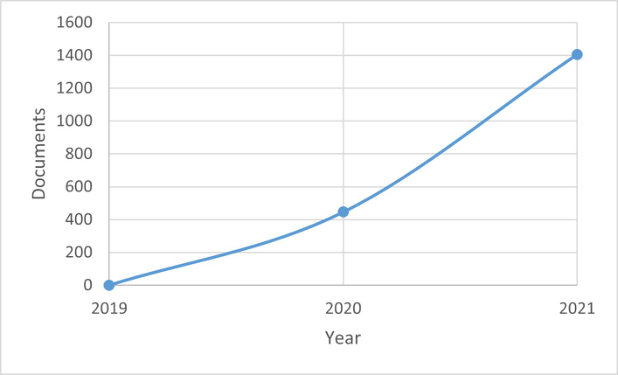
ANALYSIS AND RESULTS One approach to the body of documents obtained was made through the evolution of the documents published over time. Thus, with the emergence of COVID-19 at the end of 2019, it is understandable that no published docu- ments exist from that year. What can be observed in the following years is an accelerated growth in the number of documents on this topic, reaching 446 in 2020 and 1,406 in 2021. This publication trend reflects the great interest that the issue of COVID-19’s impact on higher education is attracting (John- son et al., 2020). Furthermore, it is necessary to indicate that due to the date of the conducted search, 2022 only has a few associated documents this early in the year.
Regarding the type of documents published, the vast majority, 1,606 (86.5%), corresponded to articles, followed by conference papers, with 100 documents (5.4%). Other types of documents – such as reviews, notes, book chapters, and letters – were less common.
Table 1 presents the main publication sources for journals that published more than 20 relevant documents. As can be seen, two journals, Sustaina- bility, with 140 documents, and Frontiers in Psychology, with 86, stood out from the others. In both cases, they are open access publications. It is also interesting that a specific journal on education, Education Scie- nces, did not rank until third place, with 41 documents. These data reflect the multidisciplinary approach from research on COVID-19 and higher education.
Table 2 presents the countries related to the authors’ institutions of affili- ation. Data are presented only for countries with more than 100 associated documents. As can be seen, the group was led by the U.S., with 412 associated documents. Most of the countries that figured into this leadership position
Figure 1: Evolution of the number of published documents (Source: Scopus).Table 1. Main publication journals (Source: Scopus).
Table available in the original PDF paper.
Source Title Documents Sustainability 140 Frontiers in Psychology 86 Education Sciences 41 BMC Medical Education 34 Education and Information Technologies 28 GMS Journal for Medical Education 27 Frontiers in Education 22 Library Philosophy and Practice 21
Table 2. Countries and associated documents (Source:Scopus)
Table available in the original PDF paper.
Country/Territory Documents United States 412 United Kingdom 133 Australia 128 China 128 Spain 114
are developed countries (e.g., United Kingdom, Australia, and Spain). An important exception on this list is China. It is an emerging country, and its location is due both to being COVID-19’s place of origin and to its growing role in the scientific world (Cruz-Cárdenas et al., 2021). It should be noted that because the existence of several authors is frequent, the same document could be associated with several countries.
As for the main funding agencies and institutions, four stood out (each with more than 10 funded studies): National Institutes of Health (United States);
Bibliometric Analysis of the Existing Literature on COVID-19 19
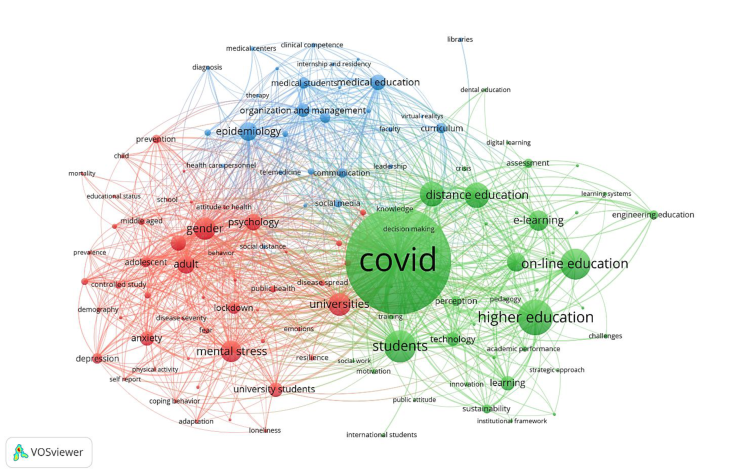
Figure 2: Co-occurrence network of documents based on keywords.
National Natural Science Foundation of China; National Science Foundation (United States); and Foundation for Science and Technology (Portugal). Once again, these institutions all come from developed or emerging countries, with none from developing countries.
This was followed by a co-occurrence study based on the keywords in the documents. This type of analysis provides a good approach to the thematic areas of interest in the documents analyzed (Cruz-Cárdenas et al., 2021). For this analysis, VOSviewer 1.6.15 software (Van Eck & Waltman, 2010) was used. It was established that a word or term should appear in at least 10 documents to be considered for inclusion in the sample. Furthermore, the list of items obtained was refined, eliminating words with a very general meaning (e.g., “human,” “article”) and also grouping words with similar meanings (e.g., “COVID,” “COVID-19,” “coronavirus”). Finally, 119 items (words or phrases) were obtained and, as a result of the cluster analysis, three thematic areas of interest in the research were generated. These subject areas are described below and shown in Figure 2.
Cluster 1 (red): This cluster grouped 48 items and comprised words or phrases such as “university students,” “universities,” “mental stress,” “anxiety,” “depression,” “prevention,” “adaptation,” “loneliness,” and “resi- lience.” These items’ meanings allow us to conclude that this cluster refers to COVID-19 and the new (mainly online) education systems’ impact on members of the university community.
Cluster 2 (green): Altogether, 42 items were associated with this cluster. Words or terms that formed this cluster included “COVID,” “online edu- cation,” “distance education,” “teaching,” “technology,” “assessment,” and “e-learning,” among others. This content indicates that this thematic area is
related to the use of technologies and other technical aspects associated with the online education system – a system implemented to function during the pandemic.
Cluster 3 (blue): Altogether, 29 items ultimately were associated with this cluster. Some words or terms that were part of this cluster include “medi- cal students,” “epidemiology,” “medical education,” “university hospitals,” “telemedicine,” and “curriculum,” among others. These words or phrases made it possible to associate this cluster with education in the health sciences area during the pandemic.
DISCUSSION AND CONCLUSION The COVID-19 pandemic has made a significant impact on all societal realms, including higher education, a particularly important sector. There- fore, COVID-19’s impact on higher education is attracting great research interest (Johnson et al., 2020), which the present study’s data have veri- fied. Other descriptive conclusions from the present study point to a leading role for articles in a publication format and journals from various areas of knowledge as means of publication. Furthermore, a great influence from developed or emerging countries associated with the authors can be seen, a trend observed in other bibliometric studies and literature reviews related to COVID-19’s impact (e.g., Cruz-Cárdenas et al., 2021). Therefore, more research is recommended in developing societies to improve understanding of how the pandemic is influencing their higher education.
The co-occurrence analysis allows for determining three thematic areas of research on COVID-19 and higher education: 1) the impact from COVID-19 and the new education systems (mainly online) on members of the university community; 2) use of technologies and other technical aspects in distance and online education; and 3) COVID-19’s impact on education in the area of medicine and health sciences. These findings will help guide future research projects toward possible topics to be studied.
Although the present study established that a large amount of research exists on COVID-19 and higher education, much of it has focused on the qua- rantine and lockdown stages. However, COVID-19 is an event that remains in progress. Mass vaccination of the population is marking a new stage in the evolution of the pandemic’s effects (Cruz-Cárdenas et al., 2021). Therefore, future research on COVID-19 and higher education should address how uni- versities and their communities face this new stage and those to come. For example, in these new stages, it could be expected that hybrid or multimo- dal education systems will gain influence (Skulmowski and Rey, 2020), i.e., combinations of in-person and online education.
REFERENCES
Aristovnik, A., Keržiˇc, D., Ravšelj, D., Tomaževiˇc, N., and Umek, L. (2020), “Impacts of the COVID-19 pandemic on life of higher education students: A global perspective.” Sustainability, 12(20), 8438.
Bibliometric Analysis of the Existing Literature on COVID-19 21
Aucejo, E. M., French, J., Ugalde Araya, M. P., and Zafar, B. (2020), “The impact of COVID-19 on student experiences and expectations: Evidence from a survey.” Journal of Public Economics, 191, 104271. Cruz-Cárdenas, J., Zabelina, E., Guadalupe-Lanas, J., Palacio-Fierro, A., and Ramos-
Galarza, C. (2021), “COVID-19, consumer behavior, technology, and society: A literature review and bibliometric analysis.” Technological Forecasting and Social Change, 173, 121179. Guo, J., Pan, J., Guo, J, Gu, F., and Kuusisto, J. (2019), “Measurement framework for assessing disruptive innovations.” Technological Forecasting and Social Change, 139, 250–265. Je˛drzejczyk, W., and Brzezi´nski, S. (2021), “The importance of social media in mana-
ging the image of the educational institutions.” Contemporary Economics, 15(4), 457–466. Johnson, N., Veletsianos, G., and Seaman, J. (2020), “U.S. faculty and administrators’ experiences and approaches in the early weeks of the COVID-19 pandemic.” Online Learning, 24(2), 6–21. Li, Q., Miao, Y., Zeng, X., Tarimo, C. S., Wu, C., and Wu, J. (2020), “Prevalence
and factors for anxiety during the coronavirus disease 2019 (COVID-19) epidemic among the teachers in China.” Journal of Affective Disorders, 277, 153–158. Osobajo, O. A., and Moore, D. (2017), “Methodological choices in relationship quality (RQ) research 1987 to 2015: A systematic literature review.” Journal of Relationship Marketing, 16(1), 40–81. Pucciarelli, F., and Kaplan, A. (2016), “Competition and strategy in higher education:
Managing complexity and uncertainty.” Business Horizons, 59(3), 311–320. Rodríguez-Hidalgo, A. J., Pantaleón, Y, Dios, I., and Falla, D. (2020), “Fear of COVID-19, stress, and anxiety in university undergraduate students: A predictive model for depression.” Frontiers in Psychology, 11, 591797. Skulmowski, A., and Rey, G. D. (2020), “COVID-19 as an accelerator for digitali-
zation at a German university: Establishing hybrid campuses in times of crisis.” Human Behavior and Emerging Technologies, 2(3), 212–216. Van Eck, N. J., and Waltman, L. (2010), “Software survey: VOSviewer, a computer program for bibliometric mapping.” Scientometrics, 84(2), 523–538. Wilcha, R-J. (2020), “Effectiveness of virtual medical teaching during the COVID-19
crisis: Systematic review.” JMIR Medical Education, 6(2), e20963. World Health Organization (WHO) (2022), “WHO coronavirus (COVID-19) dashboard.” Available at: https://COVID19.who.int
LISTED IN THE AHFE DIGITAL BOOKSTORE CATALOGUE
Explore the complete digital volume
Training, Education, and Learning Sciences
Read this individual research paper free through the original publisher, or explore the full digital proceedings book.
ISBN 978-1-958651-35-3
Explore this ISBN in the AHFE Bookstore ↗Listed in the July 2026 bookstore catalogue; search by ISBN to confirm current availability · Digital book purchase optional