Gabriela G. Reyes-Zárate, Jan Pablo Castillo Sánchez, Pablo Iván Solares Romero, Ricardo González Cerón, Narvick Nieto Gutiérrez (2022). Arduino-based system to identify sedentary behavior working in home office. In: Human Interaction & Emerging Technologies (IHIET-AI 2022): Artificial Intelligence & Future Applications. AHFE Open Access, vol. 23. https://doi.org/10.54941/ahfe100885
COVID-19 created the need for students to take classes from home. This situation led to a decrease in students’ dynamic activities and therefore by staying in the same posture for long periods of time, students can develop physical fatigue. According to ergonomic studies, short breaks during activities can benefit people’s health. The aim of this study is to investigate the impact of implementing a break during a test within two student groups. For this study, a control group worked on a ninety-minute test without breaks. A second group included a five-minute break in between the test. To track the time a student remained sat, an Arduino-based device was used in the test group to notify the student when a break was needed. The study sample consisted of forty-two students working from home on an exam in May 2021 from which half the group was the control sample. During the break, students were allowed to perform physical exercises and stretching. After the test, students answered a qualitative questionnaire about their physical and emotional condition after the test. The results showed better physical and mental for students with a break during exams. Based on this information, the tracking device, and a defined set of breaks during several hours at a desk showed a benefit in people’s well-being. Further studies can continue to investigate appropriate resting times to improve working performance and health.
The COVID-19 pandemic and the quarantine limited students’ regular activities such as classes, laboratories, sports, and cultural activities. Classes from home also created a sedentary routine in which they can spend several hours in the computer. The situation of being at home working with the computer as students could affect their health of them (Azizi et al, 2020). In our study, the time spent in front of the computer was not just taking classes but doing homework and work all day. In a study in a university, 1224 students answered a survey and in one question, 16.35% described rapid fatigue due to prolonged work in front of a computer (Bakhov et al.,2021). In order to maintain a better response to the well-being of students, taking short breaks during the day can give positive responses to the person. Workers who are in front of a computer can have greater benefits if they have breaks in their workday (Hunter and Wu, 2013). They also found preliminary evidence of taking breaks and having several of these as they are important to recover, choosing activities during this time.
In fact, a study that reviewed the breaks during work, described that those are vital to recovery (Trougakos and Hidden, 2009). The results of the study that included software development employees, describe that micropause gives a feeling of energy. Activities during the break related to creating meaning are associated with feelings of energy and decreased fatigue. Thus, this review presents the general features of recovering in order to improve the well-being that a student needs to work at home with a computer
METHODOLOGY
In order to investigate the risk of prolonged seating, a study was carried out to implement short breaks during school activities. An exam was conducted in a group for which half of the students were allowed to have a rest in between the exam. The study group of 21 students was randomly selected from a total of forty-two who applied for the exam from their homes on the university’s platform. The exam was conducted in the last third of the semester which has the highest workload due to exam preparation and semester project delivery. For this ninety-minute exam, a five-minute break was defined to stretch and move the neck, arms, legs, and back, like a program that has health benefits to the workers in Indesol (Campos-Beltrán, 2012). During these five minutes, students were recommended to make some of these movements. To validate the study group resting time, students were instructed to keep their cameras on. Additionally, one student of the study group was given an Arduino-based device to monitor and report his behavior. The students from the control group were instructed to always remain seated until the end of the exam.
The exam results were extracted from the University platform and a questionnaire was designed to know the students’ physical and concentration conditions after the exam. Mental concentration is a process that consists of focusing the mind's attention on an objective (Rodríguez, 2015). In this study, mental concentration was to answer the exam. All data was compiled in an Excel sheet and analyzed with descriptive statistics.
Description of Device Functionality The Arduino-based circuit, was coupled to a desk chair, which recorded the hours that the student was in his seat. This device also notifies the user when a recommended continuous working time is exceeded. The main functions of the device are the following:
Monitor operator’s desk working hours.
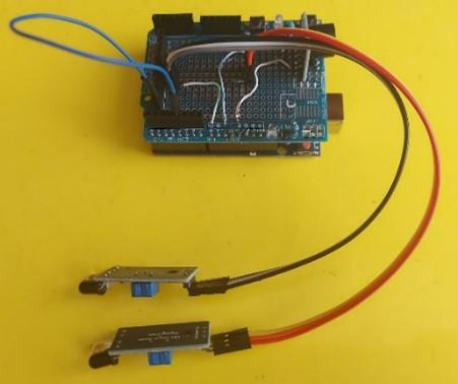
Execute a visual and auditory alert to pause the user’s work. The device includes two infrared sensor modules IR FC-51 for monitoring the operator’s activity. When the sensors detect a seated person, the device starts recording the time when the operator began his seated activity after a seven-second period. This delay in time-tracking was established to increase the robustness of the circuit. Also, the programming was designed with a feedback loop using both sensors (DIY Electronics, 2020), which forces the system to only record sitting time once both sensors are activated (Fig. 1).
Figure 1. Preliminary electronic prototype. A Protoshield with welded electronic components is attached to the Arduino Uno.
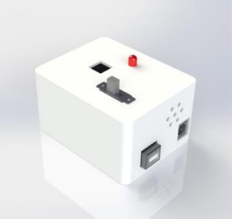
A programmed counter was implemented to keep track of the sitting time and based on the length, the worker either remains seated beyond the recommended time or the worker stands up before the time limit. In the first case, the program can display an alert to the person consisting of an intermittent light of a LED and an electroacoustic transducer (buzzer). This routine ends after the user stands up and the seven-second period ends. In the second case, the device's counting operation is set to zero and the counting starts over again. This prototype also included a switch to start or stop the tracking and was powered through the computer’s USB port. The design of a casing for the device consisted of a three-dimensional model considering the electronic component’s longitudinal dimensions so that it could be properly 3D printed. Furthermore, its design allows a compact arrangement of all components. For this design, SolidWorks software was used (Fig. 2).
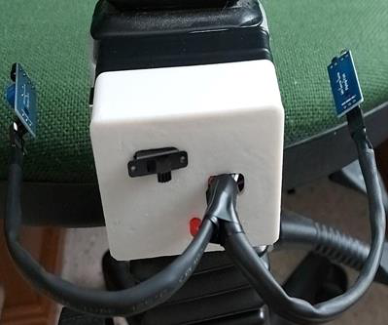
Figure 2. Integral assembly of the prototype in SolidWorks. (Isometric views). As seen in the previous images, the case consists of a two-part casing that encloses all the electronic components. In addition, the case has holes for the buzzer, the infrared sensor’s wiring, and the USB-B terminal of the Arduino UNO. To carry out the control actions an Arduino UNO was used through its integrated development environment (IDE). To analyze the data a user-device interface was developed between the Arduino and the computer using the Excel Data Streamer Tool (Wang, 2020). The computer receives the data from the Arduino once the defined continuous working time has lapsed and displays it in an organized layout using dynamic tables and graphs, showing the worker’s sitting time. Also, any alert activated during the tracking time is displayed in the excel sheet. The program was made using time stamps which helped to reduce false detections and to be able to report sitting behavior through a working day. For this, the use of the “Time.h” and “TimeLib.h” libraries in the Arduino IDE were essential for the execution of this program (GitHub, 2021). Having defined the device’s assembly of all the components and program, the final prototype was implemented. (Fig. 3.).
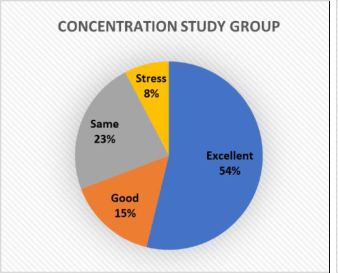
Figure 3. Final prototype, mechanical and electronic integration. Results The grades were analyzed after the test, results were compared between the two groups as shown in the graph below (Fig. 4). The maximum grade in the exam was 100. The mean of grades of the study group was 93.21 with a standard deviation of 7.99, and of the control group, it was 82.11 with a deviation of 12.89. No unusual data points were found. The distribution was also reduced in the study group meaning that most of the results landed close to 100.Figure 4. Comparison of the data and means of the samples In the questionnaire about the concentration level or mental focus at the end of the exam, the study group showed 69% of the students’ responses as “excellent” and “good”. The control group only showed 45% responses as “good” and none as “excellent”. On the opposite, the study group marked an 8% for stress and an 11% for the control group (Fig 5).
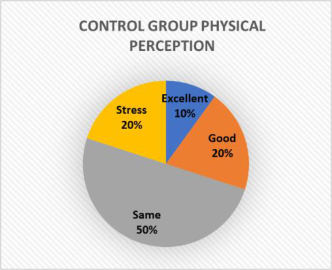
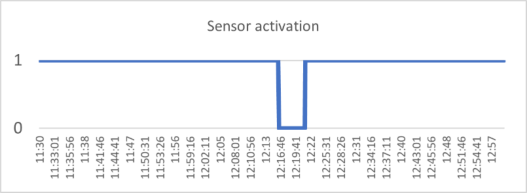
Figure 5. Mental concentration for the study and the control group For the physical perception, which was focused on bodily wellbeing, students answered 77% “excellent” and “good” responses for the study group while the control group had only 30%. This result is aligned to the effect of a break during the exam and the implementation of stretching and moving the body. Physical stress responses were similar between the two groups (Fig. 6).Figure 6. Physical perception of the students at the end of the exam for the study and control group. The pair of sensors detected the student who was sitting, and the device began to record the time when he began their activity. The following image shows a graph that summarizes the monitoring of the time. The Arduino device worked and showed the resting time of the student (Fig. 7).
Figure 7. Monitoring the time sitting and with a break during the exam for a student.
CONCLUSIONS
This study showed the effect on students to present an exam in which a break is implemented in order to improve concentration and reduce fatigue at the end of the exam. Results showed also better exam performance results for the study group. The Arduino device was useful to precisely track the sedentary behavior of a student or worker. It can be recommended to implement in schools and offices to promote that people have breaks and are in movement during working hours. As mentioned, this can help with people’s health and wellbeing. Future work will try to assess including the break in an exam with a larger sample of students.
ACKNOWLEDGMENTS
The authors would like to acknowledge the financial support of Writing Lab, Institute for the Future of Education, Tecnologico de Monterrey, Mexico, in the production of this work.
REFERENCES
Azizi, A., Achak, D., Aboudi, K., Saad, E., Nejjari, C., Nouira, Y., Hilali, A., Youlyouz-Marfak, I., & Marfak, A. (2020). Health-related quality of life and behavior-related lifestyle changes due to the COVID-19 home confinement: Dataset from a Moroccan sample. Data in brief, 32, 106239. Available at: https://doi.org/10.1016/j.dib.2020.106239 (Accessed: 24 January 2022)
Bakhov, I., Opolska N., Bogus M., Anishchenko V., & Biryukova Y. (2021) ‘Emergency Distance Education in the Conditions of COVID-19 Pandemic: Experience of Ukrainian Universities. Educ. Sci. 11(7), Available at: https://doi.org/10.3390/educsci11070364 (Accessed: 24 January 2022) Beltrán, M., Heredia, S. (2012) “Pausas para la Salud Manejo adecuado del estrés y
programa personal de autocuidado para las y los trabajadores del Indesol,” pp.18-28. Available at: https://www.gob.mx/cms/uploads/attachment/file/160956/13._cuaderno_pausa s_para_la_salud.pdf (Accessed: 24 January 2022) Hunter, E. M., Wu, C. (2016). Give Me a Better Break: Choosing Workday Break Activities to Maximize Resource Recovery, Journal of Applied Psychology, 101(2), pp. 302-311. Available at: http://dx.doi.org/10.1037/apl0000045 (Accessed: 24 January 2022) Rodríguez, J. (2015) “Cómo mejorar la memoria y la concentración”. Ed. Imagen. Trougakos, J. P., & Hideg, I. (2009). Momentary work recovery: The role of within-
https://www.youtube.com/watch?v=YAXhTOAn1bE (Accessed 25 January 2022). GitHub (2021) “Arduino Time Library,” Available at: https://github.com/PaulStoffregen/Time (Accessed 25 January 2022).
Read this individual research paper free through the original publisher, or explore the full digital proceedings book.
ISBN 978-1-7923-8989-4
Explore this ISBN in the AHFE Bookstore ↗Listed in the July 2026 bookstore catalogue; search by ISBN to confirm current availability · Digital book purchase optional