Hector Rafael Morano Okuno, Guillermo Sandoval, Rafael Caltenco Castillo, Donovan Esqueda Merino, Jose De Jesus Solis Cordova, Andres Andres Garcia Garcia (2023). Simplified CAD model of a person for the simulation of their movements. In: Human Factors in Aging and Special Needs. AHFE Open Access, vol. 88, pp. 68–75. https://doi.org/10.54941/ahfe1003663
Currently, several computer programs evaluate the ergonomics of products or measure the physical effort a person must make in a particular task, either at her job, at home, or as a mechanical or electronic machine user. However, these computer programs are expensive and sometimes need to be installed with another program to run within them and share resources such as solid modeling, mass calculation, drawing generation, and finite element analysis.This article aims to define a simplified person model that can be used in different computer programs pointed at the academic community and available with student licenses. These models will simulate the mechanisms of the devices older adults and people with special needs use for their training or recovery, making it possible to calculate the kinematics involved in using these appliances.This work also shows the type of kinematic constraints that must be defined so that the simplified model of a person can move. Each set of kinematic constraints will simulate a specific movement; the more constraints used, the better the representation of the natural movement of a person. Subsequently, with the simplified person model, devices aimed at older adults and people with special needs can be designed and evaluated and used in various computer programs with licenses for students.The methodology consists of initially defining a first simplified model of a person, as essential as possible, to define the kinematic restrictions to simulate their movements. Subsequently, a case study is used to evaluate the movements transmitted from an elliptical machine toward the person. Finally, a kinematic inversion is carried out to analyze the movements transmitted from the person to the elliptical machine.At the beginning of this work, a review of the leading computer programs that evaluate a person's ergonomics is made. Then the procedure used to define the simplified person model with its kinematic constraints is shown. Subsequently, through the case study, movements transmitted from the person to the case study and from the case study to the person are evaluated. At the end, the results are presented, as well as future work and conclusions.
In recent decades, the population of older adults has increased; therefore, the need to create adequate spaces outdoors (Wen et al., 2022) and speciali- zed hospitals (Ries, 2022) for this group of people has also been increasing. Recent research has identified that people with cognitive impairment require
Simplified CAD Model of a Person for the Simulation of Their Movements 69
more assistance (Doroszkiewicz, 2022). On the other hand, it has been found that using equipment to perform physical and mental activity helps rehabi- litate elderly and special needs people (Xu and Luh, 2022). Knowing the factors that influence musculoskeletal disorders among workers allows us to prevent possible damage to the human body. Musculoskeletal disorders have been detected in electronics manufacturing workers (Yang et al. 2023), which have an impact on neck and shoulder problems, due to uncomfor- table postures, repetitive tasks, or lifting heavy objects. Undoubtedly, the use of devices that exercise the different parts of the human body help in the treatment of pain (Otto and Wollesen, 2022) or strengthen the muscles, helping the rehabilitation of patients. One of the most common problems among the elderly is balance and mobility (Ismatullaev et al., 2022). For the design of these exercise and rehabilitation devices, ergonomic factors that justify their geometries and dimensions must be considered. Simulations of user movement are used to test the designs. These simulations have been studied from different points of view. One of them is through control the- ories, using an unknown cost function, which depends on the type of tasks and their sequences (Ishida et al. 2021); these methods are studied for the movement of robots oriented to functions of the pick and place type. Other control theories are focused on the simulation of walking robots and their equilibrium states (Jatsun et al. 2021); these consider the center of mass and the main joints of said robots. There are computational models based on Joint Avatars (Hapuarachchi et al. 2023) that simulate the movements of different parts of the human body, linking the effect produced by the union of one member with another; the above refers to the fact that the move- ment of one member is transmitted to another. Other simulation systems are based on the collection of joint movement data (Ambika and Radhika, 2022); this information can be obtained using sensors. The data is stored and analyzed and can later be reproduced to generate the simulations to design rehabilitation devices for specific joints such as knee problems (Jacome et al. 2022). When speaking of physical products or workstation design, two rele- vant human factors to look at are ergonomics and anthropometrics (Bridger, R.S. et al. 2018), the former focusing on the physical comfort of the person and the latter on the adaptation of the system to the user’s body dimensi- ons. Both become even more relevant with the understanding that a bad design can bring musculoskeletal injuries mid or long-term (Clark et al., 2018). In contrast, a good design can improve safety and comfort (Zagloel et al., 2015). A study by Dias et al. (2015) has shown that students often overlook ergonomics and anthropometrics since they consider that aesthe- tics and functionality are more relevant than minding about ergonomics and anthropometry.
In this research work, a Simplified CAD model of a person in 2D is propo- sed, which will be kinematically restricted to simulate a person’s movements. This CAD model or mannequin can be used in software tool applications aimed at the academic community to design rehabilitation equipment for older adults and people with special needs.
COMPUTER PROGRAMS THAT EVALUATE A PERSON’S ERGONOMICS Some software tool applications evaluate workers’ workstations to advise companies on improving physical working conditions and reducing possi- ble effects on their workers. These software tool applications collect data from employees about working conditions, type of activities, distances trave- led, loads, noise and light levels, and the number of cycles they perform. Afterward, they deliver recommendations to better serve these activities and reduce possible physical effects on users. As examples of these sof- tware tool applications, ErgoSuite and VelocityEHS are mentioned. Other software tool applications require 3D modeling of the workstations and the objects or tools used. There is the possibility of inserting a mannequin with a specific worker’s anthropometric characteristics and the objects’ materi- als and weight to be handled. Subsequently, the work cycles are defined. Finally, the software tool application performs an ergonomics analysis and delivers results regarding the evaluation of the workstations, as well as the possible affectations that the worker could present after a certain number of cycles; some of these could be wear on the joints or incorrect postures. These software tool applications require specialized users, are more expen- sive, and require more robust computing equipment. Examples include Jack (Esqueda et al. 2020) software tool application from Siemens PLM and CATIA (Mohammed et al. 2020) with its Ergonomics Design & Analysis modules from Dassault Systemes. Many educational institutions use CAD software tools to sensitize students in ergonomics and anthropometrics. For example, (Baier et al. 2015) used NX to identify the optimal driver height and weight for their race car, while (Gunther and Quintero-Durán, 2015) used Tecnomatix Jack for posture analysis. Moreover, these tools might benefit from specialized cameras like Microsoft Kinect but have certain limitations related to the measurements and analysis that can be carried out, besides the availability of software licenses. Even though this customized software might cover a broader range of populations and dimension requirements than regular CAD add-ins, students might not get access to it once they are in their professional environment. Thus, it is essential to use software-agnostic custo- mized tools. As shown in (Esqueda et al. 2020), standardizing assessments and methodologies for the human factors improves the student’s learning journey, and similarly, standardizing tools and making the students under- stand the way to develop those tools might be more helpful for them in their future professional activities.
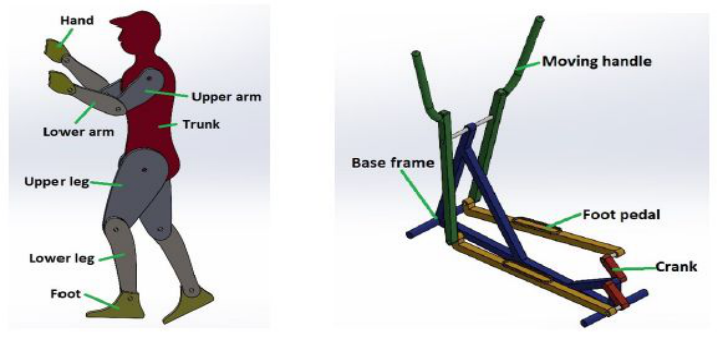
METHODOLOGY: SIMPLIFIED CAD MODEL OF A PERSON The methodology used consisted of defining a first model of a person, as simplified as possible; this means that the kinematic restrictions of their movements are also reduced and are easier to control (Morano et al., 2020). It was also decided to work in 2D and only included the essential parts of the human body, as shown in Figure 1. At this stage, it was established not to involve the movements of the head and neck; since they are not necessary for
Simplified CAD Model of a Person for the Simulation of Their Movements 71
Figure 1: Simplified CAD model of a person and the case study: Elliptical machine.
the use of the case study, an elliptical machine. The second step of the meth- odology was to define the kinematic constraints of the model or mannequin of the person. All the joints of the limbs are of the revolute type. Only the trunk will have a planar constraint. Subsequently, the kinematic constraints between the dummy and the case study will be defined to specify how both interact. The third step of the methodology consisted in defining the case study, which was an elliptical machine (see Figure 1) since it is a device that is used to exercise the quadriceps, hamstrings, glutes, and calves and is acti- vated by movement of legs and arms; this allows forces to be transmitted from the CAD model to the elliptical machine and vice versa.
It also permits us to define the kinematic constraints necessary to simulate the movements of the different parts of the CAD model. Another advantage of the case study is that the position of the trunk changes to the ground. It can move or have a slight rotation towards the front or back; this enables us to define a trajectory that the dummy should follow to use the elliptical trainer correctly. The case study was defined with the least number of components to simplify the modeling and to be able to identify its significant movements. It consists of a base frame, moving handles, foot pedals, and a crank. All the kinematic constraints of the elliptical machine are defined as revolute.
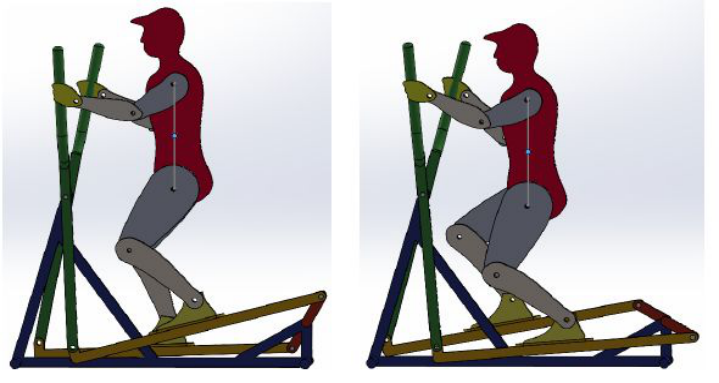
The methodology’s fourth step was assembling the dummy with the elli- ptical machine. The selected view was the side view in 2D; this will allow us to analyze the movements of the mannequin. Initially, the movement is gene- rated by the elliptical machine and transmitted to the dummy. The soles of the feet will be fixed to the foot pedals of the elliptical machine, as well as the hands to the moving handles. Only the trunk will have a planar constraint, and its center of gravity will coincide with a fixed point to the vertical midline of the trunk. In this way, the mannequin will always remain upright. These restrictions will be enough to simulate and visualize the dummy’s movement and evaluate the activities transmitted from an elliptical machine toward the person. Figure 2 shows different positions of the fixed point of the trunk
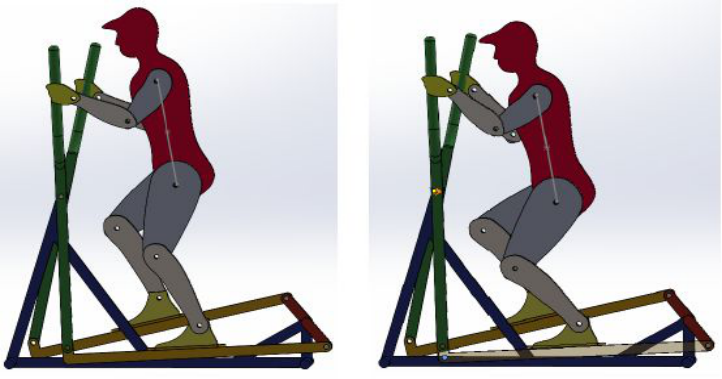
Figure 2: Different positions of the fixed point of the trunk to the base frame.Figure 3: Different positions of the trunk to the base frame.
to the base frame; this would help define the dimensions and geometries of future device designs to exercise or rehabilitate older adults and people with special needs. Finally, the methodology’s fifth step consisted of creating a kinematic inversion to analyze the movements transmitted from the person to the elliptical machine. The dummy’s kinematic constraints are preserved as revolute; what changes is the user’s position. The midline of the trunk now has to have a slight angle of inclination of ten degrees to the front so that the joints of the arms and legs do not lock or rotate in the opposite direction. Figure 3 shows different positions of the trunk to the base frame, giving the possibility of evaluating the movements transmitted to the elliptical machine.
The CAD model of the person and the elliptical machine was generated in computer files with STP extensions, which makes it possible to use them in
Simplified CAD Model of a Person for the Simulation of Their Movements 73
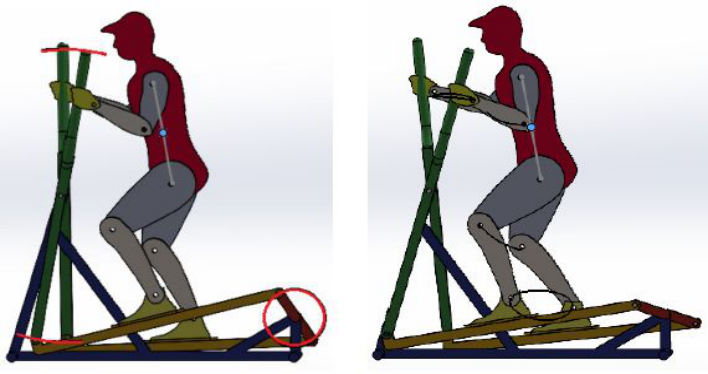
Figure 4: Some trajectories of the components of the elliptical machine and the dummy.
most software tool applications oriented to the academic community, to men- tion a few examples: Autodesk Inventor, Autodesk Fusion 360, Solidworks, CATIA, and NX. With the simulation of movements, it will be possible to obtain limited positions or trajectories of specific points, which will help design equipment to exercise and rehabilitate the elderly or people with spe- cial needs. Figure 4, in red, shows the trajectories of the extreme points of the foot pedals and the upper part of the moving handle, in black, the center of the joints of the ankles, knees, elbows, and wrists.
CONCLUSION AND FUTURE WORK Now that the CAD model of the person has been defined, each component can be scaled to use some anthropometric dimension.
The kinematic restrictions have been defined to simulate the movement transmitted by the person to the elliptical machine and vice versa.
The fixed point of the trunk could be released and allowed to generate a specific trajectory; in this way, more complex simulations would be created with the movement of the trunk.
The CAD model files have a STP extension, can be used in any CAD sof- tware tool application pointed at the academic community, and are available with student licenses.
This development can be used in the ergonomic analysis by taking the classical assessments (REBA, RULA, etc.). Likewise, anthropometric analy- sis can be carried out by adjusting the parameters associated with cer- tain dimensions, allowing students to design components for specific body dimensions.
The next step would be to define more joints in the human body, such as the neck and head. With the above, more realistic simulations could be generated.
Another activity would be to analyze how the forces are transmitted from the elliptical to the dummy and inversely from the dummy to the elliptical in order to move it.
Later the same study could be generated but in 3D. This would allow the trunk to have a lateral movement, transmitting it to other body parts to obtain more complex simulations.
ACKNOWLEDGMENT
The authors would like to acknowledge the financial support of Writing Lab, TecLabs, and Tecnologico de Monterrey, Mexico, in producing this work.
We would also like to thank Alejandra Ocáriz, Information Technology leader, and Samuel Miranda, Information Technology coordinator from the Tecnologico de Monterrey, campus Edo. de Mexico, for the support provided for the computer equipment assigned to develop this work.
REFERENCES
Ambika, K., Radhika, K. R. (2022) ‘Multi-Modality Driven Sparse Inertial Feature Representation for Gait-Based Scalable Person Authentication System’, Indian Journal of Computer Science and Engineering, Volume 13 No. 4, pp. 1308–1330. Baier, A., Baier, M., Dusik, D., Grabowski, Ł., Miera, A., Papaj, P., Sobek, M. (2014)
‘Computer-Aided Process of Designing the Mechatronic Silesian Greenpower Ele- ctric Car’. In Selected Engineering Problems, No. 4, Institute of Engineering Process Automation and Integrated Manufacturing Systems. https://doi.org/10. 4028/www.scientific.net/AMR.1036.674. Bridger, R. S. (2018) ‘Introduction to Human Factors and Ergonomics’, 4th Edition.
CRC Press, Boca Raton, FL, USA. Clark, P., Denova-Gutierrez, E., Razo, C., Rios-Blancas, M. J., Lozano, R. (2018) ‘The burden of musculoskeletal disorders in Mexico at national and state level, 1990–2016: estimates from the global burden of disease study 2016’. In Osteo- porosis International 29: 2745. Dias, A. C., Almendra, R., Moreira da Silva, F. (2015) ‘The application of ergono-
mic knowledge by undergraduate product design students: FAU Lisbon as a case study’. 6th International Conference on Applied Human Factors and Ergonomics, Procedia Manufacturing, Volume 3, pp. 5851–5858, https://doi.org/10.1016/j.pr omfg.2015.07.888. Doroszkiewicz, H. (2022) ‘How the Cognitive Status of Older People Affects Their Care Dependency Level and Needs: A Cross-Sectional Study’, International Journal of Environmental Research and Public Health, Volume 19 No. 16. Esqueda, D., Villagómez, L., Tónix, Y., & Velilla, A. (2020) ‘Inducing the Learning of
Ergonomics and Anthropometric Design using Motion Capture and Virtual Simu- lation in an Industrial Context’. Proceedings of the 12th International Conference on Computer Supported Education, pp. 74–83. Gunther, P., Quintero-Durán, M. (2015) ‘Ergonomic assessment of hospital bed moving using DHM Siemens Jack’. In Proceedings 19th Triennial Congress of the IEA, Melbourne. Hapuarachchi, H., Hagiwara, T., Ganesh, G., Kitazaki, M. (2023) ‘Effect of
connection induced upper body movements on embodiment towards a limb con- trolled by another during virtual co-embodiment’, PLoS One. Volume 18 No. 1. doi: 10.1371/journal.pone.0278022.
Simplified CAD Model of a Person for the Simulation of Their Movements 75
Ishida, S., Harada, T., Carreno-Medrano, P., Kulic, D., Venture, G. (2021) ‘Human Motion Imitation using Optimal Control with Time-Varying Weights’, In Confe- rence Proceedings IEEE/RSJ International Conference on Intelligent Robots and Systems, pp. 608–615. Ismatullaev, U., Saduakas, A., Kim, K. (2022) ‘Human Factors Considerations in
Design for the Elderly’, In: Jay Kalra (eds) Human Factors in Aging and Special Needs AHFE (2022) International Conference, Volume 38. pp. 23–33. http://doi. org/10.54941/ahfe1001660. Jacome, E. S., Ocaña, W. S., Jacome, D. S., Guzman, J. D. L. T., Bucheli, L. A. (2022) ‘Biomechanical Modeling of the Knee for Rehabilitation in Patients of Latacunga’s Patronato’, Journal International Review of Automatic Control, Volume 15 No. 3, pp. 155–163. DOI: https://doi.org/10.15866/ireaco.v15i3.22075. Jatsun, S., Yatsun, A., Fedorov, A., Saveleva, E. (2022) ‘Simulation of Static Walking
in an Exoskeleton’, In Conference Proceedings 16th International Conference on Electromechanics and Robotics, Smart Innovation, Systems and Technologies, Volume 232, pp. 49–60. Mohammed, A. R., Mohamed, M. O., Alhubaishy, Y. A. et al. (2020) ‘Ergonomic analysis of a working posture in steel industry in Egypt using digital human modeling’, SN Applied Sciences, Volume 2. https://doi.org/10.1007/s42452-020- 03872-y. Morano, H., Sandoval, G., Villagomez, L., & Esqueda, D. (2020) ‘Geometrical
Transformations to Teach Kinematics of Industrial Robots’. In Proceedings of the 9th International Conference on Educational and Information Technology, pp. 158–162. Otto, A.-K., Wollesen, B. (2022) ‘Multicomponent exercises to prevent and reduce back pain in elderly care nurses: a randomized controlled trial’, Journal BMC Sports Science, Medicine and Rehabilitation, Volume 14 No. 1. Ries, J. D. (2022) ‘A framework for rehabilitation for older adults living with
dementia’, Journal Archives of Physiotherapy, Volume 12 No. 1. Wen, C., Albert, C., von Haaren, C. (2022) ‘Nature-based recreation for the elderly in urban areas: assessing opportunities and demand as planning support’, Journal of Ecological Processes, Volume 11 No. 1. Xu, X., Luh, D. (2022) ‘Design Research on Outdoor Fitness Equipment for Cogni-
tive Exercise’ In: Jay Kalra (eds) Human Factors in Aging and Special Needs. AHFE (2022) International Conference, Volume 38, pp. 173–181. https://doi.or g/10.54941/ahfe1001678. Yang, F., Di, N., Guo, W.-W., Wang, Z.-X., Yin, Y. (2023) ‘The prevalence and risk factors of work related musculoskeletal disorders among electronics manufactu- ring workers: a cross-sectional analytical study in China’, Journal BMC Public Health, Volume 23 No.1. Zagloel, T. Y. M., Hakim, I. M., Syarafi, A. M. (2015) ‘Pre-Eliminary Design
Adjustable Workstation for Piston Assembly Line Considering Anthropometric for Indonesian People’, International Journal of Industrial and Manufacturing Engineering, Volume 9 No. 8, pp. 1584–1588.
LISTED IN THE AHFE DIGITAL BOOKSTORE CATALOGUE
Explore the complete digital volume
Human Factors in Aging and Special Needs
Read this individual research paper free through the original publisher, or explore the full digital proceedings book.
ISBN 978-1-958651-64-3
Explore this ISBN in the AHFE Bookstore ↗Listed in the July 2026 bookstore catalogue; search by ISBN to confirm current availability · Digital book purchase optional