Dominic Lammert, Stefanie Betz, Nele Wulf, Jari Porras (2023). ”Changing Death”: Initial Insights for Software Practitioners in Thanatopractice. In: Human Factors in Aging and Special Needs. AHFE Open Access, vol. 88, pp. 113–123. https://doi.org/10.54941/ahfe1003668
Digital transformation is now reaching into topics like End-of-life Care, Funeral Culture, and Coping with Grief. Those developments are inevitably accompanied by the growing challenge to design IT systems that are appropriate and helpful for the stakeholders involved. Our aim in this paper is to further introduce the rather new combined research field of Socioinformatics and Thanatology (the scientific study of death and dying) and to present it with the first results on which requirements to consider for the design of digital tools within ‘Thanatopractice’. By using Participatory Design and the Sustainability Awareness Framework (SusAF) in the context of three workshops on socio-technical systems (Online Pastoral Care, Virtual Graveyards, and AI Memory Avatars), we want to sensitize software practitioners to the multidimensional impacts of their products and services in a field, which the participants in the workshops often described as “highly sensitive”.
Whereas at the beginning of the 20th century, the majority of people from the western world died within their own four walls, today this is not even the case for a quarter of people. Today, we die in hospitals, retirement homes, or hospices (Dasch et al., 2015). Death seems to be less and less an experience in togetherness. At the same time, Thieme observes an individualization of the Thanatopractice (Thieme, 2018). Digitization enables such individuali- zation but also contains the potential for the opposite. Accordingly, we pose the following research question: What should software practitioners consi- der before embarking on the design of digital solutions in Thanatopractice? Addressees of our results are software practitioners who plan and implement such tools as well as professionals involved who are practicing or considering the use of such or comparable IT systems.
For our purpose, we made use of the principle of Participatory Design and the Sustainability Awareness Framework (SusAF) in the context of three workshops on socio-technical systems. The workshops served to bring toge- ther relevant stakeholders to discuss the Digitization of Thanatopractice,
identify potential negative impacts, and thus provide guidance on how such systems should or should not be designed. The participatory approach provi- des for the active involvement of various stakeholders in the design process, thus minimizing the risk of overlooking relevant needs.
The workshop groups agreed that the Digitization of Thanatopractice can be useful as an accompanying tool, thus complementing analog forms. However, it can by no means replace them, they concluded. In addition, the participants recommended a critical examination of the industry’s IT produ- cts and services for Thanatopractice. More scientific studies in this highly sensitive field are needed so that it is not left to industry alone.
BACKGROUND AND RESEARCH GAP In our previous work (Wulf et al., 2022), we divided Thanatopractice into five different areas/phases: End-of-life Care, Sepulchral culture, Coping with Grief, Estate Administration, and Transhumanism/Posthumanism. Here, we leave out the last two areas in this article. Moreover, digital Estate Management has been the most widely published area of research in recent years (e.g., Silva and Medeiros, 2021; Dissanayake and Cook, 2019; Cook et al., 2019). As for Transhumanism/Posthumanism, it is relevant at all stages but not for everyone.
A basis on which characteristics to pay special attention to when dealing with digital End-of-life Care is provided by Emily A. Meier et al. It identifies ten characteristics to which dying people attach a high degree of importance in their final phase of life (Meier et al., 2016) (e.g., Emotional well-being, Being at peace with family, and Quality of life. To satisfy the initial objective of designing IT systems in the field of Thanatopractice in such a way that they meet the needs of the dying and their relatives, they should be aligned with these ten aspects (Wulf et al., 2022). Accordingly, for example, traditional pastoral care could be supplemented with video telephony software, with so- called voice-over-IP platforms (e.g. Skype, Zoom, Microsoft Teams). These could also be used to communicate with relatives who are unable to arrange a visit.
Sepulchral culture comprises the totality of all rituals in the field of fune- ral and mourning culture (for example, the funeral oration, the burial, and a subsequent communal meal) (Thieme, 2018). Due to the complexity, emoti- onal weight, and concomitant need for a high level of empathy, it is evident that software practitioners face arguably difficult challenges in this field. In the field of sepulchral culture, there are currently two growing digital tools available: Online Memorial Sites and Virtual Graveyards (Wulf et al., 2022). Online Memorial Sites can be created by the bereaved using simple Content Management Systems (CMS), which are offered for a fee or free of charge, depending on the provider. After designing them with texts, images, videos, and music, bereaved persons can light digital candles here, write in a book of condolence or invite people to a funeral service (Meier et al. 2016). They are also part of the product and service portfolio of numerous funeral homes (Bundesverband Bestattungsbedarf, 2016). Virtual Graveyards go one step further by acting as a supplement or even replacement for real cemeteries.
“Changing Death”: Initial Insights for Software Practitioners in Thanatopractice 115
The range of functions varies depending on the provider. A Virtual Graveyard can be a website similar to the Online Memorial Site, but also a 360-degree world reminiscent of video games that we can enter with VR glasses (Häkkilä et al., 2019 and Huberman, 2013).
Coping with Grief is to be understood as a process until one reaches a step where one has managed to cope with grief (Thieme, 2018). A much- cited approach to understanding grief is that of Küchenoff, who states that mourners can successfully go through this process if they fulfill three condi- tions: a) being able to engage in a mourning process at all, b) being able to bear it emotionally, and c) being able to end it or bring it to a conclusion (Küchenhoff, 2011). Point c is where AI Memory Avatars become signifi- cant, as they could be viewed as one of the most extensive interventions in the mourning process in terms of digitization because they are designed to give users the feeling that the deceased person is still or once again among the living. While users may benefit from a feeling of comfort, it is questi- onable whether this mourning does not (re)start when the memory avatar is switched off and the use only postpones, even prolongs it. The avatars are usually implemented as Deep Learning-based representations that users can converse with on a screen, mimicking the appearance, voice, and word choice of the deceased person or avatar. In addition, software companies are working on AI Memory Avatars that support the use of VR glasses with haptic hardware, so that, for example, a simulation of hugs becomes possible (Huberman, 2020).
EMPIRICAL STUDY The goal of Participatory Design is to allow stakeholders to actively take part in the software design process. We envision the involvement of stakehol- ders or experts who conduct research and/or practical work in this context. One of the main tasks that Participatory Design places on its users is the generation of knowledge and opinions based on a heterogeneous stakeholder ensemble (multidisciplinarity). As a result, we can draw up recommendations for action for politics, industry, and society (Grunwald, 2010). Participatory Design goes through four stages: Requirement analysis, Analysis and Design, Implementation, and Test (Simonsen and Robertson, 2012). In this paper, we only focus on the first phase (Requirement Analysis) as a first step into the new research area.
The Sustainability Awareness Framework (SusAF), a question-based tool, addresses multidimensionality directly. Thus, it is a tool that is ideally sui- ted to our endeavour, as it enables stakeholders with different viewpoints to start a discussion about the potential impact of a socio-technical system on sustainability based on a vivid visualization. The SusAF aims to raise awareness of the connection between software and a multi-dimensional and multi-layered understanding of sustainability (Duboc et al., 2020). The SusAF consists of a set of questions for different sustainability dimensions and topics (see Table 1), guidelines, a visualization tool (Sustainability Awareness Diagram, SusAD), and examples that help software practitioners identify and discuss the potential sustainability impacts of their software. Participants are
Table 1. Five dimensions of sustainability based on the SusAF (Penzenstadler et al., 2020).
Table available in the original PDF paper.
Dimension Description Social “(1) Sense of Community; (2) Trust; (3) Inclusiveness and Diversity; (4) Equality; (5) Participation and Communication;” Individual “(1) Health; (2) Lifelong learning; (3) Privacy; (4) Safety; (5) Agency;” Environmental “(1) Material and Resources; (2) Soil, Atmospheric and Water Pollution; (3) Energy; (4) Biodiversity and Land Use; (5) Logistics and Transportation;” Economic “(1) Value; (2) Customer Relationship Management (CRM); (3) Supply chain; (4) Governance and Processes; (5) Innovation, R and D;” Technical “(1) Maintainability; (2) Usability; (3) Extensibility and Adaptability; (4) Security; (5) Scalability;”
Table 2. The three types of effects based on the SusAF (Penzenstadler et al., 2020).
Table available in the original PDF paper.
Effect Description Immediate “are direct effects of the production, operation, use and disposal of socio-technical systems.” Enabling “of operation and use of a system include any change enabled or induced by the system.” Structural “represent structural changes caused by the ongoing operation and use of the socio-technical system.”
Table 3. Composition of participants.
Table available in the original PDF paper.
Dataset Description Age between 18 and 69 years (average: 30 years) Gender female: 20 participants, male: 10 participants Education 10 cultural, social and human sciences, 9 Computer Sciences (e.g., IT Product Management), 7 Theology, 2 Educational Sciences, 1 Environmental Sciences, 1 Media Studies Professional exp. from 0 to 38 years of experience (average: 5.4 years)
supported by scenarios to consider not only the immediate characteristics and impacts of software but also their longer-term aggregate and cumula- tive impacts (see Table 2). Following, these affects and chains of effects are visualized by using SusAD (Duboc et al., 2019).
In the planning phase, we gathered three types of sources that Participatory Design presupposes based on Simonsen and Robertson (Simonsen and Robertsen, 2012): Stakeholders, Documents, and Systems in operation:
Stakeholders: The first step was a schematic stakeholder identification. In particular, we discussed these questions: Who is considered to be affected by the project, and what exact processes are affected by the proposed project? Initially, we came up with a list of stakeholders, which we had to evaluate, prioritize and map. The workshops were held only when the composition was signed off on both sides, the socio-informaticians, and the thanatologists. The final composition of the participants can be seen in Table 3.
“Changing Death”: Initial Insights for Software Practitioners in Thanatopractice 117
Documents: Both in preparation for the topic Digitization in Thanato- practice in general and the individual three areas of each workshop, we collected, analysed, and evaluated scientific texts, experience reports, and ethical values discussion (from documentaries and newspapers), etc.
Systems in operation: Within the workshops, we have dealt with the use of IT systems mainly theoretically, since at this stage we are not yet talking to potential users (the dying and bereaved), but to selected professionals who know and work with them.
In terms of data collection, we made a transcript of the workshops, the SusADs developed in the workshop, and oral feedback. Thus, we ended up with three SusADs summarizing the potential impacts and their chains-of effects identified by the participants. We first performed this task (the sum- marizing) independently of each other to compare our results. We checked each other’s results and discussed discrepancies as a group until we reached a collective view that everyone could agree on. Finally, we analysed the data of the survey (questions about the persons, sustainability awareness, con- duction and process of the workshop, comprehensibility, time factor, and improvement).
ANALYSIS In the following, we first present the main findings regarding each work- shop. We want to point out that we do intend to establish a list of obligatory specifications with the presented SusADs. The figures show results that can be attained by the use of the framework. The SusAF allows stakeholders to discuss the potential impacts of the IT product or service to be designed. In doing this, we can develop guidelines that act as a basis for software design.
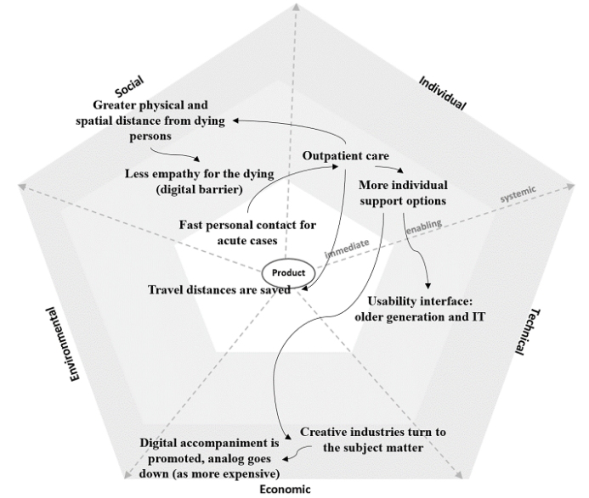
Online Pastoral Care (see Fig. 1) would result in relief for social insti- tutions, as it would bring a quick personal contact possibility for acute cases. Accordingly, we listed this point as an immediate effect in the social dimension. From this point, an arrow in enabling effects on the individual dimension goes to “Outpatient care”. Outpatient care is simplified or ena- bled. It also makes more individual care options accessible. This is only possible if the software developers design an interface adapted to the older generation, which would primarily use such a platform. In the technical dimension, a difficulty arises here.
On the other hand, the participants listed negative aspects on the social level that would go hand in hand with this digital transformation: a greater physical and spatial distance from dying persons.
On the economic level, the customizability of the support options would lead to a completely new branch of the economy unfolding, as the creative industry would turn to the topic. However, in the eyes of the workshop par- ticipants, this point entails a disadvantage on the structural level: There is a danger that digital care for the dying will turn out to be more cost-efficient, which means that analog care will be seen as expensive or too expensive. A further divide between social classes could be the result.
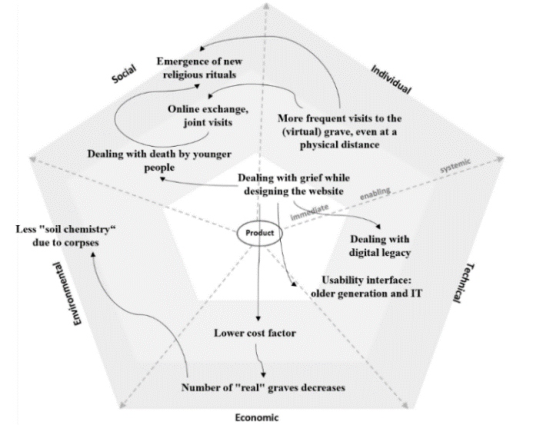
Figure 1: The completed SusAD for online pastoral care.Figure 2: The completed SusAD for virtual graveyards.
Concerning the environmental dimension, the participants mentioned only one point: Travel costs (e.g. by car) can be reduced, which benefits CO2 savings.
First, the creation of Virtual Graveyards (see Fig. 2) in the individual dimen- sion has a direct impact on those who design the online page: They are encouraged to come to terms with the death of a person and thus with their
“Changing Death”: Initial Insights for Software Practitioners in Thanatopractice 119
grief. The entry into the process of Coping with Grief benefits from “digital proximity,” since a more frequent visit to the (virtual) grave becomes possible even at a spatial distance, which the participants classified as an activating effect in the individual dimension.
This leads to (online) exchange in the social dimension, as joint “visits” e.g. in form of text messages become possible. On the structural level, the increased use of virtual cemeteries could lead to the emergence of new rituals. In the social dimension, the engagement with death by younger people can also be seen as an activating effect, since it can be assumed that more digitally inclined people will take over the creation of the virtual grave because they are already more likely to have experience with the handling of a CMS.
The designers of Virtual Graveyards need to put themselves in the position of the older generation to adapt the usability accordingly and deal with the issue of “digital legacy.” Both impacts are placed in the technical dimension.
Within the economic dimension, virtual graves mean a lower cost factor, which on the structural level can lead to a decrease in the number of real graves because this could result in an argument for cremation and against burial. Conventional cemeteries, places with cultural significance, could get into economic difficulties.
In the environmental dimension, this would result in less soil chemistry from cemeteries, although one of the participants, a pastor, added that the number of cremations is increasing every year, so this factor is no longer seen as particularly problematic anyway.
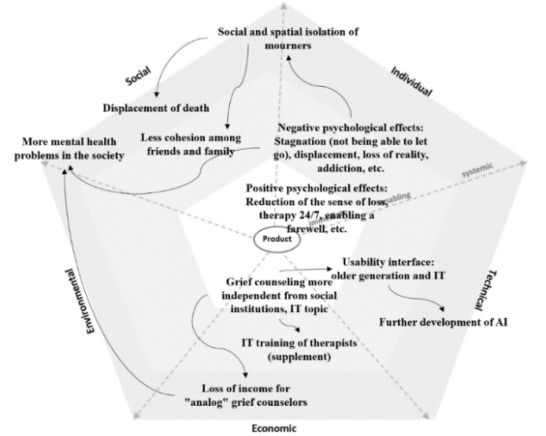
The last workshop was about AI Memory Avatars (see Fig. 3). On the one hand, the participants listed short-term positive psychological effects in the individual dimension: The minimization of the feeling of loss, therapy can be carried out around the clock and the farewell can be made up for
Figure 3: The completed SusAD for AI memory avatars (Lammert et al., 2022).
afterward. However, in the level above, in the enabling effects, the medium- and long-term negative psychological consequences that could be caused by AI Memory Avatars were dominant: Stagnation in the process of Coping with Grief (“not being able to let go”), suppression, loss of reality, addiction and others.
In the social dimension, AI Memory Avatars would bring about the overall and structural effect of social and spatial isolation of mourners. In addition, the workshop participants fear that this will increase the number of mental health problems in society. Furthermore, AI Memory Avatars could lead us to make the topic of death even more taboo than it is today. Social and spatial isolation would also lead to less support within networks such as friends and family.
In the economic dimension, participants concluded that establishing AI Memory Avatars would make grieving an “IT topic,” which would alienate it from social institutions. As an enabling effect, they listed that therapists in particular would need to engage with IT topics in a complementary way, including establishing them as a supplement to their traditional way of wor- king. In general, the participants feared that therapists working in the field of Coping with Grief would suffer a loss of income as a result, which would lead to a decline in supply and further increase the previously mentioned rise in mental illness in society.
In the technical dimension, as with the Virtual Graveyards, the partici- pants stated that IT companies would have to turn to the target group of the older generation to be able to establish such a system. They also pointed out that this would require the further development of AI technologies and that this further development could be appropriately promoted by the topic of Memory Avatars.
Our survey showed the following. 75 percent of respondents indicated that their perception of sustainability impacts had changed because of the work- shop. Explanations for this include “higher awareness of product design”, “new food for thought” and a “differentiated perception”. 88 percent of respondents said that they gained insights from the workshops that they did not have before. 75 percent would be willing to perform an analysis similar to the SusAF. 96 percent would recommend the SusAF to others. All respon- dents believe that the use of the SusAF will have an impact on the design of the IT products and services studied. Criticism emerged about the length of the workshop: 25 percent described the time as too short to do the complexity of the topic justice. Nonetheless, beneficial insights could also be obtained in a short period, as all respondents affirmed that the value of the results was commensurate with the time spent. The largest percentage of respondents (39 percent) indicated that software companies should realistically budget one to one and a half working days for the SusAF. The analysis of the results provi- des helpful insights into the design phase of IT systems in Thanatopractice, which, however, would need to be more in-depth. For example, different viewpoints between generations, cultures, and religious followers came up. There is also a need for additional tools to support software companies in implementing sustainability: Further education and training for employees in the area of sustainability (83 percent), communication between science and
“Changing Death”: Initial Insights for Software Practitioners in Thanatopractice 121
business (83 percent), interactive material for SusAF and other sustainability tools for support (58 percent) and funding programs (46 percent).
DISCUSSION
The Digitization of Thanatopractice must be classified as at least questiona- ble. All workshop groups agreed that the investigated tools should at most be used to supplement analogue forms but could and should in no way replace them because it could take away from the fundamental human experience of death and grief.
The participants also addressed the complementary aspect of the target group of users. Particularly in the case of End-of-life Care and Coping with Grief, a majority of the participants rejected leaving the dying or mourning person alone. It should be made use of a pastoral or therapeutic companion. For example, a counsellor could connect the dying person with other dying people and thus initiate an online group through a voice-over-IP platform or an online forum. The mourner could receive the opportunity to make up for a failed goodbye by using an AI memory avatar while a therapist accompa- nies the process. Thus, the use of IT systems would need an accompanying capacity.
Digital Thanatopractice provided and executed by the industry was also considered critical by the participants and, accordingly, acceptable only when regulated. For example, software companies should not make any promises of salvation. In their marketing communication strategy, they should address professional groups or voluntary institutions directly.
An obstacle to constructing validity could be that the workshop par- ticipants at first did not understand the task description correctly. In this respect, we allowed workshop participants to ask questions at any time. We tested the workshops a few times to ensure that the tasks were understandable.
We cannot exclude the risk of confounding factors because the worksh- ops took place online with the help of digital tools, which caused problems, especially for older participants. These may have had a negative impact on the internal validity. Nevertheless, we do not compare the results rather we want to show the feasibility of our approach and the importance of the new research area. It should be noted that digitization is not consistent in the international and cultural context.
Regarding external validity, it must be noted that the cases presented here are not intended to be statistically representative as this is a qualitative study. Finally, we do not attempt to generalize the findings from these three worksh- ops; we only demonstrate the feasibility of applying SusAF and participatory design to identify the potential impacts of digital Thanatopractice. However, a broad-based quantitative study could prove to be a useful addition at a later stage. To minimize risks to reliability, two researchers conducted an analysis of the results and mixed qualitative and quantitative methods have been applied. When discrepancies in attribution arose, we discussed them until we reached a consensus. Two external researchers reviewed our results.
CONCLUSION
With this contribution, we hope to have contributed to a critical discussion on this topic and to have provided initial guidelines for software practitioners. In addition, we hope that other researchers will join our efforts and address the opportunities, risks, and limitations of digitizing Thanatopractice. We consi- der further participatory studies within the Digitization of Thanatopractice to be necessary, which examine and discuss the requirements of these and other IT systems in particular also in a more detailed way. In this context, generational and cultural differences must be taken into account.
REFERENCES
Becker, C., Betz, S., Chitchyan, R., Duboc, L., Easterbrook, S. M., Penzenstadler, B., Seyff, N., and Venters, C. C. (2016). “Requirements: The Key to Sustainability,” IEEE Software (33) 2016, pp. 1–1. Bundesverband Bestattungsbedarf (2016). Bestattung 2.0 (Funeral 2.0): https://ww
w.bundesverband-bestattungsbedarf.de/blog/bestattung-2-0/. Cook, D. M., Nathasha Dissanayake, D., and Kaur, K. (2019). “The Usability factors of lost Digital Legacy data from regulatory misconduct: older values and the issue of ownership,” in 2019 7th International Conference on Information and Communication Technology (ICoICT), pp. 1–6. Dasch, B., Blum, K., Gude, P., and Bausewein, C. (2015). “Place of Death,” Deutsches
Ärzteblatt International (112:29-30), pp. 496–504. Dissanayake, D. N. and Cook, D. M. (2019). “Social Computing and Older Adults: Challenges with Data Loss and Digital Legacies,” in 2019 International Conference on Cyberworlds (CW), pp. 171–174. Duboc, L., Betz, S., Penzenstadler, B., Akinli Kocak, S., Chitchyan, R., Leifler, O.,
Porras, J., Seyff, N., and Venters, C. C. (2019). “Do we Really Know What we are Building? Raising Awareness of Potential Sustainability Effects of Sof- tware Systems in Requirements Engineering,” in 2019 IEEE 27th International Requirements Engineering Conference (RE), pp. 6–16. Duboc, L., Penzenstadler, B., Porras, J., Akinli Kocak, S., Betz, S., Chitchyan, R., Leifler, O., Seyff, N., and Venters, C. C. (2020). “Requirements engineering for sustainability: an awareness framework for designing software systems for a better tomorrow,” Requirements Engineering (25). Grunwald, A. (2010). Technikfolgenabschätzung - eine Einführung, 2nd edition.
Berlin: edition sigma. Häkkilä, J., Hannula, P., Luiro, E., Launne, E., Mustonen, S., Westerlund, T., and Colley, A. (2019). “Visiting a Virtual Graveyard: Designing Virtual Reality Cul- tural Heritage Experiences,” in Proceedings of the 18th International Conference on Mobile and Ubiquitous Multimedia, MUM ‘19. Pisa, Italy: Association for Computing Machinery. Huberman, J. (2013). “The Digital Graveyard: Online Social Networking Sites as
Vehicles of Remembrance,” in. University Press of Colorado, 2013, pp. 71–87. Küchenhoff, J. (2011). “Zu den Bedingungen gelingender Trauer (On the conditions of successful mourning),” Psychotherapie-Wissenschaft (1) 2011, pp. 111–116. Lammert, D., Abullai, L., Betz, S., and Porras, J. (2023). “Sustainability for Artificial
Intelligence Products and Services – Initial How-to for IT Practitioners,” in Hawaii International Conference on System Sciences (HICSS 2023).
“Changing Death”: Initial Insights for Software Practitioners in Thanatopractice 123
Meier, E. A., Gallegos, J. V., Thomas, L. P. M., Depp, C. A., Irwin, S. A., and Jeste, D. V. (2016). “Defining a Good Death (Successful Dying): Literature Review and a Call for Research and Public Dialogue.” The American journal of geriatric psych- iatry: official journal of the American Association for Geriatric Psychiatry (24 4), pp. 261–71. Penzenstadler, B., Duboc, L., Sedef, A., K., Becker, C., Betz, S., Chitchyan,
R., Easterbrook, S., Leifler, O., Porras, J.; Seyff, N., Venters, C. C. (2020). “The SusA Workshop – improving sustainability awareness to inform future business process and systems design,” Zenodo, p. 13 (available online at https://zenodo.org/record/3676514#. YkFxzC8RpT7). Silva, D. H. M. P. G. da and Medeiros, F. P. A. de (2021). “Digital Legacy Post Mortem
- Data mortality as part of digital life - An analysis from the perspective of Human Computer Interaction researches in Brazil,” in 2021 16th Iberian Conference on IT systems and Technologies (CISTI), pp. 1–6. Simonsen, J. and Robertson, T. (2012). Routledge International Handbook of Participatory Design. London: Routledge, 2012. Thieme, F. (2018). Sterben und Tod in Deutschland: Eine Einführung in die Thana-
tosoziologie (Dying and Death in Germany: An Introduction to the Sociology of Thanatosociology). Wiesbaden (Germany): Springer VS. Wulf, N., Lammert, D., Betz, S., Popkes, E. E., Schiller, U. (2022). “Digitalisierung des Todes. Perspektiven der Sozioinformatik und Thanatologie auf digitale Systeme der Thanatopraxis (Digitizing Death. Perspectives of Socioinformatics and Thanatology on Digital Systems of Thanatopraxis),” in Schönefeld, D. and Gahlen-Hoops, W. (eds.): Soziale Ordnungen des Sterbens. Theorie, Methodik und Einblicke in die Vergänglichkeit, Bielefeld (Germany): transcript.
LISTED IN THE AHFE DIGITAL BOOKSTORE CATALOGUE
Explore the complete digital volume
Human Factors in Aging and Special Needs
Read this individual research paper free through the original publisher, or explore the full digital proceedings book.
ISBN 978-1-958651-64-3
Explore this ISBN in the AHFE Bookstore ↗Listed in the July 2026 bookstore catalogue; search by ISBN to confirm current availability · Digital book purchase optional