Agatha Maisie Tjandra, Ziyi Li, Chien-Hsu Chen (2023). Designing Early Detection Screening System for Dementia in Indonesia. In: Human Factors in Aging and Special Needs. AHFE Open Access, vol. 88, pp. 95–103. https://doi.org/10.54941/ahfe1003666
The lack of awareness and misunderstanding between dementia and forgetfulness as normal parts of aging often leads to late diagnoses of dementia. This situation can be compounded by the fact that there is currently no cure for dementia and it is difficult to prevent or slow its progression. To address this, an early warning system for detecting dementia symptoms is essential. This study aims to design a new approach to dementia screening by using a chatbot with customized questions for each user. If any potential symptoms are detected, the chatbot will provide recommendations for medical evaluation. This research focuses on individuals over 60 years of age who reside in urban areas in Indonesia and will be conducted through the WhatsApp platform, a widely used communication tool in the country. The chatbot will gather information on personal habits based on elements of dementia measurement through questions asked. Initial data was obtained through qualitative interviews, used to customize questions specific to each participant's preferences. By using the customization questions, the Chatbot Prevention Dementia will offer a personalized approach to detecting cognitive status and help family members understand the situation of the elderly individual.
As one of the global diseases, the number of People Living with Dementia (PWD) in the world is predicted to increase from 47 million people in 2015 to 115 million in 2050. Indonesia is one of the top ten list countries with a high number of people with dementia among other Asian countries. Moreover, Indonesia as one of the most populated elderly in Southeast Asia, predicted to increase to 2 million in 2030 and 4 million people in 2050 (Azwar, 2021). The increased number of dementias linearly with the expenses for taking care and health care maintenance which can accumulate economic impact in a county, especially in low-income and middle-income countries (LMICs) where most two-thirds of PWD live globally (Holm et al., 2022). The expenses are pri- marily spent on caring for the patient and caregivers (Ong et al., 2021). PWD will cause serious healthcare problem and bring impact on socioeconomic if not anticipated.
Which has known dementia cannot be cured; thus, prevention is one of the important ways to cope with it. In some cases, misunderstanding the
dementia symptoms dementia and forgetfulness as normal parts of aging can delay the diagnosis of dementia itself and usually come to a neurologist after finding several signs of dementia. Moreover, caregivers or family members might contribute to missed or delayed diagnosis of elder dementia (Bradford et al., 2009). High activities of family members who live in an urban city can be problems in dealing with the care of dementia issues.
There were some dementia scales available to measure and diagnose dementia disease for various purposes. However, it cannot be said that one scale is better than the other. This is because the symptoms of dementia are very customized from one patient to another. One measurement of dementia is The Eight-item Informant Interview to Differentiate Aging and Demen- tia (AD8®). This was developed by Knight Alzheimer Disease Research Center, Washington University School of Medicine in St. Louis. AD 8 as a brief instrument to help discriminate between signs of normal aging and mild dementia. It contains eight items that test for memory, orientation, judgment, and function and being used as part of a brief dementia detection instrument (in conjunction with a patient assessment) to evaluate patients in community settings. Basically, AD8 can be used for normal to mild-stage demented indi- viduals. Moreover, the availability of informants can help patients diagnosed with the advanced level of dementia by AD 8 (Galvin et al., 2005).
Tracking record cognitive changing by understanding daily activities can give prevention of dementia, and at the same time, it makes family members aware of the elder who might have dementia (Wallace et al., 2018, Harding et al., 2020, Favela et al., 2020). Besides, for the long-term record using cli- nical measurements will provide monotone questions in clinical terms that might not be related to elder personality and what they face daily, although some research did other approaches such as gamification (Wallace et al., 2018) or computer avatar (Tanaka et al., 2017) to diagnose dementia. Based on it, this research tries to offer a solution by answering the question of how to design dementia screening test based on AD 8 that is able to record the elder’s cognitive based on their daily habit. Furthermore, the design is able to make the family member aware of the elder’s cognitive condition, thus prevent the late diagnose of dementia.
The aim of this paper is to explain the process of designing The Diary AD8. In this research, it is important to customized AD 8 questions for each user to ensure that the measurement of dementia scales adopts an empathetic approach towards the situations of older adults.
In the future, the prototype will test by involve some stakeholders such as elder, family members, and healthcare workers. So that if there any cognitive changes are identified, the chatbot will send suggestions to family mem- bers to discuss the possibilities of the older adult’s cognitive conditions with the doctor. Thus, The Diary AD 8 serves as screening system for detecting dementia by using a chatbot via the WhatsApp chat platform.
RELATED WORKS The conventional way to use the dementia scale of AD8 is by using pen and paper and filling out the form by the observer, who can be the family member
Designing Early Detection Screening System for Dementia in Indonesia 97
or partner who understands the patient’s daily basics. Using AD8 for self- assessment has a less high level of accuracy when compared to the assessment by observers (Chio et al., 2018). However, the results written by the observer have a high level of subjectivity. The AD 8 was one of the dementia scale system that have simple categorization and can be asses to record elder situa- tion. There are 8 elements consist of the AD 8 there are; (1) The difficulties in ability to makes any decisions, (2) Leaving the activities that previously quite interesting at that things (hobbies), (3) Frequently repeating the same que- stions or same statement, (4) Having difficulties to using the tools or things that previously the elderly using in daily life, (5) Forget the month or year, (6) Facing any difficulties to arrange the financial, (7) Facing any difficulties to remind the appointment with others, (8) Have memory problem and lack of consistency of thinking in daily life (Galvin et al., 2005).
However, these days, there are some approaches to reach patients closely, such as changing the language, which has been done in INA-AD 8 (Indonesian language) (Utomo, 2019), AD8 Chinese version (Yang et al., 2011), and AD 8 Turkish version (Usarel et al., 2019). In Indonesia, awareness for early detection of dementia has recently begun to be developed with several smartphone applications, such as the E- Memory Screening (EMS) app launched by PT Eisai Indonesia, a subsidiary of Japan-based pharmaceutical company Eisai Co., Ltd., in collaboration with PERDOSSI. It is currently available on the Google Play Store. In this appli- cation, there are three features in the form of articles, a senile screening test using AD 8, and a directory showing the nearest doctors and hospitals rele- vant to dementia specialists (Wira, 2020). One of the development chatbot using multiplatform to detect dementia with various platform is Chattybot. This chatbot as the tools is suitable to act as independent communication media for the next generation elderly and potentially extended with broader thematic purposes (Wianto et al., 2021).
METHOD
According the eight elements of AD 8, the objective of interview is to under- stand the elderly’s background, activities, hobbies and situation in their daily living, and how the younger family member thinking about the elderly’s health condition. This research was adopting contextual mapping method that commonly use in participatory design by involve user through design process (Visser et al., 2005).
The present study was initiated by conducting qualitative interviews with elderly individuals and their family members to gather information regarding their health conditions and lifestyles. Results indicated that the participants meet the criteria for the study. Subsequently, a customized set of eight AD 8 questions was developed based on the experiences and daily lives of the parti- cipants. These questions were drafted using the Landbot messaging platform, which is integrated with WhatsApp. The feasibility of the prototype was tested by administering the questions to two respondents, and their responses were recorded, as depicted in Figure 1.
Figure 1: Method designing the AD 8.
Interview Interviews were conducted twice separately with family members and parti- cipants. The purpose of this interview is to find out the habits, lifestyles, and hobbies of the elderly.
Family members as participants were selected based on their residence in Jakarta, Bogor, Depok, Tangerang, and Bekasi (Jabodetabek), living at home with parents over 60 years old or visiting their parents at least once a week. The interview was conducted by telephone.
The total number of interviewees as family members were four people, aged 25–38 years. During the interview, eight questions were asked about AD 8 and asked to reflect on their parents. Most of them are not sure whether their parents have dementia or the natural forgetfulness as part of normal aging.
The following interview on elders. In this interview, they were asked about daily activities, possible physical limitations, hobbies, favourite foods, places frequently visited, and diseases they have (especially those with the potential for dementia). As seen in Table 1.
Customized the AD8 Questions Instrument per Participant Based on the participant data, AD 8 questions were prepared per point, as shown in Table 2. Question no 3 Repeated the same things over and over (questions, stories, or statements) and was asked directly to family members when validating the data.
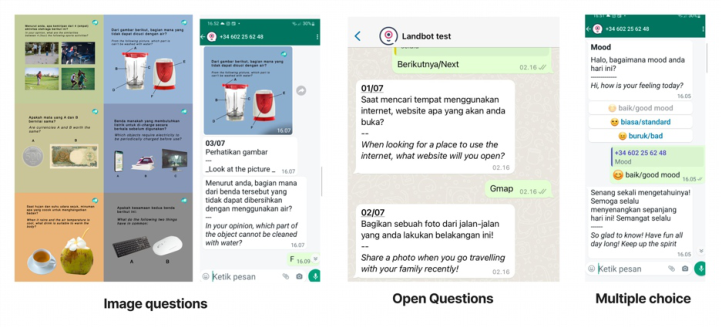
The customization questions in The Diary AD8 are not limited to the con- tent but also the types of questions. The AD 8 questions consist of three types: multiple choice (including image question), and open-ended (Figure 2). Modifying the question type will provide extended answers to give a deep understanding of the user’s way of thinking.
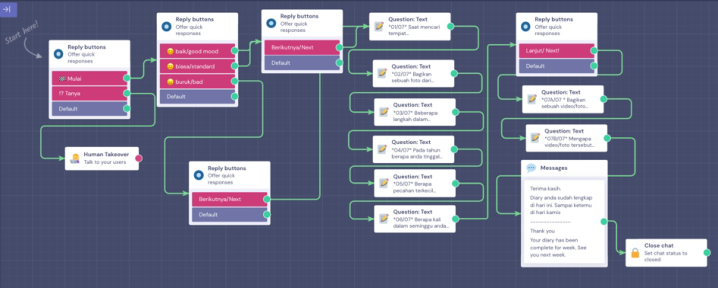
Prototype Questions to Chatbot All questions that have been written are then arranged sequentially using Landbot. Landbot is an application for creating automated chatbots, then publish it via Whatsapp, as seen in Figure 3.
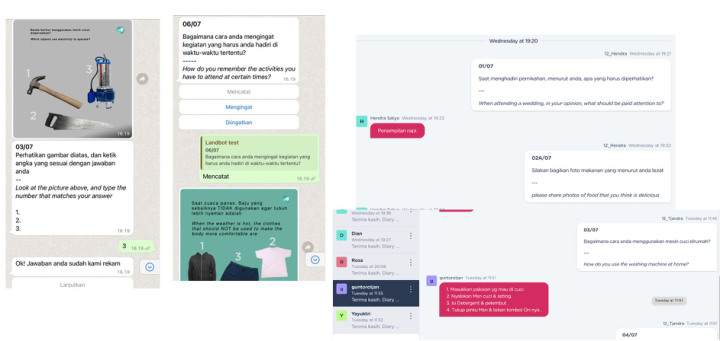
The Landbot also provide the chat view on their platform, so researcher can be monitor through the live chat, Figure 4.
Test The prototype of chatbot The Diary AD 8 was tested at a random session on 2 participants (participant 2 and participant 5). The test has done in
Designing Early Detection Screening System for Dementia in Indonesia 99
TV
Cholesterol, Had heart
surgery in 2019
Gardening, Watching
youtube, Playing with
grandchildren
(pétanque-before heart
attack), Watching videos,
TV Smartphone, Laptop, Smart
Take care home, cooking
Religious community,
Crafting community
Playing with grandchildren Take care home, cooking
Religious community,
Crafting community
cooking Reading, Cooking, Sewing Doing sport Take care home, cooking Gardening and sell plants Playing with grandchildren
AD8®Dementia Screening Interview Problems with judgment (e.g., problems making decisions, bad financial decisions, problems with thinking)
Asking about their decision or suggestion and decision about what they are possibly facing on them. Examples, what time suitable to doing the things that they usually like Less interest in hobbies/activities
Duration of their activity, asking why they like doing that, what is interesting about the hobby when they do it.
Hobby/ pass hobbies and why they change (mostly answer because of their health condition
Ask to family member
Repeats the same things over and over (questions, stories, or statements) Trouble learning how to use a tool, appliance, or gadget (e.g., VCR, computer, microwave, remote control)
Ask the step by step to operate washing machine, maintanance the devices and type of devices at their home that they usually use everyday
Asking daily devices that they use every day, Asking about the tools and how that tools should be used (using pictures) Forgets correct month or year
Ask about their schedule with doctors, drinking medicine, or praying habits
Daily problems with thinking and/or memory
Ask about common logic, such as way turning of locking and open the door.
10–15 minutes based on the task for 7 questions. Table 3 shows the results. Table 3 figured some elements including the AD 8 screening parameters, customized questions, answers, and indication of whether it found any weird or error answers.
DISCUSSION AND CONCLUSION The Diary AD 8 offers a new approach that may enable elderly to assess their own dementia symptoms with the help of family members by understanding and confirming their answers. However, the parameters of AD 8 instrument
Designing Early Detection Screening System for Dementia in Indonesia 101
Figure 2: Questions type for the diary AD 8 (multiple choice (including image questi- ons), and open question).Figure 3: Chatbot in whatsApp and landBot questions.Figure 4: Chatbot Questions in whatsapp and landbot chat interface.Table 3. Customized questions and test result The diary AD 8 participants (P2 & P5).
Table available in the original PDF paper.
has provided an overview of dementia assessment indicators, including exam- ples. On the other hand, by gaining a deeper understanding of the user, AD 8 questions can be designed to align more closely with the user’s daily life without altering the overall meaning of the AD 8 instrument.
Customization of questions in The Diary AD 8 gives users a personal approach based on what they are facing and their experiences. These more detailed questions offer a different approach from the conventional AD 8 instruments and have been found to increase user openness and willingness to share their experiences. The enthusiasm of participant can be seen in their answers to the questions. They usually use long chats as can be seen in Table 3 at participant 2. Participant 2 explained in more than 50 words and add emoji to express emotion’s when explain the interesting memory. While participant 5 asked the family member whether they missed the session or whether they will have again in the future.
The type of questions play role in shaping the user’s answers. For mea- surements related to dementia, commonly use open questions. These are preferable as they allow for a more comprehensive understanding of the user’s responses.
REFERENCES
Azwar, M. K. S., Siti 2021. Modifiable Risk Factors For Dementia In Indonesia’s Urban Population. Acta Med Indones - Indones J Intern Med, Vol 53, 31–41.
Designing Early Detection Screening System for Dementia in Indonesia 103
Bradford, A., Kunik, M. E., Schulz, P., Williams, S. P. & Singh, H. 2009. Missed And Delayed Diagnosis Of Dementia In Primary Care: Prevalence And Contributing Factors. Alzheimer Dis Assoc Disord, 23, 306–14. Chio, O. I., Yip, P. K., Liu, Y. C., Chen, L. H., Wang, P. C., Tsai, T. H. & Tang, S. H.
2018. Detection Of Cognitive Impairment Using Self-Rated Ad8 And Informant- Reported Ad8. J Formos Med Assoc, 117, 42–47. Favela, J., Cruz-Sandoval, D., Morales-Tellez, A. & Lopez-Nava, I. H. 2020. Monitoring Behavioral Symptoms Of Dementia Using Activity Trackers. J Biomed Inform, 109, 103520. Galvin, J. E., Roe, C. M., Powlishta, K. K., Coats, M. A., Muich, S. J., Grant, E.,
Miller, J. P., Storandt, M. & Morris, J. C. 2005. The Ad8: A Brief Informant Interview To Detect Dementia. Neurology, 65, 559–64. Harding, B. N., Floyd, J. S., Scherrer, J. F., Salas, J., Morley, J. E., Farr, S. A. & Dublin, S. 2020. Methods To Identify Dementia In The Electronic Health Record: Com- paring Cognitive Test Scores With Dementia Algorithms. Healthcare-The Journal Of Delivery Science And Innovation, 8, 7. Holm, E., Jacobsen, K. K., De Lony, T. B., Lembeck, M., Pedersen, H., Anders-
son, C., Johannsen, P., Jørgensen, T. S. H. & Torp-Pedersen, C. 2022. Frequency Of Missed Or Delayed Diagnosis In Dementia Is Associated With Neighborh- ood Socioeconomic Status. Alzheimer’s &Amp; Dementia: Translational Research &Amp; Clinical Interventions, 8. Ong, P. A., Annisafitrie, F. R., Purnamasari, N., Calista, C., Sagita, N., Sofiatin, Y.
& Dikot, Y. 2021. Dementia Prevalence, Comorbidities, And Lifestyle Among Jatinangor Elders. Front Neurol, 12, 643480. Tanaka, H., Adachi, H., Ukita, N., Ikeda, M., Kazui, H., Kudo, T. & Nakamura, S.
2017. Detecting Dementia Through Interactive Computer Avatars. Ieee J Transl Eng Health Med, 5, 2200111. Usarel, C., Dokuzlar, O., Aydin, A. E., Soysal, P. & Isik, A. T. 2019. The Ad8 (Dementia Screening Interview) Is A Valid And Reliable Screening Scale Not Only For Dementia But Also For Mild Cognitive Impairment In The Turkish Geriatric Outpatients. Int Psychogeriatr, 31, 223–229. Utomo, A. B., Et Al 2019. Uji Reliabilitas Dan Validitas Aplikasi Smartphone Ina-
Ad8 Untuk Tes Skrining Gangguan Fungsi Kognitif. Berkala Neurosains, 18, 46–51. Visser, F. S., Stappers, P. J., Van Der Lugt, R. & Sanders, E. B. N. 2005. Contextmapping: Experiences From Practice. Codesign, 1, 119–149. Wallace, B., Knoefel, F., Goubran, R., Masson, P., Baker, A., Allard, B., Guana, V.
& Stroulia, E. 2018. Detecting Cognitive Ability Changes In Patients With Mode- rate Dementia Using A Modified “Whack-A-Mole” Game. Ieee Transactions On Instrumentation And Measurement, 67, 1521–1534. Wianto, E., Chen, C.-H., Chen, C.-C. & Lin, C.-L. 2021. Chatty Bot: An Alternative To Implement A Memory Training Option For The Upcoming Older Adults In Indonesia. Advances In Human Factors And Ergonomics In Healthcare And Medical Devices. Wira, N. N. 2020. Mobile App Allows Early Detection Of Alzheimer’s Disease. Yang, Y. H., Galvin, J. E., Morris, J. C., Lai, C. L., Chou, M. C. & Liu, C. K. 2011.
Application Of Ad8 Questionnaire To Screen Very Mild Dementia In Taiwanese. Am J Alzheimers Dis Other Demen, 26, 134–8.
LISTED IN THE AHFE DIGITAL BOOKSTORE CATALOGUE
Explore the complete digital volume
Human Factors in Aging and Special Needs
Read this individual research paper free through the original publisher, or explore the full digital proceedings book.
ISBN 978-1-958651-64-3
Explore this ISBN in the AHFE Bookstore ↗Listed in the July 2026 bookstore catalogue; search by ISBN to confirm current availability · Digital book purchase optional