Qi Liu, Jin-Juan Duan, Pin Zhang (2023). One-handed Disabled Product Design Based on CJM-KANO-AHP User Need Model. In: Human Factors in Aging and Special Needs. AHFE Open Access, vol. 88, pp. 1–9. https://doi.org/10.54941/ahfe1003656
One-handed disabled encounter many inconveniences in life. In order to help designers focus on the high-priority needs of the one-handed disabled and avoid the subjectivity of needs selection in product design, a product design method based on CJM (Customer Journey Map)-KANO (KANO Model)-AHP (Analytic Hierarchy Process) user need model for one-handed disabled is proposed. Firstly, the user needs of the one-handed disabled are collected comprehensively by CJM which helps to collect multi-scene needs. Secondly, the collected needs are classified according to the KANO model, needs are classified into must-be needs(M), one-dimensional needs(O), attractive needs(A), indifferent needs(I), reverse needs(R), and questionable needs(Q). And only the first three types of needs are retained. Thirdly, the user need hierarchy analysis model is constructed based on the AHP method, matrix judgment, weight calculation, and consistency check are conducted for the retaining needs ranking. Finally, the one-handed washboard was designed for addressing the first-ranking need of the one-handed disabled. The user need model based on CJM-KANO-AHP is applied in the product design process of one-handed disabled, which effectively solves the problem of multi-scene need collection and need prioritization. Compared with the existing methods that only rank the relatively limited number of needs in a single scene, our method ranks needs within the scope of multi-scene for the one-handed disabled which has more practical significance. It also provides ideas for similar product design processes.
According to the estimation of the World Health Organization (WHO), the number of disabled people in the world has exceeded 1 billion, accounting for 15% of the world’s population (Ai, 2013). The total number of disabled people in China is 82.96 million, of which 24.12 million are limb disabled, accounting for 29.07% of the total number of disabled people (Chen et al., 2011). One-handed disabled is a typical group people of limb disabled. They only have one healthy hand, and the other hand or joint arm is amputated
or dysfunctional. The acquired one-handed disabled can also be divided into two categories: the remained hand is the dominant hand or the non-dominant hand (Liu, 2012). The inconveniences of one-handed disabled exist in the multi-scene of life. The number of needs is large and the scenes involved are complex, so it is impossible to meet all the needs because of cost and other reasons. At the same time, focusing on high-priority needs at the beginning of design development is one of the key factors for the success of the final new product development (Ren, 2008). Therefore, in order to help designers focus on the high-priority needs of the one-handed disabled, we need to first solve the problem of comprehensively collecting the needs of the one-handed disabled, and then solve the problem of prioritizing the needs.
RELATED WORK
The researches on the one-handed disabled product design can be gene- rally divided into two categories. The first category is to put forward design theories for the one-handed disabled according to their characteristics, for example, they may not be able to complete movements with both hands, lack strength, or lack balance. Wang et al. (2018) proposed a one-handed barrier- free product design method based on the humanized design theory. Jia (2016) proposed a design theory for the one-hand disabled based on universal pri- nciples of design. Yang (2014) proposed a barrier-free design procedure for hand-assistive devices. Priya et al. (2021) proposed the development process and method of one-handed disabled assistance products based on desktop manufacturing methods (additive manufacturing/3D printing, laser cutting, and CNC processing). The second category is practical research for the one- handed disabled product design. Karlson et al. (2008) studied the interaction design of using small devices with one hand, including thumb movements, device applications, searching, and other typical problems. Parhi et al. (2006) studied the size of small screen devices operated by one hand thumb. Yu et al. (2013) studied and designed the auxiliary interface of the one-handed handh- eld device, and finally solved the problem of quickly and accurately clicking on the area that could not be reached with the thumb before with the least amount of attention. Karlson et al. (2006) studied the basic problems in the interaction design of one-handed mobile devices and provided a basic know- ledge of user behavior and preferences, as well as the future research trends in the interaction design of one-handed mobile devices. Nagendran et al. (2021) investigated the one-handed disabled keyboard, including commercially avai- lable and patented one-handed input devices, and finally proposed their own future design direction. To sum up, the existing researches mainly propose a one-handed product design theory or practical research on a specific one- handed design issue. However, the above two categories of researches do not pay enough attention to how to select the high-priority needs of one-handed disabled for product design.
To solve the above problem, it was learned that the models frequently used in modern design researches to determine needs or calculate the need weight are the KANO Model(KANO), Quality Function Deployment(QFD), Analy- tic Hierarchy Process (AHP), Technique for Order Preference by Similarity
One-Handed Disabled Product Design Based on CJM-KANO-AHP User Need Model 3
to an Ideal Solution(TOPSIS), Theory of the Solution of Inventive Problems (TRIZ), etc (Zhao et al., 2021). Liu et al. (2018) classified user needs using the KANO model and then used QFD to convert user needs into design elements to calculate the user need priority. Kong et al. (2019) proposed a KANO- based product innovation need screening method to reduce the subjectivity of designers in need screening. Zhou et al. (2020) used AHP for weight calcula- tion, consistency check, and need priority ranking. In addition, many scholars complement these methods to address the analysis and processing of needs. However, the models available in the literature mostly address the range of needs for a defined scene such as a one-handed disabled bathing process, or a defined product such as an elderly household companion robot about its multiple design metrics. The range of needs is closed and limited. However, the high-priority needs of the one-handed disabled may exist in a wide range of life scenes, it has more practical significance to address the problem of priority ranking the needs of the one-handed disabled in the context of open, multi-scene need ranges.
CJM-KANO-AHP USER NEED MODEL CJM (Customer Journey Map) is a tool to visually represent user behavior in real environments, it helps respondents objectively and effectively recall the intersection of behavioral activities and target collection needs over vari- ous periods, and guides respondents to output the needs of the one-handed disabled in an all-around way. After user need collection, the KANO model is a good way to scientifically classify user needs by attribute (Hu et al., 2020). However, in order to determine the priority of needs and find the focus of the design, after the need classification, we need to further calculate the user needs weight and rank the needs. AHP is a frequently-used and mature method for demand prioritization, it has been used in the demand ranking of tourist souvenir design (Yang, 2017) and furniture design (Zhao et al., 2022). The AHP method, based on expert scoring and one-by-one compari- son, is a multi-criteria decision-making method that combines qualitative and
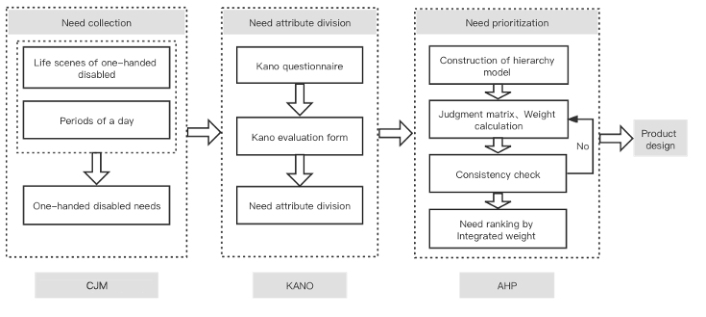
Figure 1: The research framework of CJM-KANO-AHP user need model.
quantitative aspects, it also has the advantage of being objective and systema- tic, simple and practical (Zhao et al., 2021). The KANO model can provide a hierarchical division basis for the AHP method, and the AHP method can calculate the weight for the needs divided by KANO. Therefore, CJM, KANO, and AHP are combined to construct a user need model to solve the problem of judging the high-priority needs in multiple scenes during the product design for the one-handed disabled. The research framework is shown in Figure 1.
NEED COLLECTION BASED ON CJM First, we collected needs using the CJM approach. In order to get a more realistic understanding of the actual needs of the one-handed disabled, 36 one-handed disabled respondents with hemiplegia and one upper limb ampu- tation were randomly recruited at the rehabilitation center for the disabled. Using the CJM approach to design the needs collection questionnaire (see Table 1). The vertical axis of the table is the eight periods of a whole day, and the horizontal axis of the table is the scenes where the behavioral difficulties of one-handed disabled appear and the products are used: clothes wearing and washing, cooking and eating, entertainment and learning, personal hygi- ene (Wang et al., 2018). This questionnaire was designed to help respondents recall what inconveniences and needs they would encounter in every period of each scene. Combining the dimensions of multiple scenes promotes the comprehensiveness of needs collection. Finally, among the 36 questionnaire results received, we combined the duplicate needs and then obtained a total of 33 one-handed disabled user needs (see Table 2).
Table 1. Questionnaire on the need collection of the one-handed disabled.
Table available in the original PDF paper.
Life scenes Periods of a day Clothes wearing and washing
NEED ATTRIBUTE DIVISION BASED ON KANO MODEL The user needs are classified by attribute according to the KANO questi- onnaire results and the KANO evaluation form. According to the KANO questionnaire, the 33 user needs were asked in two dimensions, positive and negative. Respondents were asked about their satisfaction toward addres- sing this need and not addressing it, and satisfaction was classified into five levels (like, expect, neutral, live with, dislike) using Likert five-point scale. We distributed 106 questionnaires and got 97 valid questionnaires by recrui- ting one-handed disabled in disabled rehabilitation centers, nursing homes, and online. The results of the KANO questionnaires were analyzed using the KANO evaluation form and the user needs were classified into six types:
One-Handed Disabled Product Design Based on CJM-KANO-AHP User Need Model 5
Table 2. Result of the need collection of the one-handed disabled.
Table available in the original PDF paper.
No. Needs No. Needs No. Needs N13 Cut vegetables N24 Eat with chopsticks N1 Tie shoelaces N12 Wash vegetables N23 Exercise N2 Put on or take off clothes
N16 Use a ruler N27 Use a dustpan
N3 Wash hands N14 Wash dishes N25 Squeeze toothpaste onto the toothbrush N4 Zip up a zipper N15 Hang wet clothes N26 Wring out water N5 Fasten buttons on clothes N29 Tie up hair N6 Tie a leather belt N17 Use a camera N28 Tie garbage bags N7 Unscrew a bottle cap N18 Unplug the plug on the socket
N8 Peel fruits N19 Use a game handle N30 Handwash something N9 Peel eggshell N20 Carry heavy objects N31 Take a bath N10 Open packing bags N21 Write with the non-dominant hand
N32 Move a large basin of water N11 Put a glove on the healthy hand
N22 Use scissors with the non-dominant hand
N33 Cut fingernails for the healthy hand
Table 3. One-handed disabled need attribute analysis.
Table available in the original PDF paper.
Number of people Attribute Need
Number of people Attribute
Need No.
No.
M O A I R Q M O A I R Q N1 9 18 20 45 4 1 I N18 3 7 23 43 1 20 I N2 82 6 2 7 0 0 M N19 8 25 56 5 0 3 A N3 34 24 14 20 5 0 M N20 11 25 35 23 3 0 A N4 12 29 37 19 0 0 A N21 19 6 22 50 0 0 I N5 12 16 28 39 0 2 I N22 14 8 25 48 1 1 I N6 15 12 21 49 0 0 I N23 11 14 21 29 8 14 I N7 9 17 23 47 0 1 I N24 2 13 23 45 12 2 I N8 13 14 29 41 0 0 I N25 9 12 20 45 2 9 I N9 7 12 33 43 0 2 I N26 37 25 18 13 1 3 M N10 9 12 23 53 0 0 I N27 16 7 33 39 0 2 I N11 7 16 18 23 15 18 I N28 18 5 27 44 0 3 I N12 25 37 24 11 0 0 O N29 13 6 23 53 0 2 I N13 25 37 20 14 1 0 O N30 67 15 10 5 0 0 M N14 70 10 11 6 0 0 M N31 7 40 27 23 0 0 O N15 15 36 25 20 1 0 O N32 19 39 27 12 0 0 O N16 3 12 13 53 0 16 I N33 21 19 27 29 0 1 I N17 2 12 23 50 5 5 I
must-be need(M), one-dimensional need(O), attractive need(A), indifferent need(I), reverse need(R), and questionable need(Q) (see Table 3). Finally, indifferent needs, reverse needs, and questionable needs were excluded, and the must-be needs, one-dimensional needs, and attractive needs are retained for the next stage of AHP user needs weight analysis.
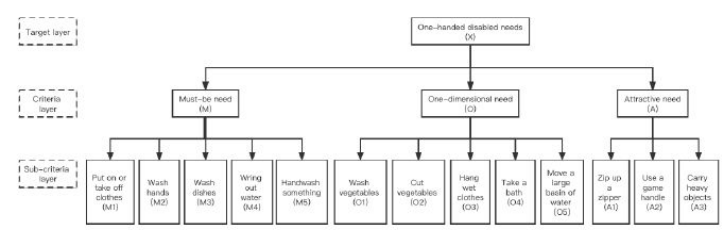
NEED WEIGHT ANALYSIS BASED ON AHP Based on the analysis result of the KANO model, Judgment matrix constru- ction, need weight calculation, and consistency check were performed using the AHP method. As shown in Figure 2, the target layer is the one-handed
disabled needs, the criteria layer is must-be need, one-dimensional need, and the attractive need, while the specific needs under these three attributes of needs are expanded to the sub-criteria layer. With X denoting the target layer, M denoting the must-be need in the criteria layer, its expanded sub-criteria layer M1 indicates put on and take off clothes, M2 indicates wash hands, M3 indicates wash dishes, M4 indicates wring out water, M5 indicates handw- ash something, and so on. The AHP user needs questionnaire with the 1–9 scale proposed by Saaty (Saaty & Kearns, 1985) was used to determine the importance of each item. A focus group of 10 people including 2 one-handed disabled due to amputation, 5 hemiplegics who were logical and spoke nor- mally, and 3 medical staff of the rehabilitation center for the disabled who were familiar with the situation of one-handed disabled made the scores of the questionnaire. The one-by-one comparison results of the criteria layer are shown in Table 4, and the one-by-one comparison results of each group for the sub-criteria layers are shown in Table 5. The priority ranking of the 13 needs was derived from the integrated weight value (see Table 6), the inte- grated weight value of a need is the product of its criteria layer weight and its sub-criteria layer weight. With limited time and cost, prioritizing needs can help designers better understand the high-priority needs of users, reduce cost waste and the risk of innovative product development, and improve the likelihood of successful design outcomes.
The consistency check was conducted to ensure the accuracy of the AHP matrix calculation results. In the criteria layer, CRX value is 0.009. In the sub-criteria layer, CRM value is 0.031, CRO value is 0.004, and CRA value is 0.004. All of them were less than 0.1, and the consistency check was passed.
Figure 2: AHP need model of one-handed disabled.Table 4. Judgment matrix and weight of the criteria layer.
Table available in the original PDF paper.
X M O A Weight value CRX 1/2 1 2 0.296 96 Must-be need 1 2 3 0.539 61 0.009 One-dimensional need
Attractive need 1/3 1/2 1 0.163 42
One-Handed Disabled Product Design Based on CJM-KANO-AHP User Need Model 7
Table 5. Judgment matrix and weight of the sub-criteria layer.
Table available in the original PDF paper.
M M1 M2 M3 M4 M5 Weight value CRM
1 1 1 3 1 0.237 72 0.031
Put on or take off clothes Wash hands 1 1 1 1 1/2 0.166 12 Wash dishes 1 1 1 2 1/2 0.190 83 Wring out water 1/3 1 1/2 1 1/2 0.116 09 Handwash something 1 2 2 2 1 0.289 24
O O1 O2 O3 O4 O5 Weight value CRO
1/2 1 1/2 1/4 1 0.098 21
Wash vegetables 1 2 1 1/3 2 0.181 12 0.004 Cut vegetables 1/2 1 1/2 1/4 1 0.098 21 Hang wet clothes 1 2 1 1/2 2 0.196 42 Take a bath 3 4 2 1 4 0.426 03 Move a large basin of water A A1 A2 A3 Weight value CRA
Zip up a zipper 1 5 2 0.581 55 0.004 Use a game handle 1/5 1 1/3 0.109 45 Carry heavy objects 1/2 3 1 0.309
Table 6. Needs priority ranking.
Table available in the original PDF paper.
Ranking Needs Integrated weight value Handwash something 0.156 08 1 Put on or take off clothes 0.128 28 2 Take a bath 0.126 51 3 Wash dishes 0.102 97 4 Zip up a zipper 0.095 04 5 Wash hands 0.089 64 6 Wring out water 0.062 64 7 Hang wet clothes 0.058 33 8 Wash vegetables 0.053 79 9 Carry heavy objects 0.050 5 10 Cut vegetables 0.029 16 11 Move a large basin of water 0.029 16 11 Use a game handle 0.017 89 13
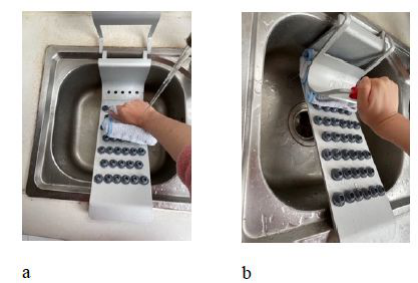
ONE-HANDED DISABLED PRODUCT DESIGN Due to time constraints, we designed the product with the need to “handw- ash something” which is the first priority ranking need. Finally, we got the one-handed washboard design and made a physical model, which was tested by one-handed disabled users to show how that it can address the need for one-handed handwash something. This product uses a dense metal mate- rial and a non-slip rubber layer design in the contact positions between the one-handed washboard and the sink so that the one-handed washboard can
Figure 3: One-handed washboard usage scenarios.
remain stable on the sink while the user washes a towel or other clothes with one hand (see Figure 3a). And users can squeeze the towel dry with one hand after washing (see Figure 3b) which solves another must-be need “wring out water”.
CONCLUSION
One-handed disabled often place a significant burden on their families because of their life inconveniences. Product design for one-handed disa- bled can help them face many challenges in life and work independently. The CJM-KANO-AHP user need model is proposed to solve the problems of need collection and need priory ranking in the actual product design for the one-handed disabled. It improves the scientific nature of needs selection, increases the effectiveness of design results, and gives ideas for need analysis of similar product design processes.
Meanwhile, during the random survey process, it was found that one- handed disabled due to hemiplegia accounted for more than 70% of the respondents. Patients with hemiplegia are older, and the facial and lower ton- gue muscles may have different degrees of motor impairment, which results in slow or even slurred speech and time-consuming communication. It is expe- cted that future survey methods for hemiplegics can be optimized to improve survey efficiency.
ACKNOWLEDGMENT
In writing this paper, I have benefited from the presence of my teachers and Mr. Qi. They generously support and help me throughout writing this paper. I hereby extend my grateful thanks to them, without them the paper would not have been what it is.
The paper is funded by Central University Basic Research Funding, grant number JBKTZD2023–1.
REFERENCES
Ai, C. (2013) One in Seven People with Disabilities 80% in Developing Countries UN Deneral Assembly Pays Attention to 1 Billion Disabled People in the World. Disability in China (10), 32.
One-Handed Disabled Product Design Based on CJM-KANO-AHP User Need Model 9
Chen, S., Chen, G. & Zheng, X. (2011) Survey and Data on Disability in China.
Journal of International Reproductive Health/Family Planning, 30(3), 2. Hu, S., Liu, J., Wang, Y., Guo, W. & Wang, N. (2020) Research on Product Iterative Innovation Design Method Based on User Dynamic Demand. Modern Manufacturing Engineering (012), 000. Jia, Y. (2016) Universal Design for Single Arm Disabled. Modern Decoration: Theory
(6), 1. Karlson, A. K., Bederson, B. B. & Contreras-Vidal, J. L. (2006) Understanding Single- Handed Mobile Device Interaction. Karlson, A. (2008) Interface Design for Single-handed Use of Small Devices. proc
uist. Kong, Z., Zhao, X., Li, B. & Geng, L. (2019) Product Innovation Demand Screening Method based on KANO-utility Theory. Manufacturing Automation, 41(2), 5. Liu, X. (2012) Design and Research on the Life of Single-hand Disabled People
Tianjin Polytechnic University. Liu, Z. & Ge, B. (2018) Design of Elderly Household Companion Robot Based on QFD. Journal of Graphics, 39(4), 5. Nagendran, G. A., Singh, H., Raj, R. & Muthukumaran, N. (2021) Input Assistive
Keyboards for People with Disabilities: A Survey, 2021 Third International Con- ference on Intelligent Communication Technologies and Virtual Mobile Networks (ICICV). Parhi, P., Karlson, A. K. & Bederson, B. B. (2006) Target Size Study for One-handed Thumb Use on Small Touchscreen Devices, Proc of the International Conference on Human Computer Interaction with Mobile Devices & Services. Priya, K. & Upadhyay, P. (2021) Assistive Devices for One-Handed People Using
Desktop Manufacturing MethodsDesign for Tomorrow—Volume 3, Proceedings of ICoRD 2021. Saaty, T. L. & Kearns, K. P. (1985) The Analytic Hierarchy Process. Analytical Planning. Ren, J. (2008) Study and Application on Getting Customer Subliminal Demand in
the Initial Stage of Product Design Beijing Institute of Fashion Technology. Wang, X., Zhang, Q. & Zheng, D. (2018) Design Method of Single-hand Accessible Product Based on Humanized Design. Packaging Engineering, 39(22), 6. Yang, J. (2017) Evaluation on Demand Indexes of Tourist Souvenirs at Shaanxi Han
Tang Scenic Spot Based on KANO-AHP Model. Packaging Engineering, 38(4), 9. Yang, Y. (2014) Barrier-free Design Research of the Hand-disorders Living Assistive DevicesWuhan University of Technology. Yu, N. & Zhan, L. (2013) Research on Auxiliary Interface of One-hand Held
Device, In Proceedings of Chinese International Symposium on Human Computer Interaction Zhao, X., Wei, F. & Bai, Y. (2021) Construction and Application of Product Design Model Driven by User Needs. Journal of Machine Design, 38(S01), 6. Zhou, C., He, C. & Ma, B. (2020) Design of Sanitary Ware for One-armed Man
Based on “B-AHP-FAST”. Packaging Engineering, 41(24), 8. Zhao, X., Wei, F. & Miao, Y. (2022) Research on design methods of furniture products driven by user demands. Journal of Forestry Engineering (004), 007.
LISTED IN THE AHFE DIGITAL BOOKSTORE CATALOGUE
Explore the complete digital volume
Human Factors in Aging and Special Needs
Read this individual research paper free through the original publisher, or explore the full digital proceedings book.
ISBN 978-1-958651-64-3
Explore this ISBN in the AHFE Bookstore ↗Listed in the July 2026 bookstore catalogue; search by ISBN to confirm current availability · Digital book purchase optional