Álvaro M. Sampaio, Vitor Carneiro, António J. Pontes (2026). Enhancing Design Flexibility in Electric Vehicles via Robotic extrusion-based Additive Manufacturing. In: Industrial and Systems Engineering. AHFE Open Access, vol. 219, pp. 69–75. https://doi.org/10.54941/ahfe1007777
This article focuses on design-driven development of light electric vehicles for sustainable urban mobility. In response to EU directives to reduce city traffic, light electric vehicles are increasingly relevant for personal and commercial use, requiring innovative design and production strategies.Additive manufacturing (AM), particularly large-scale robotic extrusion, was explored as a tool to expand design freedom and optimize structural components. User needs and mobility challenges informed product requirements, guiding conceptual design, detailed component development, material selection, numerical simulations, and prototyping.The resulting vehicle demonstrates over 80% of components produced via additive technologies, validating robotic extrusion as a sustainable method that enhances design flexibility. This approach positions design at the core of innovation in urban electric mobility solutions.
Urban mobility is undergoing a profound transformation driven by environmental imperatives, demographic shifts, and technological innovation. Cities concentrate economic activity and population, but they also concentrate congestion, emissions, and competition for space. The European Union (EU) has established ambitious targets for reducing greenhouse gas emissions and local pollutants, directly affecting the transportation sector, which remains one of the largest contributors to urban environmental impact. Although electrification of conventional vehicles represents an important step, it does not address fundamental issues such as spatial inefficiency, congestion, and the material intensity of large vehicles. Light electric vehicles (LEVs) have therefore emerged as a complementary mobility category (Fishman, 2016; Shaheen & Cohen, 2019), positioned between bicycles and passenger cars. LEVs offer lower energy consumption, smaller physical footprint, and the potential to support a wide range of use cases, including commuting, last-mile delivery, and mobility for elderly or physically limited users. Despite these advantages, many existing LEV
solutions remain limited in terms of ergonomic adaptability, perceived safety, and design differentiation. Products often rely on conventional manufacturing processes and incremental adaptations of bicycle or scooter platforms. This constrains design freedom and restricts the ability to integrate functions, customize geometry, and explore alternative vehicle architectures.
Additive manufacturing (AM) has evolved rapidly over the past two decades, transitioning from a prototyping tool to a viable production technology for functional components. Among the different AM modalities, large-scale robotic extrusion - also referred to as Robotic Extrusion Based Additive Manufacturing (REBAM) - enables the fabrication of polymer and composite components with dimensions suitable for structural applications. Pellet-fed extrusion systems, combined with industrial robotic arms or gantry- based platforms, provide high deposition rates and geometric flexibility.
Beyond production efficiency, REBAM fundamentally alters the relationship between design and manufacturing (Costa et al., 2025). Conventional processes impose geometric constraints that strongly influence product architecture. In contrast, AM allows geometry to be driven primarily by functional and ergonomic requirements. This shift enables the integration of structural, functional, and aesthetic features within single components, reducing part count and enabling novel design strategies.
This paper argues that the principal value of REBAM in LEV development lies in its capacity to act as a design enabler. Rather than treating AM merely as a manufacturing alternative, the technology is positioned as a central driver of product architecture, ergonomic integration, and modularity. A design- driven case study is presented, demonstrating how robotic extrusion supports the development of a modular, ergonomic, and sustainable light electric vehicle with a high proportion of additively manufactured components.
A design-driven methodology was adopted, combining human-centered design principles with engineering validation tools. The methodological framework is based on the Double Diamond model (Design Council, 2005), consisting of four iterative phases: Discover, Define, Develop, and Deliver.
DISCOVER PHASE: USER AND CONTEXT ANALYSIS The Discover phase focused on developing a comprehensive understanding of contemporary urban mobility ecosystems, user expectations, and technological opportunities. A multi-layered approach was adopted, combining literature review, market analysis, and observational studies.
Academic and industry literature was reviewed to identify emerging trends in micro-mobility, light electric vehicles, and sustainable transport systems. Attention was given to studies addressing user acceptance, safety perception, and barriers to adoption. In parallel, a benchmarking analysis of commercial LEVs and concept vehicles was conducted, evaluating vehicle dimensions, seating configurations, access solutions, cargo capacity, and production technologies.
Urban context analysis considered typical European city characteristics, including narrow streets, limited parking space, and mixed traffic environments. These constraints emphasize the need for compact vehicles
Enhancing Design Flexibility in Electric Vehicles via Robotic Extrusion-Based 71 capable of operating safely alongside bicycles and pedestrians while maintaining sufficient robustness for daily use.
The primary user profiles were defined as daily commuters seeking reliable and time-efficient transport, that could be elderly users with reduced mobility, so there was a need for high perceived stability, low physical effort during entry and exit, capacity to transport small loads, and intuitive human–product interaction. These insights provided the foundation for subsequent requirement definition.
DEFINE PHASE: REQUIREMENTS AND SPECIFICATIONS Insights obtained during the Discover Phase were translated into explicit design requirements and technical specifications. Requirements were organized into five categories: ergonomic, functional, structural, production-related, and sustainability-oriented. Ergonomic requirements focused on accommodating a wide range of body dimensions, minimizing physical strain, and ensuring comfortable posture during extended use. Functional requirements addressed stability, modularity, and compatibility with urban infrastructure. Structural requirements defined minimum stiffness and strength targets to support vehicle mass, payload, and dynamic loads. Production-related requirements emphasized compatibility with robotic extrusion-based AM, including limitations on overhang angles, minimum wall thickness, and feasible component dimensions. Sustainability requirements prioritized the use of recyclable thermoplastics, material efficiency, and reduced part count.
Table 1: Primary design requirements.
Table available in the original PDF paper.
Category Requirement Ergonomics Accommodation of 5th–95th percentile users
Production ≥80% AM components Sustainability Recyclable thermoplastics
Modularity Interchangeable functional modules
DEVELOPED PHASE: CONCEPT GENERATION This section presents the detailed development of the vehicle concept, translating methodological principles and design requirements into a coherent physical solution. Emphasis is placed on the definition of the overall architecture, ergonomic integration, modular strategy, and geometry-driven functionality enabled by robotic extrusion. The section demonstrates how design decisions are progressively refined through iterative evaluation and aligned with AM constraints. Multiple vehicle architectures were explored through sketching, digital ideation, and low-fidelity CAD models. Initial concepts included delta three-wheel layouts, tadpole configurations, enclosed microcar bodies, and open tricycle platforms. Each concept was evaluated according to ergonomic accessibility, structural feasibility, manufacturability via robotic extrusion, and potential for modular expansion.
Vehicle Architecture A tadpole three-wheel configuration (two front wheels, one rear wheel) was selected as the optimal compromise, offering high directional stability, improved braking behaviour, and favourable packaging for front-mounted steering and suspension components. Compared to delta configurations, this layout provides superior lateral stability and reduces rollover risk, which is particularly important for inexperienced users and elderly populations. The architecture integrates the main structural elements into a continuous printed frame composed of longitudinal side members connected by transverse ribs. This semi- monocoque approach distributes loads efficiently while remaining compatible with robotic extrusion constraints. The architecture permits interchangeable modules, including cargo boxes, passenger modules, and utility enclosures. Each module interfaces with standardized mounting features integrated into the printed structure. Mechanical interfaces are designed as dovetail-like geometries combined with bolted joints, ensuring repeatable positioning and load transfer.
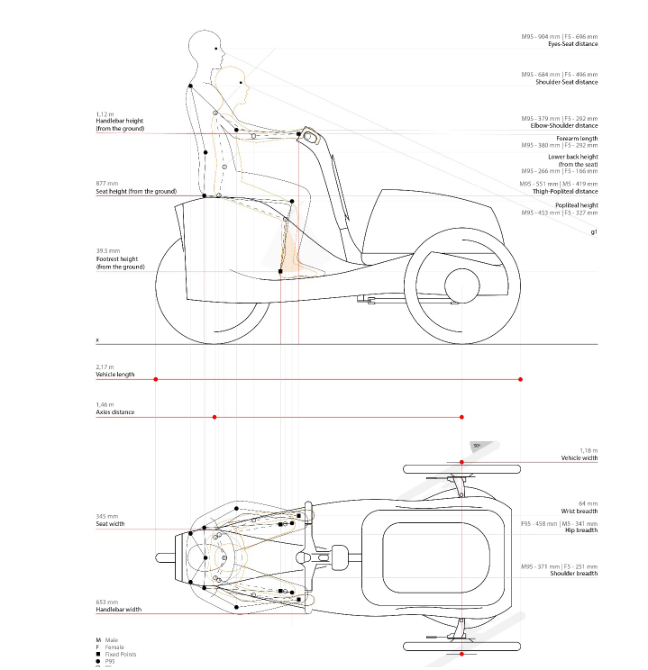
Ergonomic Design Ergonomics constituted a central driver of the vehicle architecture, as comfort, accessibility, and perceived safety are decisive factors for LEV adoption. A semi- recumbent seating posture was adopted to reduce lumbar compression forces, distribute body weight over a larger contact area, and promote a relaxed riding position suitable for extended use. Anthropometric data from Arezes et al. (2005), were used to define key reference points including fixed points (feet and wrists), eye position, and reach envelopes. In addition, joint-to-joint distances (eye-seat, shoulder-seat, shoulder-elbow, elbow-wrist, lower backseat, thigh-popliteal and popliteal-foot) and width of shoulders, hip, and wrists, were applied to ensure adequate reachability, posture comfort and biomechanical compatibility with the control interfaces. The integration of these anthropometric parameters enabled the accommodation of a wide range of users while maintaining appropriate driving posture, control accessibility, and visual field requirements. A digital human model representing 5th percentile female and 95th percentile male users was employed to verify accommodation ranges (Figure 1). A step- through central opening allows users to enter and exit the vehicle without lifting the leg over a high frame member. This feature significantly improves accessibility for elderly users and those with reduced mobility. The seat pan geometry incorporates contoured surfaces to support the ischial tuberosities and reduce localized pressure. Handlebar geometry was designed to minimize wrist deviation, shoulder elevation, and ulnar deviation. The handlebar width and sweep angle were iteratively adjusted using ergonomic analysis to ensure neutral joint postures. Control interfaces were positioned within the primary reach zone to minimize upper-limb fatigue. Pedal-free throttle operation was selected to accommodate users with limited lower-limb mobility.
Geometry-Driven Functionality and Manufacturability One of the most significant advantages of robotic extrusion-based additive manufacturing is the ability to embed multiple functions directly into geometric features. In the proposed vehicle, internal channels for cable routing,
Enhancing Design Flexibility in Electric Vehicles via Robotic Extrusion-Based 73 ventilation ducts, and attachment points were integrated within structural walls, eliminating the need for external conduits and secondary brackets. Curved surfaces were used not only for aesthetic coherence but also to enhance structural stiffness through shell behaviour. The integration of ergonomic and multifunctional surfaces directly into the product platform represents a departure from conventional product assemblies improving overall system reliability. Following concept selection, the vehicle architecture was developed into a high-resolution CAD model. Parametric CAD modelling was employed to allow rapid geometric variation of key dimensions such as track width, wheelbase, seat height, and module interfaces. This parametric approach enabled efficient exploration of design alternatives and supports future mass-customization scenarios. Design for Additive Manufacturing (DfAM) (Gibson et al., 2015; Thompson et al., 2016, Costa et al., 2025) principles were embedded from the earliest design stages. These principles included: (i) continuous deposition paths to maximize interlayer bonding; (ii) avoidance of large unsupported overhangs; (iii) gradual thickness transitions to minimize stress concentrations; and (iv) geometric self-support through curvature and ribbing. Critical interfaces between modules, steering components and body panels were defined. Finite element simulations were performed to assess global stiffness and identify high-stress regions requiring geometric redesign.
Figure 1: Ergonomic envelope and seating posture.
DELIVER PHASE: MANUFACTURING AND VALIDATION This section describes the manufacturing strategy adopted to translate the digital design into a functional physical prototype, emphasizing process planning, parameter selection, and quality control considerations associated with large- scale robotic extrusion.
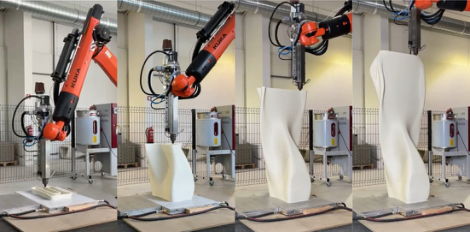
REBAM with pellet-fed extruders was employed for major polymer components (Figure 2). A six-axis industrial robotic arm equipped with a high-throughput extrusion head was used, enabling deposition of thermoplastic material at rates suitable for large structural components. The use of pellet feedstock allows a wider range of materials, including fiber-reinforced compounds and recycled polymers, while reducing material cost. The selected layer height was 3 mm, representing a compromise between surface quality, mechanical performance, and build time. A 4 mm nozzle diameter was employed, producing 10 mm wide deposition beads that promote interlayer bonding and structural continuity.
Build orientation and deposition path planning were critical to achieving acceptable mechanical performance. Principal load directions identified in preliminary simulations were aligned, where possible, with filament deposition paths. Continuous toolpaths were favoured over segmented paths to reduce start–stop defects and improve interlayer adhesion.
Thermal management was addressed through controlled cooling strategies. Forced air cooling and dwell times between layers were used to reduce residual stresses and minimize warpage. Large components were printed in segmented builds and subsequently assembled to accommodate build volume limitations and facilitate handling. Post-processing operations included localized CNC machining of functional interfaces, drilling of mounting holes, and light surface finishing. These operations ensure dimensional accuracy where required while preserving the near-net-shape advantages of additive manufacturing.
This study demonstrates that robotic extrusion-based additive manufacturing can act as a powerful design enabler for light electric vehicles when integrated within a design-driven development methodology. By positioning design at the core of the process and leveraging the geometric freedom of large-scale AM, it becomes possible to explore vehicle architectures that are difficult or impossible to realize using conventional manufacturing.
Enhancing Design Flexibility in Electric Vehicles via Robotic Extrusion-Based 75 The case study highlights the potential of robotic extrusion to support deep ergonomic integration, allowing seating geometry, structural elements, and user interfaces to be embedded into a continuous printed architecture. The modular platform concept further demonstrates how AM enables product families and functional variation without tooling changes, supporting both customization and scalability. From a production perspective, the successful fabrication of a vehicle with more than 80% additively manufactured components confirms the feasibility of REBAM for functional LEV applications. While surface quality and anisotropy remain challenges, the results indicate that these limitations can be managed through design strategies and process optimization. The work contributes to the growing body of knowledge on DfAM by illustrating how its principles can be applied at the vehicle-system level rather than only at the component level. This system-oriented perspective represents an important step toward the broader adoption of AM in transportation design.
Future work will focus on extensive structural testing, long-term durability evaluation, and user trials to quantify comfort, usability, and acceptance. Additional research will also explore multi-material printing and recycled thermoplastics to further enhance sustainability.
ACKNOWLEDGMENT
This work was carried out within the framework of project “ASTREA – Advanced Sensors and Technologies for Robotic Extrusion and Automation”, supported by “Fundo Europeu de Desenvolvimento Regional (FEDER)” through “Sistema de Incentivos à Investigação e Desenvolvimento” Within the scope of the “Programa Operacional para a Competitividade e Internacionalização, of Portugal 2030.
REFERENCES
Arezes, PM., Miguel, AS., Gomes da Costa, L., Barroso, MP., Cordeiro, P. (2005).
Base de dados antropométricos de uma população laboral, Revista Ingenium, Ordem dos Engenheiros, vol. II, nº 88, pp. 64–69. Costa, A., Santos, A., Sampaio, A.M. & Pontes, A.J. (2025). Design and Production of Large-Scale Products by Robotic Extrusion-Based Additive Manufacturing. In B. Mrugalska (Eds.), Industry 4.0 and Intelligent Manufacturing Technologies. (pp. 132–150). Routledge, New York. https://doi.org/10.1201/9781003625360-8 Design Council. (2005). The Double Diamond Design Process Model. London, UK. Fishman, E. (2016). Bikeshare: A review of recent literature. Transport Reviews,
36(1), 92–113. https://doi.org/10.1080/01441647.2015.1033036 Gibson, I., Rosen, D., & Stucker, B. (2015). Additive manufacturing technologies: 3D printing, rapid prototyping, and direct digital manufacturing (2nd ed.). New York, NY: Springer. Shaheen, S., & Cohen, A. (2019). Shared micromobility policy toolkit. Transportation
Sustainability Research Center, University of California, Berkeley. Thompson, MK. et al. (2016). Design for Additive Manufacturing: Trends, opportunities, considerations, and constraints. CIRP Annals, 65(2), 737–760. https://doi. org/10.1016/j.cirp.2016.05.004 Ulrich, K. T., & Eppinger, S. D. (2016). Product design and development (6th ed.).
New York, NY: McGraw-Hill.
LISTED IN THE AHFE DIGITAL BOOKSTORE CATALOGUE
Explore the complete digital volume
Industrial and Systems Engineering
Read this individual research paper free through the original publisher, or explore the full digital proceedings book.
ISBN 978-1-964867-95-3
Explore this ISBN in the AHFE Bookstore ↗Listed in the July 2026 bookstore catalogue; search by ISBN to confirm current availability · Digital book purchase optional