Ramon Angosto Artigues, Andrea Fernández Martínez, Santiago Muíños Landín, Ander Reizábal López-para, Amirmohammad Daareyni, Iñigo Flores Ituarte (2026). Bioinspired Design in Additive Manufacturing: A Review of AI, Multi-Scale Strategies, and Fabrication Constraints. In: Intelligent Human Systems Integration (IHSI 2026): Disruptive and Innovative Technologies. AHFE Open Access, vol. 200, pp. 490–500. https://doi.org/10.54941/ahfe1007108
Bioinspired design represents a paradigm shift in engineering, drawing upon millions of years of evolutionary optimization to create advanced structures and materials. This comprehensive review examines the intersection of bioinspired design principles with additive manufacturing (AM) technologies, focusing on multi-scale strategies and the inclusion of artificial intelligence (AI) to create lightweight, efficient, and multifunctional components. We analyse key biological design principles, including hierarchical organization, lightweight efficiency, and multifunctionality, demonstrating how these can be translated into engineering solutions through AM. The review covers state-of-the-art design strategies, including lattice structures, topology optimization, generative design, and multi-scale modelling approaches, with a particular focus on the constraints imposed by fabrication processes. We examine digital tools that facilitate the translation of biological models into manufacturable designs, including computer-aided design systems and AI platforms. Current challenges in scaling, first-time-right fabrication, and complexity management are critically assessed, along with knowledge gaps in structure-property-process relationships. The outlook section presents future directions for industrial integration, emphasizing the potential for bioinspired AM to revolutionize multiple sectors, from aerospace to biomedical applications
Bioinspired Design in Additive Manufacturing 491 In the context of advanced manufacturing and mechanical design, bioinspired design means leveraging nature’s design principles to create engineered components with superior performance.
Additive manufacturing (AM), or 3D printing, is a key enabling technology for bio-inspired design. Unlike traditional subtractive methods, AM builds objects layer by layer from digital models, allowing unprecedented geometric freedom to fabricate complex, hierarchical structures with high precision (Wei et al., 2023). This layer-wise “bottom-up” fabrication is analogous to how biological structures grow and assemble, making AM especially suited to mimicking nature’s intricate architectures (Kenny, Bapat, Smith, La Scala, & Malshe, 2025). Indeed, additive processes can incorporate fine details across multiple length scales in a single build, from micro- scale lattices to macro-scale shapes, much like organisms that integrate nano-, micro-, and macro-structures seamlessly (Alsheghri et al., 2021; Wei et al., 2023). The significance of this integration cannot be overstated. Traditional manufacturing constraints have historically limited designers to relatively simple geometries, forcing compromises between optimal performance and manufacturability. AM removes many of these constraints, allowing engineers to pursue biomimetic designs that were previously impossible to realize.
This review provides a systematic examination of bioinspired design principles in AM, with particular focus on (i) multi-scale internal structural design, (ii) the integration of AI in design and optimization workflows, and (iii) the constraints and opportunities introduced by contemporary manufacturing processes. Special emphasis is placed on Large-Format Additive Manufacturing (LFAM), as the scalability of bio-inspired architecture remains one of the primary obstacles to their industrial deployment. LFAM provides an essential context in which the challenges of material behavior, process stability, and structural fidelity become most pronounced.
The remainder of the paper is organized as follows. The next section details the methodology employed to identify, select, and analyze the relevant literature. The principal bio-inspired design concepts and their implementation within additive manufacturing workflows are then reviewed. This is followed by a critical discussion of the prevailing challenges and research gaps that constrain broader adoption. The final section summarizes the key insights derived from the review and delineates avenues for future investigation.
REVIEW METHODOLOGY The review was conducted following a structured procedure to ensure comprehensive coverage of the literature on bio-inspired design and additive manufacturing. The bibliographic search was performed in Scopus, Web
of Science (Core Collection), and Google Scholar, covering publications from 2010 to December 2025. The search strategy relied on predefined and systematically applied keyword combinations, iteratively refined as needed: “bioinspired” OR “biomimetic” OR “bio-inspired” AND “additive manufacturing” OR “3D printing” AND (lattice OR TPMS OR cellular OR hierarchical) AND (“topology optimization” OR “generative design” OR “machine learning” OR “reinforcement learning”) AND (“process simulation” OR “Design for AM (DfAM)” OR “large-format additive manufacturing”). Complementary works were identified through systematic backward and forward citation analysis.
Studies were considered eligible for inclusion if they (i) addressed biological principles with direct relevance to engineered structures, (ii) examined computational, material, or manufacturing methods applicable to their realization in AM, or (iii) reported advances that meaningfully contribute to the integration of bio-inspiration within additive manufacturing workflows. Publications lacking methodological rigor, technical depth, or peer review were excluded.
The initial search yielded several hundred records. After removing duplicates and screening titles and abstracts, 120 works were retained for full-text assessment, leading to a final corpus of 34 peer-reviewed publications and authoritative industry resources. Selection prioritized recent comprehensive reviews and seminal primary works (2018–2025), together with earlier foundational references where necessary.
A thematic synthesis was applied to organize the selected literature into conceptual categories: (1) foundational bio-inspired principles (hierarchy, lightweight efficiency, multifunctionality); (2) methodologies for AM translation (lattice and TPMS structures, multi-scale topology optimization, generative design); (3) digital tools and verification (Computer-Aided Design/Engineering (CAD/CAE) integration, process simulation, in-situ inspection); and (4) scalability and industrial constraints (DfAM, LFAM, standardization).
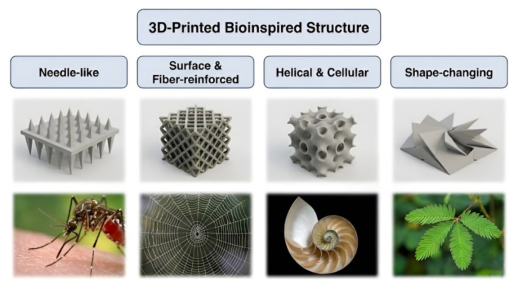
FOUNDATIONAL BIO-INSPIRED PRINCIPLES Biological systems exhibit recurring structural strategies that have been refined by evolution to deliver efficiency, resilience, and multifunctionality. Figure 1 illustrates representative natural motifs, needle-like, fiber- reinforced, helical/cellular, and shape-changing systems, and the corresponding classes of architected geometries they inspire in AM. While nature offers greater diversity, three cross-cutting principles capture the structural abstractions most relevant to AM: hierarchical organization, lightweight efficiency, and multifunctionality. These principles underpin many of the bioinspired structures explored in the literature and form the conceptual basis for the design methodologies reviewed in the following sections.
Figure 1: Overview of different categories of bio-inspiration for 3D-printed structures, showing examples from nature for needle-like, fiber-reinforced, helical, cellular, and shape-changing designs.
Hierarchical Organization Most biological materials exhibit a hierarchy of structure—defined, ordered features at multiple scales from the molecular to the macroscopic (Velasco-Hogan et al., 2018; Wei et al., 2023). For example, bone and wood have a coaxial layered architecture with distinct levels of organization (from nano-scale fibers up to macro-scale hollow beams) that together yield exceptional mechanical properties (Davami et al., 2019; Siddique, Hazell, Wang, Escobedo, & Ameri, 2022). This hierarchical design allows nature to achieve combinations of properties that no single-scale homogeneous material could attain. In engineering, adopting hierarchical design means structuring a component on several scales. Additive Manufacturing makes it possible to fabricate such multi-scale structures; for instance, a part can be printed with microscale lattice infill and a macroscale shape concurrently (Harish et al., 2024; Wei et al., 2023). Research into bone-inspired fiber- reinforced composites has shown that mimicking this hierarchy can lead to enhanced fracture toughness.
Efficiency Evolution drives organisms to achieve required strength and functionality with minimal material usage, as reducing weight is advantageous for mobility and resource economy (Kenny et al., 2025). The natural paradigm of “minimum material for maximum performance” is observed in structures like bird bones (hollow with internal struts) and plant stems (Kenny et al., 2025; Wu, Sigmund, & Groen, 2021). These biological designs often use cellular or porous architectures to save weight while maintaining mechanical integrity. Engineers mimic this by incorporating lightweight lattice structures or voids, often using topology optimization and lattice infill strategies inspired by how bone remodels itself (Kenny et al., 2025).
Multifunctionality In nature, structures rarely serve a single purpose; they often fulfill multiple functions simultaneously. A tree trunk, for example, provides mechanical support, transports fluids, and stores nutrients. This principle drives bioinspired designers to create components that integrate several roles, such as load bearing, energy absorption, and thermal regulation. AM facilitates multifunctional design by allowing complex internal features (like cooling channels or electrical circuits) to be embedded within structural parts. An illustrative biological strategy is the Bouligand structure in certain shells (layers of fibers in a helicoidal stack), which provides high impact resistance and resistance to crack propagation (Wei et al., 2023).
METHODOLOGIES FOR BIO-INSPIRED DESIGN IN AM Translating biological principles into engineered components requires specific design strategies and digital tools. This section reviews the leading methodologies that leverage the geometric freedom of AM. Figure 1 compares representative natural systems with their corresponding classes of architected geometries, illustrating how biological motifs, such as needle- like, fiber-reinforced, helical–cellular, and shape-changing, can be abstracted into design strategies for 3D-printed structures. This mapping sets up the methods that follow in the subsequent sections lightweighting via cellular architectures, load-path-aware topology optimization, and AI-assisted generative design workflows.
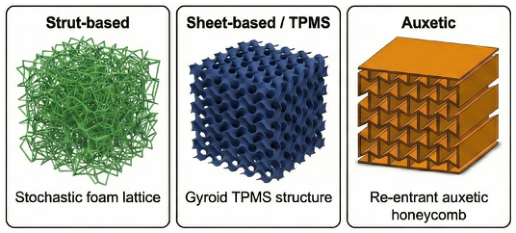
Lattice and Cellular Structures Lattice structures are a cornerstone of bioinspired AM design, mimicking the cellular architectures found in bone, wood, and sponges to achieve high specific strength and energy absorption (Pan, Han, & Lu, 2020). Bio-inspired lattice design often begins by identifying a natural cellular structure with desirable properties. For example, 3D-printed models inspired by the Euplectella sea sponge’s diagonally reinforced skeleton showed significantly improved buckling resistance (Wei et al., 2023). Recent research has demonstrated a systematic bioinspired lattice design by copying the internal microstructures of beetle elytra (forewings) and the mantis shrimp dactyl club (Harish et al., 2024). The mantis shrimp’s club is renowned for its extreme impact resistance, derived from a helicoidal (Bouligand) fiber structure. By translating these biological microstructures into lattice unit cells and 3D printing them, studies found significantly improved mechanical performance. This highlights an emerging trend of creating hybrid lattices that merge features from multiple biological sources to achieve controlled failure modes and optimized performance. To ground this discussion, Fig. 2 shows a few digital “unit-cell examples” commonly used in AM, the same palette of primitives referenced throughout this subsection.
Figure 2: Representative digital unit-cell library for additive manufacturing, spanning strut-based, sheet-based/TPMS, auxetic and graded architectures used to tailor stiffness, strength and energy absorption prior to fabrication.
From a multi-scale perspective, lattice structures can be designed hierarchically. For instance, a lattice strut can themselves be composed of a finer lattice (a meta-lattice), creating a hierarchy of two or more scales. Such hierarchical lattices have been shown to achieve superior properties like higher energy absorption for the same relative density, though they push the limits of manufacturability and require advanced AM processes to realize without flaws (Wei et al., 2023).
Topology Optimization (TO) This computational technique optimizes material layout within a given design space and is closely associated with biomimicry because its free-form, organic outputs often resemble natural structures. Methodologically, TO typically works on a meshed domain, using algorithms like SIMP (Solid Isotropic Material with Penalization) or level-set methods to iteratively redistribute material density. The process emulates nature’s evolutionary refinement by reinforcing load paths, a concept directly inspired by biological processes like bone remodeling (Wolff’s Law) (Alsheghri et al., 2021; Velasco-Hogan et al., 2018).
New research is extending TO in bioinspired ways. Multi-scale TO concurrently optimizes both the macro-scale shape and the microstructural topology (e.g., a lattice infill pattern), mirroring nature’s hierarchical optimization (Wu et al., 2021). Multi-objective TO aims for multifunctionality by incorporating multiple physics into optimization, such as balancing mechanical stiffness with thermal conductivity. A critical aspect of modern TO is the integration of manufacturing constraints (e.g., minimum feature size, overhang angle limits) to ensure the final design is directly manufacturable via AM (Ryan-Johnson, Wolfe, Byron, Nagel, & Zhang, 2021).
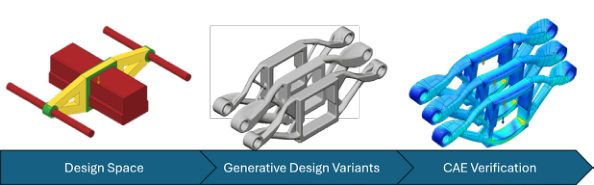
Generative Design and Artificial Intelligence Generative design algorithms automatically produce a multitude of design alternatives based on performance criteria and constraints, a process analogous to natural evolution. This is exemplified by software inspired by the growth patterns of slime mold and the structure of human bones (‘AskNature’, 2016). Figure 3 illustrates a generative design workflow applied to the
exploration of multiple train bogie design variants. The example reflects a broader trend in engineering practice in which generative design is integrated with performance evaluation and multi-objective decision-making, enabling the identification of balanced trade-offs among mass, structural integrity, and life span rather than solutions optimized for a single criterion (Daareyni, Queguineur, Mokhtarian, Asadi, & Ituarte, 2024).
Recently, machine learning (ML) and reinforcement learning (RL) have been integrated into this process. For instance, Kumar et al. (2025) demonstrated an RL-based framework where an AI agent learned to generate optimal material layouts, achieving up to 40% weight reduction compared to conventional TO while respecting manufacturing constraints (Sun & Ma, 2020).
Figure 3: Generative design framework for a train bogie as case study.
Multi-Scale Modelling and Simulation Bioinspired designs inherently involve multiple length scales, which poses a significant challenge for modelling. Multi-scale modelling techniques, such as homogenization, are used to predict the macro-scale performance of components with complex microstructures like lattices, thereby reducing computational cost. A critical and related tool is the simulation of the AM process itself. Given that bioinspired designs often contain thin and complex features, they can be particularly susceptible to thermal distortion and residual stress during printing. Process simulations are therefore crucial for predicting and mitigating these issues, enabling first-time-right fabrication (Colosimo, Grasso, Garghetti, & Pagani, 2024).
DIGITAL TOOLS FOR TRANSLATING BIO-INSPIRATION Implementing bioinspired designs requires advanced digital tools to model, analyze, and realize them. The rise of computational design software and AI is providing engineers with the means to handle the complexity of biomimetic structures.
Computer-Aided Design and Engineering (CAD/CAE) Modern CAD software has evolved to accommodate the complex organic geometries prevalent in bio-inspired designs. Parametric and implicit modelling techniques allow for the creation of shapes with curved surfaces
Bioinspired Design in Additive Manufacturing 497 and intricate internal details. Many CAD programs now include dedicated lattice generation tools for filling volumes with predefined or custom cell topologies (e.g., gyroid, Voronoi) . On the analysis side, CAE tools like finite element analysis are essential for virtually verifying the performance of these complex designs under expected loads. Recent work highlights that integrated CAD–CAE frameworks enable early performance assessment and informed decision-making across design and manufacturing stages, forming a key enabler of sustainability-by-design and digital-twin-based workflows (Daareyni, Ylä-Autio, Martikkala, Mokhtarian, & Ituarte, 2026; Ituarte, Pagone, Daareyni, Thayapararajah, & Tosello, 2025).
Generative Design Software Commercial software packages from companies like Autodesk, nTopology, and Siemens allow engineers to input goals and constraints, then automatically explore a vast design space. These tools often use TO and other algorithms under the hood but provide a user-friendly interface. A key feature is the ability to impose manufacturing processes as a constraint, ensuring the biomorphic forms generated are manufacturable. These tools effectively act as a co-designer, accelerating the translation of a concept to a detailed, optimized, and printable design.
Machine Learning and AI in Design Beyond generative algorithms, AI supports bio-inspired design in several ways. Shape recognition and retrieval algorithms can help convert 3D scan data from a biological structure into a usable CAD model. Generative AI models can also learn from a database of biological shapes to produce novel hybrid designs. The RL framework for topology optimization (Sun & Ma, 2020) demonstrates how AI agents can automate complex design tasks, effectively learning design principles through simulated trial and error. This points toward a future where AI-powered knowledge-based systems could suggest bio-inspired solutions from a “Biological Design Toolbox” based on an engineer’s problem statement.
DISCUSSION, CHALLENGES AND FUTURE WORK The literature review reveals that despite significant progress, several barriers still limit the widespread adoption of bioinspired additive manufacturing (AM). Scaling bioinspired designs from prototypes to industrial components remain challenging, as geometric complexity, printer limitations, and insufficiently mature Design for AM (DfAM) guidelines frequently lead to distortion, residual stresses, and difficulties in achieving first-time- right fabrication. In parallel, the design space itself is inherently complex: although biological systems inspire highly efficient architectures, systematic methodologies to identify, abstract, and implement beneficial principles are still lacking. Consequently, bioinspired structures are often over-engineered or disconnected from manufacturing constraints. A further challenge
concerns the limited understanding of structure–property relationships in novel bioinspired geometries. Long-term behavior—such as fatigue, creep, and damage evolution—remains insufficiently characterized, and the absence of standardized testing protocols or design codes restricts adoption in safety- critical sectors.
Looking ahead, the industrial relevance of bioinspired AM is expected to increase across domains such as aerospace, biomedical devices, and consumer products, where lightweight and multifunctional components offer clear advantages. Progress will be strongly supported by advances in automation and artificial intelligence, with future CAD and simulation tools likely to embed bioinspiration libraries and AI-assisted optimization workflows, enabling engineers to specify performance targets while receiving validated, manufacturable design candidates. Finally, broader industrial uptake will require updated standards and dedicated education efforts. Evolving certification frameworks and integrating bioinspiration and AM design principles into engineering curricula are essential steps toward building a workforce capable of applying these interdisciplinary approaches at scale.
CONCLUSION
The synthesis of bioinspired design principles with additive manufacturing, supercharged by artificial intelligence, offers a transformative pathway for engineering. By emulating nature’s time-tested strategies—such as hierarchical structures, lightweight efficiency, and multifunctionality—engineers can create components with unprecedented performance. Methodologies like lattice structuring, topology optimization, and generative design are the primary tools for this translation, allowing for the creation of complex, optimized forms that were previously unmanufacturable. While significant challenges remain in scalability, quality control, and managing design complexity, the trajectory is clear. The continued development of digital tools, coupled with a deeper understanding of structure-property relationships and the establishment of new standards, will drive the transition of bioinspired AM from a research frontier to a mainstream industrial reality. This paradigm promises not only more efficient and resilient products but also a more sustainable approach to engineering, grounded in the principle of achieving maximum function with minimal resources.
ACKNOWLEDGMENT
This work has been supported by the project “Organic Biological Transformation Of Additive Manufacturing Processes For The Sustainable Manufacturing Of Bio-Inspired Products” (ORGANIC), which has received funding from the European Union’s Horizon Europe research and innovation programme under grant agreement No. ID: 101178127. Views and opinions expressed are however those of the author(s) only and do not necessarily reflect those of the European Union or HADEA. Neither the European Union nor the granting authority can be held responsible for them.
REFERENCES
Alsheghri, A., Reznikov, N., Piché, N., McKee, M. D., Tamimi, F., & Song, J.
(2021). Optimization of 3D network topology for bioinspired design of stiff and lightweight bone-like structures. Materials Science and Engineering C, 123. doi: 10.1016/J.MSEC.2021.112010. Colosimo, B. M., Grasso, M., Garghetti, F., & Pagani, L. (2024). On-Line Inspection of Lattice Structures and Metamaterials Via In-Situ Imaging in Additive Manufacturing. doi: 10.2139/SSRN.4830413. Daareyni, A., Queguineur, A., Mokhtarian, H., Asadi, R., & Ituarte, I. F. (2024).
Multi-objective Optimization-Driven Design: Generative Design Approach for Manufacturing of a Train Bogie. Lecture Notes in Mechanical Engineering, 48–55. doi: 10.1007/978-3-031-74485-3_6. Daareyni, A., Ylä-Autio, A., Martikkala, A., Mokhtarian, H., & Ituarte, I. F.
(2026). Combining data-driven and model-driven methods to support digital- twin engineering design: A case study for the (Re)design optimization of a quadcopter. Expert Systems with Applications, 296, 129113. doi: 10.1016/J. ESWA.2025.129113. Davami, K., Mohsenizadeh, M., Mitcham, M., Damasus, P., Williams, Q., & Munther, M. (2019). Additively Manufactured Self-Healing Structures with Embedded Healing Agent Reservoirs. Scientific Reports 2019 9:1, 9(1), 7474. doi: 10.1038/ s41598-019-43883-3. Generative Design Software Inspired by Slime Mold and Human Bones — Innovation
— AskNature. (n.d.). Retrieved 15 December 2025, from https://asknature.org/ innovation/generative-design-software-inspired-by-slime-mold-and-human- bones/. Harish, A., Alsaleh, N. A., Ahmadein, M., Elfar, A. A., Djuansjah, J., Hassanin, H., … Essa, K. (2024). Designing Lightweight 3D-Printable Bioinspired Structures for Enhanced Compression and Energy Absorption Properties. Polymers 2024, Vol. 16, Page 729, 16(6), 729. doi: 10.3390/POLYM16060729. Ituarte, I. F., Pagone, E., Daareyni, A., Thayapararajah, S., & Tosello, G. (2025).
Enabling sustainability-by-design with multi-disciplinary computer aided systems. CIRP Annals, 74(1), 209–213. doi: 10.1016/J.CIRP.2025.03.019. Kenny, V., Bapat, S., Smith, P., La Scala, J., & Malshe, A. P. (2025). Bioinspired Designs for Lightweighting, a Critical Review for Manufacturing. Biomimetics 2025, Vol. 10, Page 150, 10(3), 150. doi: 10.3390/BIOMIMETICS10030150. Kumar N, K., C M, M., Kumar B K, P., & Bali, M. (2025). Reinforcement learning-
based topology optimization for generative designed lightweight structures. MethodsX, 15, 103539. doi: 10.1016/J.MEX.2025.103539. Kunkel, M. E., Sauer, A., Isaacs, C., Ganga, T. A. F., Fazan, L. H., & Keller Rorato, E. (2025). Teaching Bioinspired Design for Assistive Technologies Using Additive Manufacturing: A Collaborative Experience. Biomimetics (Basel, Switzerland), 10(6). doi: 10.3390/BIOMIMETICS10060391. N. Musthafa, H. S., & Walker, J. (2024). Design of Trabecular Bone Mimicking
Voronoi Lattice-Based Scaffolds and CFD Modelling of Non-Newtonian Power Law Blood Flow Behaviour. Computation, 12(12), 241. doi: 10.3390/ COMPUTATION12120241/S1. Narongdej, P., Yuhasz, B., Kong, T., Rojas, D., Peng, Q., & Barjasteh, E. (2025). Machine learning-aided lattice optimization for ultra-lightweight 3D-printed aligners. Materials & Design, 254, 114139. doi: 10.1016/J.MATDES.2025.114139.
Pan, C., Han, Y., & Lu, J. (2020). Design and Optimization of Lattice Structures: A Review. Applied Sciences 2020, Vol. 10, Page 6374, 10(18), 6374. doi: 10.3390/ APP10186374. Ryan-Johnson, W. P., Wolfe, L. C., Byron, C. R., Nagel, J. K., & Zhang, H. (2021).
A Systems Approach of Topology Optimization for Bioinspired Material Structures Design Using Additive Manufacturing. Sustainability 2021, Vol. 13, Page 8013, 13(14), 8013. doi: 10.3390/SU13148013. Siddique, S. H., Hazell, P. J., Wang, H., Escobedo, J. P., & Ameri, A. A. H. (2022).
Lessons from nature: 3D printed bio-inspired porous structures for impact energy absorption – A review. Additive Manufacturing, 58, 103051. doi: 10.1016/J. ADDMA.2022.103051. Sun, H., & Ma, L. (2020). Generative Design by Using Exploration Approaches of Reinforcement Learning in Density-Based Structural Topology Optimization. Designs 2020, Vol. 4, Page 10, 4(2), 10. doi: 10.3390/DESIGNS4020010. Velasco-Hogan, A., Xu, J., Meyers, M. A., Velasco-Hogan, A., Meyers, M. A., &
Xu, J. (2018). REVIEW 1800940 (1 of 26) Additive Manufacturing as a Method to Design and Optimize Bioinspired Structures. doi: 10.1002/adma.201800940. Wei, J., Pan, F., Ping, H., Yang, K., Wang, Y., Wang, Q., & Fu, Z. (2023). Bioinspired Additive Manufacturing of Hierarchical Materials: From Biostructures to Functions. Research, 6. doi: 10.34133/research.0164;pagegroup:string:publication. Wu, J., Sigmund, O., & Groen, J. P. (2021). Topology optimization of multi-scale
structures: a review. Structural and Multidisciplinary Optimization 2021 63:3, 63(3), 1455–1480. doi: 10.1007/S00158-021-02881-8.
LISTED IN THE AHFE DIGITAL BOOKSTORE CATALOGUE
Explore the complete digital volume
Intelligent Human Systems Integration (IHSI 2026): Disruptive and Innovative Technologies
Read this individual research paper free through the original publisher, or explore the full digital proceedings book.
ISBN 978-1-964867-76-2
Explore this ISBN in the AHFE Bookstore ↗Listed in the July 2026 bookstore catalogue; search by ISBN to confirm current availability · Digital book purchase optional