Udit Shivansh, Saptarshi Kolay, Vivek Jain (2026). Application of Generative design in Urban Planning. In: Human Factors in Architecture, Sustainable Urban Planning and Infrastructure. AHFE Open Access, vol. 229, pp. 209–219. https://doi.org/10.54941/ahfe1007969
Generative design is reshaping urban planning, becoming a major theme in modernisation; however, many aspects of this development are disjointed, with many methods and application areas scattered across the field. Performing this systematic review of literature, we integrated the adoption of generative techniques showing the transition from initial parametric rule-based systems to recent deep learning models, and found the main topics in the publications. Following PRISMA rules, our focused search and screening procedure resulted in 175 peer-reviewed papers that were classified according to eight main areas of investigation. The data shows a distinct move from using simple parametric rules to designing urban forms through probabilistic generative adversarial networks (GANs) and diffusion models; the considerable amount of performance-based design literature focusing on optimising energy consumption, environmental quality and mobility; and participatory planning gradually adopting human-in-the-loop generative systems, but scalability remains problematic. The use of large language models (LLMs) for policy simulation is an initial area that is growing very fast. Unfortunately, the problem of measuring effectiveness and considering ethics, such as bias, transparency, and accountability, is very weak across this research field. This paper posits that even when generative design can automate and improve urban planning processes to a great extent, substantial problems still exist in the lack of standard evaluation frameworks, ethical guidelines and the genuine interweaving of human agency. Future research should therefore prioritise robust validation methods and participatory governance models to ensure that generative urbanism delivers equitable and sustainable urban outcomes.
Urban planning has always struggled with designing intricate, multi-scale systems that have to meet a variety of social, economic, environmental, and aesthetic requirements that often conflict with one another. Traditional planning methods, which are based on linear, hierarchical processes and manual drafting, are now deemed by some to be hardly the right tool to solve the challenges of modern urbanism, such as a booming population, climate change, and the need for social equality (Vanessa Watson, 2007). Computer- aided design techniques have gradually become a part of the planning sector, and among them, generative design stands out as an especially attractive model. One of the main features that sets generative design apart is that it Received May 8, 2026; Revised June 5, 2026; Accepted June 23, 2026; Available online July 20, 2026
can generate a wide range of design options on its own using as input only the setting of objectives, identification of constraints, and the writing of rules (Dean & Loy, 2020). Therefore, it is a radical change in the planner-machine interaction model.
Generative design for urban problems was originally conceived after some experiments with parametric modelling and shape grammars in the 1970s and 1980s, when designers tried to abstract design logic through rule-based formal systems (Stiny & Gips, 1972). Later, evolutionary computing got involved, including genetic algorithms that searched for the best solutions in the highly complex design space (Rooker, 1991). Deep learning introduction, especially GANs and diffusion models, led to the very rapid growth of the discipline to an extent that was unimaginable (Goodfellow et al., 2014; Ho et al., 2020). Based on the modelling of very complex probability distributions from large amounts of urban form data, these networks gave rise to the production of highly credible and novel urban plans, building patterns, and street networks, which were not bound by the limitations of hand-coded rules.
Even though technology is advancing at great speed, using generative design in urban planning is still a very disorganised process. There is a very large research gap as there is no united framework combining different methodology strands - parametric rules to deep learning - and with real planning issues, ethics and governance. Ethics of using generative AI in a domain that has a major impact on people’s lives, including algorithmic bias, transparency and accountability, are very much neglected (Sanchez et al., 2025). This systematic literature review fills these research gaps by offering a detailed overview of the whole field of study.
METHODOLOGY
This review was guided by the Preferred Reporting Items for Systematic Reviews and Meta-Analyses (PRISMA) framework (Page et al., 2021). There were four steps involved: deciding on the protocol and search strategy; categorizing research themes into eight dimensions; determining the inclusion/ exclusion criteria; and the study selection with quality assessment.
Search Strategy and Databases Five major academic databases were searched: IEEE Xplore, Scopus, Web of Science, ACM Digital Library, and Google Scholar. The core Boolean query was: (“generative design” OR “parametric design” OR “algorithmic design” OR “computational design”) AND (“urban planning” OR “city planning” OR “urban design” OR “spatial planning”). Review articles, surveys, and meta-analyses were excluded via a negative clause. The search was conducted in January 2026 with no lower date restriction, capturing the full historical evolution of the field.
Thematic Dimensions and Inclusion Criteria Eight major research dimensions were identified iteratively from an initial scoping review: (1) the evolution of generative methodologies from parametric
Application of Generative Design in Urban Planning 211 rules to deep learning; (2) urban form synthesis through GANs and diffusion models; (3) performance-driven design optimising energy, environment, and mobility; (4) participatory planning and human-in-the-loop systems; (5) large language models and generative AI for policy and governance; (6) evaluation frameworks, metrics, and ethical considerations; (7) applications in landscape architecture, heritage, and specific urban typologies; and (8) research trends across the field.
Our selection criteria for the studies were that: they specifically addressed generative parametric algorithmic, or computational design in the urban planning context; they were peer-reviewed articles written in English published until January 2026; and they reported empirical simulation case study, or theoretical work. On the other hand, review articles, articles focusing only on non-urban design, those without sufficient methodological details, duplicates, or editorials or opinion pieces were excluded from consideration.
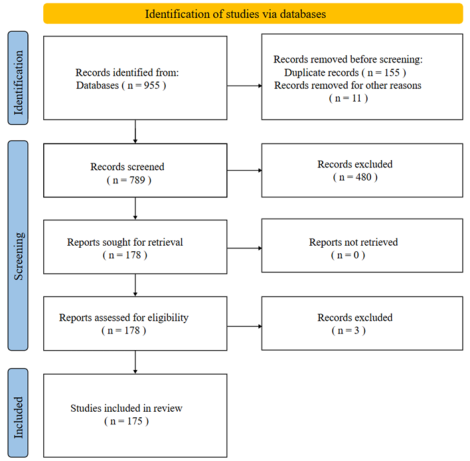
Study Selection The four-stage PRISMA selection process was as follows: in total, 955 records were found in five databases; after the removal of 155 duplicates and 11 records for other reasons (e. g., a retracted article or an article that was not accessible), 789 records were left for title and abstract screening, of which 480 were excluded as obviously irrelevant. All 178 reports that were requested for retrieval have been obtained successfully; 3 were thereafter excluded after a full-text eligibility assessment, giving rise to 175 studies that have been included in the final review.
Figure 1: PRISMA flowchart of the study selection process.
The main limitations are: a language bias because only English studies were considered; some studies with different terminologies may have been overlooked; grey literature was not considered; and, even though two reviewers assessed independently, screening is a subjective process.
RESULTS
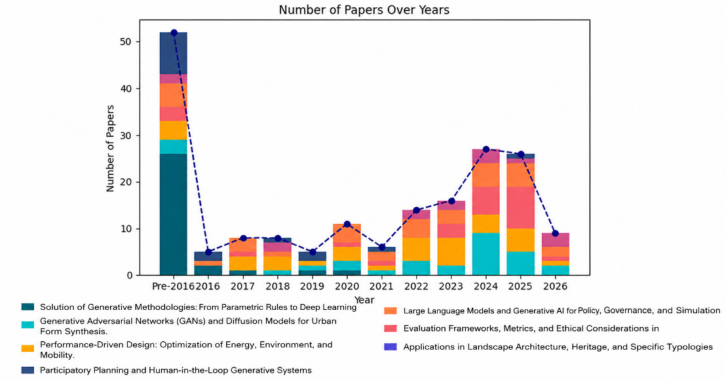
Research Trends The 175 publications studied show a field with extensive historical roots but a significant recent growth. Before 2016, there were 43 publications that laid the foundation period during which genera tive ideas were mainly implemented through parametric rules, shape grammars, and first-stage evolutionary algorithms. The yearly pub lication numbers during 2016–2021 were between three and eleven, which may indicate a phase that was only making small improve ments. From 2022 onwards, a distinct turning point can be seen; the numbers are growing dramatically from 14 in 2022 to 27 in 2024 and 26 in 2025. This increase is related to the development and large-scale use of deep generative models, in particular GANs and diffusion models (Goodfellow et al., 2014; Ho et al., 2020). The field is therefore moving from the research and development stage to a stage of rapid growth and diversification.
Figure 2: Research trends in the domain of application of generative design in urban planning.
From Parametric Rules to Deep Learning: A Methodological Trajectory The earliest generative techniques were based on rule-based and parametric systems. Beirão et al. (2010) suggested that the design decisions of urban planners could be encoded into generative design patterns, thus transforming the implicit knowledge of professionals into a computational system. Ventura & Giuffrida (2016) brought forward a pattern that is value-generative for the process of restoration of urban fabric in historic towns. Such systems were deterministic, thus transparent and controllable, but lacked in terms of novelty. Parametric methods were further developed by Kitchley & Srivathsan (2014), who designed a tool for planning conceptual settlements,
Application of Generative Design in Urban Planning 213 and by Pellitteri et al. (2010), who built an interactive generative system based on urban regulation.
Evolutionary and optimization algorithms allowed the implementation of stochastic search capability. For example, the GENE_ARCH system (Caldas, 2006) used a genetic algorithm to evolve building and urban forms that complied with multiple performance criteria. Agent-based modelling and cellular automata for urban morphogenesis involve a bottom-up generative logic (Popov, 2011), where complex patterns emerge from simple, locally defined agents; the role of the designer is fundamentally rethought. The biggest paradigm shift has been the acceptance of GANs and diffusion models, which, by learning the underlying probability distribution of training datasets, generate novel samples that are not bound by hand-coded rules. Such a move has greatly diversified the generative urban design field while raising new challenges: the need for extensive training datasets, the complexity of interpreting the learned generative process, and the possibility of reproducing the biases of the training data.
GANs and Diffusion Models for Urban Form Synthesis Twenty-nine studies are included that use GANs and diffusion models for the synthesis of urban forms. Noyman & Larson (2020a) created an urban design tool for participatory use that employed generative image methodology to facilitate real-time prototyping and visualisation. UDGAN, in particular, was created as a tool for urban design inspiration, producing novel layouts of urban areas (Gan et al., 2024). At the level of a block, GANs have been employed to generate designs of urban blocks that improve wind conditions at the pedestrian level through the use of CFD-based performance criteria integrated into the generative process (Li et al., 2024). MaskPLAN, a masked generative model for layout planning, is capable of producing complete designs from partial inputs - this is especially useful for interactive design scenarios (Zhang et al., 2024).
Diffusion models are better in terms of training stability and quality of output than GANs. Wang et al. (2025) used them to synthesise satellite images for urban planning purposes. RECITYGEN, an interactive participatory urban design tool, uses latent diffusion models together with the Segment Anything model so that users can guide the generation process interactively (Mo et al., 2026). Dual-stage flows-based modelling approach for traceable urban planning is an interesting concept that uses diffusion models in order to make sure that the generated plans are not only realistic but also interpretable and traceable to the input conditions (Hu et al., 2024). Besides form generation, GANs and diffusion models have also been used in urban morphology prediction, simulation of environmental performance (traffic noise mapping, sunlight access computation), and high-definition map generation, which incorporates urban planning features such as connectivity and node density.
Performance-Driven Design: Optimisation of Energy, Environment, and Mobility A big chunk of research has been conducted on using generative design for improving specific urban performance metrics. These works combine generative algorithms with quantitative simulation and optimisation to generate designs that are not only new but also capable of outperforming according to certain criteria. Optimising energy performance is by far the most advanced area, where parametric rule-based systems and evolutionary algorithms are mainly used for designing building envelopes, urban block massing, and neighbourhood layout (Frazer et al., 2002). Han et al. (2020) used deep reinforcement learning for performance-based urban block design, incorporating the visual perception of the built environment into the optimisation process — a step closer to human-centric generative design. These works as a whole illustrate that performance-based methods are not limited to technical metrics only but can also capture the subjective and experiential aspects of urban life (Li et al., 2024).
Participatory Planning and Human-in-the-Loop Generative Systems Integrating human agency into generative design workflows is a huge challenge in the evolution of design tools. Solely relying on AI to generate urban forms may lead to designs that may be the most efficient from a technical perspective, but could be socially or culturally alien. A case in point is WeDesign, a generative AI-assisted community consultation platform for urban public space design, that illustrates how AI can balance different stakeholder preferences and come up with consensus-based proposals (Mushkani et al., 2025). Generative and participatory parametric frameworks for multi-player design games have turned the planning activity into a collaborative one, where a number of stakeholders can together change the generative parameters (Bier & Ku, 2013).
The governance, policy, and ethical side of participatory generative systems bring up some very challenging questions. The concerns about generative AI becoming “oracles” for anticipatory urban governance, with issues such as accountability, transparency, and the centralisation of decision-making power in non-transparent algorithmic systems, have been the subject of discussion in the literature (Cugurullo & Xu, 2025). One major problem that cuts across this track is the issue of scalability: most of the participatory generative design research has been done with small groups or in a single location, and the question of how to really engage different stakeholders at a city-wide level is still open.
Large Language Models for Policy, Governance, and Simulation Using large language models and generative AI for policy making, governance, and urban simulation is the least developed but fastest growing thematic area at present. Architext, a language-based generative architectural design system, lets users create architectural designs by simply describing them in text- this is basically using LLMs to generate spatial forms (Galanos et al., 2023). Agent-based urban simulation models incorporating generative AI
Application of Generative Design in Urban Planning 215 with retrieval-augmented generation (RAG) make it possible to simulate the complex behaviours of humans in the urban environment (Bruzzone et al., 2023). Visualisation tools such as DeepScope for real-time generation of cityscapes, and Generativr for virtual reality spatial interaction with generative design spaces, constitute another cluster (Noyman & Larson, 2020b; Jennings et al., 2022). One of the major issues is the lack of strong frameworks for the validation of planning outputs based on LLM or for making sure that planning outputs do not carry over the biases of the training data.
Evaluation Frameworks, Metrics, and Ethical Considerations The assessment of generative design outputs for urban planning is a major missing piece. On one hand, with the wide range of generative methods that came out, on the other hand, there is no agreement on how to evaluate a generated urban design in terms of quality, suitability, or fairness. The existing methods are scattered: computer vision-based quantitative image quality metrics (e.g. Fréchet Inception Distance) taken from computer vision are not the best way to measure urban design quality; expert-based qualitative assessment is hard to reproduce; and performance simulation is lacking contextual fit or stakeholder satisfaction. None of the papers surveyed put forward a thorough, all-in-one evaluation framework that includes technical performance, contextual appropriateness, stakeholder satisfaction, and ethical considerations at the same time. Ethics-related issues were only mentioned in a limited number of studies (algorithmic bias, transparency, accountability, and the risk of cultural homogenization), but were done without reference to existing AI ethics frameworks and quite inconsistently (Yelken Kar et al., 2026). The lack of a clear ethical framework for generative urbanism, and the broader challenge of ensuring trustworthy AI in urban policy contexts, are critical priorities for the field (Calzada, 2025).
Applications in Landscape Architecture, Heritage, and Specific Typologies One clear area of focus is the use of generative techniques in different specialised domains. For example, CycleGANs have been applied in landscape architecture to generate plant scape plans from spatial layout types and design elements. In the field of heritage conservation, generative rules combined with evaluative criteria have been used to lead preservation strategies in historic towns (Ventura & Giuffrida, 2016). This is an example of how generative design can be a tool for cultural preservation, rather than destruction. Generative design projects applied to urban scale, domain-specific systems for modular housing arrangement, and sustainable architecture tools are a few examples that collectively demonstrate to us that the future of generative urbanism is not one single model but rather a diverse ecosystem of specialised tools for different planning contexts and design traditions.
DISCUSSION
The analysis of 175 studies illustrates that, on one hand, the post parametric architecture field is developing rapidly and is presenting significant research opportunities, but on the other hand, it is also fragmented, and it has a lot of tensions that have not yet been worked out. The changeover from parametric rules to deep learning involves more than just technical progress: it is, in fact, a fundamental change in the nature of knowledge. In the beginning, rule-based systems explicitly implemented design logic defined by humans; the generative process was transparent and interpretable, whereas nowadays, deep generative models only learn data patterns, producing results that are statistically plausible, but the internal reasoning remains opaque to external interpretation. In other words, these changes will impact to a large extent the way planners are going to trust, criticise, and control generative design tools.
Another contradiction that keeps coming up is the automation versus human agency conflict. A number of studies regarding performance-driven design show that generative algorithms can, in fact, optimise for quantifiable metrics to a great extent; however, these optimisations are often done by downplaying human judgment. Participatory planning studies try to reintroduce human agency by means of human-in-the-loop systems, but the question of city scale is still a very big unknown in terms of scalability. The appearance of LLMs and the use of generative AI for policy and governance are a major development that goes well beyond the mere physical form synthesis and call for a deeper and broader debate about the issues of accountability, transparency and concentration of decision-making power in secretive algorithmic systems (Cugurullo & Xu, 2025), which have not yet been solved by the early literature.
The most pressing discovery is the lack of standardised evaluation frameworks and comprehensive ethical guidelines. Without frameworks that integrate technical performance, contextual fit, stakeholder satisfaction, and ethical considerations, one cannot determine if generative design tools really create better urban environments. This gap is even more worrying considering the very nature of urban planning decisions, which influence communities’ health, safety, and well-being for a long time. The formulation of institutional guidelines concerning the responsible use of generative AI in planning codes is a matter of high priority. This review is a call to policymakers to set regulatory frameworks that would require generative AI systems used in planning to be validated and audited independently. Besides, researchers are most in need of multi-dimensional evaluation frameworks, scalable participatory design systems, longitudinal impact studies, as well as systematic ethical investigations based on AI ethics and critical urban studies.
CONCLUSION
This systematic literature review has analysed the rapidly changing field of generative design in urban planning by summarising 175 papers in eight thematic areas. We identify a direct path from deterministic parametric rules to probabilistic deep learning models, with GANs and diffusion models presently leading the production of urban form. The largest part of the research is on performance-driven optimisation; however, participatory planning and
Application of Generative Design in Urban Planning 217 ethical issues are very insufficiently developed. Besides generating physical forms, the area now also includes policy simulation via LLMs, which is a major step forward for the generative paradigm.
Generative tools give designers enormous ability to examine many design alternatives and optimise according to measurable parameters. However, the successful implementation of such tools demands close attention to human control and the suitability of the context. The lack of standardised evaluation frameworks and the absence of comprehensive ethical guidelines are the main problems that research still faces. Consequently, we invite future research to focus on multi-dimensional and integrated methods of validation combining technical performance with stakeholder satisfaction and equity considerations. It is vital to have longitudinal studies that follow the real- world effects and interdisciplinary teams of computer scientists, planners, and ethicists to guarantee that generative urbanism leads to fair and sustainable outcomes and does not just replicate existing biases and power structures through automation.
REFERENCES
Beirão, J., Mendes, G., Duarte, J., & Stouffs, R. (2010). Implementing a generative urban design model: Grammar-based design patterns for urban design. Proceedings of the International Conference on Education and Research in Computer Aided Architectural Design in Europe, 265–274. https://doi.org/10.52842/CONF. ECAADE.2010.265 Bier, H., & Ku, Y. (2013). Generative and participatory parametric frameworks for
multi-player design games. Footprint, 7(2), 1–10. Bruzzone, A., Giovannetti, A., Genta, G., & Cefaliello, D. (2023). Generative AI and Retrieval-Augmented Generation (RAG) in an Agent-Based Simulation Framework for Urban Planning. https://doi.org/10.46354/i3m.2024.mas.021 Caldas, L. (2006). GENE_ARCH: An evolution-based generative design system for
sustainable architecture. Lecture Notes in Computer Science (Including Subseries Lecture Notes in Artificial Intelligence and Lecture Notes in Bioinformatics), 4200 LNAI, 109–118. https://doi.org/10.1007/11888598_12 Calzada, I. (2025). Generative AI and the urban AI policy challenges ahead: Trustworthy for whom? Transforming Government: People, Process and Policy, 1–17. https://doi.org/10.1108/TG-08-2025-0240/1320724 Cugurullo, F., & Xu, Y. (2025). When AIs become oracles: Generative artificial
intelligence, anticipatory urban governance, and the future of cities. Policy and Society, 44(1), 98–115. https://doi.org/10.1093/polsoc/puae025 Dean, L., & Loy, J. (2020). Generative Product Design Futures. The Design Journal, 23(3), 331–349. https://doi.org/10.1080/14606925.2020.1745569 Frazer, J., Frazer, J., Liu, X., Tang, M., & Frazer, P. (2002). Generative and evolutionary
techniques for building envelope design. Generative Art Conference Proceedings, 3–4. Galanos, T., Liapis, A., & Yannakakis, G. N. (2023). Architext: Language-driven generative architecture design. arXiv preprint arXiv:2303.07519. Gan, W., Zhao, Z., Wang, Y., Zou, Y., Zhou, S., & Wu, Z. (2024). UDGAN: A
new urban design inspiration approach driven by using generative adversarial networks. Journal of Computational Design and Engineering, 11(1), 305–324. https://doi.org/10.1093/jcde/qwae014
Goodfellow, I. J., Pouget-Abadie, J., Mirza, M., Xu, B., Warde-Farley, D., Ozair, S., Courville, A., & Bengio, Y. (2014). Generative adversarial nets. Advances in Neural Information Processing Systems, 27, 2672–2680. Han, Z., Yan, W., & Liu, G. (2020). A Performance-Based Urban Block Generative
Design Using Deep Reinforcement Learning and Computer Vision. https://doi. org/10.1007/978-981-33-4400-6_13 Ho, J., Jain, A., & Abbeel, P. (2020). Denoising diffusion probabilistic models.
Advances in Neural Information Processing Systems, 33, 6840–6851. Hu, X., Fan, W., Wang, D., Wang, P., Li, Y., & Fu, Y. (2024). Dual-stage flows-based generative modeling for traceable urban planning. In Proceedings of the ACM SIGKDD International Conference on Knowledge Discovery and Data Mining. Jennings, N., Nandy, A., Zhu, X., Wang, Y., Sui, F., & Müller, P. (2022). Generativr:
Spatial interactions in virtual reality to explore generative design spaces. In CHI Conference on Human Factors in Computing Systems Extended Abstracts. https:// doi.org/10.1145/3491101.3519852 Kitchley, J. J. L., & Srivathsan, A. (2014). Generative methods and the design process: A design tool for conceptual settlement planning. Applied Soft Computing Journal, 14(PART C), 634–652. https://doi.org/10.1016/J.ASOC.2013.08.017 Li, J., Guo, F., & Chen, H. (2024). A Study on Urban Block Design Strategies for
Improving Pedestrian-Level Wind Conditions: CFD-Based Optimization and Generative Adversarial Networks. https://doi.org/10.2139/SSRN.4592044 Li, Z., Li, S., Hinchcliffe, G., Maitless, N., & Birbilis, N. (2024). Automated architectural space layout planning using a physics-inspired generative design framework. arXiv preprint arXiv:2406.14840. Mo, D., Sun, M., Yin, C., Tian, R., Wu, Y., & Xu, L. (2026). RECITYGEN: Interactive
and generative participatory urban design tool with latent diffusion and segment anything. arXiv preprint arXiv:2602.07057. Mushkani, R., Berard, H., & Koseki, S. (2025). WeDesign: Generative AI-facilitated community consultations for urban public space design. arXiv preprint arXiv:2508.19256. Noyman, A., & Larson, K. (2020a). A deep image of the city: Generative urban-
design visualization. In Proceedings of the 11th Annual Symposium on Simulation for Architecture and Urban Design (SimAUD 2020). Noyman, A., & Larson, K. (2020b). DeepScope: HCI Platform for Generative Cityscape Visualization. https://doi.org/10.1145/3334480.3382809 Page, M. J., McKenzie, J. E., Bossuyt, P. M., Boutron, I., Hoffmann, T. C., Mulrow, C. D.,
Shamseer, L., Tetzlaff, J. M., Akl, E. A., Brennan, S. E., Chou, R., Glanville,J., Grimshaw, J. M., Hróbjartsson, A., Lalu, M. M., Li, T., Loder, E. W., Mayo-Wilson, E., McDonald, S., … Moher, D. (2021). The PRISMA 2020 statement: an updated guideline for reporting systematic reviews. BMJ, 372. https://doi.org/10.1136/ BMJ.N71 Pellitteri, G., Lattuca, R., Conti, G., & De Amicis, R. (2010). A Generative Design System to Interactively Explore Different Urban Scenarios. http://graphitech.it Popov, N. (2011). Generative sub-division morphogenesis with Cellular Automata
and Agent-Based Modelling. http://www.unitec.ac.nz Rooker, T. (1991). Genetic Algorithms in Search, Optimization, and Machine Learning. AI Magazine, 12(1), 102–103. https://doi.org/10.1609/AIMAG. V12I1.889 Sanchez, T. W., Brenman, M., & Ye, X. (2025). The Ethical Concerns of Artificial
Intelligence in Urban Planning. In Journal of the American Planning Association (Vol. 91, Number 2, pp. 294–307). Routledge. https://doi.org/10.1080/0194436 3.2024.2355305
Application of Generative Design in Urban Planning 219 Stiny, G., & Gips, J. (1972). Shape grammars and the generative specification of
painting and sculpture. In Proceedings of IFIP Congress (Vol. 71, pp. 1460–1465). North-Holland. Watson, V. (2007). Urban planning and twenty-first century cities: Can it meet the challenge? In Global Urban Poverty: Setting the Agenda. Woodrow Wilson International Center for Scholars. Ventura, V., & Giuffrida, S. (2016). Strategic Planning in the Old Towns’ Preservations.
A Valuation-generative Pattern for the Urban Fabric Rehabilitations. Procedia - Social and Behavioral Sciences, 223, 271–276. https://doi.org/10.1016/j. sbspro.2016.05.365 Wang, Q., Liang, Y., Zheng, Y., Xu, K., Zhao, J., & Wang, S. (2025). Generative AI for urban planning: Synthesizing satellite imagery via diffusion models. Computers, Environment and Urban Systems, 108, 102269. https://doi.org/10.1016/j. compenvurbsys.2024.102269 Yelken Kar, Z. E., Kutlay, E., & Çalışkan, O. (2026). Revisiting critical regionalism
from an urbanistic perspective: A generative typomorphology for contextual urban design. Urban Design International. https://doi.org/10.1057/s41289-025- 00302-6 Zhang, H., Savov, A., & Dillenburger, B. (2024). MaskPLAN: Masked generative layout planning from partial input. In Proceedings of the IEEE/CVF Conference on Computer Vision and Pattern Recognition (CVPR 2024).
LISTED IN THE AHFE DIGITAL BOOKSTORE CATALOGUE
Explore the complete digital volume
Human Factors in Architecture, Sustainable Urban Planning and Infrastructure
Read this individual research paper free through the original publisher, or explore the full digital proceedings book.
ISBN 979-8-950676-05-5
Explore this ISBN in the AHFE Bookstore ↗Listed in the July 2026 bookstore catalogue; search by ISBN to confirm current availability · Digital book purchase optional