You Li, Yuwei Wu, Yan Huang (2026). Impact of Street Landscape Factors on Noise Exposure: An XGBoost - SHAP Modelling Approach. In: Human Factors in Architecture, Sustainable Urban Planning and Infrastructure. AHFE Open Access, vol. 229, pp. 110–116. https://doi.org/10.54941/ahfe1007959
Urban street sound exposure levels serve as critical physical indicators for assessing traffic noise pollution. While existing research has focused predominantly on source parameters such as traffic volume and speed, systematic investigations into the potential regulatory mechanisms of street landscapes remain limited. This study aims to quantify multidimensional street landscape factors and, employing an explainable machine learning approach, precisely decipher their impact degree and underlying mechanisms on noise exposure level (NEL). Through the collection of street view imagery and semantic segmentation techniques, morphological indicators, including the sky view factor, green view ratio, building interface height and continuity, and road width, were extracted. The daytime equivalent continuous A-weighted sound pressure level (LAeq) was used as the NEL metric. An XGBoost machine learning model was constructed, with street landscape factors as the core independent variables for NEL prediction. The SHapley additive exPlanations framework was incorporated to quantify the contribution of each factor, revealing nonlinear relationships and interaction effects with NEL. The results demonstrate the following findings. First of all, the XGBoost model achieved high predictive accuracy for NEL, outperforming traditional benchmark models. Secondly, street landscape factors exhibited significant explanatory power for NEL, with contribution levels comparable to those of some traditional source parameters.Additionally, pronounced nonlinear relationships were identified between key factors, such as building interface height and continuity. Lastly, interaction effects existed among street landscape factors, manifesting as synergistic noise reduction or antagonistic effects under specific combinations. This research deepens the understanding of urban sonic environment formation mechanisms both theoretically and methodologically. Theoretically, street landscape factors are key environmental variables regulating NEL, promoting a paradigm shift in noise research from “source management” to “environmental mediation”. Methodologically, the developed XGBoost-SHAP framework provides a powerful, explainable tool for addressing nonlinearity and interactions within complex urban systems. Practically, the findings offer a quantitative basis for implementing coordinated “source‒path” noise mitigation at the forefront of urban planning and design, translating abstract acoustic goals into precise spatial design language and advancing a data-driven preventive environmental governance model.
Urban noise pollution, particularly traffic noise, has become a prominent global environmental issue affecting public health and urban quality of Received February 4, 2026; Revised April 3, 2026; Accepted April 17, 2026; Available online July 20, 2026
Impact of Street Landscape Factors on Noise Exposure 111 life (Clark, Head and Stansfeld, 2013). The acoustic dimension is a crucial factor in assessing street-level comfort (Montenegro et al., 2026). With accelerating urbanization and rising resident expectations for better living conditions, demands for improved acoustic environments in cities have increased accordingly (Martinez et al., 2025). However, the urban street sound environment constitutes not only a physical acoustic space but also a dynamic assemblage that integrates natural elements and human activities that shape street landscapes (Ozturk, Kang and Aletta, 2025). These elements exert nonlinear threshold-dependent influences on NEL and acoustic comfort (Lorenzino et al., 2020), but their interrelationships remain insufficiently elucidated in current research (Vardaxis, Bard and Persson Waye, 2018). Traditional studies on NEL have focused predominantly on parameters intrinsic to the noise source itself, overlooking the potential moderating role of street landscapes (Das et al., 2024). The application of conventional linear models often fails to capture these complex nonlinear dynamics (Okeke, 2023). While machine learning models (MLDs) are increasingly applied to assess street soundscape comfort, many models suffer from inadequate generalizability due to a lack of targeted hyperparameter optimization and retain black-box effects (Wang et al., 2024), failing to yield human-interpretable rules and offering limited practical guidance (Zini and Awad, 2022). Fragmented sensory assessment, spatial misalignment and poor model interpretability are major limitations remained in the existing research (Wang and Groh, 2022). In light of this, this study establishes the following specific objectives: establish an NEL assessment framework by quantifying an acoustic comfort index; employ the Physically Constrained Kriging Interpolation (PCCI) for optimizing spatial alignment and capturing nonlinear patterns; and develop an acoustic comfort model using a Bayesian-optimized XGBoost - SHAP integrated algorithm to address poor generalization and black-box effects.
METHODOLOGY
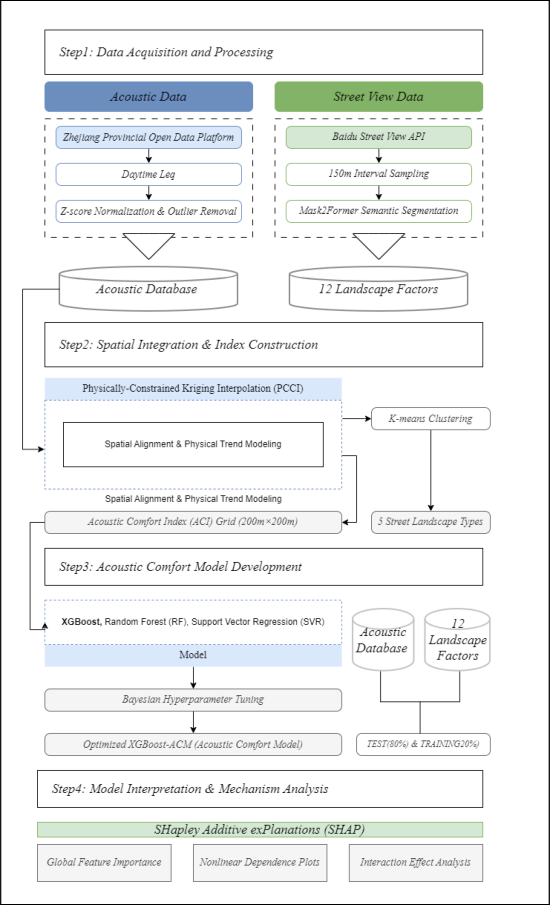
The overall research framework is illustrated in Figure 1 and comprises four main phases: construction of an acoustic comfort index (ACI) evaluation framework based on perceptual spatial dimensions and street landscape complexity; optimization of the spatial alignment between landscape elements and the ACI via a multiscale spatial analysis approach with respect to urban spatial logic; comparison of multiple machine learning algorithms and development of an XGBoost-based acoustic comfort model; and quantification of the nonlinear influences of key landscape elements on the ACI via SHAP values.
Figure 1: Methodological flowchart.
Within the evaluation system for acoustic comfort, this study employs the NEL as the primary assessment metric. A fundamental premise is that a lower NEL corresponds to a higher level of acoustic comfort (Lu et al., 2024). The study area focuses on the main urban area of Hangzhou, characterized by its diverse spatial typology. Acoustic data were obtained from open urban environmental noise data for Hangzhou provided by the Zhejiang Provincial Government Open Data Platform. Daytime LAeq data from 500 valid monitoring points were used. Street view data came from Baidu Street View (SVI) images, with a total of 20,107 sampling points generated at 150- meter intervals along the urban road network. The core dependent variable,
Impact of Street Landscape Factors on Noise Exposure 113 the ACI, is defined as the relative deviation rate of the measured LAeq from the limit stipulated in the Hangzhou Environmental Noise Standard. This study integrates perceptual spatial dimensions and complexity theory (Youvan, 2024) to establish an evaluation framework comprising 12 street view assessment factors, quantified through computer vision techniques and the Mask2Former semantic segmentation model: waterfront proximity (WP), color differentiation coefficient (CDC), color complexity (CC), texture complexity (TexC), spatial enclosure (SE), acoustic source diversity (ASD), active space proportion (ASP), sky view factor (SVF), the green view index (GVI), the green coverage ratio (GCR), the street canyon aspect ratio (SCAR), and the building interface ratio (BIR). To address the spatial mismatch and enhance physical plausibility, the PCCI method was applied, incorporating a simplified noise propagation attenuation model into the kriging framework. The spatially integrated data were converted into a regular 200 m x 200 m grid. An XGBoost model was then constructed, with the 12 landscape factors as inputs and the ACI as the output. The model’s objective function aimed to minimize a regularized loss. The SHAP framework was employed to interpret the trained model, calculating mean absolute SHAP values for feature importance, generating dependence plots for nonlinear relationships, and calculating interaction values.
RESULTS AND DISCUSSION
The XGBoost model achieved a coefficient of determination (R²) of 0.79 on the test set, significantly outperforming benchmark models (RF R² = 0.72, SVR R² = 0.68), validating its high predictive accuracy and ability to capture complex nonlinear relationships.
Table 1: Performance comparison of different machine learning models in predicting ACI.
Table available in the original PDF paper.
Model Training Set R² Test Set R² Test Set RMSE Test Set MAE XGBoost 0.92 0.79 0.36 0.31
RF 0.82 0.72 0.46 0.40 SVR 0.81 0.68 0.53 0.46
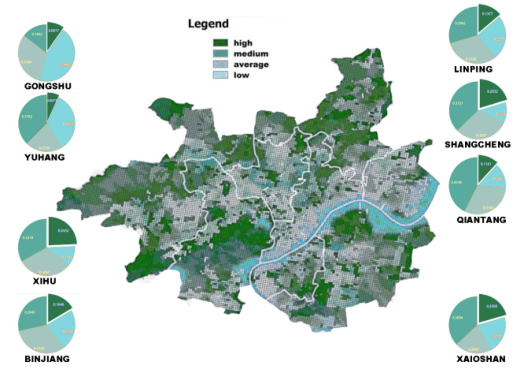
Spatial distribution analysis of the ACI in Hangzhou’s main urban area revealed significant gradient characteristics from southwest to northeast. High-acoustic comfort areas (HACAs) were highly clustered in regions rich in natural ecological elements, such as around West Lake and the waterfront zones along the Qiantang River, with proportions in Xihu, Xiaoshan, and Shangcheng Districts being 24.32%, 20.58%, and 20.32%, respectively. Conversely, low acoustic comfort areas (LACA) were concentrated in highly urbanized built-up areas. K-means clustering analysis (K = 5) categorized street landscapes into five types: ecological function, mixed-function commercial, balanced residential, vibrant pedestrian, and waterfront landscapes.
Figure 2: Spatial distribution of the urban ACI.
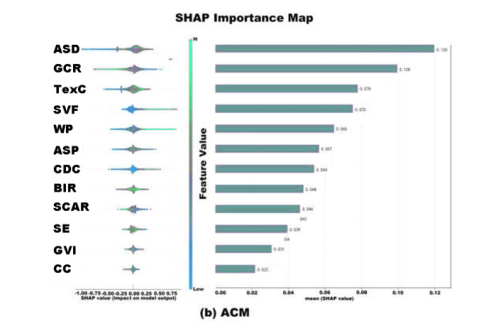
SHAP analysis revealed significant disparities in the influencing strength among factors. ASD, GCR, TexC and SVF were identified as the most critical drivers, with SHAP value contributions of approximately 12.0%, 10.4%, 7.8% and 7.5%, respectively, confirming that street landscape factors have significant explanatory power for NEL.
Figure 3: Feature importance and summary plot of ACM by SHAP value.
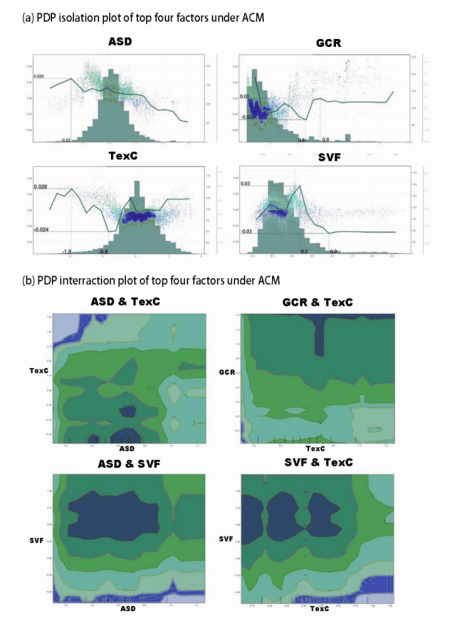
SHAP dependence plots elucidated prevalent complex nonlinear relationships and distinct threshold effects. The GCR is positively correlated with the ACI but with a clear diminishing returns threshold at 0.6. The influence of the ASD is also nonlinear, with a critical threshold at 0.3, beyond which the ACI decreases at an accelerating rate. Building interface height and continuity (represented by factors such as BIR) showed a positive contribution within an optimal range of 0.3-0.7. Interaction effects among factors were also identified. A combination of high GCR and moderately regular landscape textures produced a strong synergistic positive effect. Conversely,
Impact of Street Landscape Factors on Noise Exposure 115 when the street landscape environment is extremely complex and has very low greening levels, an antagonistic effect occurs. These findings demonstrate that the XGBoost-SHAP framework successfully addresses black-box effects and provides a powerful, explainable tool for analysing complex urban environmental issues. The results confirm that street landscape factors are key environmental variables that regulate NEL through nonlinear, threshold- dependent, and interactive mechanisms, offering a quantitative basis for precise urban design.
Figure 4: Isolation plot and interaction plot of the top ten factors under ACM.
CONCLUSION
This study, through the application of an explainable machine learning model, not only confirms the significant influence of street landscape factors on sound exposure levels but also, more importantly, reveals their inherent nonlinear, threshold dependent, and interactive mechanisms. The developed XGBoost-SHAP framework provides a scientific foundation and a powerful tool for proactively shaping healthy and livable acoustic environments through precise and systematic urban design. By enabling the prediction of acoustic outcomes on the basis of design parameters, the model supports a shift from reactive noise mitigation to proactive, preventative soundscape
planning integrated into the earliest stages of urban development. This approach translates abstract acoustic goals into concrete, actionable spatial design language, advancing a data-driven environmental governance model that will prove a boon to citizens’ welfare.
ACKNOWLEDGMENT
The authors would like to acknowledge all individuals and institutions whose support has been indispensable to this research. This research would not have been possible without the foundational support from them, whose assistance sustained the research throughout this endeavor.
REFERENCES
Abrash, V. et al. (1996) ‘Acoustic adaptation using nonlinear transformations of HMM parameters’, 1996 IEEE International Conference on Acoustics, Speech, and Signal Processing Conference Proceedings, 2, pp. 729–732. Clark, C., Head, J. and Stansfeld, S.A. (2013) ‘Longitudinal effects of aircraft noise
exposure on children’s health and cognition: A six-year follow-up of the UK RANCH cohort’, Journal of Environmental Psychology, 35, pp. 1–9. Das, C. P. et al. (2024) ‘Health effects of noise and application of machine learning techniques as prediction tools in noise induced health issues: a systematic review’, Environmental and Ecological Statistics, 31(4), pp. 949–975. Lorenzino, M. et al. (2020) ‘Acoustic comfort depends on the psychological state of
the individual’, Ergonomics, 63(12), pp. 1485–1501. Lu, X. et al. (2024) ‘Comparative evaluation of soundscapes in human activities spatial contexts of pedestrian spaces adjacent to arterial roads’, Science of The Total Environment, 928, 172198. Martinez, J. D. et al. (2025) ‘Toward acoustic-based normalization of laryngeal EMG
for improved interspeaker consistency in muscle-to-acoustic mapping’, Journal of Voice. Montenegro, A. L. et al. (2026) ‘Exploring the relationship between urban acoustic environments and mental well-being’, Applied Acoustics, 242, 111092. Okeke, C. (2023) ‘Nonlinear Dynamics of Complex Systems: Modeling and Analysis’,
Communications on Applied Nonlinear Analysis, 30(1). Ozturk, Z. S., Kang, J. and Aletta, F. (2025) ‘Soundscape Research in Streets: A Scoping Review’, Sustainability, 17(8), 3329. Vardaxis, N.-G., Bard, D. and Persson Waye, K. (2018) ‘Review of acoustic comfort
evaluation in dwellings-part I: Associations of acoustic field data to subjective responses from building surveys’, Building Acoustics, 25(2), pp. 151–170. Wang, S. et al. (2024) ‘Gnothi Seauton: Empowering Faithful Self-Interpretability in Black-Box Transformers’, arXiv. Wang, Y. A. and Groh, A. M. R. (2022) ‘Improving diagnosis for disorders of
consciousness: The case for a novel multi-paradigm approach’, STEM Fellowship Journal, 8(2), pp. 70–73. Youvan, D. C. (2024) ‘Hybrid Classical-Quantum Algorithms for P = NP: Reducing Computational Complexity’. Zini, J. E. and Awad, M. (2022) ‘On the Explainability of Natural Language
Processing Deep Models’, ACM Computing Surveys, 55(5), pp. 1–31.
LISTED IN THE AHFE DIGITAL BOOKSTORE CATALOGUE
Explore the complete digital volume
Human Factors in Architecture, Sustainable Urban Planning and Infrastructure
Read this individual research paper free through the original publisher, or explore the full digital proceedings book.
ISBN 979-8-950676-05-5
Explore this ISBN in the AHFE Bookstore ↗Listed in the July 2026 bookstore catalogue; search by ISBN to confirm current availability · Digital book purchase optional