Ziqi Zhang, Xiaoxi Cheng (2026). Impacts of Atrium Geometric Characteristics in University Research Buildings on Occupants’ Restorative Performance. In: Human Factors in Architecture, Sustainable Urban Planning and Infrastructure. AHFE Open Access, vol. 229, pp. 1–8. https://doi.org/10.54941/ahfe1007948
University researchers who spend prolonged periods in indoor environments are prone to increased psychological stress and decreased attention, which is widely confirmed in previous research. Indoor open spaces in research buildings, particularly atriums, are recognized as restorative environments that can provide a temporary escape from work areas, facilitating emotional and cognitive recovery. Existing studies have primarily focused on the physical environmental performance of atrium, such as daylighting and ventilation. Although the geometric characteristics of atrium have been shown to influence indoor environmental performance, empirical evidence on their effects on occupants’ restorative experiences remains limited, which constrains a comprehensive evaluation of atrium performance.This study aims to investigate the effects of atrium geometric characteristics on occupants’ restorative performance in university research buildings through virtual reality. 6 experimental scenarios were designed, covering 4 geometric variables: bidirectional expansion, unidirectional elongation, number of stories, and overall form. 30 participants were recruited, and both psychological and physiological data were collected. The results indicate that certain experimental conditions significantly enhanced psychological restorative effects, whereas no significant between-scenario differences were observed in physiological indicators. This study empirically examines the restorative potential of indoor atrium geometry and provides methodological and theoretical contributions for evidence-based design of built environments aimed at enhancing occupants’ well-being.
Occupants in university research buildings often spend prolonged periods working in relatively enclosed and monotonous indoor environments. A growing body of evidence indicates that sustained exposure to such settings may be associated with heightened psychological stress and depletion of attentional resources, ultimately compromising work performance, emotional well-being, and overall health (Zhang et al., 2023).
Research on restorative environments originated in the field of environmental psychology and is primarily grounded in two classic theoretical frameworks:
2 Zhang and Cheng Attention Restoration Theory (Kaplan, 1995) and Stress Reduction Theory (Ulrich et al., 1991). Although a substantial body of work has established the pronounced restorative benefits of natural environment, accumulating evidence in recent years suggests that indoor built environment may also possess restorative potential (Wang et al., 2025).
Open spaces within research buildings, particularly atriums, are often regarded as valuable settings where occupants can briefly disengage from work areas and achieve rapid emotional and cognitive recovery. Atriums are typically characterized by pronounced vertical openness and visual connectivity across floors, which together create a continuous spatial experience. Existing research has largely focused on differences in the physical environmental performance of atriums, such as natural ventilation and daylighting conditions and their associated energy implications (Moosavi et al., 2015). Although this line of work is essential for evaluating building performance, it does not directly address an equally important question: do different atrium spaces yield measurable differences in occupants’ restorative outcomes.
Against this background, this study employs a virtual reality based experimental approach to examine how variations in atrium geometry within university research buildings influence occupants’ restorative outcomes. Six representative experimental scenarios were developed, and 30 participants were recruited. Both psychological and physiological measures were collected, with the aim of providing methodological and theoretical support for health- oriented, evidence-based design.
METHODS
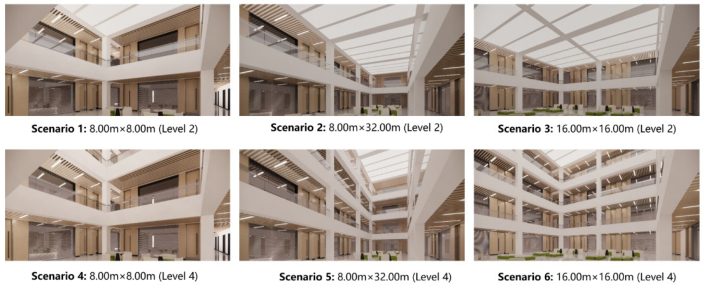
Based on a systematic review and synthesis of atrium spaces in existing university research buildings, six representative atrium scenarios were selected for the experiment. The plan dimensions were defined as 8.00 m × 8.00 m, 8.00 m × 32.00 m, and 16.00 m × 16.00 m. To control key geometric variables, Scenarios 1 and 3 shared the same plan shape but differed in area (Bidirectional expansion), whereas Scenarios 2 and 3 had the same area but differed in plan shape (Unidirectional elongation versus a more compact proportion).
Figure 1: Spatial renderings of the six experimental scenarios.
Impacts of Atrium Geometric Characteristics in University Research Buildings 3 In addition, compared with Scenarios 1 and 3, Scenario 2 introduced a pronounced depth effect due to its elongated plan proportion. Building on these plan variations, we further manipulated the number of atrium stories, resulting in six experimental conditions in total. The spatial characteristics of the six scenarios are illustrated in Figure 1, and the corresponding dimensional settings are summarized in Table 1.
To ensure that spatial form was the only manipulated factor, all other design elements including interior surface materials and functional attributes were held constant across scenarios.
Table 1: Different geometric parameters of 6 experimental scenarios.
Table available in the original PDF paper.
Scenario Plan Parameter Height Parameter (Level) 1 8.00 m × 8.00 m 8.00 m (Level 2)
2 8.00 m × 32.00 m 8.00 m (Level 2) 3 16.00 m × 16.00 m 8.00 m (Level 2)
4 8.00 m × 8.00 m 16.00 m (Level 4) 5 8.00 m × 32.00 m 16.00 m (Level 4)
6 16.00 m × 16.00 m 16.00 m (Level 4) The virtual simulation experiment was conducted in an office in Beijing, China, between February and March 2025. The atrium scenarios were modelled in Rhino and imported into the Unity engine for real-time interaction using a head-mounted virtual reality (VR) system (HTC VIVE). The HTC VIVE displays VR content at a resolution of 2880 × 1600 with a refresh rate of 90 Hz, which helps reduce motion blur and cybersickness and supports a smooth, natural visual experience during immersive exposure. The system comprises tracking sensors (base stations), a head-mounted display, and stereo headphones.
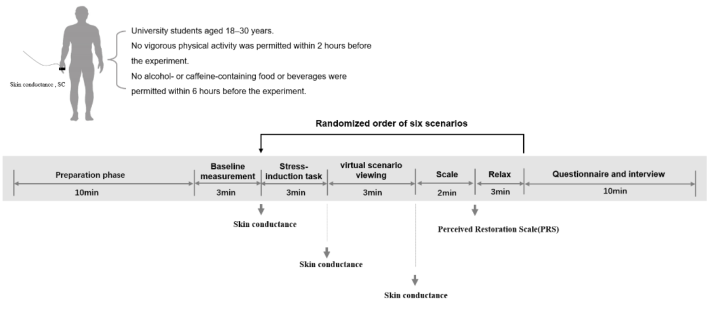
Figure 2: Experimental procedure flowchart.
Participants were recruited from the primary user group of university research buildings. A total of 30 university students from multiple departments took part in the experiment. Participants were 18–30 years old and included
4 Zhang and Cheng undergraduates as well as master’s and doctoral students, with diversity in academic background, age, and gender.
The overall experimental protocol comprised six main stages: a preparation phase, baseline measurement, a stress-induction task, exposure to virtual scenarios, relaxation, and post-exposure assessment, including a questionnaire survey and semi-structured participant interviews (Figure 3). Throughout the experiment, physiological signals were continuously recorded, and subjective evaluation data were collected to capture participants perceived experiences.
(1) Preparation Phase Participants were introduced to the experimental equipment and virtual scenarios and were given time to familiarize themselves with the interface and operation of the stress-induction task in advance.
(2) Baseline Measurement Participants were fitted with an electrodermal activity (EDA) sensor, and baseline skin conductance was recorded during a seated resting period.
(3) Stress-Induction Task To simulate stress escalation during studying or working, we employed the well-established Montreal Imaging Stress Task (MIST), a validated paradigm for rapidly inducing psychological stress (Dedovic et al., 2005). In this task, participants completed a series of time-limited mental arithmetic problems presented on a screen and were required to meet predefined performance targets.
(4) Virtual Scenario Viewing Participants experienced atrium spaces across different scenario types in the VR headset, each participant experienced all six scenarios in a random order. Electrodermal activity was continuously recorded during each immersive exposure. Immediately afterward, participants completed the Perceived Restorativeness Scale (PRS) to quantify their restorative experience in the corresponding space (Hartig et al., 1997). For visualization, PRS scores were min–max normalized to the [0,1] range within each scenario.
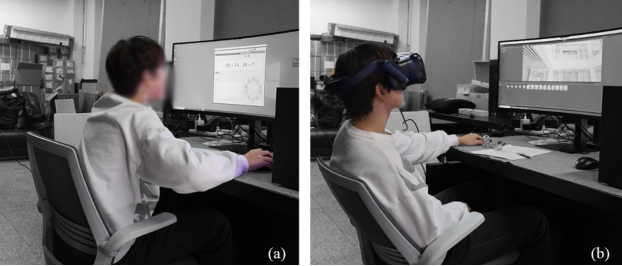
Figure 3: (a) Experimental setup for the stress-induction task; (b) Experimental setup for virtual scenario viewing.
Impacts of Atrium Geometric Characteristics in University Research Buildings 5 (5) Relaxation
After each experiment, participants removed the VR headset and physiological sensors and were given sufficient time to rest to minimize fatigue effects before proceeding to the next trial. Each participant completed six trials corresponding to the six atrium scenarios.
(6) Questionnaire and Interview After completing all experiments, participants completed a questionnaire survey and took part in a brief interview with the experimenter.
RESULTS AND DISCUSSION
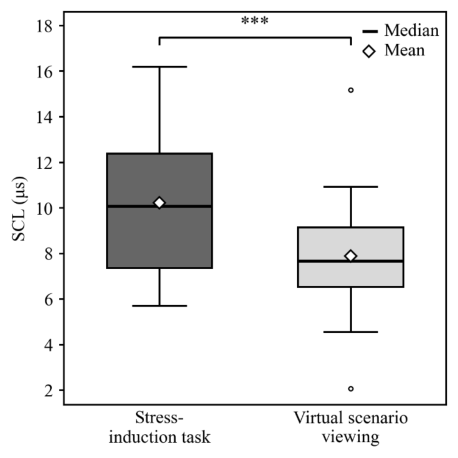
Figure 4 presents a pre–post comparison of skin conductance levels averaged across the six scenarios for each participant. The left boxplot represents the mean skin conductance level during the final 20 s before completion of the MIST stress-induction task, whereas the right boxplot represents the mean skin conductance level during the final 20 s of the 3-min virtual scenario viewing period. Pre–post differences were tested using two-sided paired- samples t-tests at the participant level. Overall, exposure to the virtual atrium environments promoted stress recovery for most participants (P < 0.001). In contrast, when physiological recovery was examined separately across the six scenarios, no significant between-scenario differences were detected (one- way repeated-measures ANOVA, P > 0.05).
Figure 4: Comparison of skin conductance between the stress-induction task and the virtual scenario viewing period.
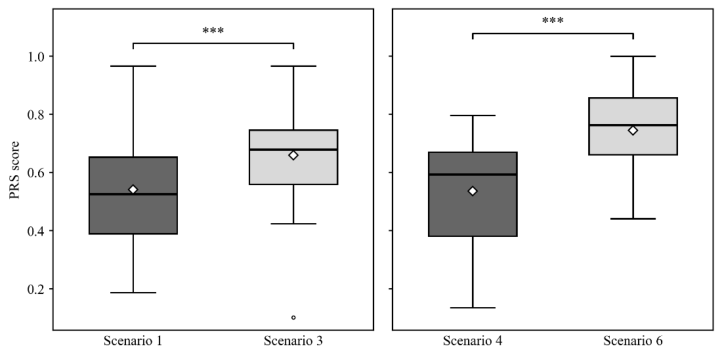
In the psychological outcomes, restorative effects differed across several experimental scenarios. To test whether atrium area influences perceived restoration, two pairs of scenarios were constructed in which plan area
6 Zhang and Cheng was the only manipulated variable (Scenarios 1 vs. 3 and Scenarios 4 vs. 6). Significance testing showed that atriums with a larger plan size (16.00 m × 16.00 m) yielded significantly stronger restorative outcomes than those with a smaller plan size (8.00 m × 8.00 m) in both comparisons (P < 0.001). These results suggest that, to some extent, increasing atrium area can enhance occupants’ psychological restorative experience (Figure 5).
Figure 5: Min-max normalized PRS scores under atrium scenarios with different plan areas.
Table 2 summarizes the paired comparisons for the four geometric variables. In addition to the improvement in restorative outcomes associated with increasing atrium plan area, increasing plan length (an 8.00 m × 32.00 m atrium compared with an 8.00 m × 8.00 m atrium) also produced a significant enhancement in restorative outcomes (P < 0.001). Consistent with the interview findings, some participants reported that extending the space along a single direction strengthened the perceived depth of the atrium, which in turn contributed to a more restorative experience. It should be noted that the plan-length manipulation in our scenarios was coupled with an increase in plan area; therefore, the observed advantage of more elongated layouts should be interpreted as a combined effect of plan elongation and larger floor area rather than a pure plan-length effect. By contrast, within the present experiment, increasing the atrium height from two to four stories did not yield a statistically significant gain in restorative outcomes. Moreover, when atrium area was held constant, no significant difference in restorative outcomes was observed between the elongated 8.00 m × 32.00 m plan and the square 16.00 m × 16.00 m plan.
Table 2: Variable control across experimental scenarios and significance testing results.
Table available in the original PDF paper.
Variables Scenario P value Bidirectional expansion Scenario1, Scenario3 P < 0.001
Scenario4, Scenario6 P < 0.001 (Continued)
Table 2: Continued.
Table available in the original PDF paper.
Variables Scenario P value Scenario1, Scenario2 P < 0.001 Unidirectional elongation Scenario4, Scenario5 P < 0.001
Scenario1, Scenario4 ns
Number of stories
Scenario2, Scenario5 ns Scenario3, Scenario6 ns
Overall form Scenario2, Scenario3 ns Scenario5, Scenario6 ns
CONCLUSION
This study investigates how variations in atrium geometry within university research buildings influence occupants’ restorative outcomes. Using a virtual reality based experimental approach, we developed six representative atrium scenarios and conducted controlled comparisons across four geometric variables: bidirectional expansion, unidirectional elongation, number of stories, and overall form.
The results indicate that virtual atrium exposure provides an overall stress- recovery benefit: participants’ skin conductance levels showed a significant downward trend while resting in the virtual atrium environments. However, no statistically significant differences in physiological recovery were detected across the six scenarios. This suggests that, under the present experimental settings and exposure duration, the physiological restorative gains associated with atrium geometry may be relatively insensitive, and may require longer exposure, richer physiological measures, and more refined contextual controls to be robustly identified.
In contrast, psychological restoration was more responsive to geometric manipulations. Overall, unidirectional elongation and bidirectional expansion were both associated with higher PRS, suggesting that spaciousness and directional depth may contribute to restorative perception in atrium environments (P < 0.001). Whereas variations in the number of stories and overall form did not produce measurable differences in restoration.
These findings offer actionable guidance for evidence-based, health- oriented design of indoor spaces in office buildings. Future research should expand sample size, extend exposure duration, and incorporate additional physiological and behavioural indicators to more comprehensively elucidate the mechanisms and boundary conditions through which atrium geometry contributes to restorative benefits.
ACKNOWLEDGMENT
The authors would like to thank all participants who took part in the experiment for their time and cooperation.
REFERENCES
Dedovic, K., Renwick, R., Mahani, N. K., Engert, V., Lupien, S. J., and Pruessner, J. C. (2005). ‘The Montreal Imaging Stress Task: using functional imaging to investigate the effects of perceiving and processing psychosocial stress in the human brain’, Journal of Psychiatry and Neuroscience, 30(5), pp. 319–325. Hartig, T., Korpela, K., Evans, G. W., and Gärling, T. (1997). ‘A measure of restorative
quality in environments’, Scandinavian housing and planning research, 14(4), pp. 175–194. Kaplan, S. (1995). ‘The restorative benefits of nature: Toward an integrative framework’, Journal of environmental psychology, 15(3), pp. 169–182. Moosavi, L., Mahyuddin, N., and Ghafar, N. (2015). ‘Atrium cooling performance
in a low energy office building in the Tropics, a field study’, Building and Environment, 94, pp. 384–394. Ulrich, R. S., Simons, R. F., Losito, B. D., Fiorito, E., Miles, M. A., and Zelson, M. (1991). ‘Stress recovery during exposure to natural and urban environments’, Journal of environmental psychology, 11(3), pp. 201–230. Wang, Y., Wang, D., and Zhang, X. (2025). ‘Higher greenery visibility is not
necessarily better: A quantitative approach to evaluating window view quality in residential buildings’, Building and Environment, 113563. Zhang, X., Du, J., and Chow, D. (2023). ‘Association between perceived indoor environmental characteristics and occupants’ mental well-being, cognitive performance, productivity, satisfaction in workplaces: A systematic review’, Building and Environment, 246, 110985.
LISTED IN THE AHFE DIGITAL BOOKSTORE CATALOGUE
Explore the complete digital volume
Human Factors in Architecture, Sustainable Urban Planning and Infrastructure
Read this individual research paper free through the original publisher, or explore the full digital proceedings book.
ISBN 979-8-950676-05-5
Explore this ISBN in the AHFE Bookstore ↗Listed in the July 2026 bookstore catalogue; search by ISBN to confirm current availability · Digital book purchase optional