Amon Onodera, Yohsuke Yoshioka (2026). Effects of the Pony Wall Position and Memory Strategy on Reproduced Spatial Depth in a Virtual Environment. In: Human Factors in Architecture, Sustainable Urban Planning and Infrastructure. AHFE Open Access, vol. 229, pp. 117–127. https://doi.org/10.54941/ahfe1007960
Physical occlusion, particularly of the ground surface, often distorts distance perception in indoor environments. However, how observers' visual search strategies modulate this effect remains unclear. This study investigated how pony wall placement (Non, Left, Center) affects egocentric distance perception under two instructional strategies: Geometric and Holistic. Using Virtual Reality, participants estimated distances while eye movements were recorded. Results revealed a significant difference between strategies. The Geometric group maintained distance accuracy even in the Center condition where the floor was occluded. Fixation analysis showed they actively compensated for missing ground information by increasing fixations on side walls to extract linear perspective cues. Conversely, the Holistic group—reflecting natural daily spatial experience—significantly underestimated distance in the Center condition. The salient pony wall attracted their gaze, reducing attention to the far wall, which provides crucial depth information for spatial boundaries. This gaze attraction hindered integrated perception of the entire space.These findings reveal an important distinction. The analytical search strategy overcame physical constraints through side walls that served as alternatives to the interrupted floor continuity. In contrast, the holistic strategy typical of daily experience was vulnerable to central occlusion due to gaze attraction. For architectural design, this suggests that ensuring visual permeability—specifically, maintaining gaze access to the far wall—is essential for preserving the sense of spaciousness and supporting natural spatial experience. Therefore, when placing pony walls, designers should consider not only physical area but also the psychological quality of spatial perception.
Various elements in interior spaces, such as furniture and partition walls, function not only as visual occluders but also as reference frames for spatial scale measurements. Furniture arrangement and wall texture in virtual reality (VR) studies have significantly altered the perception of spaciousness (Wang et al., 2020; Von Castell et al., 2014). Pony walls are particularly unique in this context because they provide visual continuity in the upper space while physically interrupting the floor surface, which is a primary cue for distance perception.
118 Onodera and Yoshioka The accuracy of distance perception heavily depends on the ground surface extending from the observer to the target (Gibson, 1950). Continuous texture gradients and linear perspective of the floor are decisive in accurate estimation (Wu & He, 2007). When this continuity is physically interrupted, the resulting disruption of sequential surface integration often leads to significant distance underestimation (He et al., 2004). Although architectural permeability theory suggests that visual clearance can mitigate the sense of enclosure (Stamps, 2010), empirical VR research has confirmed that environmental context and furniture arrangement inevitably bias perceived dimensions (Meagher & Marsh, 2015; Tural & Tural, 2024; Witt et al., 2007). However, the quantitative interaction between the positive factor of visual clearance and negative factor of floor occlusion is an unresolved issue.
To address this interaction, it is necessary to focus on the observer’s cognitive process. Humans often organize spatial information using intrinsic frames of reference, such as room axes or major boundaries (Mou & McNamara, 2002). Because the brain processes geometric boundaries and landmarks through distinct parallel systems (Doeller & Burgess, 2008), pony walls likely function as powerful geometric reference frames. Consequently, when tasked with precise estimation, observers may adopt a geometric strategy that treats the wall as a critical boundary.
However, spatial cognitive processes are highly task-dependent (Tatler & Tatler, 2013). Beyond analytical processing, humans utilize a holistic strategy to instantly capture the global “spatial envelope” or atmosphere of a scene (Oliva & Torralba, 2001). If the task shifts from measurement to the feeling of spaciousness, then observers may prioritize the overall volume over specific wall boundaries. Because task demands fundamentally change gaze patterns and information sampling (Tatler et al., 2010), eye tracking provides an effective method of quantifying how these different strategies utilize specific architectural elements as information sources (Duchowski, 2007).
This study aimed to clarify how the placement of pony walls in VR environments affects depth perception by comparing geometric and holistic memory strategies. By measuring cognitive errors and analyzing fixation distributions across specific areas of interest (AOIs), we investigated the mechanisms of partial occluders that transform spatial perception from both cognitive and behavioral perspectives.
RESEARCH METHODS Experimental Environment and Procedure
This experiment investigated the effects of the pony wall position and memory strategy on the perception of spatial depth dimensions. Participants wore a head-mounted display (HTC-VIVE; HTC Corporation, New Tapai City, Taiwan) and experienced a virtual environment constructed using Vizard 8.0 (Worldviz, Inc., Santa Barbara, CA, USA). Fifteen university and graduate students with normal visual function (10 male and 5 female students) participated in the experiment. Participants were first presented
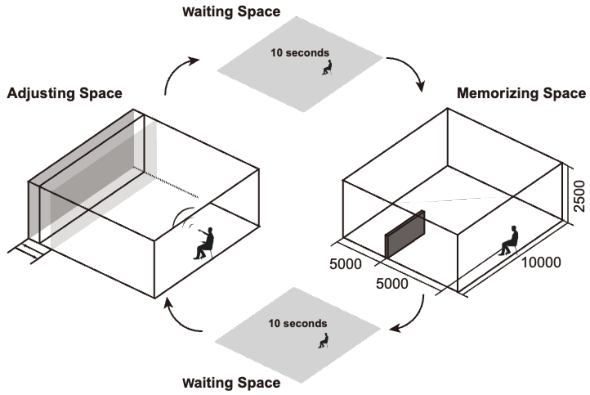
Effects of the Pony Wall Position and Memory Strategy 119 with a space under a specified condition (no pony wall, left pony wall, or center pony wall) and instructed to memorize its depth for 10 seconds. Then, they moved to a waiting space where only the floor was visible and waited for 10 seconds. Next, they moved to the adjustment space without a pony wall and used a controller to adjust the position of the far wall until it matched the remembered depth dimension. After completing the adjustment task, the participants returned to the waiting space, waited for another 10 seconds, and proceeded to the next trial.
Figure 1: Experimental procedure and trial sequence. (Top) Adaptation in the waiting room for 10 seconds. (Right) Memorization of the room depth with the pony wall. (Bottom) Readaptation in the waiting room for 10 seconds. (Left) Reproduction of the memorized depth in the adjustable room.
Experimental Conditions The virtual environment was constructed based on the settings from our previous research, and the basic spatial dimensions were identical to those of our previous study (Amon Onodera et al., 2025). The depth of the space to be memorized was 11.0 m (10.0 m forward and 1.0 m backward from the participant’s position), and the pony wall (width, 4.0 m; thickness, 0.1 m; height, 1.0 m) was positioned 5.0 m forward from the participant. The experimental design comprised the following factors: pony wall position; method of adjustment series; and memory strategy. The pony wall positions were non (none), left, and center. The method of adjustment series comprised descending and ascending, which were determined by the position of the wall at the start of adjustment. Under the descending series condition, participants started at +4.0 m (further back) relative to the correct position (10.0 m) and adjusted toward the near side (thus reducing the distance value). Under the ascending series condition, participants started at −4.0 m (near side) and adjusted toward the far side (thus increasing the distance
120 Onodera and Yoshioka value). Memory strategies were classified as geometric or holistic based on the spatial information encoding process. The geometric strategy comprised an analytical processing style that focused on geometric features within the space (distance, angle, boundaries, and others) and the absolute positional relationships between individual elements. The holistic strategy comprised a global processing style focused on perceiving information as the overall spatial arrangement and visual whole rather than isolating individual elements within the space. However, because of the abstract nature of its definition, the holistic strategy is prone to individual differences in interpretation among participants, thus raising concerns about variability in experimental results. To reduce ambiguity, we used a block design with a fixed presentation order.
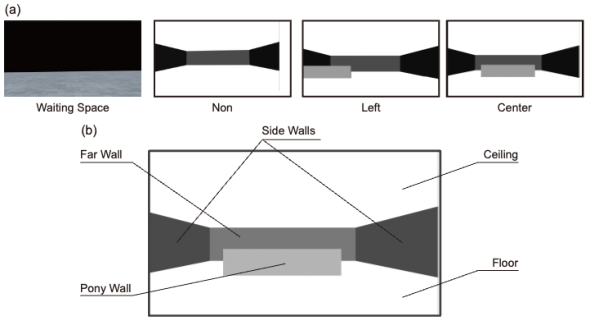
Measurement Metrics This experiment used cognitive error and fixation ratio as the measurement metrics. Cognitive error was calculated as the difference between the adjusted wall position and the memorized correct position (adjusted value − correct value). To quantify the tendency to gaze at the architectural elements analyzed using the gaze coordinate data obtained during the experiment, the area of interest (AOI) was defined and the metric was calculated. Within the participant’s field of view during memorization, the following three areas were defined as the primary analysis targets (AOI): pony wall; side walls (wall surface areas located on both sides of the passageway; and far wall (wall surface area located behind the pony wall). Additionally, during the initial analysis phase, the floor and ceiling were defined as separate AOIs.
Although the memory duration for each trial was 10 seconds, the first second immediately after the start of each trial was excluded from the analysis. This exclusion accounted for the impact on fixation caused by sudden visual changes attributable to scene transitions and orienting responses to the experimenter’s announcements. Therefore, the effective analysis period was defined as the 9-second interval between 1 second after the start to 10 seconds after the start of each trial.
As a quantitative metric for fixation, the fixation ratio (the proportion relative to the number of valid data points) was adopted instead of simple dwell time. This approach eliminated the varying impact of data loss caused by blinks or eye-tracking measurement errors across trials and individuals. Specifically, the fixation ratio of the AOI in each trial was calculated using the following equation:
i
R n N i
valid =
Ri = fixation ratio ni = number of gaze points that landed on the target AOI within the analysis period Nvalid = total number of valid gaze points acquired during the same period
Figure 2: Experimental conditions and area of interest (AOI) definitions. (a) Egocentric views across conditions (from left to right: waiting room, non, left, and center conditions). (b) Illustration of AOI segmentation using the center condition as an example.
Data Screening Prior to the analysis, data screening of all 15 participants was conducted, resulting in the exclusion of two participants. One participant (participant 9) was excluded because an evaluation of the overall results revealed a tendency to continuously fixate on a specific area. Because this behavioral pattern was unique to this participant, the data were treated as outliers. The data of another participant (participant 13) were excluded as outliers through a sensitivity analysis because the inclusion of this participant’s responses substantially altered the overall patterns observed across the other participants. Therefore, the data of the remaining 13 participants were used for subsequent analyses.
RESULTS
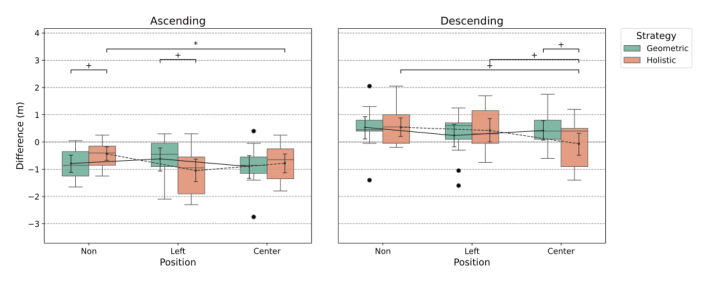
Cognitive Error A three-factor analysis of variance (ANOVA) (5% significance level) was conducted to examine the effects of position (non, left, center), series (ascending, descending), and memory strategy (geometric, holistic). The analysis revealed significant main effects of position [F(2, 24) = 3.423; p = .049] and series [F(1, 12) = 72.601; p < .001], but it did not reveal a main effect of memory strategy [F(1, 12) = 0.154; p = .702]. Critically, a significant three-way interaction between position, series, and memory strategy was observed [F(2, 24) = 6.971; p = .004] (Figure 3).
Simple main effect tests revealed that the effect of position was significant for the holistic/descending condition [F(2, 24) = 5.098; p = .014], and that the non condition showed significantly smaller errors compared with those associated with the left condition. In contrast, no significant position effects of the geometric condition were observed in either series. Compared with the ascending series group (which showed underestimation), the descending
122 Onodera and Yoshioka series group consistently showed positive shifts (overestimation) across all conditions.
Most importantly, the effect of memory strategy showed contrasting patterns depending on the position and series. Under the descending/center condition, the geometric group showed marginally larger errors than those of the holistic group [F(1, 12) = 3.265; p = .096]; however, under the ascending/left condition, the holistic group showed larger errors than those of the geometric group [F(1, 12) = 3.455; p = .088].
Figure 3: Boxplots showing the distribution of depth perception errors as a function of pony wall placement, strategy, and method of adjustment series. Each plot represents the data distributions of specific combinations of placement (non, left, center) and memory strategy (geometric, holistic) or method of adjustment series (ascending, descending).
Gaze Distribution Preliminary Analysis
A preliminary three-way ANOVA of position, memory strategy, and method of adjustment series was conducted to obtain an overview of the effects of experimental factors on fixation ratios of all AOIs defined in this experiment. The results revealed significant main effects or interactions involving experimental factors (position or strategy) only for the pony wall, side walls, and far wall. For the other AOIs, no statistically significant differences were observed. Consequently, subsequent detailed analyses focused on these three areas. In this preliminary analysis, the main effect of series and its interactions with other factors were not significant for any AOI. This finding confirmed the absence of systematic effects attributable to the trial order or repetition. Therefore, the data were pooled across series within each condition, and integrated values were adopted as representative values for each condition.
AOI: Pony Wall During the evaluation of the pony wall as the AOI, the non condition was not analyzed; only the left and center conditions were analyzed. The non
Effects of the Pony Wall Position and Memory Strategy 123 condition was excluded because the pony wall does not physically exist in the non condition; therefore, fixation on this area cannot occur. Including such a condition with structural missing data in the statistical model could violate the assumption of homogeneity of variance and risk significant distortion of the interpretation of the results. Therefore, we focused on a two-factor analysis including position (left, center) and memory strategy (geometric, holistic).
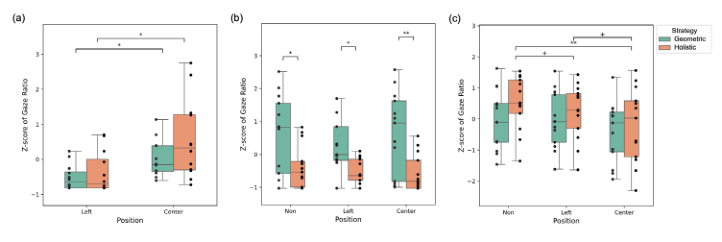
After Z-score standardization and outlier exclusion (|Z| > 4.0 after removing participant 15), a two-way ANOVA was conducted (Figure 4a). The results revealed a significant main effect of position [F(1, 12) = 12.510; p = .005]; however, they did not reveal main effects of memory strategy [F(1, 12) = 2.589; p = .136] or interaction [F(2, 28) = 1.101; p = .317]. To confirm the consistency of the main effect of position across memory strategies, simple main effect tests were conducted. These tests revealed that the simple main effects of position were significant under both the geometric [F(1, 11) = 7.976; p = .017] and holistic [F(1, 11) = 7.028; p = .023] conditions. Fixation on the pony wall under the center condition was significantly higher than that under the left condition, regardless of the memory strategy.
AOI: Side Walls A two-way ANOVA of position (non, left, center) and memory strategy (geometric, holistic) was conducted after Z-score standardization (Figure 4b). The results revealed a significant main effect of memory strategy [F(1, 12) = 10.571; p = .007]; however, they did not reveal main effects of position [F(1.49, 17.82) = 1.061; p = .347] or interaction [F(2, 24) = 1.159; p = .330].
To confirm the consistency of the effects, simple main effect tests were conducted. The results showed that the simple main effects of memory strategy were significant under the non [F(1, 12) = 5.555; p = .036], left [F(1, 12) = 8.865; p = .012], and center [F(1, 12) = 11.508; p = .005] position conditions. Compared with the holistic group, the geometric group consistently fixated more on the side walls, regardless of the pony wall placement.
AOI: Far Wall A two-way ANOVA of position (non, left, center) and memory strategy (geometric, holistic) was conducted after Z-score standardization (Figure 4c). The results revealed a significant main effect of position [F(1.34, 16.11) = 9.770; p = .004]; however, they did not reveal main effects of memory strategy [F(1, 12) = 1.469; p = .249] or interaction [F(1.33, 16.01) = 1.112; p = .328].
To further investigate the main effect of position, simple main effect tests were conducted. The results indicated that the simple main effect of position was not significant under the geometric condition [F(2, 24) = 1.867; p = .176]; however, it was significant under the holistic condition [F(2, 24) = 8.561; p = .002]. Post hoc comparisons using Shaffer’s method under the holistic condition revealed that fixation on the far wall under the non condition was
124 Onodera and Yoshioka significantly higher than that under the center condition (adjusted p = .006); additionally, marginally significant differences were observed between the non and left conditions (non > left; adjusted p = .052) and between the left and center conditions (left > center; adjusted p = .053). In the holistic group, fixation on the far wall decreased progressively as the pony wall moved toward the center of the visual field.
Figure 4: Boxplots showing the distributions of standardized Z-scores of the fixation ratios of the areas of interest. (a) Distribution of standardized Z-scores of the fixation ratios of the pony wall. (b) Distribution of standardized Z-scores of the fixation ratios of the side walls. (c) Distribution of standardized Z-scores of the fixation ratios of the far wall.
DISCUSSION
In this study, the geometric group maintained accurate distance perception even under the center condition when a pony wall was present. Wang et al. (2020) reported that visual occlusion caused by partition walls or furniture in architectural spaces reduces the sense of spaciousness and depth perception. Generally, as indicated by the isovist theory (Benedikt, 1979), physical blockage of the visual field is regarded as information loss and leads to underestimation.
However, the results of the geometric group indicated that observers can overcome this physical constraint through exploratory behavior. A fixation analysis revealed that the participants significantly increased fixation on the side walls when the floor surface was hidden, suggesting that they actively compensated for the missing floor information using geometric cues, such as the linear perspective of the side walls. In other words, accurate distance perception can be maintained despite physical occlusion if an appropriate visual search is performed.
In contrast, the holistic group underestimated distance under the central condition. This finding is particularly significant because the holistic strategy closely resembles the daily spatial experience. This approach captured the coherence and atmosphere of the entire space rather than individual elements. Oliva (2005) reported that when humans enter a new environment, they instantly sense the entire scene, and this sensing process is faster than the process of analyzing detailed features. In daily life, individuals rarely adopt analytical views, such as counting floor joints. Instead, most viewing
Effects of the Pony Wall Position and Memory Strategy 125 behaviors involve broadly perceiving the space for the purpose of movement or inhabitation. Thus, the holistic condition reproduces this natural state of grasping the spatial essence and has higher ecological validity than that of the geometric condition.
Eye-tracking data revealed the mechanism underlying this underestimation. The holistic group frequently fixated on the pony wall under the center condition, resulting in decreased viewing of the far wall, which was a primary distance cue. This pattern indicated that attention was captured by the salient object in the center of the visual field. Attention that should have been distributed across the entire space was attracted to this specific object instead. Consequently, gaze was arrested by the foreground pony wall, thus hindering integrated perception of the entire space, including the far wall. This resulted in underestimation of distance and a reduced sense of spaciousness.
These findings extend the previous research of spatial perception, such as the study by Stamps (2010), who discussed the effects of partition wall permeability and arrangement on the sense of openness. The present study is novel because it demonstrated this mechanism through differences in gaze behavior. The results of the geometric group suggest that the design features of side walls (e.g., continuity of lines) can function as compensatory distance information in occluded environments. More importantly, the central placement of the pony wall caused a significant loss of spaciousness under the holistic condition, which was closest to the daily spatial experience. This demonstrated that pony wall placement not only physically blocks the visual field but also qualitatively transforms the observer’s spatial experience. In actual architectural spaces, layout planning for a pony wall may more decisively influence the sense of openness and comfort than previously assumed.
This study had some limitations. Fixation duration in each area was used to identify general attention allocation trends. However, microscopic gaze dynamics, such as saccades or individual fixation sequences and durations, were not examined. To fully understand how gaze moves between objects and how spatial information is integrated, further analyses including detailed metrics such as saccade amplitude, frequency, and fixation sequences are needed.
CONCLUSION
This study investigated how pony wall placement in indoor spaces affects distance perception and focused on differences in observers’ visual search strategies. These findings indicated that the geometric strategy demonstrated high robustness against physical occlusion. Observers maintained accurate distance perception even when floor information was missing by actively sampling alternative geometric cues such as side walls. Additionally, the holistic strategy, which closely resembled the daily spatial experience, comprised a centrally placed obstacle that acted as a bottleneck for visual guidance. The central pony wall strongly captured attention and prevented gaze from reaching the spatial depth, thereby significantly reducing the sense of spaciousness, suggesting that ensuring a “visual breakthrough” in which
126 Onodera and Yoshioka gaze can reach the far wall may be more important to the sense of openness than merely securing physical area during architectural planning. The findings of this study contribute to the understanding of the cognitive mechanism that links physical occlusion and psychological openness in architectural spaces through gaze behavior analyses.
REFERENCES
Benedikt, M. L. (1979). “To Take Hold of Space: Isovists and Isovist Fields”, Environment and Planning B, Volume 6, No. 1, pp. 47–65. Doeller, Christian F. Burgess, Neil. (2008). “Distinct error-correcting and incidental
learning of location relative to landmarks and boundaries”, Proceedings of the National Academy of Sciences, Volume 105, No. 15, pp. 5909–5914. Duchowski, Andrew T. (2007). Eye tracking methodology: Theory and practice.
London: Springer. Gibson, James J. (1950). “The Perception of Visual Surfaces”, The American Journal of Psychology, Volume 63, No. 3, pp. 367–384. He, Zijiang J. Wu, Bing. Ooi, Teng Leng. Yarbrough, Gary. and Wu, Jun. (2004).
“Judging Egocentric Distance on the Ground: Occlusion and Surface Integration”, Perception, Volume 33, pp. 789–806. Meagher, Benjamin R. Marsh, Kerry L. (2015). “Testing an Ecological Account of Spaciousness in Real and Virtual Environments”, Environment and Behavior, Volume 47, No. 7, pp. 782–815. Mou, Weimin. McNamara, Timothy P. (2002). “Intrinsic frames of reference in
spatial memory”, Journal of Experimental Psychology: Learning, Memory, and Cognition, Volume 28, No. 1, pp. 162–170. Oliva, Aude. (2005). “Gist of the Scene”, in: Neurobiology of Attention, Itti, Laurent.
Rees, Geraint and Tsotsos, John (Eds.). Burlington, MA: Elsevier, pp. 251–256. Oliva, Aude. Torralba, Antonio. (2001). “Modeling the Shape of the Scene: A Holistic Representation of the Spatial Envelope”, International Journal of Computer Vision, Volume 42, No. 3, pp. 145–175. Onodera, Amon. Yoshioka, Yohsuke. (2025). “The Influence of Geometric Properties
of Spandrel Wall on the Perception of Spatial Depth”, in: Human Factors in Architecture, Sustainable Urban Planning and Infrastructure, Maciejko, Alicja (Ed.). AHFE Open Access, Volume 191, pp. 134–143. Stamps, Arthur E. (2010). “Effects of Permeability on Perceived Enclosure and Spaciousness”, Environment and Behavior, Volume 42, No. 6, pp. 864–886. Tatler, Benjamin W. Wade, Nicholas J. Kwan, Hoi. Findlay, John M. and Velichkovsky,
Boris M. (2010). “Yarbus, Eye Movements, and Vision”, i-Perception, Volume 1, pp. 7–27. Tatler, Benjamin W. Tatler, Sarah L. (2013). “The influence of instructions on object memory in a real-world setting”, Journal of Vision, Volume 13, No. 2, Article 5, pp. 1–13. Tural, Alp. Tural, Elif. (2024). “Exploring sense of spaciousness in interior settings:
Screen-based assessments with eye tracking, and virtual reality evaluations”, Frontiers in Psychology, Volume 15, pp. 789–806. Von Castell, Christoph. Oberfeld, Daniel and Hecht, Heiko. (2014). “The Effect of Furnishing on Perceived Spatial Dimensions and Spaciousness of Interior Space”, PLoS ONE, Volume 9, No. 11, e113267.
Effects of the Pony Wall Position and Memory Strategy 127 Wang, Chong. Lu, Wei. Ohno, Ryuzo. and Gu, Zongchao. (2020). “Effect of Wall
Texture on Perceptual Spaciousness of Indoor Space”, International Journal of Environmental Research and Public Health, Volume 17, No. 11, pp. 4177–4190. Witt, Jessica K. Stefanucci, Jeanine K. Riener, Cedar R. and Proffitt, Dennis R. (2007).
“Seeing beyond the Target: Environmental Context Affects Distance Perception”, Perception, Volume 36, pp. 1752–1768. Wu, Bing. He, Zijiang J. (2007). “The linear perspective information in ground surface representation and distance judgment”, Perception & Psychophysics, Volume 69, No. 5, pp. 654–672.
LISTED IN THE AHFE DIGITAL BOOKSTORE CATALOGUE
Explore the complete digital volume
Human Factors in Architecture, Sustainable Urban Planning and Infrastructure
Read this individual research paper free through the original publisher, or explore the full digital proceedings book.
ISBN 979-8-950676-05-5
Explore this ISBN in the AHFE Bookstore ↗Listed in the July 2026 bookstore catalogue; search by ISBN to confirm current availability · Digital book purchase optional