Takumi Nagata, Yohsuke Yoshioka (2026). Effects of Stair Geometry and Surrounding Factors on Perceived Vertical Ascending Distance. In: Human Factors in Architecture, Sustainable Urban Planning and Infrastructure. AHFE Open Access, vol. 229, pp. 20–29. https://doi.org/10.54941/ahfe1007950
Stair design involves not only physical attributes such as form and material but also psychological factors that shape users’ perceptual experiences. However, empirical studies focusing on the perception of upward movement during stair ascent remain limited. This study examines how stair configuration and surrounding environmental factors influence the sense of upward movement, quantified as Perceived height, using an immersive virtual environment.Five factors were manipulated: WIDTH, WALL, TYPE, MATERIAL, and WALKING SPEED. Participants ascended virtual stairs corresponding to a 10-step staircase. After each ascent, they reproduced the vertical distance they perceived having ascended by adjusting the height of a virtual object, which was defined as Perceived height.As a result, WIDTH exerted the strongest influence on Perceived height. The 1200 mm width condition produced a significantly smaller Perceived height than the 1500 mm condition, whereas no significant differences were observed between the 900 mm and 1200 mm conditions or between the 900 mm and 1500 mm conditions. No significant effects were found for WALL, TYPE, MATERIAL, or WALKING SPEED.Overall, the results indicate that stair width independently modulates perceptual scaling during ascent. In particular, medium-width stairs may attenuate the perceived magnitude of vertical movement relative to wider stairs, highlighting stair width as an important design parameter for shaping psychological experiences of vertical movement.
Stairs are essential architectural elements that support vertical circulation while shaping spatial experience, safety, and usability. Although stair dimensions have been extensively investigated from biomechanical and ergonomic perspectives, particularly in relation to physical demands, movement efficiency, and fall risk, their influence on the perception of vertical distance has received limited attention. How stair geometry and surrounding environmental factors collectively shape the subjective perception of elevation remains insufficiently understood.
From a biomechanical perspective, multiple studies have demonstrated that stair geometry substantially affects movement patterns and safety. Variations in riser and tread dimensions have been shown to influence stability and comfort (Yanase & Suzuki, 2009), whereas tread width affects movement Received February 24, 2026; Revised April 9, 2026; Accepted April 29, 2026; Available online July 20, 2026
Effects of Stair Geometry and Surrounding Factors on Perceived Vertical 21 trajectories during ascent and descent, thereby affecting usability (Mori et al., 2011). Irregular riser heights increase tripping risk by reducing foot clearance (Francksen et al., 2020), and older adults tend to preserve habitual stepping strategies even when stair dimensions change, potentially elevating fall risk in nonstandard environments (Ackermans et al., 2020).
Other studies have examined the effects of stair inclination and walking speed on descending efficiency (Sasaki & Yanase, 2011), the influence of stair dimensions on joint kinematics in clinical populations (Trinler et al., 2016), and the role of environmental elements such as lighting and handrails in terms of enhancing perceived safety and balance during stair negotiation (Reeves et al., 2008; Perre et al., 2019). Collectively, these findings indicate that stairways are shaped not only by geometric parameters, but also by broader environmental characteristics that influence both movement and experience.
However, beyond motor performance, perceptual processes also play a critical role in how stair environments are experienced and navigated. The effort hypothesis proposed by Cohen et al. (1978) suggests that increased physical exertion leads to overestimation of distance, indicating that perceived spatial extent is partly shaped by the anticipated bodily effort. Sadalla et al. (1979) further demonstrated that route configuration and landmarks significantly influenced perceived distance, highlighting the role of environmental structure and cognitive processing in spatial perception. Taken together, these perspectives suggest that distance estimation is sensitive to both physical and contextual environmental factors.
Recent architectural research has indicated that environmental characteristics such as spatial proportions influence psychological impressions and distance estimation. Yao et al. (2024) investigated the effects of length, width, and height on psychological evaluations of underground commercial spaces, using immersive virtual environment technology. Their results demonstrated that spatial width exerted the strongest influence among these spatial factors. As the width increased, the sense of enclosure associated with underground spaces was alleviated and the ceiling’s height was perceived as less oppressive. Similarly, Takaku et al. (2009) examined the effects of corridor geometry on psychological evaluations of architectural spaces. They found that corridor width had a strong impact on perceived oppression, with wider corridors leading to reduced spatial pressure. Yonezawa et al. (2020) examined the effects of route width on distance perception and gaze behavior during walking, also using immersive virtual environment experiments. Their findings showed that wider routes were perceived as shorter, and that changes in route width affected gaze distribution. Collectively, these studies suggest that spatial configuration can systematically alter perceived distance and spatial experience.
However, whether and how such environmental variations influence perceived vertical distance in stair contexts remains unclear. Although horizontal spatial environments have been shown to affect distance estimation, few studies have examined how environmental variations within stairway settings modulate subjective height perceptions during vertical movements.
To address this gap, this study investigates how variations in stair geometry and surrounding environmental conditions influence the perceived vertical distance using immersive virtual reality (VR) technology. By systematically manipulating multiple environmental factors within controlled virtual stairway environments,
22 Nagata and Yoshioka we aimed to clarify the perceptual mechanisms underlying elevation estimation, as well as provide empirical insights relevant to architectural stair design.
METHODS
This study investigated the effects of stair geometry and surrounding factors on Perceived height, using an experimental approach based on immersive VR.
Participants and Apparatus Ten healthy university students in their twenties (nine males and one female) participated in this study. All provided written informed consent before participating in the experiment.
The experiment was conducted in a mixed-reality environment that included virtual stairs, which had been created using the virtual environment construction software Unity 6 (Unity Software Inc., San Francisco, US). The participants wore VIVE Focus Vision head-mounted displays (HTC Corporation, Taiwan), and were able to move within the virtual environment by operating controllers.
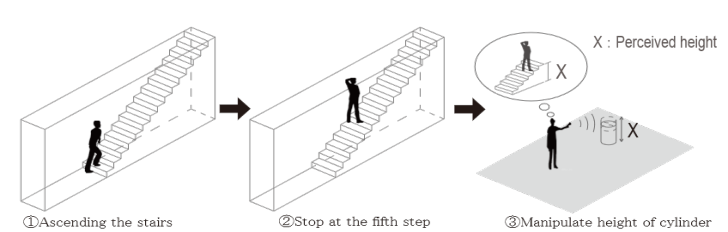
Procedure The measurement method was adapted from the approach proposed by Sugiyama et al. (2021), and its validity was confirmed through preliminary testing. Four candidate measurement methods were evaluated in a preliminary experiment, before the most reliable one was selected for the main experiment. The participants adjusted the height of a virtual cylinder using a controller until it corresponded to their perceived ascent height. The difference between the Perceived height obtained from the cylinder adjustment and the actual height of the virtual staircase was defined as the “difference from real height.”
Two primary indicators were used for the analysis: Perceived height, and its difference from real height. In each trial, the participants followed the standardized procedure outlined below.
1. 1. Ascend the designated staircase. 2. Pause at the specified step. 3. Adjust the height of the virtual cylinder to match your Perceived height of the staircase (Figure 1).
Figure 1: Research methods.
Effects of Stair Geometry and Surrounding Factors on Perceived Vertical 23 Experimental Condition A single-factor variation design was used, based on the reference condition. Five factors were examined: WIDTH (three levels), WALL (three levels), TYPE (three levels), MATERIAL (three levels), and WALKING SPEED (three levels), with no interaction effects between them considered. This design yielded 12 experimental conditions, including the reference condition and 11 single-factor variations. Conditions A–K represent the individual modifications applied to the reference condition (Table 1).
The reference condition was defined as follows: tread depth, 300 mm; riser height, 150 mm; stair width, 900 mm; 10 steps; sidewalls on both sides; straight staircase configuration; uniform concrete finish; and travel speed, 0.75 m/s.
The experimental conditions were as follows: A) Width Change ① (Width 1200 mm) B) Width Change ② (Width 1500 mm) C) Wall Change ① (Transparent Wall) D) Wall Change ② (Handrail) E) Type Change ① (Turn around at Fifth Step) F) Type Change ② (Angled Turn at Fifth Step) G) Material Change ① (Wood Grain Stairs) H) Material Change ② (Wood Grain on Both Sides) I) Walking Speed Change ① (Walking Speed: 1.0 m/s) J) Walking Speed Change ② (Walking Speed: 0.5 m/s) K) Dummy Condition
Table 1: Reference condition and experimental conditions A–H.
Table available in the original PDF paper.
Results
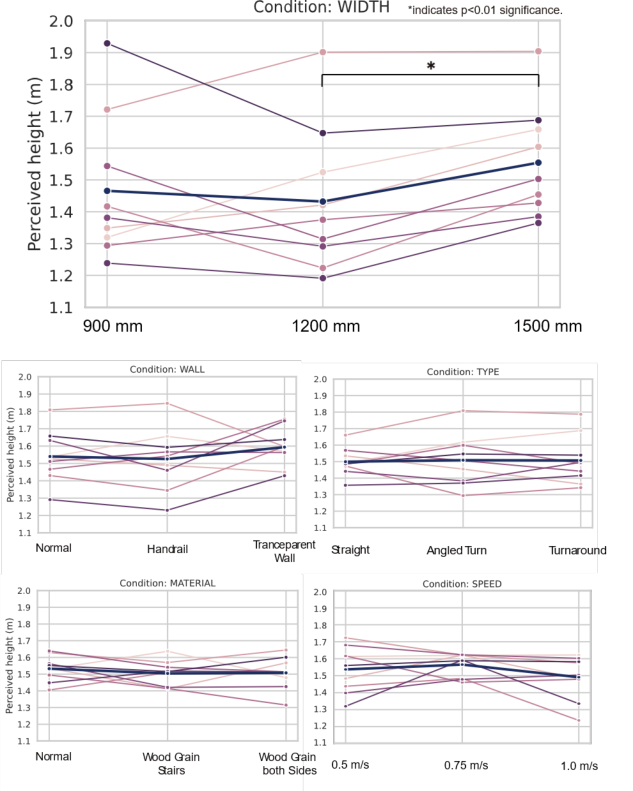
Comparisons between the conditions were conducted concerning the Perceived height obtained experimentally for each operational factor (i.e., WIDTH, WALL, TYPE, MATERIAL, and WALKING SPEED; Figure 2).
WIDTH For the WIDTH condition, the mean Perceived height was 1.47 m for a width of 900 mm, 1.43 m for 1200 mm, and 1.55 m for 1500 mm. The 1200 mm condition yielded the smallest mean Perceived height, whereas the 1500 mm one yielded the largest.
Analysis of variance revealed a significant main effect of WIDTH (F[2,18] = 3.96, p = .038, η² = .069). However, Mauchly’s test indicated a violation of the sphericity assumption (W = 0.47, p = .048). Therefore, the Greenhouse– Geisser correction was applied, which yielded a corrected significance level of p = .062.
Although the Greenhouse–Geisser corrected main effect did not reach conventional significance, the effect size was medium (η² = .069). This indicated a non-negligible magnitude of width-related variance in Perceived height.
Post-hoc comparisons revealed a significant difference between the 1200 mm and 1500 mm conditions (p = .002, Hedges’ g = −0.61). This pattern indicates that specific contrasts in stair width may influence Perceived height. No significant differences were found between the 900 mm and 1200 mm conditions (p = 1.000), or between the 900 mm and 1500 mm ones (p = .360).
Other Factors For the WALL factor, the mean Perceived height was 1.59 m for the Transparent Wall condition, 1.54 m for the Normal Wall condition, and 1.53 m for the Handrail condition. The Transparent Wall condition exhibited the largest mean Perceived height, while the Handrail condition exhibited the smallest.
Analysis of variance revealed no significant main effect of WALL (F[2,18] = 1.39, p = 0.274, η² = 0.047). Post-hoc comparisons likewise indicated no significant differences between the conditions (all p > 0.05).
For the TYPE factor, the mean Perceived height was 1.50 m for the Normal condition, 1.51 m for the Angled Turn condition, and 1.51 m for the Turnaround condition. The mean values were comparable across all of these conditions.
Analysis of variance revealed no significant main effect of TYPE (F[2,18] = 0.05, p = 0.952, η² = 0.001). Post-hoc comparisons with Bonferroni correction did not identify any significant differences between the conditions.
For the MATERIAL factor, the mean Perceived height was 1.53 m for the Normal condition, 1.50 m for the Wood Grain Stairs condition, and 1.51 m for the Wood Grain on Both Sides condition. The differences in mean Perceived heights among these material conditions were minimal.
Effects of Stair Geometry and Surrounding Factors on Perceived Vertical 25 Analysis of variance revealed no significant main effect of MATERIAL (F[2,18] = 0.57, p = 0.576, η² = 0.028). Post-hoc comparisons showed no significant differences among the three material conditions.
For the WALKING SPEED factor, the mean Perceived height was 1.54 m at 0.50 m/s, 1.56 m at 0.75 m/s, and 1.49 m at 1.00 m/s. The highest mean Perceived height was observed at 0.75 m/s, whereas the lowest was observed at 1.00 m/s.
Analysis of variance revealed no significant main effect of WALKING SPEED (F[2,18] = 2.43, p = 0.116, η² = 0.081). Although the effect size was relatively large, post-hoc comparisons indicated only a marginal trend between the 0.75 m/s and 1.00 m/s conditions (p = 0.053). No significant differences were identified between any of the speed conditions after Bonferroni correction.
Figure 2: Results for each experimental condition.
DISCUSSION
In this study, we examined how variations in stair dimensions and environmental characteristics influence perceptions of upward movement in stairways. The results indicated that Perceived height was selectively modulated by stair width. Although the Greenhouse–Geisser corrected main effect did not reach conventional significance (p = .062), the observed medium effect size (η² = .069) and the significant difference between the 1200 mm and 1500 mm conditions (g = −0.61, p = .002) suggest that stair width contributes meaningfully to perceptual scaling, albeit in a non-uniform manner.
Notably, this relationship was not monotonic. The perceived Height decreased slightly at 1200 mm relative to 900 mm, and increased again at 1500 mm. This pattern does not support a simple linear expansion account in which wider spaces uniformly amplify perceived vertical extent. Instead, it suggests that perceptual scaling may shift once spatial configurations cross a transitional range. Such nonlinearity is consistent with the notion that spatial perception is governed by the reweighting of cues, rather than by proportional geometric mapping. Changes in stair width may alter the relative dominance of lateral boundaries, perspective convergence, and horizontal extent cues, thereby reorganizing the internal reference frame used to estimate vertical displacement.
From a perceptual standpoint, vertical distance estimation during stair ascention likely relies on an integration of visual perspective information, spatial enclosure cues, and internally generated motion signals. When the stair width is narrow (e.g., 900 mm), strong lateral boundaries may provide stable perspective gradients that anchor height estimation. At intermediate widths (e.g., 1200 mm), the weakening of these boundary cues may reduce the reliability of vertical anchoring without yet establishing a sufficiently expansive horizontal reference structure. This intermediate configuration may induce a temporary reduction in the perceived vertical magnitude. When the width increases further (e.g., 1500 mm), the expanded horizontal span may become perceptually dominant, recalibrating spatial scaling and increasing the perceived magnitude of the ascent.
This interpretation suggests that stair width operates through changes in perceptual organization, rather than through direct geometric amplification. Notably, our present findings emerged in a context in which bodily effort was minimized by the use of a virtual environment. In contrast to effort- based accounts of vertical distance perception, which emphasize energy expenditure as a driver of overestimation, our results indicate that spatial framing alone can also modulate perceived ascent. This distinction implies that the perceptual scaling of vertical movement is not solely dependent on biomechanical factors, but is also sensitive to higher-order spatial structuring.
The absence of significant effects for the WALL, TYPE, MATERIAL, and WALKING SPEED factors further reinforces this interpretation. Over the range we tested, variations in surface properties or stair configurations may not have substantially altered the global spatial reference frame of our participants. Width directly modifies the lateral limits of the perceptual field, and thus may exert a stronger influence on the internal calibration of spatial
Effects of Stair Geometry and Surrounding Factors on Perceived Vertical 27 dimensions. Taken together, these findings support the view that stair width functions as a structural parameter that reorganizes perceptual reference frames during vertical movement, rather than merely adjusting the apparent scale of a space.
CONCLUSION
In this study, we investigated how variations in stair configuration and environmental characteristics influence the perception of upward movement during stair ascention in an immersive virtual environment. The results showed that stair width exerted the strongest influence on Perceived height, with a significant difference observed between the 1200 mm and 1500 mm width conditions. Conversely, no significant differences were found between the 900 mm and 1200 mm conditions, or between the 900 mm and 1500 mm ones. These findings suggest that the perceptual experience of vertical movement does not change linearly with stair width, but may rather be altered once a certain spatial threshold is exceeded.
Consistent with the results of previous studies on corridor and pathway perception, our present results indicate that stair width plays a key role in the modulation of perceptual scaling during stair ascention, potentially through changes in the spatial enclosure or the availability of visual reference cues. This suggests that width is not merely a geometric parameter, but also a perceptual factor that shapes how vertical movement is experienced.
The main findings of this study can be summarized as follows:
1. Stair width influences the perceived magnitude of upward movement during stair ascention; and 2. A threshold-like effect was observed, whereby increases in stair width affect Perceived height only beyond a specific range.
Taken together, these results demonstrate that stair width is a critical design parameter in terms of shaping psychological experiences of vertical movement. By incorporating perceptual considerations alongside physical requirements, stairway designs can actively contribute to the qualitative experience of architectural spaces during vertical circulation.
Limitations and Future Directions Some limitations of this study merit acknowledgment.
First, this experiment was conducted using an immersive virtual environment, so the experience of stair ascent thus differed substantially from real-world stair climbing. In particular, physical loads such as muscular effort, balance demands, and fatigue were not fully represented. Consequently, the perceptual responses observed in this study may not directly correspond to those experienced during actual stair ascention, where bodily effort plays a more substantial role.
Second, the staircase used in the experiment consisted of only 10 steps, which represents a relatively short ascent vs many physical, architectural
28 Nagata and Yoshioka staircases. The perceptual effects of stair width and other design parameters may accumulate or change when applied to longer staircases, and the limited number of steps assessed in this study may have constrained the magnitude or expression of such effects.
Third, Perceived height was assessed using an adjustment task wherein the participants reproduced their perceived ascents by manipulating the height of a virtual object. Although the validity of this method was confirmed in a preliminary experiment, some degree of uncertainty remains regarding how accurately it captures internal perceptual experience. Further validation, or the use of complementary measurement approaches, may improve the accuracy of perceptual assessments.
Our present findings indicate that stair width plays a critical role in terms of shaping perceptions of upward movement, with a significant difference observed between specific width conditions. To clarify the mechanisms underlying this effect, future studies should consider focusing on stair width in greater detail. This could be done by incorporating additional measures such as spatial impression ratings (e.g., openness, enclosure, and pressure) and eye tracking to examine visual attention and reference cue utilization during ascentions. Combining perceptual, behavioral, and visual data may provide deeper insights into precisely how stair width influences Perceived height, as well as contribute to the development of stair designs that more deliberately shape users’ psychological experiences.
REFERENCES
Ackermans, T. M. A., Francksen, N. C., Holzer, D., Ebner, S. A., Maganaris, C. N., Hollands, M. A., Roys, M., O’Brien, T. D. and Karamanidis, K. (2020). Stair negotiation behaviour of older individuals: Do step dimensions matter? Journal of Biomechanics, 109, 109616. Cohen, R., Baldwin, L. M. and Sherman, R. C. (1978). Cognitive Maps of a
Naturalistic Setting. Child Development, 49(4), pp. 1216–1218. Francksen, N. C., Ackermans, T. M. A., Holzer, D., Ebner, S. A., Maganaris, C. N., Hollands, M. A., Karamanidis, K., Roys, M. and O’Brien, T. D. (2020). Negotiating stairs with an inconsistent riser: Implications for stepping safety. Applied Ergonomics, 87, 103131. Mori, T., Yoshimura, M., Sugano, Y. and Muraki, S. (2011). The Effects of Stair
Dimensions on Movements during Climbing Up and Down Stairs. Journal of the Society of Biomechanisms Japan, 35(3), pp. 201–207. Perre, L. V. et al. (2019). Safety perception of stairs with integrated lighting. Building and Environment, 166, 106389. Reeves, N. D. et al. (2008). Influence of light handrail use on the biomechanics of
stair negotiation in older adults. Gait & Posture, 28(2), pp. 327–332. Sadalla, E. K., Staplin, L. J. and Burroughs, W. J. (1979). Retrieval Processes in Distance Cognition. Memory & Cognition, 7(4), pp. 291–296. Sasaki, D. and Yanase, R. (2011). Experimental Study About Stairs Inclination and
Walking Speed in Descending the Staircases. Journal of Architecture and Planning (Transactions of AIJ), 76, pp. 747–754. Sugiyama, T. and Yoshioka, Y. (2021). Relationship Between Bending Pattern of Leading Passages and Feeling Value of Ceiling Height in High Ceiling Room. Journal
Effects of Stair Geometry and Surrounding Factors on Perceived Vertical 29 of Architecture and Planning (Transactions of AIJ), 86(782), pp. 1224–1232. Takaku, Y. and Yanase, R. (2009). A Fundamental Study about Form and Width of
Passage in Architectural Space. Journal of Architecture and Planning (Transactions of AIJ), 74(638), pp. 809–814. Trinler, U. et al. (2016). Stair dimension affects knee kinematics and kinetics in patients with good outcome after TKA. Journal of Orthopaedic Research, 34, pp. 1753–1761. Yanase, R. and Suzuki, H. (2009). The Relationship Between Dimensions of Stairs
and Ratings of Impression with Walk. Journal of Architecture and Planning (Transactions of AIJ), 74, pp. 585–591. Yao, T., Ding, S., Zhang, Y., Chen, X., Xu, Y., Hu, K., Xu, X., Sun, L., Liang, Z.
and Huang, Y. (2024). Research on the Range of Appropriate Spatial Scale of Underground Commercial Street Based on Psychological Perception Evaluation. Preprints, 10.20944/preprints202405.1969.v1. Yonezawa, K. and Yoshioka, Y. (2020). Effect of Path width on human distance perception and position during path walking. Proceedings of the 43rd Symposium on Computer Technology of Information, pp. 108–111.
LISTED IN THE AHFE DIGITAL BOOKSTORE CATALOGUE
Explore the complete digital volume
Human Factors in Architecture, Sustainable Urban Planning and Infrastructure
Read this individual research paper free through the original publisher, or explore the full digital proceedings book.
ISBN 979-8-950676-05-5
Explore this ISBN in the AHFE Bookstore ↗Listed in the July 2026 bookstore catalogue; search by ISBN to confirm current availability · Digital book purchase optional