Takumi Nagata, Yohsuke Yoshioka (2025). Effect of Stair Tread Width on Perception of Vertical Ascending Distance. In: Human Factors in Architecture, Sustainable Urban Planning and Infrastructure. AHFE Open Access, vol. 191, pp. 34–43. https://doi.org/10.54941/ahfe1006607
This study aimed to investigate the relationship between stair tread width and the perception of vertical movement distance during stair ascent.The experiment tested whether variations in stair tread width (300mm, 600mm, and 900mm) influenced the perceived vertical movement distance. Twenty healthy university students participated, ascending a five-step stair constructed in the real world while wearing a head-mounted display (VIVE Focus Vision/HTC). The head-mounted display presented an immersive virtual environment where virtual stairs were aligned with the actual physical stairs. This setup controlled visual input while allowing participants to perform physical stair-climbing motions.Previous studies have proposed reproducing the sensation of stair ascent using virtual environments with only horizontal walking. However, horizontal movement alone lacks the muscle activity and physical effort associated with stair ascent, which may affect the perception of vertical movement. To address this limitation, this study utilized real stairs to test the validity of the effort hypothesis.During the experiment, participants repeatedly ascended the target stairs. After each ascent, the stairs were temporarily hidden, and a ground plane—set at ground level—was displayed as the measurement space. A single cylinder was shown on the ground, which participants could adjust in height using a controller. They were instructed to adjust the cylinder's height to match the height of the stairs they had just climbed. The adjusted height of the cylinder was recorded as the "perceived height," quantifying the ascending sensation induced by the stairs.A one-way ANOVA with stair tread width as the factor, followed by multiple comparisons, revealed statistically significant differences (p < 0.10) between the 300mm and 600mm conditions and between the 300mm and 900mm conditions. In both cases, the perceived height was greater for the 300mm tread condition, suggesting that smaller tread dimensions enhanced the sense of ascent.These findings are consistent with the effort hypothesis. The 300mm tread condition resulted in steeper gradients than the other conditions, requiring greater effort per unit of horizontal movement. The findings suggest that this increased effort contributed to the heightened perception of vertical movement distance.In conclusion, this study demonstrates that altering stair tread width can influence the perceived height, providing insights into how physical effort affects perception in stair-climbing tasks.
Effect of Stair Tread Width on Perception of Vertical Ascending Distance 35
stairs also influence spatial perception, safety, and user experience. Extensive research has been conducted on stair dimensions and their impacts on biomechanics, ergonomics, and perceived effort. However, further investigation is required to understand how stair tread width specifically affect the perception of vertical distance.
Biomechanical studies have demonstrated that the stair dimensions significantly affect user movement and safety. For example, Yanase and Suzuki (2009) found that variations in riser and tread dimensions influence users’ impressions of security and comfort. Similarly, Mori et al. (2011) reported that tread width affects movement trajectories during ascent and descent, thereby affecting the perceived ease of use. Francksen et al. (2020) emphasized the risks associated with inconsistent riser heights, showing that unexpected variations reduce foot clearance and increase the likelihood of tripping. Ackermans et al. (2020) found that older adults tend to maintain their biomechanical stepping behaviors despite changes in stair dimensions, potentially increasing the fall risk in environments with nonstandard stair geometries. Ram et al. (2024) extended these findings by comparing stair fall risks in controlled laboratory settings and in real houses, revealing biomechanical differences between fallers and non-fallers.
The perceptual and cognitive aspects of stair use were also explored. The effort hypothesis proposed by Cohen et al. (1978) suggests that greater physical effort leads to overestimation of route length. Sadalla et al. (1979) demonstrated that route shape and landmarks significantly affect perceived distance, highlighting the cognitive factors in spatial perception. Eves et al. (2013) examined perceived steepness and found that individuals tend to overestimate stair inclination, which may deter stair usage. Skervin et al. (2021) investigated the horizontal-vertical illusion in a stair design and demonstrated that specific visual cues can alter foot clearance and reduce the risk of falls. Novak et al. (2016) further explored balance control and step geometry and showed that long treads and low risers improve stability during stair descent.
Recent advancements in virtual reality (VR) technology have provided new opportunities for studying stair perception. Kanoya and Okajima (2022) investigated the effects of pseudo-stair simulations in VR, highlighting their potential for assessing user behavior in controlled environments. Veselá (2019) analyzed the geometric deviations in stair step dimensions, emphasizing the need for accurate stair construction to ensure safety. Koutamanis (2024) suggested integrating affordance-based analyses into stair design to optimize user interactions and minimize accident risks. Sasaki and Yanase (2011) focused on the walking speed and stair inclination to demonstrate the influence of specific dimensions on descending movement efficiency. Trinler et al. (2016) examined stair-climbing biomechanics in patients with total knee arthroplasty (TKA), showing that stair dimensions significantly affect knee kinematics. Perre et al. (2019) explored the safety perception of stairs with integrated lighting, highlighting the role of illumination in stairway navigation. Reeves et al. (2008) investigated handrail use and its impact on balance control, and found that light handrail support improves stair negotiation safety. Bertucco and Cesari (2009) conducted a
36 Nagata and Yoshioka
dimensional analysis of the ground reaction forces during stair climbing, emphasizing age-related differences in movement adaptation.
Given these findings, stair geometry affects users’ perceptions of vertical distance. However, previous research has not fully elucidated how tread dimensions affect the perceived elevation. In this study, we aimed to address this gap by analyzing the effects of stair tread width on the subjective perception of elevation using immersive VR technology. By systematically manipulating the stair dimensions in a controlled virtual environment, we inform architectural design strategies that optimize user comfort, safety, and spatial perceptions.
METHOD
In this study, we investigated the effects of stair tread width on perceived height using an experimental approach based on immersive virtual reality (VR).
Participants and Apparatus Ten healthy university students in their twenties (nine male adults and one female adult) participated in this study. All participants provided informed consent before participating in the experiment.
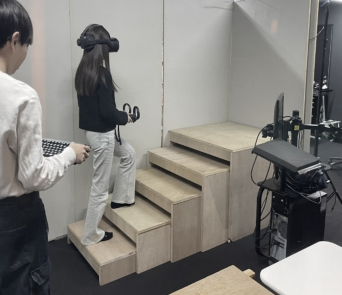
The experiment was conducted in a mixed-reality environment combining a physical five-step staircase with adjustable tread dimensions and a virtual staircase created using the virtual environment construction software Vizard 7.0 (WORLD VIZ). The participants performed stair ascent under different tread dimensions while wearing a head-mounted display (HMD) (HTC VIVE Focus Vision, HTC) (Figure 1).
To ensure safe stair ascent, an HTC Vive Tracker (3.0) was used to provide real-time visualization of the foot positions within the virtual environment. After ascending the staircase, the participants were asked to estimate the distance they had traveled (perceived height). The effect of tread dimension variations on the perceived vertical movement distance was then evaluated.
Figure 1: Participants conducting part in the experiment.
Effect of Stair Tread Width on Perception of Vertical Ascending Distance 37
Procedure The measurement method was based on the approach proposed by Sugiyama et al. (2021) and was validated through preliminary testing. Four candidate measurement methods were compared at the Pre-Experiment and the most reliable approach was selected. The participants used a controller to adjust the height of the virtual cylinder to match their perceived ascent heights. The discrepancy between the perceived height (obtained via cylinder height adjustments) and the actual height was defined as the “Difference from real height.” The experimental results were analyzed using two key indicators: the perceived height and the difference from the real height. For each trial, the participants followed a standardized protocol.
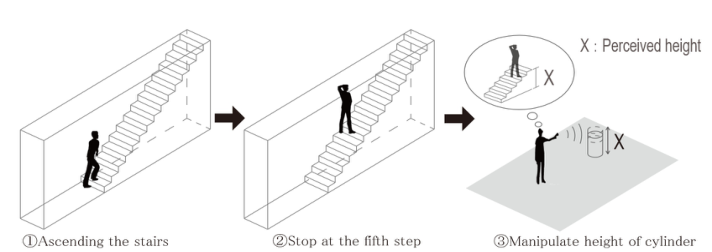
1. Ascend the designated staircase. 2. Pause at the specified step. 3. Adjust the height of the virtual cylinder to match the Perceived height (Figure 2).
Figure 2: Research methods.
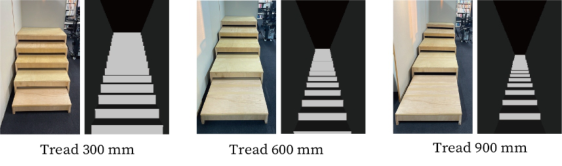
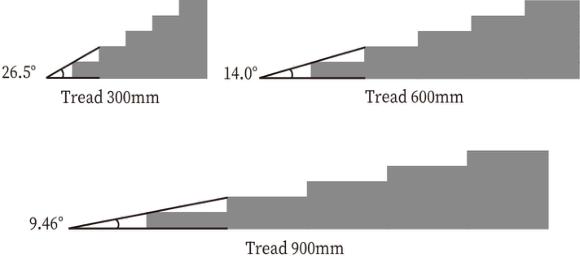
Experimental Conditions The experiment included three main conditions with tread dimensions of 300 mm, 600 mm, and 900 mm (Figure 3) and one dummy condition. In the main conditions, the stairs had a rise dimension of 150 mm, width of 900 mm, and five steps. The dummy condition was designed to familiarize the participants with the experimental process before starting the actual measurements. It also aimed to prevent the participants from assuming that all stairs had the same rise dimensions and number of steps. The dimensions of the dummy staircase were 450 mm for the tread and 250 mm for the rise. Under all conditions, the stairs were modeled with walls on both sides in the virtual environment for consistency.
At the start of each trial, the participants stood upright 600 mm in front of the first step of the staircase assigned to the condition being measured. In the virtual environment, a staircase with the corresponding tread and rise dimensions was placed at the same position as the real staircase. Before the experiment, the participants were fitted with trackers on both ankles. A foot model displayed in the virtual environment at the position of each tracker
38 Nagata and Yoshioka
allowed participants to see their foot placement in real time. This feature enabled the participants to climb stairs safely within the virtual environment.
Figure 3: Experimental conditions.
Significance of Using Stairs We employed an immersive virtual reality (VR) environment combined with a physical staircase to account for the biomechanical demands of stair ascent. While researchers in previous studies have attempted to simulate the sensation of stair climbing using only horizontal movements, such approaches primarily manipulated visual or sensory feedback in virtual environment.
Kanoya et al. (2022) explored whether stair ascent sensations can be replicated through visual manipulation alone in VR. Their study applied magnification effects to real-world foot movements by modifying virtual foot placements to simulate stair ascent visually.
However, biomechanical studies have highlighted key differences between stair ascent and level walking. Andriacchi et al. (1980) analyzed joint movements, forces, and moments during stair climbing and found that stair ascent generates significantly higher forces and moments than level walking. McFadyen and Winter (1988) further demonstrated that knee extensors and ankle plantar flexors play a primary role in stair climbing, requiring a consistent support moment distinct from level walking.
Given these findings, this study integrates immersive VR with real stair climbing rather than relying solely on visual manipulation or horizontal movement. This approach enabled a comprehensive investigation of both the physical and perceptual aspects of stair ascent.
The Stairs Used in the Experiment Based on the results and considerations of the preliminary experiment, we designed a staircase (Figure 4) to allow for a significant variability in tread width and reduce the time required to adjust the experimental conditions.
The staircase consisted of five U-shaped boxes, each 150 mm in height. The top surfaces were made of 18 mm thick plywood, and the footplates were 24 mm thick. Wood reinforcement was added at various points to ensure stability. The shape of the staircase could be flexibly adjusted by shifting the positions of the boxes. The staircase included five steps, with each riser height fixed at 150 mm, and the tread width could be adjusted from 0 to 900 mm.
Effect of Stair Tread Width on Perception of Vertical Ascending Distance 39
The tread width could be quickly modified by sliding the boxes, which significantly reduced the time required to change the experimental conditions. This design also enabled the participants to compare the different conditions intuitively. Before starting the experiment, a comprehensive safety check was conducted, and the necessary precautions were taken to ensure participant safety throughout the experiment.
RESULTS
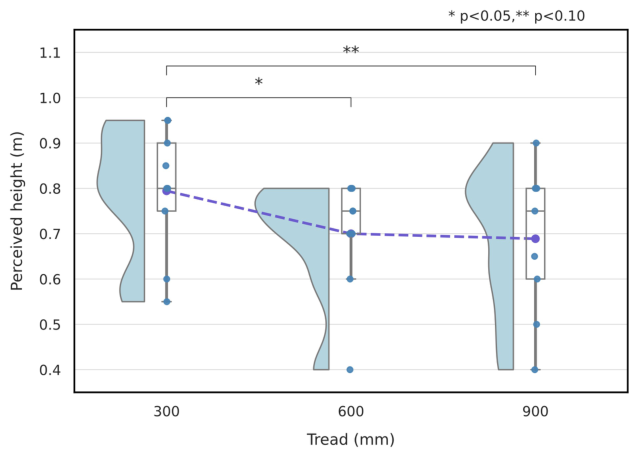
The perceived heights for the 300, 600, and 900 mm tread conditions were 0.800m (SD = 0.1354), 0.725m (SD = 0.1458), and 0.700m (SD = 0.1581), respectively. The mean value for the 300 mm tread condition was the highest, and the perceived height decreased as the tread dimension increased.
A repeated-measures one-way analysis of variance (ANOVA) comparing the perceived height across the three conditions resulted in F (2,18) = 3.3815, p < 0.10, η2 = 0.0852, indicating statistical significance at the 10% level. A post-hoc multiple comparison using Bonferroni correction showed no significant difference between the 600 mm and 900 mm tread conditions. However, weak associations were observed between the 300 mm and 600 mm conditions (p = 0.1022, d = 0.648) and between the 300 mm and 900 mm conditions (p = 0.1022, d = 0.699).
To refine the analysis, Participant 5 was excluded as an outlier based on their post-experiment interview responses, which differed significantly from the actual experimental results (Figure 5). A repeated-measures ANOVA was conducted again after removing the outlier, yielding F (2,16) = 3.8414, p < 0.05, η2 = 0.1059, demonstrating statistical significance at the 5% level.
Figure 5: Perceived height in tread.
40 Nagata and Yoshioka
Bonferroni-corrected multiple comparisons revealed no significant differences between the 600 mm and 900 mm tread conditions. However, significant differences were found between the 300 mm and 600 mm conditions (p = 0.0184) and between the 300 mm and 900 mm conditions (p = 0.0691), with the 300 mm tread condition being associated with a significantly higher perceived height than the other two conditions.
DISCUSSION
The results of this study confirm the initial hypothesis that small tread dimensions lead to high perceived height. The 300 mm tread condition resulted in a significantly higher perceived height compared to the 600 mm and 900 mm conditions, supporting the idea that steeper staircases enhance vertical distance perception. However, no significant difference was observed between the 600 mm and 900 mm tread conditions, suggesting that changes in tread width beyond a certain threshold do not further influence height perception.
The observed results align with the effort hypothesis proposed by Cohen et al. (1978), which posits that increased physical effort contributes to distance overestimation. As the 300 mm tread condition required a steeper ascent, the associated increased exertion likely amplified the perceived vertical displacement. This finding is consistent with previous research demonstrating that physical exertion affects distance perception not only in horizontal movement (Sadalla et al., 1979) but also in vertical ascent scenarios.
Furthermore, prior research on stair ascent biomechanics (Andriacchi et al., 1980; McFadyen & Winter, 1988) indicated that climbing steeper staircases demands greater joint movements and energy expenditure. This suggests that the participants experienced greater muscular engagement in the 300 mm tread condition, reinforcing the perceptual effects associated with effort.
Moreover, the similarity in step patterns between the larger tread conditions (600 and 900 mm) likely contributed to the absence of significant differences in perceived height (Figure 6). Observations in this study indicated that participants took only one step per stair in the 300 mm tread condition, while they required two steps per stair in the 600 mm and 900 mm conditions. This consistent movement strategy across the two larger-tread conditions likely resulted in similar perceived heights.
In addition, recent studies on VR stair perception (Kanoya et al., 2022) have suggested that visual cues alone are insufficient for fully replicating stair- climbing experiences. The findings of this study emphasize the importance of incorporating both biomechanical effort and visual perception into VR stairway simulations. For instance, Cooper et al. (2018) demonstrated that augmented physical feedback such as tactile or proprioceptive cues significantly enhanced task scores in virtual environments. These findings further highlight the multifaceted nature of stair-climbing perception, which combines physical and visual components to shape the human experience,
Effect of Stair Tread Width on Perception of Vertical Ascending Distance 41
emphasizing the importance of incorporating both biomechanical effort and visual perception in VR stairway simulations.
Figure 6: Gradient of each staircase.
CONCLUSION
Throughout the experiment, we found that the perceived height was significantly greater for the 300 mm tread condition than for the 600 mm and 900 mm conditions, and no significant differences were observed between the 600 mm and 900 mm conditions. These findings suggest that the effort hypothesis originally developed for horizontal distance perception may also apply to vertical distance perception during stair ascent.
The effort hypothesis posits that increased effort tor the anticipation of increased effort leads to an overestimation of perceived distance. In this study, the stairs of the 300 mm tread condition likely required greater physical effort for ascent, resulting in a higher perceived elevation distance compared to the stairs of the 600 mm and 900 mm conditions.
The findings of this study are as follows:
1. Stair tread width affects the sense of elevation. 2. The effort hypothesis can be applied to the perception of vertical movement distance when ascending stairs.
Limitations and Future Directions As we specifically focused on tread dimensions and used a five-step physical staircase, the participants were limited to ascending only up to the 5th step in the experimental setup. By contrast, real-world staircases typically consist of more than five steps. Changes in tread dimensions may have a greater or different impact on elevation perception when applied to longer staircases.
Moreover, in the experimental setup, we assumed that the sides of the stairs were enclosed by walls, restricting the participants’ access to external visual information. In real-world environments, the surrounding visual context, such as open spaces, architectural elements, and landscape views, play a significant role in shaping the perception of vertical distance. Incorporating these contextual factors into future research could enhance the ecological
42 Nagata and Yoshioka
validity of the findings and provide deeper insights into the impact of stairs’ design on user perception.
Participants adjusted the height of the virtual cylinder to represent their perceived elevation distance. Although this method was validated in a preliminary experiment, some participants experienced difficulty in accurately reproducing their perceptions. For instance, refining the measurement approach by exploring alternative or supplementary methods may yield more precise results and better capture the nuances of elevation perception influenced by tread dimensions.
These limitations highlight the need for future investigations that address the constraints of this study. Future research could provide a more comprehensive understanding of how tread dimensions influence the perception of stair ascent by extending the experimental conditions to include longer staircases, more open environments, and improved measurement tools.
REFERENCES
Ackermans, T. M. A., Francksen, N. C., Holzer, D., Ebner, S. A., Maganaris, C.
N., Hollands, M. A., Roys, M., O’Brien, T. D. and Karamanidis, K. (2020). Stair negotiation behaviour of older individuals: Do step dimensions matter? Journal of Biomechanics, 109, 109616. Andriacchi, T. P., Andersson, G. B., Fermier, R. W., Stern, D. and Galante, J. O. (1980).
A study of lower-limb mechanics during stair-climbing. The Journal of Bone and Joint Surgery. American Volume, 62(5), pp. 749–757. Bertucco, M. and Cesari, P. (2009). Biomechanics and motor control of stair negotiation: A review. Gait & Posture, 30(1), pp. 1–10. Cohen, R., Baldwin, L. M. and Sherman, R. C. (1978). Cognitive Maps of a
Naturalistic Setting. Child Development, 49(4), pp. 1216–1218. Cooper, R. et al. (2018). Investigation of stair descent biomechanics and its relation to falls risk in older adults. Journal of Aging and Physical Activity, 26(3), pp. 456–465. Eves, F. F., Thorpe, S. K. S., Lewis, A. and Taylor-Covill, G. A. H. (2013).
Does perceived steepness deter stair climbing when an alternative is available? Psychonomic Bulletin & Review, 21, pp. 637–644. Francksen, N. C., Ackermans, T. M. A., Holzer, D., Ebner, S. A., Maganaris, C.
N., Hollands, M. A., Karamanidis, K., Roys, M. and O’Brien, T. D. (2020). Negotiating stairs with an inconsistent riser: Implications for stepping safety. Applied Ergonomics, 87, 103131. Kanoya, K. and Okajima, K. (2022). Evaluation Method of Walking Feel and Effects of Incoherent Body Movement on Pseudo Stairs in Virtual Reality. The 27th Annual Conference of the Virtual Reality Society of Japan, 3D4–1. Koutamanis, A. (2024). Stair Design and User Interaction. Architecture, 4(3), 36. McFadyen, B. J. and Winter, D. A. (1988). An integrated biomechanical analysis of
normal stair ascent and descent. Journal of Biomechanics, 21(9), pp. 733–744. Mori, T., Yoshimura, M., Sugano, Y. and Muraki, S. (2011). The Effects of Stair Dimensions on Movements during Climbing Up and Down Stairs. Journal of the Society of Biomechanisms Japan, 35(3), pp. 201–207.
Effect of Stair Tread Width on Perception of Vertical Ascending Distance 43
Novak, A. C., Komisar, V., Maki, B. E. and Fernie, G. R. (2016). Age-related differences in dynamic balance control during stair descent and effect of varying step geometry. Applied Ergonomics, 52, pp. 275–284. Perre, L. V. et al. (2019). Safety perception of stairs with integrated lighting. Building
and Environment, 166, 106389. Ram, M. et al. (2024). Stair-fall risk parameters in a controlled gait laboratory environment and real houses. Sensors, 24. Reeves, N. D. et al. (2008). Influence of light handrail use on the biomechanics of
stair negotiation in older adults. Gait & Posture, 28(2), pp. 327–332. Sadalla, E. K., Staplin, L. J. and Burroughs, W. J. (1979). Retrieval Processes in Distance Cognition. Memory & Cognition, 7(4), pp. 291–296. Sasaki, D. and Yanase, R. (2011). Experimental Study About Stairs Inclination and
Walking Speed in Descending the Staircases. Journal of Architecture and Planning (Transactions of AIJ), 76, pp. 747–754. Skervin, T. et al. (2021). The horizontal-vertical illusion on stairs: Optimizing the visual appearance of stairs to reduce falls risk. LJMU Thesis. Sugiyama, T. and Yoshioka, Y. (2021). Relationship Between Bending Pattern
of Leading Passages and Feeling Value of Ceiling Height in High Ceiling Room. Journal of Architecture and Planning (Transactions of AIJ), 86(782), pp. 1224–1232. Trinler, U. et al. (2016). Stair dimension affects knee kinematics and kinetics in patients with good outcome after TKA. Journal of Orthopaedic Research, 34, pp. 1753–1761. Veselá, L. (2019). Staircase - Dimensions of Stair Steps and their Deviations of
Geometrical Accuracy. IOP Conference Series: Materials Science and Engineering, 471, 032034. Yanase, R. and Suzuki, H. (2009). The Relationship Between Dimensions of Stairs and Ratings of Impression with Walk. Journal of Architecture and Planning (Transactions of AIJ), 74, pp. 585–591.
LISTED IN THE AHFE DIGITAL BOOKSTORE CATALOGUE
Explore the complete digital volume
Human Factors in Architecture, Sustainable Urban Planning and Infrastructure
Read this individual research paper free through the original publisher, or explore the full digital proceedings book.
ISBN 978-1-964867-67-0
Explore this ISBN in the AHFE Bookstore ↗Listed in the July 2026 bookstore catalogue; search by ISBN to confirm current availability · Digital book purchase optional