Takahisa Nakamura, Yohsuke Yoshioka (2022). Effectiveness of Bollards in Deterring Pedestrians from Running into the Roadway. In: Human Factors in Transportation. AHFE Open Access, vol. 60, pp. 133–140. https://doi.org/10.54941/ahfe1002443
Bollards are poles that are placed at the intersection of a roadway and a sidewalk to prevent vehicles from entering. They are mainly installed to alert motorists and are rarely used to control pedestrians. However, given their morphological characteristics, bollards should be able to play a role in physically and psychologically controlling pedestrian behavior.This study focuses on the deterrent effect of bollards on pedestrians, preventing them from running into the roadway. We have developed an experimental method to reproduce situations where people are likely to run into the roadway using immersive virtual environment technology. It was difficult to quantitatively analyze the behavioral characteristics of such situations using conventional methods. In addition, we conducted experiments on subjects using the developed experimental method to verify the effect of linearly placed bollards on pedestrians to deter them from running into the roadway. This study aims to obtain knowledge that will help improve the environment and prevent accidents caused by pedestrians walking into the roadway.A total of ten students (seven men and three women) participated in the experiment. The subject experienced the virtual environment through the head-mounted display (HMD). Wireless intercommunication allows the subject to move freely in the virtual environment, and the specification of the experimental route can be changed according to the subject's location information. The experimental route consisted of a series of bends and T-intersections. The area at the end of the T-intersection was divided into a sidewalk and a roadway. A red ball moving at 1.7m/s was presented in this experimental route. The ball randomly entered or did not enter the roadway beyond the T-intersection. We had subjects chase a red ball and induced them to run into the roadway.A total of 16 conditions were set by combining four variables: the presence of bollards (bollards or no bollards), the presence of a motorcycle (motorcycle or no motorcycle), a ball rolling into the roadway (entry, no entry), and ball height (0.1m, 1.4m). We analyzed the change in speed and location information when the subjects ran into the roadway. In analyzing the experimental data, three analysis items were defined: "maximum deceleration," which indicates the degree of deceleration in front of the bollard, "deceleration point," which is the distance between the bollard and the position where the maximum deceleration occurred, and "safety check rate," which is the rate of head movement to pay attention to the surroundings. As a result of the verification, the following findings were obtained. The linear arrangement of bollards between the roadway and the sidewalk reduces the speed of movement in the direction of running from the sidewalk onto the roadway. The preceding effect was more strongly confirmed in the group of subjects who did not run onto the roadway. These results suggest that it is possible to encourage people to slow down by making the bollards visible from a distance.
Bollards are poles installed at the boundary of roadways and sidewalks, intersections, entrances to plazas, and so on to prevent vehicles from ente- ring. Unlike guardrails and other road equipment, bollards are installed in various shapes and sizes according to their location and purpose (Choi and Morita, 1999). They are mainly installed to alert motorists and are rarely used to control pedestrians (Ando, 2016). However, given their morphological characteristics, bollards should play a role in physically and psychologi- cally controlling pedestrian behavior. For example, in controlling pedestrian crowd flow during an evacuation, bollard arrays influence the behavioral characteristics of the group (Galea et al., 2015, Galea et al., 2016).
The present study focuses on the deterrent effect of bollards on pedestrians, preventing them from running into the roadway. Most research on dashing- out behavior is based on official statistics, literature, and questionnaires,
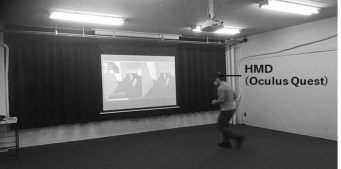
Figure 1: A subject experiencing the experimental environment.
and few experimental studies have observed actual dashing-out behavior. One approach is to simulate a situation where running into a dangerous place is likely to occur and observe the subjects’ behavior. This approach has previously been applied in preschoolers, and elementary school children (Shibawaka et al., 1984). Through the analysis, the relationship between the age of the children and their dashing-out behavior was clarified.
The present study attempted to induce dashing-out behavior in “adult subjects” using virtual environment technology. By controlling various ele- ments in a virtual environment and observing the behavioral characteristics of the subjects, it is possible to experimentally verify the dashing-out beha- vior. This study aims to obtain knowledge that will lead to the improvement of environments to prevent accidents caused by running into roadways.
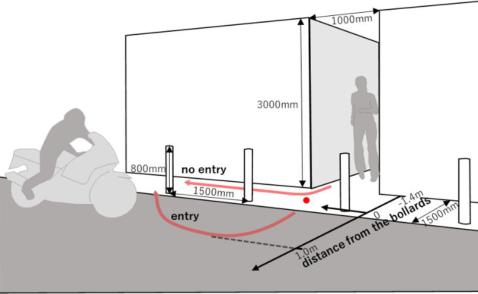
EXPERIMENT A total of ten university students (seven males and three females) participated in the experiment. The subjects experienced a virtual environment through a head-mounted display (HMD). An experimental pathway created using virtual environment software (vizard6.0/WorldViz) was presented to the HMD (Oculus Quest/Oculus) via transfer software (Virtual Desktop/Virtual Desktop). Wireless intercommunication allowed the subject to move freely in the virtual environment, and the specification of the experimental route could be changed according to the subject’s location information (Fig. 1). The expe- rimental route consisted of a series of bends and T-intersections. At the end of the T-intersection, the area was divided into a sidewalk and a roadway (Fig. 2). A ball moving at 1.7 m/s was presented in this experimental path. The speed of the ball was assumed to be a fast walking speed. The ball ran- domly entered or did not enter the roadway beyond the T-intersection. We had subjects chase the red ball and induced them to run into the roadway.
METHOD
The time spent walking along the T-intersection, as shown in Fig. 2, is the “test phase” for inducing a dashing-out behavior, and the rest of the time is the “dummy phase.” The experimental path was created by pseudo-randomly inserting 16 test phases between the dummy phases. In the test phase, a total of 16 conditions were set by combining four variables: the presence of bol- lards (bollards or no bollards), the presence of a motorcycle (motorcycle or
Effectiveness of Bollards in Deterring Pedestrians from Running into the Roadway 135
Figure 2: T-intersection to induce dushing-out behavior.
no motorcycle), a ball rolling into the roadway (entry or no entry), and ball height (0.1 or 1.4 m).
In the “bollards” condition, bollard arrays with a height of 0.8 m and diameter of 0.12 m are arranged with a spacing of 1.5 m (Fig. 2). The bollards are placed 0.1 m in front of the roadway. In the “no bollards”condition, there are no such bollards at all. This is the primary variable of this experiment. In the “motorcycle” condition, a motorcycle drives on the roadway on the other side of the bollard array at 40 km/h. In the “no motorcycle” condition, nothing is moving. In the “entry” condition, the ball enters the roadway at 1 m. In the “no entry” condition, the ball turns in front of the roadway and does not enter the roadway (Fig. 2). This variable was set up to make it impossible for the subject to predict whether the ball would enter the roadway or not. The height of the ball was set to “0.1 m” or “1.4 m”, assuming that the user was looking down while walking and facing the midair direction. Since experiencing all 16 conditions at once would increase the experiment time and the burden on the subject, the experiment was divided into four trials (four conditions in each trial).
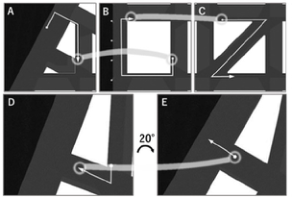
In order to continuously experience several experimental conditions in the limited space of the laboratory, a method was developed to connect multi- ple experimental paths without the subject noticing. Fig. 3 shows the case of connecting the experimental paths from an overhead view. The white arrows indicate the trajectory of the ball leading the subject. Since the ball’s position is controlled by the elapsed time, the position of the subject chasing the ball is also generally determined by time. Therefore, we adjusted the system so that another single experimental space was connected at a location that the subject could not see when the subject was moving straight ahead. This ope- ration allowed the subject to experience an uninterrupted experimental path combining several experimental conditions.
For the connection from D to E in Fig. 3, the space was rotated by 20 degrees. This is a function introduced by Redirected Walking (Razzaque et al., 2001). By implementing this function at key points in the experimental path, the participants can experience a larger space than the real one. In this expe- riment, we also implemented a function that gradually rotates the subject’s
136 Nakamura and Yoshioka
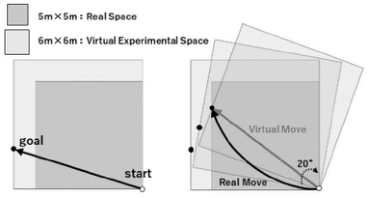
Figure 3: Connection method of the experimental paths.Figure 4: Change in walking trajectory due to rotation of virtual experimental space.
direction of moving not only when changing direction but also when going straight (Matsumoto et al., 2016). Fig. 4 illustrates the effect of rotating the experimental path when going straight. The user can walk a long virtual dista- nce, and the direction of movement at the goal point is close to parallel to the wall of the real space, which facilitates the subsequent spatial connection. From the preliminary verification before the experiment, it became clear that to reduce the subject’s discomfort caused by the rotation, it was necessary to simultaneously rotate the elements (such as the distant view and the ground) and keep the rotation speed at 6°/s. Therefore, we implemented the function within the specification and range in this experiment. Besides, these operati- ons were not worked near the exit of the “T-intersection,” which is the main section that was analyzed.
ANALYTICAL PROCEDURES The analysis was based on the subject’s movement speed, calculated from the change in position information of the HMD every 0.1 seconds. The subject occasionally walked on a rotating path in this experiment. Since the rotation affects the subject’s positional information, the accurate speed of the sub- ject in this section cannot be calculated. Therefore, this rotating path is not included in the analysis. The relationship between the change in acceleration, the head rotation angle, and the distance from the bollard arrays in the “test phase” is analyzed. The analysis was conducted only when the subject was going straight towards the roadway. The distance from the bollard in “no
Effectiveness of Bollards in Deterring Pedestrians from Running into the Roadway 137
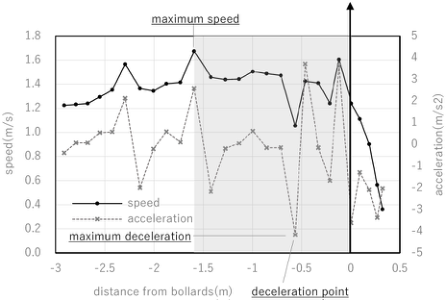
Figure 5: Definition of “maximum deceleration” and “deceleration point”.
bollards” condition was measured with the position of the bollard in “bol- lards” condition as 0 (Fig. 2). There were three analysis items: “maximum deceleration,” “deceleration point,” and “safety check rate”.
The “maximum deceleration” is the minimum acceleration between the time when the maximum speed is measured and the time when the subject passes through the bollard arrays (Fig. 5). The smaller the value, the more rapid the deceleration is. The “deceleration point” is where the maximum deceleration is detected, expressed as the distance from the bollards (Fig. 5). The value on the sidewalk side of the bollard is set to a negative value. The “safety check rate” is defined as the percentage of movements in which the head is turned more than 30 degrees from the movement direction. The percentage of safety checks performed more than once in each experimental condition was analyzed.
RESULTS AND DISCUSSION
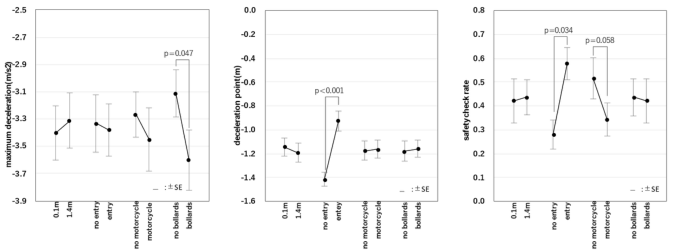
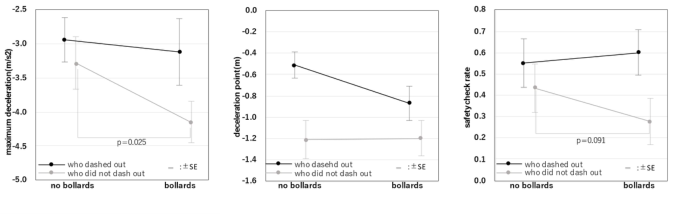
The data for “maximum deceleration,” “deceleration point,” and “safety check rate” were aggregated for each experimental condition, and ANOVA was conducted. Multiple comparison tests using the Bonferroni method were then conducted for the factors for which main effects were confirmed (Fig. 6). Henceforth, we refer to this as the ‘comparison of all conditions.’ Observing the behavior of the subjects in the “entry” condition, we found that some subjects followed the ball and dashed out into the roadway, while others did not. Therefore, we divided the data for the “entry” condition into two groups: subjects who dashed out and subjects who did not dash out (Fig. 7). For the two groups, we compared the effect of bollard (bollard vs no bollard); henceforth, we call this ‘comparison by dashing out.’
Maximum Decleration In the ‘comparison of all conditions,’ “maximum deceleration” significantly changed with the presence of bollards (Fig. 6, left). There were no main effe- cts of the other factors or interactions between factors. This indicates that, regardless of other factors such as the appearance of a motorcycle or the ball
138 Nakamura and Yoshioka
Figure 6: ‘Comparison of all conditions’ for “maximum deceleration” (left), “decelera- tion point” (center), and “safety check rate” (right).Figure 7: ‘Comparison by dashing out’ for “maximum deceleration” (left), “decelera- tion point” (center), and “safety check rate” (right).
entering the roadway, the bollards alone have an effect of slowing down the speed of movement.
In the ‘comparison by dashing out,’ there was a significant change in the “maximum deceleration” with the presence of the bollard in the group of subjects who did not actually dash out of the roadway (Fig. 7, left). It is not the physical contact with the bollard that encourages deceleration but the visibility of the bollard from a distance.
Decleration Point In the ‘comparison of all conditions,’ there was no significant change in the “deceleration point” due to the presence of bollards. However, the decele- ration point moved significantly depending on whether the ball entered the roadway or not (Figure 6, center). The transition of the data shows that the deceleration point moved more toward the roadway in the condition where the ball entered the roadway. This result indicates that the ball’s movement, set as the experimental condition, may have induced the subject to dash out of the roadway.
In the ‘comparison by dashing out,’ there was no significant difference between the subjects in the presence of the bollard. However, the data shows that bollards tend to move the deceleration point to the sidewalk side in the group of subjects who actually dashed out into the roadway (Fig. 7, center).
Effectiveness of Bollards in Deterring Pedestrians from Running into the Roadway 139
This suggests that the presence of bollards has a deterrent effect on careless subjects who tend to dash out into the roadway.
Safety Check Rate In the ‘comparison of all conditions,’ there was no significant change in the “safety check rate” due to the presence of bollards. However, there was a significant change in the “safety check rate” depending on whether the ball entered or not and whether the motorcycle was present or not (Figure 6, right). The significant increase in the “safety check rate” in the “entry” con- dition can be attributed to the fact that many subjects feared the motorcycle when entering the roadway. On the other hand, the reason why the “safety check rate”decreased in the condition with motorcycles may be because there were many subjects who were able to see the motorcycles and stopped moving their heads to look only at the motorcycles. In this experiment, there was only one motorcycle passing in front of them, but if there had been more than one motorcycle, the “safety check rate” might not have significantly decreased even in the condition with motorcycles.
In the ‘comparison by dashing out,’ there was a significant decrease in the change in the “safety check rate” with the presence of bollards in the group of subjects who did not actually dash out into the roadway (Figure 7, right). The subjects who tended to hesitate to dash out into the roadway may have been reassured by the presence of the bollards and neglected to check their surroundings.
CONCLUSION
Using immersive virtual environment technology, it is now possible to repro- duce a situation in which a pedestrian is likely to run into a roadway, which has been difficult to achieve using conventional methods. In addition, an experimental method was developed to quantitatively analyze the behavio- ral characteristics of such situations. We also conducted experiments using the developed experimental method to verify the effect of bollard arrays on pedestrians to deter them from running into the roadway. The speed and acceleration of the subjects were used to analyze the experimental data. As a result, the following findings were obtained.
Bollards placed between the roadway and the sidewalk can slow down the running speed in the direction from the sidewalk towards the roadway.
The above effect was more remarkable in subjects who did not actually run into the roadway, suggesting that the visibility of the bollards from a distance encourages deceleration.
REFERENCES
Ando, K. (2016), “Study on the Structure of Traffic Bollards Designed for Low-Speed Impact by a Vehicle.” Civil engineering journal, 58(8), 62-65. Choi, S., and Morita, Y. (1999), “The Product Characteristics and Design Problems
of Bollards Settings - A Study on Public Product Design of Urban Environmental Installations (1).” BULLETIN OF JSSD, 45(6), 55-64.
140 Nakamura and Yoshioka
Galea, E. R., Cooney, D., Sharp, G. G., and Gwynne, S. (2015), “The Impact of Security Bollards on Evacuation Flow.” Human Behaviour in Fire, Proceedings 6th Int Symp 2015, Interscience Communications Ltd, London, 131–142. Galea, E. R., Cooney, D. P., Xie, H., and Sharp, G. G. (2016), “Impact of Hostile
Vehicle Mitigation Measures (Bollards) on Pedestrian Crowd Movement Phase2 Final Report.” Matsumoto, K., Ban, Y., Narumi, T., Yanase, Y., Tanikawa, T., and Hirose, M.
(2016), “Unlimited corridor: redirected walking techniques using visuo haptic interaction.” ACM SIGGRAPH 2016 Emerging Technologies. Razzaque, S., Kohn, Z., and Whitton, M. C. (2001), “Redirected Walking.”
Eurographics 2001-Short Presentations. Shibawaka, T., Ieda, S., Takahashi, H., Nishioka, N., Okajima, Y., and Watanabe, M.
(1984), “A study on “Dashing-Out” Behavior of Children.” University of Tokyo, Faculty of Education, Departmental Bulletin Paper, 24, 165–180.
LISTED IN THE AHFE DIGITAL BOOKSTORE CATALOGUE
Explore the complete digital volume
Human Factors in Transportation
Read this individual research paper free through the original publisher, or explore the full digital proceedings book.
ISBN 978-1-958651-36-0
Explore this ISBN in the AHFE Bookstore ↗Listed in the July 2026 bookstore catalogue; search by ISBN to confirm current availability · Digital book purchase optional