Vanessa Stange, Sarah Helweg, Mark Vollrath (2022). Take a Seat! – Passengers’ Perceived Risk and Driving Behavior Preferences During Automated Driving in Urban Mixed Traffic Depending on the Seating Position. In: Human Factors in Transportation. AHFE Open Access, vol. 60, pp. 109–116. https://doi.org/10.54941/ahfe1002440
Publisher statistics will load when you open Metrics.
AHFE OPEN ACCESS OPEN ACCESS CONFERENCE PROCEEDINGS PAPER
Take a Seat! – Passengers’ Perceived Risk and Driving Behavior Preferences During Automated Driving in Urban Mixed Traffic Depending on the Seating Position
In future urban mixed traffic, passengers of highly automated vehicles (HAVs; SAE Level 4) will observe from a passive position how the automated system resolves space-sharing conflicts with crossing vulnerable road users (VRUs) at junctions. Since passengers are no longer required to intervene in the driving task but can choose any seat in the automated vehicle, we investigated the effects of seating position on passengers' driving behavior preferences and perceived risk in this space-sharing conflict. In a stationary driving simulator study, we varied HAV speed, VRU type, VRU crossing direction, and the passenger’s seating position (driver’s seat, passenger seat). During each VRU interaction, participants triggered the HAV’s braking maneuver by pressing a button, at (a) a point they considered ideal and (b) at the last acceptable braking onset they considered safe enough for the HAV to stop at the stop line. After each trial, participants rated perceived risk on an 8-point scale. We also analyzed the distance of the HAV from the VRU and the time-to-collision with the VRU at braking onset. Data were collected from 30 participants. The results show that seating position has no effect on passengers' perceived risk or on their preferred braking onset timing. Instead, passengers aimed to avoid risk experiences when interacting with the VRU, regardless of the seat position. These results are consistent with previous studies.
During automated driving (SAE Level 4, SAE, 2021), passengers hand over the entire driving task to the automated system and remain in a passive position while the HAV interacts with other road users in mixed traffic (Sch- ieben et al., 2019). Therefore, the passenger in the HAV can choose any seat while being driven automatically. Several studies have investigated passenger seating preferences, including seat configuration, orientation, position, and sitting posture (e.g., Nie et al., 2020; Bohman et al., 2020; Koppel et al., 2019; Yang, Klinkner & Bengler, 2019). These studies were conducted as online surveys (e.g., Nie et al., 2020; Koppel et al., 2019), in a stationary
test vehicle (Bohman et al., 2020), or mock-up seat boxes (Grébonval, Beil- las & Wang, 2021; Yang, Klinkner & Bengler, 2019). Regarding passengers’ seating position preference, i.e., which seat they would prefer in an HAV, the evidence is mixed. While one study found that passengers in a conventional forward-facing seating arrangement with two seat rows preferred to sit in the back row for safety reasons (Nie et al., 2020), another study found that passengers preferred to sit in the (former) driver’s seat (Koppel et al., 2019).
To date, it is unclear where passengers prefer to sit in the HAV while the automated system interacts with vulnerable road users (VRUs) in urban mixed traffic. It is possible that passengers assess the HAV’s driving beha- vior differently when they sit in a passenger seat, possibly because they feel even less able to control the HAV than when they sit in the driver’s seat. We therefore examined passengers’ preferences for HAV driving behavior in a space-sharing conflict (Markkula et al., 2020), involving an HAV that approaches and a bicyclist or pedestrian crosses a junction, depending on the passenger’s seating position.
METHODS AND MATERIALS Research questions. The driving simulator study was conducted in a sta- tionary driving simulator of the Department of Traffic and Engineering Psychology at the TU Braunschweig. By means of this study, we aimed to answer the following research questions:
1. (RQ1) Perceived risk: What is the perceived risk that passengers accept when interacting with crossing VRUs at an urban junction, depending on their seating position in the HAV? 2. (RQ2) Pleasantness: How pleasant do passengers perceive the HAV’s driving behavior in the interaction with VRUs at an urban junction, depending on their seating position in the HAV? 3. (RQ3a) From the passenger’s perspective, when should an HAV ideally brake in interaction with crossing VRUs at an urban junction, depending on the seating position in the HAV? 4. (RQ3b) When is the last acceptable braking onset time when approaching an urban junction with crossing VRUs, depending on the seating position in the HAV?
Experimental design and questionnaires. The study followed a repeated- measures design that included five independent variables: (a) vehicle speed (30 km/h 50 km/h), (b) VRU type (cyclist, pedestrian), (c) seating position (driver’s seat, passenger seat), (d) VRU crossing direction (left to right, right to left), and (e) braking onset (ideal, last acceptable). In addition to these 32 variations of the driving scenario, we implemented eight variations without a crossing VRU present in the driving scenario in the driving simulator. In total, each participant completed 40 variations of the driving scenario.
The dependent variables in this study were (a) perceived risk (RQ 1), (b) pleasantness (RQ 2), (c) distance from the VRU (RQ 3a, b), and (d) time-to-collision (RQ 3a, b) with the VRU at the braking onset. We mea- sured passengers’ ratings of perceived risk (How did you perceive the driving
Take a Seat! – Passengers’ Perceived Risk and Driving Behavior Preferences 111
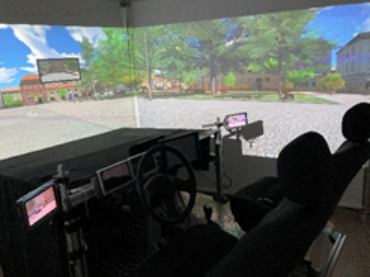
Figure 1: Stationary driving simulator of the TU Braunschweig with run- ning simulation.
behavior of the automated vehicle?) on an 8-point scale (Neukum et al., 2008; Stange, 2021) that included the categories harmless, unpleasant, dangerous, and Driving behavior not acceptable. In the categories unpleasant and dan- gerous, participants could refine their ratings using the subcategories a little, medium, or very. Participants were familiarized with the definition of each category before rating perceived risk for the first time. Pleasantness (How pleasant was the driving behavior of the automated vehicle for you?) was measured using a five-point Likert scale from 1 (very little) to 5 (very much). Participants rated perceived risk and pleasantness after each trial. We used the software unipark (Tivian, formerly Questback) to program the online questionnaire.
We measured passengers’ ideal and the last acceptable braking onset times using (a) the distance from the VRU, (b) the time-to-collision with the VRU at braking onset. These measurements were recorded in the driving data log.
Procedure. Prior to the simulator drive, participants received information about SAE Level 4 high automation. Thus, participants knew the HAV could in principle perform the entire driving task, and participants were in a passive position throughout the study (except for the participants’ task, as described in the following paragraph), regardless of which seat they were sitting in.
When approaching the junction in automated driving mode, participants’ task was to trigger the HAV braking maneuver by pressing a button at (a) a time they considered ideal and (b) a time they considered the last accepta- ble time to start braking. The ideal braking onset was defined as the time at which participants perceived braking to be completely safe. The last, accepta- ble time to start braking was defined as the last point in time that participants perceived as safe enough to brake and to stop immediately before the stop line. After the participants triggered the braking maneuver, the HAV decele- rated and came to a stop immediately before the stop line. Deceleration was determined by the timing of the onset of braking.
Participants. The final sample consisted of N = 30 passengers (13 male) aged 18 to 69 years (M = 27.8 years, SD = 14.8). Data from one participant were excluded from the analysis due to errors in data collection. The study complied with the American Psychological Association’s Code of Ethics as
amended by the German Psychological Societies and was approved by the ethics committee of the Faculty of Life Sciences and the University Board of the Technische Universität Braunschweig. Data was collected in November 2021. Due to the Covid-19 pandemic, we implemented a hygiene concept, which was also approved by the University Board.
RESULTS
(RQ1) Perceived risk. Descriptive statistics show that the average ratings of perceived risk in the conditions studied ranged in the lower half of the scale between the labels harmless and very unpleasant. The repeated-measures ANOVA revealed no significant main effect of seating position on passen- gers’ perceived risk, F(1,29) = 2.7, p = .114, with ratings ranging between the labels a little and medium unpleasant regardless of seating position (MDriver’s seat = 2.2, MPassenger seat = 2.3). There were no other significant inte- raction effects between seating position and the other independent variables included in the analysis (p = .074 – .990). Instead, vehicle speed and braking onset type had both significant main effects and an interaction effect on the passengers’ perceived risk, F(1,29) = 6.8, p = .014. At 50 km/h, the diffe- rence between the ratings of perceived risk were larger for the two braking onsets (Mideal = 1.6, Mlast = 3.3) than at 30 km/h.
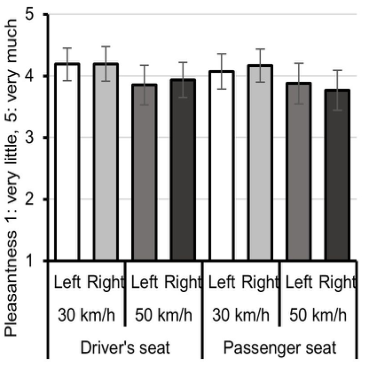
(RQ2) Pleasantness. Descriptive statistics show that average ratings of ple- asantness in the conditions studied were in the upper half of the scale between the labels medium and very pleasant. The repeated-measures ANOVA revea- led a significant three-way interaction effect between seating position, vehicle speed and VRU crossing direction, F(1,29) = 4.4, p = .046, η2par = .13. How- ever, as Fig. 3, on the left, shows, this effect is marginal and thus not further commented. A second three-way interaction was found between seating posi- tion, VRU type and braking onset, F(1,29) = 8.2, p = .008, η2par = .22. as well as a main effect of braking onset. As Fig. 3, on the right, shows the main effect of braking onset is clearly visible in all four combinati- ons of the other two factors. Again, the interaction effect seems marginal and is not further interpreted. The main effect of seating position was not significant, F(1,29) = 3.6, p = .066, with mean ratings in the two condi- tions approximately equal to the label rather pleasant (MDriver’s seat = 4.04; MPassenger seat = 3.97). No other significant interaction effects were found between seating position and the other independent variables included in the analysis (p = .144 – .991).
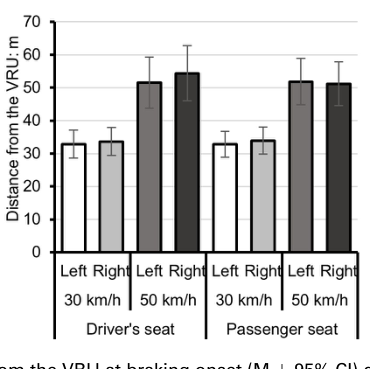
(RQ3) Braking onset timing. Descriptive statistics for the distance from the VRU measured at the onset of the HAV braking maneuver showed that, on average, passengers triggered the braking maneuver at M = 39.3 m (ideal) and M = 27.3 m (last) in the 30-km/h condition, and at M = 63.1 m (ideal) and at M = 41.4 m (last) in the 50-km/h condition. The repeated-measures ANOVA revealed no main effect of seating position, F(1,29) = 0.7, p = .426. Instead, the other independent variables included in the analysis had significant main effects on the distance from the VRU at braking onset, vehicle speed, F(1,29) = 117.1, p < .001, braking onset time, F(1,29) = 146.7, p < .001, VRU type, F(1,29) = 6.6, p = .016, VRU crossing direction, F(1,29) = 6.9,
Take a Seat! – Passengers’ Perceived Risk and Driving Behavior Preferences 113
Figure 2: Pleasantness ratings (M ± 95% CI) depending on seating position, vehicle speed, and VRU crossing direction (on the left), and on seating position, VRU type, and braking onset (on the right).Figure 3: Distance from the VRU at braking onset (M ± 95% CI) depending on seating position, vehicle speed, and VRU crossing direction.
p = .014. There was also a significant interaction effect between seating posi- tion, vehicle speed, and VRU crossing direction, F(1,29) = 4.7, p = .039. However, as Fig. 3, on the left shows, the difference between 30 km/h and 50 km/h is very similar for the two seating positions. The two-way interaction between seating position, and VRU crossing direction was not significant, F(1,29) = 4.2, p = .050. The analysis revealed no other significant intera- ction effects between seating position and the other independent variables included in the analysis (p = .127 – .591).
Regarding time-to-collision with the VRU at braking onset, descriptive statistics show that, on average, passengers triggered the braking onset at M = 4.7 s (ideal) and M = 3.3 s (last) in the 30-km/h condition, and at M = 4.5 s (ideal) and at M = 3.0 s (last) in the 50-km/h condition. The
repeated-measures ANOVA revealed neither a significant main effect of sea- ting position, F(1,29) = 0.3, p = .569, nor a significant interaction effect between seating position and the other independent variables included in the analysis (p = .088 – .809). Instead, time-to-collision was dependent on the vehicle speed, F(1,29) = 9.8, p = .004, the braking onset time, F(1,29) = 157.8, p = .001, the VRU type, F(1,29) = 7.0, p = .013, and crossing direction, F(1,29) = 9.1, p = .005. There were no other signifi- cant interaction effects between seating position and the other independent variables included in the analysis.
DISCUSSION AND CONCLUSION The present driving simulator study investigated passengers’ risk perception and their preferred timing of braking initiation during automated driving when approaching an intersection with crossing VRUs depending on seating position.
Regarding perceived risk, results show that the seating position (driver’s vs. passenger seat) has no effect on passengers’ perceived risk or their pre- ferred initiation of braking. Instead, the results suggest that passengers want to avoid any subjective risk and prefer harmless interactions with VRUs. At most, passengers accepted unpleasant interactions (RQ1). This finding is in line with previous research (Stange, 2021; Stange et al., 2022). In line with this finding, passengers perceived their self-selected braking onset as rather pleasant at the ideal braking onset, and at least medium pleasant at the last braking onset, regardless of the seating position (RQ 2).
Furthermore, passengers prefer an early braking onset, i.e., the HAV should brake at least 5 s (ideal braking onset) or 3 s (last braking onset) before the VRU, regardless of the seating position (RQ3). These mean values are comparable to those obtained in previous studies in a driving simulator and in a real test vehicle at a test site (Stange, 2021; Stange et al., 2022). The distance from the VRU at braking onset depended on seating position, vehi- cle speed, and VRU crossing direction, with passengers initiating the braking maneuver at a greater distance from the VRU at 50 km/h than at 30 km/h. The seating position and the VRU crossing direction had no substantial effect on the passenger’s braking initiation. Instead, the effect of vehicle speed was more evident as described (see Fig. 3, on the left).
Summing up, these results suggest that the seating position in this space- sharing conflict might be irrelevant to passengers’ risk perception and the timing of braking onset. At the same time, however, using a stationary dri- ving simulator with a seat box to investigate this research question neglects both the vehicle dynamics of a real vehicle and the hazard potential of real traffic. In addition, passengers in this study had an active part by selecting their preferred braking onsets. Due to this active intervention in the driving task, passengers did not surrender the entire driving task to the Level 4 HAV. Therefore, ratings of perceived risk may be underestimated in the present study.
Further research should therefore ensure that passengers do not intervene actively in the driving task, but instead remain passive, and let the HAV
Take a Seat! – Passengers’ Perceived Risk and Driving Behavior Preferences 115
drive them. The mean values for the distance from the VRU and the time- to-collision could be used to parameterize the HAV braking onset in future studies.
In addition, it might be worth considering whether the possibility to over- steer the automated system using the steering wheel and the pedals should be given, or whether a steering wheel should be present in the HAV at all.
ACKNOWLEDGEMENTS
We thank Doris Sonntag for implementing the driving scenario in the driving simulator.
FUNDING This research received no external funding.
REFERENCES
Bohman, Katarina. Örtlund, Ronja. Kumlin Groth, Gustav. Nurbo, Pernilla and Jakobsson, Lotta. (2020). Evaluation of users’ experience and posture in a rota- ted swivel seating configuration, TRAFFIC INJURY PREVENTION Volume 21 Sup. 1. Grébonval, Cyrille. Beillas, Philippe and Wang, Xuguang. (2021). “Experimen-
tal investigation of preferred seating positions and postures in reclined seating configurations”, proceedings of the Comfort Congress 2021, Online Conference. Koppel, Sjaan. Jiménez Octavio, Jesús. Bohman, Katarina. Logan, David. Raphael, Wassim. Quintana Jimenez, Leonardo. Lopez-Valdes, Francisco. (2019). Seating configuration and position preferences in fully automated vehicles. TRAFFIC INJURY PREVENTION Volume 20 Sup. 2. Markkula, Gustav. Madigan, Ruth. Nathanael, Dimitris. Portouli, Evangelia. Lee,
Yee Mun. Dietrich, Andre. Billington, Jac. Schieben, Anna and Merat, Natasha. (2020). Defining interactions: a conceptual framework for understanding intera- ctive behaviour in human and automated road traffic, THEORETICAL ISSUES IN ERGONOMICS SCIENCE Volume 21 No. 6. Neukum, Alexandra. Lübbeke, Thomas. Krüger, Hans.-Peter. Mayser, Christoph and Steinle, Joachim. (2008). “ACC-Stop&Go: Fahrerverhalten an funktionalen Systemgrenzen”, in: 5. Workshop Fahrerassistenzsysteme – FAS 2008, Maurer, Markus and Stiller, Christoph (Eds.), pp. 141–150 Nie, Bingbing. Gan, Shun. Chen Wentao and Zhou, Qing (2020). Seating preferences
in highly automated vehicles and occupant safety awareness: A national survey of Chinese perceptions, TRAFFIC INJURY PREVENTION Volume 21 No. 4. Schieben, Anna. Wilbrink, Marc. Kettwich, Carmen. Madigan, Ruth. Louw, Tyron and Merat, Natasha. (2019). Designing the interaction of automated vehicles with other traffic participants: design considerations based on human needs and expectations, COGNITION, TECHNOLOGY AND WORK Volume 21. SAE International. (April 30, 2021). Taxonomy and Definitions for Terms Related
to Driving Automation Systems for On-Road Motor Vehicles. SAE International Website: https://www.sae.org/standards/content/j3016_202104/ Stange, Vanessa. (2021). DISSERTATION, “Human driver and passenger reactions to highly automated vehicles in mixed traffic on highways and in urban areas”, Technische Universität Braunschweig, https://doi.org/10.24355/dbbs.084- 202107221339-0
Stange, Vanessa. Goralzik, Anne. Ernst, Susanne. Steimle, Markus. Maurer, Markus and Vollrath, Mark. (2022). Please stop now, automated vehicle! - Passengers aim to avoid risk experiences in interactions with a crossing vulnerable road user at an urban junction. Transportation Research Part F: Traffic Psychology and Behaviour Volume 87. Yang, Yucheng. Klinkner, Jan Niklas and Bengler, Klaus. (2019). “How Will the Dri-
ver Sit in an Automated Vehicle? – The Qualitative and Quantitative Descriptions of Non-Driving Postures (NDPs) When Non-Driving-Related-Tasks (NDRTs) Are Conducted”, in: Proceedings of the 20th Congress of the International Ergonomics Association (IEA 2018). IEA 2018. Advances in Intelligent Systems and Compu- ting, Bagnara, Sebastiano. Tartaglia, Riccardo. Albolino, Sara. Alexander, Thomas and Fujita, Yushi (Eds.), pp. 409–420.
LISTED IN THE AHFE DIGITAL BOOKSTORE CATALOGUE
Explore the complete digital volume
Human Factors in Transportation
Read this individual research paper free through the original publisher, or explore the full digital proceedings book.
ISBN 978-1-958651-36-0
Explore this ISBN in the AHFE Bookstore ↗Listed in the July 2026 bookstore catalogue; search by ISBN to confirm current availability · Digital book purchase optional