Melina Makris, Anna-Lisa Osvalder (2022). Experimental Setup for Assessing Drivers’ Experiences of Reclined Sitting Posture in Automated Vehicles. In: Human Factors in Transportation. AHFE Open Access, vol. 60, pp. 117–126. https://doi.org/10.54941/ahfe1002441
Highly automated vehicles are opening new opportunities for alternative sitting postures, such as the reclined posture, when drivers disengage from conventional driving tasks. This paper presents an experimental setup to assess drivers’ experiences of the reclined sitting posture and the human machine interfaces (HMI) for transitions between upright and reclined modes, and between manual and automated driving modes. The method used to develop the setup consisted of identifying the necessary equipment for developing the experimental setup, defining the preparation and execution of the experimental setup, and collecting and analysing feedback from eight human factors experts. The experimental setup consisted of four steps: practicalities, preparations, execution, and data collection methods. Also, six aspects must be considered when assessing user experiences in a dynamic test: (1) recruiting appropriate participants, (2) providing consistent tasks, (3) providing adequate time constraints, (4) avoiding social influences, (5) utilizing appropriate data collections methods, (6) and carrying out a pilot study.
Automated vehicle (AV) technology is developing rapidly. This is heightening the importance of both safety and useful protection principles customised for a wide range of sitting postures. Due to the driving task, today’s passengers have a greater variety of sitting postures compared to drivers. However, in future AVs, drivers are expected to become passengers and thus have more freedom to choose their sitting postures. One posture desired by drivers is the reclined sitting posture (Koppel et al., 2019; Bohrmann and Bengler, 2019). In terms of higher levels of automation corresponding to the Society of Auto- motive Engineers Level 4 (SAE L4) and above, the driver is not considered a fallback option (Banks et al., 2018). However, driver-initiated transitions are possible if the driver wants to take over control. Hence, the driver will still be able to actively drive, although the traditional driving task will change significantly. The automated driving system (ADS) sets requirements on the human machine interface (HMI), e.g., for transitions between different sit- ting modes and between manual and automated driving modes. An area of
major interest is studying how drivers experience the reclined sitting posture in AVs. So far, occupants’ experiences in dynamic environments have not been broadly studied. Drivers’ experiences are needed to aid the development of restraint systems adapted to reclined sitting. The purpose of this paper is to present an experimental setup to assess drivers’ experience of the reclined sit- ting posture and the two related HMIs in an SAE L4 automated vehicle. The HMIs are used for transitions between the upright and reclined modes and for vehicle transitions between manual and automated modes.
METHOD
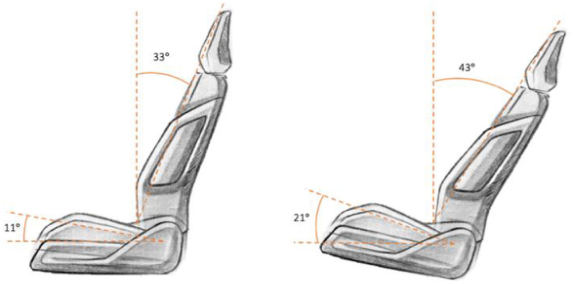
The method used to develop the experimental setup for assessing drivers’ preferences for reclined sitting in AV was divided into three phases. The first phase consisted of identifying the necessary equipment for developing the experimental setup. The second consisted of defining the preparation and execution of the experimental setup, resulting in an initial version of it. The third consisted of collecting and analysing feedback on the initial version from human factors experts, resulting in the proposed experimental setup. The first phase identified the equipment needed for running the expe- riments. These consisted of a prototype vehicle with a flexible seat and an ADS corresponding to SAE L4, an HMI for alternating between manual and automated driving modes, an HMI for alternating between upright and recli- ned modes, and an outdoor test track. In this case, the prototype vehicle was a medium-sized car with a maximum ADS of 30 km/h and a flexible driver seat for reclined sitting. In the upright sitting mode, the seat pan angle was 11 degrees and the back angle 33 degrees. In the reclined sitting mode, the seat automatically moved backwards 100 mm and the seat pan tilted 10 degrees, resulting in a seat pan angle of 21 degrees and a seat-back angle of 43 degrees (Figure 1). The prototype vehicle was equipped with extra brake pedals in the front passenger’s footwell. In this case the outdoor test track comprised two straight routes of 1000 m each and two U-turns with a diameter of 25 m.
Figure 1: Upright sitting posture and reclined sitting posture.
The second phase consisted of defining preparations and the execu- tion of the experimental setup. These preparations included conducting a
Experimental Setup for Assessing Drivers’ Experiences of Reclined Sitting Posture 119
storyboard, a failure mode and effect analysis (FMEA) and executing a pilot study to test the experimental setup. The execution of the experimental setup included defining the test route and data collection method. The second phase resulted in the initial version of the experimental setup. The third phase consisted of collecting feedback from human factors experts on the initial version of the experimental setup. Presenting an initial version of an expe- rimental setup to independent experts, who review and critique it from a new perspective, is a method aimed at ensuring a high-quality approach in a user study (Nielsen, 1994). Eight independent human factors experts from academia and industry, with a wealth of experience in conducting user stu- dies, each participated in an online interview to discuss the experimental setup. Before the interview, they were given written documentation descri- bing the setup. The interviews were recorded with audio and video with the permission of the interviewees. These recordings were later transcribed, clu- stered into relevant focus areas, and analysed. The findings were then used to refine the initial version of the experimental setup, resulting in the proposed experimental setup.
RESULTS
The proposed experimental setup for assessing drivers’ experience of the reclined sitting posture, and the HMIs for transitions between upright and reclined modes and between manual and automated modes, included four steps consisting of practicalities, preparations, execution, and data collection methods.
Practicalities Practicalities refer to the practical aspects which form the basis for con- ducting the experimental study and includes logistical management and administration. Logistical management refers to recruiting participants, assi- gning a test leader, and involving appropriate technical support operators. Administration includes forming test protocols and consent forms, providing participants with information before their participation, allocating questi- onnaires, keeping contact with participants and paperwork before and after each study session. The test leader manages the study and sits in the right- hand rear seat during the drive to handle questionnaires and interviews. These are conducted inside the vehicle, while the participant sits in the front seat. During each drive, a safety operator should sit in the front passenger seat to handle additional braking in case of unexpected events.
Recruitment of Participants The participants should represent ordinary drivers holding a category B dri- ving licence. They should be used to driving every week to avoid the test being influenced by drivers who are uncomfortable in everyday driving situations. Both men and women with a variety of anthropometric measures in terms of height and body constitutions should be recruited, preferably eight males and eight females, as drivers with different anthropometric measures are likely to
120 Makris and Osvalder
experience the reclined sitting posture differently. Age can also be a parame- ter to consider when recruiting participants, since the perception of comfort changes with age (Bohman et al., 2019).
Preparations of Experiemental Setup The preparations include conducting a storyboard to estimate timing, an FMEA to predict and mitigate risks and a pilot study to reveal inconsistencies in the setup.
Storyboard A storyboard facilitates understanding of the experimental setup in terms of time, by mapping how much time is required for each transition (Van Der Lelie, 2006). In this study, vehicle speed, the time it takes to alternate between different sitting modes and driving modes, the number of transitions and the length of the test route will all influence the schedule. The storyboard serves as a tool to plan for how long the participants should experience the different sitting postures and how many times they should interact with the HMIs.
FMEA An FMEA should be carried out to detect and mitigate risks that might arise during the study. In the FMEA, predicted risks are given a risk prio- rity number (RPN) from 1-10, corresponding to the product of the severity of the consequence and the probability of its occurrence (Stamatis, 2003). The higher the RPN value, the greater the risk. Risks that should be conside- red and mitigated include cameras detaching during the ride, loose equipment inside the car, participants driving too fast, bad weather conditions, motion sickness and ADS failure during the ride.
Pilot Study A pilot study should be conducted with a few participants. Its aim is to reveal inconsistencies in the experimental setup which must be addressed to achieve a reliable, valid, and smooth-running setup. The pilot study enables inve- stigation of how instructions, tasks, questionnaires, and interview questions are interpreted by the participants and reveals any misunderstandings. It also enables further estimation of the schedule, distribution of tasks between the test leader and assisting operators and other practicalities which may arise.
Execution of User Study With Experimental Setup The execution starts with an introduction followed by four laps driven on the test track, with subjective data collection between each lap.
Introduction of Experimental Setup First, the test leader should introduce each participant to the experimental procedure, answer any questions, ask the participant to sign the consent form and state that they may terminate their participation at any time during the test. Thereafter, the participants should drive lap zero on the test track. This is an introductory lap before the real test session starts. During lap zero,
Experimental Setup for Assessing Drivers’ Experiences of Reclined Sitting Posture 121
the participants familiarise themselves with the test route and learn how to manoeuvre the prototype vehicle and HMIs to avoid influences from learning effects. They should also adjust their seat in the x-axis forward or backward to find an upright sitting posture that allows them to conveniently reach the pedals and steering wheel in the manual driving mode.
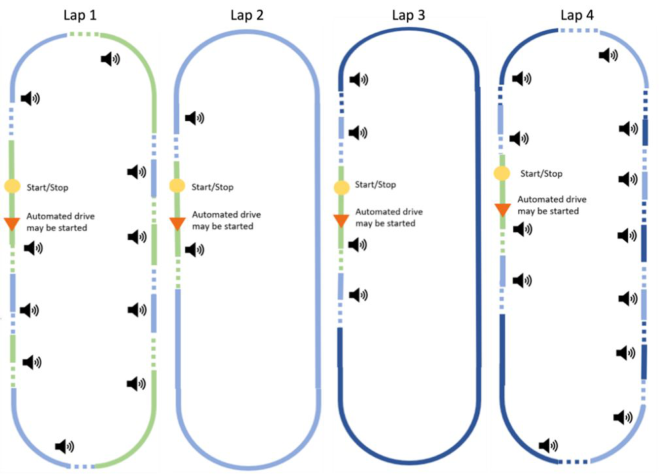
Four Laps on Test Track Each participant should drive four laps on the track. Lap 1 focuses on the HMI for alternating between manual and automated driving modes, lap 2 on the upright sitting posture in automated driving mode, lap 3 on the reclined sitting posture in automated driving mode, and lap 4 on the HMI for alterna- ting between upright and reclined modes (Figure 2). It should be noted that the experience of the upright posture is evaluated only to enable compari- son with the reclined posture. Half the participants should test the upright posture first and then the reclined posture and vice versa for the others, to decrease the influence of experience over time. All laps start in the manual driving mode. Audible and visible instructions are provided by the vehicle to inform the participant when to alternate between manual and automated mode, and between upright and reclined mode.
Figure 2: The four laps. Green = manual drive, light blue = automated drive in upri- ght sitting posture, dark blue = automated drive in reclined sitting posture, dotted line = transition to next phase, audio speaker = instructions on altering to another mode.
Data Collection Methods The data collection includes subjective and objective methods. The objective data collection consists of video recordings of participants’ HMI interactions
122 Makris and Osvalder
and sitting postures. These recordings are enabled by two cameras fixed inside the vehicle. The subjective data collection concerns participants’ expe- riences of the two sitting postures in lap 2 and 3, and the HMI interactions in lap 1 and 4. These evaluations consist of questionnaires after each lap, followed by interviews.
Questionnaires for Evaluation of HMIs The first questionnaire uses a semantic differential scale to evaluate the sub- jective satisfaction of the HMIs. Two opposite words are given, which the respondent should rate on a six-point scale. As proposed by Nielsen (1994), a six-step scale should be used to avoid responses in the middle. After lap 1, this scale is accompanied by the question: “How did you experience the interface for alternating between manual and automated drive?”, and after lap 4 with the question “How did you experience the interface for alternating between the upright and reclined postures?”. The second questionnaire uses the system usability scale (SUS) and should be applied to assess the usability of the HMIs (Table 1). The SUS survey comprises 10 statements, scored on a five-point scale relating to the respondent’s strength of agreement (Lewis and Sauro, 2009). To make the questionnaire more easily understood by par- ticipants, the word ‘cumbersome’ in statement 8 (as used in the original SUS) has been replaced with the word ‘awkward’ (Bangor et al., 2008).
Table 1. Semantic differential evaluating the experience of the HMIs, and SUS evaluating the perceived usability of the HMIs.
1. I think that I would like to use this HMI frequently. 2. I found the HMI unnecessarily complex. 3. I thought the HMI was easy to use. 4. I think that I would need the support of a technical person to be able to use this HMI. 5. I found the various functions in this HMI very well-integrated. 6. I thought there was too much inconsistency in this HMI. 7. I would imagine that most people would learn to use this HMI very quickly. 8. I found the HMI very awkward to use. 9. I felt very confident using the HMI. 10. I needed to learn a lot of things before I could get going with this HMI.
Experimental Setup for Assessing Drivers’ Experiences of Reclined Sitting Posture 123
Questionnaire for Evaluating Sitting Postures A semantic differential scale should also be used to evaluate the subjective satisfaction of the sitting postures (Table 2). This scale should be used after lap 2, accompanied by the question “How did you experience the upri- ght sitting posture in automated driving mode?”, and after lap 3, with the
Table 2. Semantic differential scale evaluating the experience of sitting postures.
Table available in the original PDF paper.
Semantic differential scale 1 2 3 4 5 6 Comfortable Uncomfortable Safe Unsafe Practical Impractical Natural Unnatural Suitable for road gazing Not suitable for road gazing Suitable for window gazing Not suitable for window gazing Necessary Unnecessary
Table 3. Interview questions evaluating the experiences of HMIs and sitting postures. (3a) General questions after every lap 1. How did you experience this lap? 2. How did you experience the HMI/sitting posture? 3. What did you like, and not like about the HMI/sitting posture? 4. What advantages and disadvantages do you see with this HMI/sitting posture? 5. Why do you think people would, or would not want to use this HMI/sitting posture? 6. How would you feel about using the system alone, without the test leader present? 7. What additional comments do you have? (3b) Specific questions regarding HMIs, asked after lap 1 and 4 1. How did you experience the feedback of the HMI? 2. In what way would you prefer to receive feedback? 3. In which modality would you prefer to receive feedback? 4. If you could choose freely, how would you like to interact with the vehicle to alternate between upright and reclined sitting posture? 5. What would you like to add to, or remove from the interface? 6. To what extent do you think this HMI is suitable in the context of an automated SAE L4 vehicle? (3c) Specific questions regarding sitting postures, asked after lap 2 and 3 1. If you could choose freely, how would you like to be sitting when in automated SAE L4 drive, and why? 2. Which sitting posture would you prefer (upright or reclined) and why? 3. Which additional features of the sitting posture in an automated SAE L4 vehicle are of the highest importance in making you feel comfortable? 4. What other factors are important to for you to feel comfortable when travelling in an automated SAE L4 vehicle?
Table available in the original PDF paper.
124 Makris and Osvalder
question “How did you experience the reclined sitting posture in automated driving mode?”
Interview Questions After the questionnaires have been completed, each participant should be interviewed. The interviews are semi-structured, allowing the interviewer to ask follow-up questions and the interviewees to raise additional thoughts (Nielsen, 1994). The interview consists of general questions (Table 3a) asked after each lap. It should be noted that the general questions 2-5 refer to the HMI after lap 1 and 4, and to the sitting posture after lap 2 and 3. In addi- tion, further questions regarding the HMIs should be asked after lap 1 and 4 (Table 3b), and regarding the sitting postures after lap 2 and 3 (Table 3c).
DISCUSSION
This paper describes an experimental setup for assessing drivers’ experience of the reclined sitting posture and the HMIs for transitions between upright and reclined modes, as well as transitions between manual and automated modes in an AV. The purpose of the experimental setup is to allow partici- pants to experience a reclined sitting posture in a dynamic, yet controlled, test environment. This affords the participants an experience that mimics the real world more than would be the case in static experiments. Few studies have so far been carried out to assess drivers’ experiences of reclined seats in dynamic environments, meaning that comparison with other dynamic expe- rimental setups is not easy. However, there are several static studies relating to occupants’ desires and attitudes regarding reclined sitting postures (Jorlöv et al., 2017) (Bohrmann and Bengler, 2019). The results of these showed that drivers desire a reclined sitting posture in HAVs but also highlighted a need for further studies of reclined sitting postures.
The experimental setup that has been developed presupposes a medium- sized prototype vehicle with an ADS of maximum 30 km/h, including a flexible driver’s seat to enable reclination. The properties of a flexible seat, in terms of its upholstery and shape, can affect the user experience, as well as vibrations and roominess in the test vehicle. However, it should be noted that it is the reclined sitting posture in automated driving mode that is being evaluated and not the comfort of the actual seat or prototype vehicle. The HMIs can also affect the user experience, as they must be interacted with to obtain the reclined sitting posture. Although the aim is to evaluate the HMIs separately in laps (1) and (4), it is unavoidable that the user experience of the HMIs will also influence their experience of the reclined sitting posture. Fur- thermore, depending on how smoothly the ADS works, it may also impact the user experience. All these influencing factors should be considered care- fully when interpreting the results of a study using the experimental setup. The importance of providing participants with consistent tasks, focusing on the sitting postures and HMIs, is therefore stressed.
Each study session must include adequate time to avoid a stressful envi- ronment for the participants and test leader. Participants must be able to take their time to experience each sitting posture and the HMIs, as well as
Experimental Setup for Assessing Drivers’ Experiences of Reclined Sitting Posture 125
enough time to answer the questionnaires and interviews. Another reason why the time aspect is crucial is to ensure that participants are made to feel as comfortable as possible before, during and after the test session (Nielsen, 1994). Regarding the FMEA, ADS failure is a potential hazard. A control measure for this could be an extra brake pedal in the passenger footwell, and a safety operator tasked with braking in case of emergency. However, a safety opera- tor sitting in the vehicle may influence the participants’ experience, making them feel observed or uncomfortable. Thus, the social influence of operators should be addressed in the interview, to gain insight about whether the par- ticipant was affected by this or not. Moreover, the low speed of 30 km/h has been set partly for safety reasons and partly for the wellbeing of the participants, as they will be experiencing a new and unfamiliar technology. However, once HAVs have been further developed, studies at higher speeds should also be possible, as well as studies on more advanced test tracks, to further mimic real-world situations.
In summary, the experimental setup provides an initial approach for asses- sing drivers’ experience of the reclined sitting posture and its two related HMIs. However, parts of it may need further development if more advanced user studies in real traffic environments are to be conducted.
CONCLUSION
When conducting an experimental study for assessing drivers’ experiences of the reclined sitting posture and related HMIs in an automated vehicle, six aspects must be considered. These are: (1) recruiting appropriate partici- pants, (2) providing consistent tasks, (3) providing adequate time constraints, (4) avoiding social influences, (5) utilising appropriate data collections meth- ods, and (6) carrying out a pilot study. Specifically, the proposed experimental setup presented in this paper requires a prototype vehicle with ADS, a flexi- ble driver’s seat, HMIs for transitions between upright and reclined modes and between manual and automated modes respectively and an outdoor test track. The preparations include developing a storyboard, conducting an FMEA, recruiting participants and running a pilot study. The execution of the experimental setup includes an introductory lap on the test track, fol- lowed by four laps, data collection including video recordings of the driver during drive, followed by questionnaires and semi-structured interviews after each lap.
REFERENCES
Bangor, A., Kortum, P. T. & Miller, J. T. (2008), An empirical evaluation of the system usability scale. Intl. Journal of Human–Computer Interaction, 24, 574–594. Banks, V. A., Eriksson, A., O’donoghue, J. & Stanton, N. A. (2018), Is partially
automated driving a bad idea? Observations from an on-road study. Applied ergonomics, 68, 138–145. Bohman, K., Osvalder, A.-L., Ankartoft, R. & Alfredsson, S. (2019), A comparison of seat belt fit and comfort experience between older adults and younger front seat passengers in cars. Traffic injury prevention, 20, S7–S12.
126 Makris and Osvalder
Bohrmann, D. & Bengler, K. (2019), Reclined posture for enabling autonomous driving. International Conference on Human Systems Engineering and Design: Future Trends and Applications. Springer, 169–175. Jorlöv, S., Bohman, K. & Larsson, A. (2017), Seating positions and activities in highly
automated cars–a qualitative study of future automated driving scenarios. Int. research conference on the biomechanics of impact. 13–22. Koppel, S., Jiménez Octavio, J., Bohman, K., Logan, D. et al. (2019), Seating configuration and position preferences in fully automated vehicles. Traffic injury prevention, 20, S103–S109. Lewis, J. R. & Sauro, J. (2009), The factor structure of the system usability scale.
International conference on human centered design. Springer, 94–103. Nielsen, J. (1994), Usability engineering, Morgan Kaufmann. Stamatis, D. H. (2003), Failure mode and effect analysis: FMEA from theory to execution, Quality Press.
LISTED IN THE AHFE DIGITAL BOOKSTORE CATALOGUE
Explore the complete digital volume
Human Factors in Transportation
Read this individual research paper free through the original publisher, or explore the full digital proceedings book.
ISBN 978-1-958651-36-0
Explore this ISBN in the AHFE Bookstore ↗Listed in the July 2026 bookstore catalogue; search by ISBN to confirm current availability · Digital book purchase optional