Melina Makris, Anna-lisa Osvalder, Mikael Johansson, Jonas Borell (2024). Unveiling the Complexity of Car Ride Comfort: A Holistic Model. In: Advances in Human Factors of Transportation. AHFE Open Access, vol. 148, pp. 653–663. https://doi.org/10.54941/ahfe1005257
In recent years, the automotive industry has increasingly prioritized comfort to meet rising consumer expectations for luxurious car experiences. Comfort, a subjective concept associated with well-being and relaxation, encompasses multidimensional aspects rooted in physical, psychological, and functional aspects. While existing comfort models focus mainly on seated positions and sensations like fatigue and restlessness, the car travel experience introduces complexities due to varying number of occupants, diverse anthropometrics, different safety perceptions and desired activities. This paper proposes a holistic car ride comfort model, developed from interview data collected in two empirical studies involving 48 participants evaluating comfort in cars. The holistic model categorizes influential factors into physical, psychological, and functional comfort aspects and integrates elements of the product (the car), individual, and environment, unveiling the complexity of car ride comfort.
In recent decades, the automotive industry has witnessed a heightened emphasis on comfort, driven by intensified consumer expectations for lux- urious car experiences. This trend reflects a growing recognition of comfort, a subjective, time-dependent experience, defined as a pleasant state of an individual in response to the environment (De Looze et al., 2003). Com- fort encompasses multidimensional aspects rooted in physical, psychological, and functional factors. Physical comfort is associated with relaxed muscles and minimal static loads, while visual, auditory, and haptic senses influence psychological comfort. Sensory input serves as a connection between an indi- vidual’s senses and the environment (De Korte et al., 2012; Vink & Hallbeck, 2012). Functional comfort refers to usability, reflecting on factors such as ease of use, practicality, and the ability to perform tasks effectively, and is especially mentioned in the context of workspaces (Vischer, 2007). Similarly, a comfort model of for sitting acknowledges that the tasks performed while seated can play a role in determining overall comfort (De Looze et al., 2003), whereas another comfort model emphasises that the purpose of using a seat can affect the usage and further the discomfort (Moes, 2005). The multidi- mensionality of comfort makes it a complex concept, and hence, studies often
revolve around subjective perceptions of discomfort (Helander & Zhang, 1997; De Looze et al., 2003). In the context of seated positions, comfort models have primarily centred on factors influencing discomfort, which relates to sensations of fatigue, rest- lessness, and compromised circulation (Helander & Zhang, 1997; De Looze et al., 2003). However, the experience of comfort during car travel extends beyond sitting comfort and discomfort, introducing additional complexi- ties related to vehicle dynamics and safety systems. For instance, the safety systems contribute to a perceived sense of safety that may affect the psycho- logical comfort experience. The seat belt, a crucial safety system, also has the potential to cause discomfort, which, in turn, can lead to misuse. In addition, previous studies of ride comfort in cars have shown that temperature, air quality, sound and vibration, influence the ride comfort (Wang et al., 2022).
In automated driving (AD), perceived trust, situation awareness and the possibility to engage in non-driving related activities (NDRAs) have been considered to affect the comfort experience (Peng et al., 2023). A com- fort model for automated vehicles (AVs) was proposed based on findings from a literature review focused on comfort only in automated vehicles (Domova et al., 2022). However, it lacked a more holistic overview of overall comfort-influencing factors.
The complexity of ride comfort is heightened by varying number of occupants (driver and passengers) and diversity of occupants, including indi- viduals of various anthropometrics, individual preferences, and subjective comfort perceptions. This variety implies nuanced dimensions that impact the car ride comfort. Yet, existing literature lacks a holistic model providing an overview of factors influencing the ride comfort experience in cars.
A holistic car ride comfort model can offer valuable insights into the mul- titude of factors influencing the ride comfort and their interrelationships. These insights can assist in making informed decisions for designing future comfort user studies, by systematically mapping out the potential factors influencing comfort experiences in a safety critical environment. Further- more, a holistic model for car ride comfort can increase the understanding of factors to consider in the car interior design process. The objective of this paper is therefore to provide a holistic model of overall ride comfort aspects in cars, gathering various factors that influence the comfort experience. The model is based on insights from two empirical studies; one where partici- pants sit in the rear seat in an estate car during drive (Makris et al., 2023), and one where the participants sit in the driver’s seat in an automated sedan car on a test track (Makris et al., 2024), complemented by scientific literature regarding comfort-influencing factors.
METHOD
The holistic car ride comfort model was developed by analysing insights from subjective data from two user studies on comfort in cars, including 48 par- ticipants (Table 1), and insights from scientific literature regarding comfort factors. The studies assessed the perceived comfort of 19 belted adults during a 45-minute rear seat travel in a medium-sized combustion car (Makris et al.,
Unveiling the Complexity of Car Ride Comfort: A Holistic Model 655
2023), and of 29 belted adults in the front seat during 8 minutes of reclined sitting during automated driving (AD) in a medium-sized combustion car on a test track (Makris et al., 2024).
In the rear seat study, the participants listened to self-selected podcasts or music through their own headphones, which they had prepared in before- hand. They were not allowed to use their phones, nor adjust any rear seat settings during the ride. The session consisted of 10 minutes city riding at 50 km/h, followed by 25 minutes highway riding at 100 km/h, and ended up with another 10 minutes of city riding. The route did not include any evasive manoeuvres or harsh braking.
In the reclined seat study, the participants were instructed to adjust the driver’s seat settings to a comfortable, reclined position, as if they were on a 2–3 hours’ drive on a highway. The adjustments included the seat height, pan angle, back angle, distance to pedals, and the steering wheel position. The AD session consisted of two laps on a test track at 30 km/h, comprising two straight lines of approximately 1000 meters and two curves of 30 meters in diameter. In both studies, the participants were instructed not to talk to the test leader, except if they wanted to terminate the test.
Table 1. Overview of the setups of the two user studies.
Table available in the original PDF paper.
Rear seat study during ride (right side passenger position)
Reclined seat study during AD (driver position) Participants 19 29 Duration 45 minutes 8 minutes Position Right rear seat Driver’s seat Activity Listen to self-selected podcasts or music through headphones
Sit in a comfortable, self-selected, reclined position, as if you were on a 2–3 hours’ drive on a highway Context City and highway riding, daily traffic
Test track, controlled environment
After the sessions were finalised, all participants in both studies were inter- viewed for about 10 minutes with a semi-structured approach while still seated in the car. The interviews focused on the overall comfort experiences of their sitting postures and the seat belt. All interviews were transcribed ver- batim in Swedish. A thematic analysis was conducted based on the interview data from the two studies, identifying comfort-influencing factors positioned in three categories: physical, psychological, and functional comfort. To complement topics that were not specifically addressed in the two studies, additional comfort-influencing factors from existing scientific literature were also included in the model (Wang et al., 2022; De Looze et al., 2003). Fur- ther, the interrelationships between the comfort aspects were analysed and mapped out in the proposed model.
FINDINGS: FACTORS INFLUENCING CAR RIDE COMFORT In both studies, the physical discomfort was low, while the psychological and functional discomfort were more prominent in the reclined seat study during AD compared to the rear seat study during manual driving. The following section will present the identified comfort-influencing factors, positioned in three categories, consisting of physical, psychological, and functional comfort aspects.
Physical Aspects In both studies, participants experienced physical discomfort due to inade- quate support, limited stretching possibilities, and pressure on different body regions, primarily attributed to car features. These discomforts manifested through internal biomechanical responses, leading to sensations such as fatigue. Additionally, participants’ anthropometrics and clothing influenced the comfort experience.
Seat In both studies the participants stated discomfort related to the head, back, and legs, caused by inadequate physical support. In the rear seat study, the inadequate head support was referred to the head restraint being placed too far back, not supporting the head in an upright posture. Similarly, the head restraint in the reclined seat study was considered to not provide enough head support during reclined sitting.
Interior Space Over time in the rear seat, the participants expressed increased back discom- fort, associating it with increased fatigue, numbness, reduced circulation, or a need to stretch. Some compensated for this by adopting a slumped posture over time. Referring to physical discomfort in the feet over time, the rear seated participants mentioned biomechanical responses including numbness or a tingling sensation. They expressed a wish for a more spacious interior, as they wanted to stretch their legs and feet. A few participants experienced that the seat in front of them was on a low setting too close to the floor, resulting in limited space for the feet.
Seat Belt In both studies, the participants expressed no, or low discomfort related to the overall seat belt. However, in the rear seat study, a few participants felt discomfort related to the shoulder belt, which moved towards the neck and caused chafing.
Anthropometrics and Clothes In the rear seat study, certain anthropometrical characteristics including larger chest, pronounced abdominal fat, shorter sitting height, or higher BMI was observed among participants whose shoulder belt moved towards the neck over time during the ride. A few of them held onto the shoulder belt,
Unveiling the Complexity of Car Ride Comfort: A Holistic Model 657
preventing it from moving towards the neck and causing discomfort. Fur- ther, a few participants referred to clothing features which affected their comfort experience. For instance, a few participants in the rear seat study wore collars which prevented the shoulder belt from causing chafing when it moved towards the neck. Others wore bulky winter boots that reduced the ability to stretch their feet, especially with the low setting of the front seat. This shows that anthropometrical characteristics and clothes influence the comfort experience in relation to various car features.
Psychological Aspects The mentioned psychological discomfort in both studies related to the par- ticipants’ feelings and emotions, and was associated with perceived control, situational circumstances, and previous references and expectations.
Perceived Control The overall experience of sitting reclined in AD was not necessarily com- fortable, despite selecting a reclined angle that was deemed comfortable and describing the reclined posture as physically relaxing. One participant said: ‘Even though I am lying comfortably, I do not feel comfortable in the situ- ation that I am in’. Similarly, several participants expressed concern about feeling less in control when sitting reclined, which they deemed crucial for comfort during AD. The interviews revealed two distinct perceptions of con- trol: observation and intervention. When it comes to observation, having a clear view of the road was crucial for feeling in control and fostering a sense of safety and trust while sitting reclined in AD (Makris et al., 2024). Some participants worried about becoming too tired and losing focus while sitting reclined in AD, not being attentive enough to their surroundings. One par- ticipant mentioned that since they are not the one driving, technically they do not need to keep an eye on the road. Still, they wanted to see the road due to lack of trust in the AD technology. When it comes to intervention, participants wanted to be able to take over in case of unexpected events.
Some participants elaborated that sitting reclined in AD was a novel experience and that their trust would likely increase as they gained more expe- rience and learned how the car handles various traffic scenarios. Conversely, a few participants were positive towards sitting reclined in AD, as it com- pelled them to let go of control and helped them relax. Overall, this points to a complex relationship between the psychological and functional comfort, where the need to feel in control affects the activities that participants want to be able to perform and vice versa.
Perceived Safety In the rear seat study, a few participants reasoned that some of the physical discomfort related to safety-related aspects. For instance, when the shoul- der belt moved towards the neck, some participants adjusted the seat belt over the course of the journey, as a strategy guiding it to fit as intended. Some of them expressed frustration related to the shoulder belt movements, which caused discomfort, whereas others were more accepting of adjusting
the shoulder belt. For instance, one participant said ‘The seat belts are devel- oped like this for safety reasons’. Other participants mentioned a desire for adjustable head restraints but interpreted the fixed design as being for safety reasons. This points towards that perceived safety can justify experienced physical discomfort.
Previous Experiences and Expectations In the rear seat study, the comfort experience was often compared with par- ticipants’ previous experiences. Participants expressed the desire for being able to adjust the rear seat settings, comparing it with the front seat or office chairs. A few participants also expressed their wish for softer seats, comparing with the softness of armchairs and cinema chairs, whereas oth- ers compared the experience in the rear seat with their own car. Further, many of the participants who experienced shoulder belt discomfort in the rear seat study recognised the issues of the shoulder belt moving towards the neck from experiences in other cars. This points towards that participants’ previous experiences set expectations on the next comfort experience.
Functional Aspects In both studies, the functional discomfort was associated with the possibility to perform desired activities while sitting in the car, such as resting, observing the surroundings, and taking over the control.
Ability to Rest In the rear seat study, the complaints about the head restraint not providing adequate support was linked to functional comfort. A few participants expe- rienced that it was challenging to use the head restraint for resting their head due to its position, described as being too far back.
Ability to Observe Surroundings During reclined sitting in the AD study, some participants were dissatisfied with their ability to view the road from the reclined position. A few men- tioned that the head restraint was tilted in a way that enabled viewing the ceiling, not the surroundings. In the rear seat study, participants enjoyed window-gazing and related this activity with feelings of pleasantness.
Ability to Intervene In the reclined seat study during AD, most participants experienced that their ability to intervene (in terms of taking over the driving task) was hindered. They considered it challenging to reach control functions such as steering and pedals while sitting reclined, and worried about how to take over the driving function quickly enough in the event of an emergency.
Proposed Holistic Car Ride Comfort Model The comfort-influencing factors in cars, derived from the two empirical stud- ies and completed by factors found in scientific literature, are positioned in three categories: physical, psychological, and functional aspects (Table 2).
Unveiling the Complexity of Car Ride Comfort: A Holistic Model 659
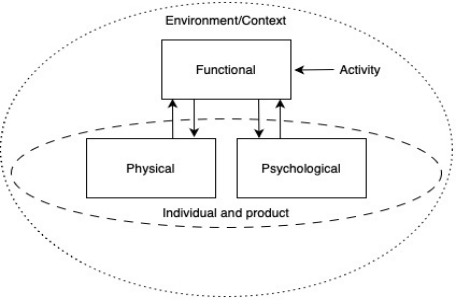
The comfort aspects and their interrelationship are visualised in the proposed holistic car ride comfort model found in Figure 1. The model illustrates that physical comfort is affected by human-related factors such as anthropomet- rics and clothes, as well as product-related factors including the interior space. Psychological comfort is affected by factors related to the individual’s experi- ence, including individual perception of control and safety, as well as previous experiences and expectations in reaction to the product and context.
Functional comfort emerges during the interaction between the individual and the product (the car), when the individual engages with the product with the intention of performing desired activities. The extent to which a desired function can be performed is influenced by both physical and psychologi- cal factors. Furthermore, psychological, and physical factors also impact the individual’s desired actions and whether these activities can be executed as intended. Finally, the environment or context (e.g., riding the rear seat in daily traffic or sitting reclined during AD on a test track) in which individ- uals interact with the product will affect their desired activity and further influence functional aspects.
Table 2. The comfort-influencing factors derived from the two empirical studies categorised in physical, psychological and functional comfort aspects. The factors affecting physical comfort are further specified as car-related factors noted with ‘(C)’ and human-related factors noted with ‘(H)’. Additionally, comfort- influencing factors from scientific literature are positioned with references.
Table available in the original PDF paper.
Physical Psychological Functional Ability to perform desired activities, such as: Intervene/take over Observe surroundings Rest (e.g. against head restraint) Perceived control Perceived safety Previous experiences Expectations Social interactions (De Looze et al., 2003) Interior space (C) Seat (C) Seat belt (C) Temperature, vibration, sound (C, Wang et al., 2022) Anthropometrics (H) Clothes (H)
Figure 1: The proposed holistic ride comfort model, where the comfort-influencing factors and their interrelationships are shown.
A car is a complex product, consisting of multiple physical artefacts such as the interior space and seat belt, used by occupants of different anthro- pometrics and subjective perceptions, in dynamic environments influencing the desired activities and interactions in the car. The interrelations among these factors imply that alterations in one factor can impact perceptions and experiences in another. For instance, a seat could be perceived to be physically comfortable, resulting in enhanced psychological well-being and overall satis- faction with the ride. However, perceived psychological discomfort in relation to a situation (e.g. during AD) can override perceived physical comfort, leav- ing the individual with an unpleasant feeling, affecting the overall comfort experience. Further, perceiving difficulties in intervening with control func- tions influences the functional comfort, and may further induce psychological discomfort in terms of perceived lack of control, causing dissatisfaction.
DISCUSSION
This paper suggests a holistic car ride comfort model based on empirical data from participants travelling in two different cars and scenarios, com- plemented by scientific literature on comfort-influencing factors. The results show that the overall car ride comfort encompasses physical, psychological, and functional comfort aspects that are interconnected.
In general, the results show that time influences the physical discomfort. For instance, shoulder belt chafing can cause temporary physical discomfort, while longer periods of sitting in the car can cause fatigue. This is consis- tent with existing literature, which indicates that physical discomfort is a time-dependent experience (Vink & Hallbeck, 2012). Temporary physical discomfort such as shoulder belt chafing can be prevented by adjusting the seat belt, it can be more challenging to adjust for fatigue inside the limited space of a car. There, the ability to stretch and vary the posture are connected to functional aspects, where physical factors such as the interior space and anthropometrics set boundaries for the ability to stretch.
Physical discomfort related to the shoulder belt was also especially appar- ent for participants with certain anthropometrical characteristics (such as larger chest, pronounced abdominal fat, shorter sitting height, or higher BMI), who tended to wear the seat belt closer to the neck (Makris et al., 2023). This shows that physical product-related factors (e.g. the seat belt) are perceived differently among individuals of different anthropometrics. This confirms the subjective nature of comfort, implying that an artefact, such as the seat belt, cannot be comfortable per se; rather, it becomes comfortable (or not) when it is used (De Looze et al., 2003).
Furthermore, seat belt discomfort can compromise safety. For instance, when the discomfort becomes noticeable and intrusive, it may both dimin- ish mental capacity by demanding attention and prompt movements and behaviours indented to alleviate discomfort, that may entail risks. On this note, studies have indicated that discomfort is a reason for non-usage of seat belts (Fockler and Cooper, 1990; Begg and Langley, 2000). Similar associa- tions between discomfort and misuse have been reported in other domains,
Unveiling the Complexity of Car Ride Comfort: A Holistic Model 661
where e.g. construction workers misuse personal protective equipment due to discomfort (Osvalder et al., 2022; Borell et al., 2024).
Moreover, the results from the rear seat study showed that participants who experienced chafing often adjusted the shoulder belt or held onto it during parts of the journey (Makris et al., 2023). This behaviour can be a strategy to alleviate physical discomfort and guide the shoulder belt into a proper position. However, properly adjusting the seat belt requires a cor- rect understanding of optimal seat belt fit. This is crucial for the seat belt to fulfil its function of reducing injury risk in crashes. Hence, guaranteeing optimal seat belt fit is essential for avoiding physical discomfort and enhanc- ing safety. These finding are noteworthy, as they diverge from previous car comfort models, which seldom acknowledge the role of seat belt discomfort in the comfort experience in cars (Peng et al., 2023; Domova et al., 2022; Moertl et al., 2019).
As the participants reclined during autonomous driving (AD), they found themselves physically comfortable. Yet, they did not feel comfortable in the situation, due to factors tied to psychological and functional discomfort. This highlights the complexity of comfort experiences; focusing solely on one aspect fails to capture the holistic comfort experience. In fact, earlier findings indicate that comfort can only be achieved in the absence of discomfort and vice versa (Hertzberg, 1958; Floyd and Roberts, 1958). This underscores the necessity of considering the holistic experience, as discomfort in any aspect can overshadow the overall comfort. Thus, the comfort experience proves to be multidimensional, influenced by physical, psychological, and functional factors within the contextual environment. Consequently, understanding of the various aspects of comfort and their interrelationship is needed to enhance overall car ride comfort.
A dominant psychological comfort factor in the empirical studies was the sense of being in control. This is associated with perceived safety, partic- ularly in situations perceived as uncertain, such as during reclined sitting in AD, which is a new situation that participants lack previous experience from. Becoming used to sitting reclined in the driver seat during AD requires form- ing trust towards the AD technology, which develops through continuous experience. On a similar note, an existing model of comfort and discomfort in AVs suggests that perceived safety, lack of control, and lack of trust affect comfort and discomfort in AVs (Peng et al., 2023). The results from the rear seat study (Makris et al., 2023) emphasised that previous experiences fur- ther affect the perceived psychological comfort, as individuals form different expectations based on experience. This phenomenon may also explain why participants in AD emphasise the importance of feeling in control, potentially drawing parallels with experiences of driving themselves, where they are in control and must be attentive to their surroundings.
The empirical studies that this paper is based on did not allow for social interactions between the participant and test leader, yet it is reasonable to expect social interactions in more realistic conditions. These will influence the environment, in terms of physical space but also in terms of possible activities such as socialising, affecting occupants’ feelings and psychological aspects. Further, car-related factors, e.g., noise and vibrations, and external
environment e.g., weather conditions, were not specifically addressed in the two empirical studies but have also shown to affect physical comfort (Wang et al., 2022). Such factors may further influence the perception of an activity, e.g., social interaction between occupants. This is supported by an existing comfort model (De Looze et al., 2003), which emphasizes that psychoso- cial factors and the performed activity are part of the context that further influences the experienced comfort.
CONCLUSION
This paper proposes a holistic model for car ride comfort, based on empiri- cal data from two studies in different cars and travel contexts, supplemented by relevant scientific literature on comfort-influencing factors. The paper provides an overview of influential factors categorised in physical, psycholog- ical, and functional aspects. The holistic car ride comfort model emphasizes the complex relationship between these physical, psychological, and func- tional aspects, as well as it illustrates the various parts involved in a car ride, including the product, individual and the environment. Further, it shows that alterations in one comfort aspect can impact perceptions and experiences in another, influencing the holistic car ride comfort experience.
ACKNOWLEDGMENT
The authors acknowledge Katarina Bohman from Volvo Cars for her contri- butions to the rear seat study and Arun Muthumani, Mateo Herrera, and Da Wang from Autoliv for contributing to the reclined seat study. Both studies were conducted in association with SAFER - Vehicle and Traffic Safety Centre at Chalmers, Sweden, funded by FFI (Strategic Vehicle Research and Inno- vation), VINNOVA, the Swedish Transport Administration, and the Swedish Energy Agency.
REFERENCES
Begg, D., Langley, J. (2000). Seat belt use and related behaviors among young adults.
J Saf Res. 31(4):211–20. Borell, J., Osvalder, A-L., & Aryana, B. (2024). Evaluating the correct usage, comfort, and fit of personal protective equipment in construction work. International Conference on Applied Human Factors and Ergonomics (AHFE), July 2024, Nice, France. De Looze, M. P., Kuijt-Evers, L. F., & Van Dieen, J. (2003). Sitting comfort and
discomfort and the relationships with objective measures. Ergonomics, 46(10), 985–997. De Korte, E. M., Huysmans, M. A., De Jong, A. M., Van de Ven, J. G., & Ruijsendaal, M. (2012). Effects of four types of non-obtrusive feedback on computer behaviour, task performance and comfort. Applied Ergonomics, 43(2), 344–353. Domova, V., Currano, R., & Sirkin, D. (2022). Toward a High-Level Integrative
Comfort Model in Autonomous Driving. In Adjunct Proceedings of the 14th International Conference on Automotive User Interfaces and Interactive Vehicular Applications (pp. 141–144).
Unveiling the Complexity of Car Ride Comfort: A Holistic Model 663
Floyd, W. F., & Roberts, D. F. (1958). Anatomical and physiological principles in chair and table design. Ergonomics, 2(1), 1–16. Fockler, SK., Cooper, PJ. (1990). Situational characteristics of safety belt use. Accid
Anal Prev. 22(2):109–18. Helander, M. G., & Zhang, L. (1997). Field studies of comfort and discomfort in sitting. Ergonomics, 40(9), 895–915. Makris, M., Osvalder, A.-L., Bohman, K. (2023). Comfort experience of rear seat
car passengers over time in stationary and driven scenarios. In: Makris, M. (2023) How does it feel and how is it measured? Assessing sitting comfort and postures of rear-seated car passengers in stationary and driven scenarios over time, licentiate thesis, Chalmers University of Technology, Gothenburg, Sweden. Makris, M., Muthumani, A., Herrera, M., Wang, D., Johansson, M., Osvalder, A.-L.
(2024). Drivers’ overall comfort experiences of reclined positions in a passen- ger car with an automated driving function. Manuscript submitted to Applied Ergonomics. Moertl, P., Marx, C., Neuhuber, N., & Pretto, P. (2019). A Holistic Comfort Model for Virtual Cabin Designs. In International Comfort Congress: 2nd International Comfort Congress. Moes, N. C. C. M. (2005). Analysis of sitting discomfort, a review. In: Bust, P. D.,
McCabe, P. T. (Eds.), Contemporary Ergonomics 2005. Taylor & Francis, London, pp. 200–204. Osvalder, A-L.; Osterman, C., Nilsson, P. (2022). Evaluation of comfort and fit of personal protective equipment. Proceedings at the Nordic Ergonomics and Human Factors Society (NES). Peng, C., Horn, S., Madigan, R., Marberger, C., Lee, J. D., Krems, J., Beggiato, M.,
Romano, R., Wei, C., & Wooldridge, E. (2023). Conceptualising user comfort in automated driving: Findings from an expert group workshop. PsyArXiv; 2023. doi: 10.31234/osf.io/76k8w. Vink, P., & Hallbeck, S. (2012). Comfort and discomfort studies demonstrate the need for a new model. In (Vol. 43, pp. 271–276): Elsevier. Vischer, J. C. (2007). The effects of the physical environment on job performance:
towards a theoretical model of workspace stress. Stress and health: Journal of the International Society for the Investigation of Stress, 23(3), 175–184. Wang, X., Osvalder, A.-L., & Höstmad, P. (2023). Sound and vibration influence overall ride comfort in a combustion passenger car under different driv- ing scenarios. International Journal of Human Factors and Ergonomics, 10(2), 207–234.
LISTED IN THE AHFE DIGITAL BOOKSTORE CATALOGUE
Explore the complete digital volume
Advances in Human Factors of Transportation
Read this individual research paper free through the original publisher, or explore the full digital proceedings book.
ISBN 978-1-964867-24-3
Explore this ISBN in the AHFE Bookstore ↗Listed in the July 2026 bookstore catalogue; search by ISBN to confirm current availability · Digital book purchase optional