Jonas Borell, Anna-lisa Osvalder, Bijan Aryana (2024). Evaluating the Correct Usage, Comfort and Fit of Personal Protective Equipment in Construction Work. In: Ergonomics In Design. AHFE Open Access, vol. 129, pp. 67–74. https://doi.org/10.54941/ahfe1004812
Several factors contribute to the use, non-use, or inadequate use of personal protective equipment (PPE) in construction work. This study aimed to analyse correct usage of various PPE, such as helmet, ear protectors, goggles, respiratory mask, gloves, protective clothing, and a safety harness. Correct usage was assessed as guessability, which refers to human perceptions of how to don, adjust, use, and doff the equipment as intended. First an analytical evaluation was conducted using ECW (enhanced cognitive walkthrough) and PUEA (predictive use error analysis) to identify usability problems and use errors during handling. Then usability tests were performed with 13 persons of different heights and body constitutions. Observations, the think-aloud method, short interviews, and subjective estimations were employed. The analytical evaluation revealed most minor usability problems and use errors resulting in physical discomfort. Some safety harness-related errors emerged, particularly for novices, potentially leading to severe incidents. The usability tests demonstrated physical as well as functional discomfort when using a combination of PPE, intensifying over time. The combination of goggles and face mask caused pressure, chafing, heat rash and limited vision. The helmet, combined with goggles and ear protectors, did not fit well, and caused pressure. The guessability for donning and wearing the combination of PPE was moderate, requiring time for proper adjustment. The guessability of the safety harness was poor, lacking design cues for donning, adjusting, and positioning on skeletal bones. Physical discomfort arose when straps were overly tightened. Not all straps could be adjusted for some body constitutions, compromising safety. In conclusion, using several types of PPE together may lead to physical and functional discomfort and pain over time, potentially resulting in misuse, non-use, or reduced performance. The findings of this study can serve as a basis for redesigning PPE, particularly for scenarios involving combined usage.
In the workplace, there are many environments and situations where employ- ees need to use personal protective equipment despite the employer having taken both technical and organizational measures. It is known that per- sonal protective equipment (PPE) is not always used, or not used correctly,
or to the desired extent. This can be due to several reasons, such as the equipment being uncomfortable (Bohm & Harris, 2010), poorly adapted for different body sizes, or causing reduced mobility and limited field of vision (Lombardi et al., 2009).
It can also be difficult to combine multiple PPE at the same time (Nwudu et al., 2018). Lack of understanding of the benefits of wearing pro- tective systems also plays a role (Antonucci et al., 2010). The construction industry is an example of a hazardous work environment where PPE is widely used, but still accident-prone due to deficiencies in usage. Physically demanding work is carried out in confined spaces both indoors and outdoors year-round with a variety of machinery and tools. Here, many professional groups work with different skills, traditions, cultures, language barriers, work motivations, and attitudes towards risk-taking. Sometimes, macho cul- tures with attitudes that PPE is unnecessary are present. Tacit knowledge on how to perform work safely with the right techniques and tools with- out getting injured is often held by experts (Osvalder & Colmsjö, 2017). This knowledge is often unspoken or undocumented, and individuals often keep it to themselves, consciously or unconsciously. It is often only through long-term apprenticeship that younger, less experienced individuals build up similar knowledge.
Numerous studies have been published on why individuals use or do not use PPE, often with proposed actions. In the context of workplaces and PPE often physical and functional comfort is discussed. Physical comfort is asso- ciated with relaxed muscles and minimal static loads. Functional comfort refers to usability, reflecting on factors such as ease of use, practicality, and the ability to perform tasks effectively (Vischer, 2007). There are models that describe individuals’ decision-making processes in relation to the use of PPE, as well as models on individuals’ risk-taking and safe behaviours at work (Fang et al., 2016; Low et al., 2019). Factors such as values, risk perception, social pressure, knowledge, comfort, and availability of PPE are examples of components in many models. Individuals’ beliefs and values, including per- ceived expectations from others, are assumed to play a role in safety-related behaviour (Reason, 1990; Ajzen, 1991).
Direct studies on non-use of personal protective equipment are rare (Salehi et al., 2019). The reasons for non-use are assumed to interact with each other and may be due to (1) organizational deficiencies, such as lack of knowledge and procedures or lack of suitable equipment; (2) individual employees’ lack of knowledge and understanding of the purpose of correct use of personal protective equipment; (3) culture and values, either directly or indirectly linked to the use of personal protective equipment through prioritization of efficiency and production; and (4) inadequate design and usability of available protective equipment, for example, where combinations of different protections can be uncomfortable or impractical.
The challenges of effective injury prevention have been recognized for a long time (Weinstein, 1988). A clear understanding from a systems perspec- tive is still lacking, i.e. the interaction between users, tasks, and context must be considered as a whole. Injuries and accidents that could have been pre- vented through the correct use of PPE continue to occur. Often there is a lack
Evaluating the Correct Usage, Comfort and Fit of Personal Protective Equipment 69
of support from a systems perspective for supervisors, safety representatives, and others in the selection of appropriate PPE.
The purpose of this study was to analyse the correct usage, comfort, and fit of various types of PPE used in construction work individually or in com- binations. Correct usage was assessed as guessability, which refers to human perceptions of how to don, adjust, use, and doff the equipment as intended.
METHOD
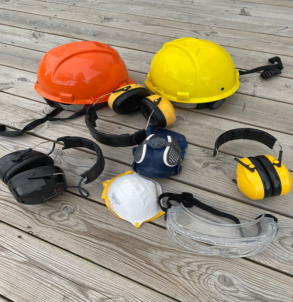
The PPE included in the study, which were tested individually or in com- binations were helmet, ear protectors, goggles, respiratory mask, gloves, protective clothing, and a safety harness (Figure 1).
First, an analytical heuristic evaluation was made using the evaluation methods ECW, Enhanced Cognitive Walkthrough (Bligård & Osvalder, 2013) and PUEA, Predictive Use Error Analysis (Bligård & Osvalder, 2014-a). The methods were used to identify usability problems and use errors when don- ning, adjusting, using, and doffing various types of PPE. These analytical methods are useful for evaluating human interactions with technical products to understand if they afford sufficient cues and help about how they should be used correctly and safely (Bligård & Osvalder 2014-b; 2017). Three experts in human factors design performed the heuristic evaluations.
Usability tests were then carried out with 13 participants, nine men and four women, of different heights and body constitutions. Four of the men were frequent users of PPE. The usability tests evaluated comfort and fit, as well as the guessability of correct usage, i.e. if the PPE were used as intended. The test sessions included observations when donning and doffing the PPE, as well as performing a number of work tasks with heavy hand-held machines at different heights; ground level, waist level and above the shoulders. The participants were asked to use the think-aloud method when they donned, doffed and worked, i.e. express verbally what they were thinking and doing.
After finalising the test session, subjective estimations of comfort experi- ence were made in terms of physcial and functional discomfort. Also, short interviews were made about experience of the PPE’s function, fit and comfort.
Figure 1: Some of the PPE tested in the usability study.
RESULTS
The analytical evaluation showed that a few usability problems and user errors can occur when donning and doffing various types of PPE, but the severity of these was small and they were estimated to only cause minor or moderate physical or functional discomfort. For the safety harness, several usability problems and use errors arose, some of which could entail a high risk of serious incidents.
The usability tests showed that using one PPE at a time worked rather well. The ear protectors, goggles, and face masks could be adjusted for different head sizes and donning was possible to perform for all participants, however more easily without gloves. Some physical discomfort, such as pressure or heat, occurred first after a period of use (about 15–20 minutes). The helmet is considered to cause the most problems, both in terms of additional physical strain, especially on the neck, and a restriction of the field of vision.
The usability tests showed that the predictability of how to don and use a combination of different PPE was reasonably good, but it took some time to adjust them for a good fit. Minor physical discomfort occurred nearly initially for all participants when using a combination of PPE, and then increased over time. For example, goggles combined with a face mask caused pressure and chafing around the nose and heat rash on the face. This combination also limited vision, which may cause functional discomfort. A helmet, combined with goggles and ear protection, did not fit well together, caused uncom- fortable pressure at the temples, and might obscure events in the immediate environment.
For the safety harness, the predictability was low if you had not previously used a harness. There were few cues in the design showing how it should be donned and doffed, adjusted, and put correctly on skeletal bones in the chest, shoulder, and pelvis. The straps could not be optimally adjusted for all partic- ipants depending on body size and constitution, which may lead to reduced safety. Several participants noted that uncomfortable pressure occurred from the straps after a short period of working time with the harness on.
The overall result from the usability study was that if several types of PPE are used together, physical discomfort leading to pain during longer periods of use is most likely to occur. The discomfort may lead to incorrect or omitted use, or reduced protection. Regarding the safety harness it needs to be simpler and more intuitive to don, ensuring correct usage, especially for individuals who do not frequently use them, and/or be manufactured in several different sizes.
DISCUSSION
The purpose of this study was to analyse the correct usage, comfort, and fit of various types of PPE. The findings revealed that physical discomfort emerges as the primary factor leading to improper or non-use, particularly when multiple types of PPE need to be worn concurrently.
Evaluating the Correct Usage, Comfort and Fit of Personal Protective Equipment 71
Comfort and Fit PPE often causes discomfort issues, due to pressing and shafing. Straps may be stiff or narrow, cutting into the skin. It becomes hot, humid, and sweaty, or cold and wet in winter. Discomfort issues often increase after a period of use. PPE in combination with beards and hair, or piercings and jewellery also cause discomfort. Beards prevent respiratory masks and safety goggles from sealing tightly, reducing their protective effectiveness. Long, loose hair can get caught or be in the way of ear protection and safety goggles. With hair tied up, it can become uncomfortable under the helmet. The PPE does not always fit well; it may be too loose and slide off, or too tight and press too hard. Sometimes, the PPE does not fit well with protective clothing, reducing the willingness to wear certain PPE.
PPE is often tailored to a certain type of norm regarding body size, which typically corresponds to larger sizes. Individuals who do not fit into the assumed norm, risk receiving reduced protection or being without equip- ment that fits. Women are often smaller than men and may have difficulty finding the right size. The sizing of clothing and other protective equipment also sends subtle signals about who is intended to work in the construction industry.
PPE used by multiple individuals, such as safety harnesses, creates spe- cific problems. The straps on the safety harness may chafe or press, and the entire harness may restrict natural movement, thus hindering work. Safety harnesses are often purchased in only one size. Typically, a larger size is cho- sen to fit everyone. This results in reduced protective effectiveness for shorter individuals as the straps cannot be properly positioned against the body’s skeletal parts or adjusted to the correct length. To streamline usage and ensure optimal fit, each individual should have their own safety harness rather than having to readjust it each time it is used.
Other problems that may arise include respiratory masks not sealing tightly, increasing the risk of inhaling hazardous substances, or safety gog- gles fogging up or accumulating sweat droplets, impairing vision. Helmets may be too large, causing them to slide or tilt, which can be irritating and require constant readjustment, or too small, causing the chin strap to tighten excessively.
Combinations of PPE In many situations, several different types of PPE need to be used together to manage various risks. Using multiple PPE together often feels uncomfortable because they overlap, causing pressure, squeezing, or chafing. Often, different PPE are not designed to be used together, but constructed to create effective protection when used separately. When PPE do not work together, misuse increases, and the willingness to use PPE decreases. Often, one PPE is removed when another needs to be put on.
The PPE must also be adapted to the work situation and the tasks to be car- ried out. If the work environment is hot or cold, the PPE should be adjusted accordingly. It should be possible to wear several PPE simultaneously and also in conjunction with work clothes. The protections should also go together
with the working tools, machinery, materials, and other equipment used in the work.
On construction sites, it may sometimes be necessary to wear a helmet, ear protection, safety goggles, and respiratory protection simultaneously. How- ever, wearing all four PPE together, even if required, does not work without discomfort issues. Using two PPE simultaneously, such as safety goggles and respiratory protection, or helmet and ear protection, usually works. How- ever, using safety goggles or a visor in combination with a helmet can be problematic.
A safety harness in combination with other PPE can also cause problems. Anchorage devices and safety lines attached to the back can get caught or press against ear protection, safety goggles, and helmet. This can cause them to shift from their correct position, resulting in reduced effectiveness. It can also be difficult to adjust the PPE because the safety harness is in the way, and mobility is limited.
When combinations of ear protection, goggles, respiratory protection, and helmet need to be used simultaneously, this may result in too loose fit, reduc- ing their effectiveness, or being too tight, causing discomfort, chafing, and heat. Often, only one or two PPE that are considered as most important for protection during a working task, are used simultaneously. Design strategies to reduce PPE noncompliance have been suggested by Aryana et al. (2024).
Impact of PPE on Execution of Work PPE not only provides protection but also affects the execution of work tasks. Some tasks become more difficult and may take longer time to accomplish when PPE are used. Both strength and precision in work can decrease. To use PPE under time pressure and stress can result in incorrect usage or non-usage.
Gloves are often bulky and can reduce grip when handling tools or when climbing, carrying, or supporting oneself. For tasks requiring fine motor skills, gloves often need to be removed, which increases the risk of cuts. Thin plastic liners can be used for finer screwing and assembly work.
Helmets can be heavy and load the neck and shoulders. For instance, when working on scaffolding, the free height under the scaffolding platform is so low that tall individuals need to bend their necks while walking, or standing, and working with a helmet. This is burdensome and provides poor visibility. Ear protection can pose a risk because it isolates individuals from the sur- roundings, preventing them from hearing their co-workers or various types of warnings. However, there are ear protectors available that allow alarm signals and speech to pass through, while attenuating background noise.
The respirator mask can be perceived as inhibiting in work. It often makes breathing heavier, which becomes strenuous, especially when moving around. This is mainly true for those individuals with reduced respiratory capacity. The respirator mask is experienced more as inhibiting rather than as useful protection.
Safety harnesses are an example of PPE that can create problems during work. The tightened straps of the harness can inhibit natural body move- ment. If its anchoring device and safety lines are located at the front of the
Evaluating the Correct Usage, Comfort and Fit of Personal Protective Equipment 73
body at chest height, they often obstruct the arms and hands. There is also a risk of getting tangled in the safety lines with the arms or legs and tripping. If one falls and becomes suspended in a harness, there is a risk of experiencing suspension trauma, with limited blood supply to various parts of the body after a few minutes. This can lead to serious injuries and even death. There- fore, it is important not to work alone when using a safety harness and to have procedures in place for a quick and safe rescue.
Problems that may arise include PPE interfering with the tasks to be per- formed. For example, gloves can affect grip, tactile sensitivity, and precision, while safety goggles may fog up or scratch, thus limiting vision. Ear pro- tection can block out sounds and warnings from the surroundings, and respirator masks increase physical exertion. Safety harnesses can restrict free- dom of movement. Another issue is that the PPE are not adapted to the environment where the work is carried out. For instance, straps risk getting stuck, and in hot environments, the PPE can cause increased strain on the body. During winter, it is often difficult to fit warm enough clothing under the PPE.
CONCLUSION
The most common reasons for non-use with PPE include physical discomfort arising from poor fit, equipment deficiencies impeding workflow, and time constraints.
Simultaneously using various types of PPE can present challenges such as discomfort and inconvenience, which may exacerbate over time, leading to increased physical and functional discomfort. Consequently, this may result in misuse, non-compliance, or reduced effectiveness in protection.
For PPE to be effectively utilized, it must be available in different sizes, styles, and models, tailored to individual measurements, concurrent PPE usage, work clothes, as well as the specific tasks and environmental con- ditions.
The safety harness lacks design cues for proper donning, adjustment, and positioning on skeletal structures. Tightening the straps can cause severe physical discomfort for individuals with certain body shapes.
The findings of this study can serve as a basis for redesigning PPE, partic- ularly for scenarios involving combined usage. How this can be performed is discussed in Aryana et al. (2024).
ACKNOWLEDGMENT
The authors would like to acknowledge Dr. Cecilia Österman, Linneaus Uni- versity, Kalmar and Dr. Lars-Ola Bligård, Chalmers University of Technology, Gothneburg, for their valuable participation in the analythical evaluation. This study has been perfomed with funding from AFA Insurance, Sweden.
REFERENCES
Ajzen, I. (1991). The theory of planned behavior. Organiz behav and human dec processes. 50(2), 179–211.
Antonucci, A., Di Giampaolo, L., Zhang, Q. L., Siciliano, E., D’abruzzo, C. C., Niu, Q. & Boscolo, P. (2010). Safety in construction yards: perception of occupa- tional risk by Italian building workers. European Journal of Inflammation, 8(2), 107–115. Aryana, B., Osvalder, A-L., and Borell, J. (2024) Design Strategies to reduce personal
protective equipment noncompliance. Proc.: AHFE, 1–10. Bligård, L.-O. & Osvalder, A.-L. (2013). Enhanced Cognitive Walkthrough: Development of the Cognitive Walkthrough Method to Better Predict, Identify, and Present Usability Problems. Advances in Human-Computer Interaction, Volume 2013, 931698. Bligård, L.-O. & Osvalder, A.-L. (2014-a). Predictive use error analysis – Devel-
opment of AEA, SHERPA and PHEA to better predict, identify and present use errors. International Journal of Industrial Ergonomics, 44(1), 153–170. Bligård, L.-O. & Osvalder, A.-L. (2014-b) CCPE: Methodology for a Combined Evaluation of Cognitive and Physical Ergonomics in the Interaction between Human and Machine. Human Factors and Ergonomics in Manufacturing & Service Industries, 24(6), 685–711. Bligård, L.-O. & Osvalder, A.-L. (2017). Evaluating usability problems and use errors
in ergonomic products: comparing analytical methods and usability test. Int. J. Human Factors/Ergonomics. 5(1), 1–21. Bohm, J. & Harris, D. (2010). Risk perception and risk-taking behavior of construction site dumper drivers. International journal of occupational safety and ergonomics, 16(1), 55–67. Fang, D., Zhao, C. & Zhang, M. (2016). A cognitive model of construction work-
ers’ unsafe behaviors. J Construction Engineering and Management, 142(9), 04016039 Low, B. K. L., Man, S. S. et al. (2019). Construction worker risk-taking behavior model with individual and organizational factors. International journal of environmental research and public health, 16(8), 1335. Lombardi, D. A., Verma, S. K., Brennan, M. J. & Perry, M. J. (2009). Factors influenc-
ing worker use of personal protective eyewear. Accident Analysis & Prevention, 41(4), 755–762. Nwudu, V., Fletcher, A. M. & Bauer, M. (2018) Patterns and Predictors of Personal Protection Compliance and Workplace Hygiene Behaviors among Workers with Elevated Blood Lead Levels in New York State. J Occupational and Environmental Hygiene, 15(9), 654–663. Osvalder, A.-L. & Colmsjö, A. (2017). Transferring Tacit Knowledge in Process Con-
trol. In: Kantola et al. (eds.), Advances in Human Factors, Business Management, Training and Education, Advances in Intelligent Systems and Computing 498, Springer International Publishing, Switzerland, pp. 485–492. Reason, J. (1990). Human error. Cambridge University Press. Salehi H, Pennathur P. R., Da Silva J. P. & Herwaldt L. A. (2019). Examining health care personal protective equipment use through a human factors engineering and product design lens. Am J Infect Control. 47(5), 595–598. Vischer, J. C. (2007). The effects of the physical environment on job performance:
Towards a theoretical model of workspace stress. Stress and health: Journal of the International Society for the Investigation of Stress, 23(3), 175–184. Weinstein, N. D. (1988). The precaution adoption process. Health psychology, 7(4),
355–386.
LISTED IN THE AHFE DIGITAL BOOKSTORE CATALOGUE
Explore the complete digital volume
Ergonomics In Design
Read this individual research paper free through the original publisher, or explore the full digital proceedings book.
ISBN 978-1-964867-05-2
Explore this ISBN in the AHFE Bookstore ↗Listed in the July 2026 bookstore catalogue; search by ISBN to confirm current availability · Digital book purchase optional