Rikard Eklund, Anna-Lisa Osvalder (2022). Transferring tacit knowledge during maritime pilot training: assessment of methods in use. In: Human Factors in Transportation. AHFE Open Access, vol. 60, pp. 665–674. https://doi.org/10.54941/ahfe1002503
Accurate knowledge management is vital for an organization to perform well. Managing explicit knowledge is relatively easy but managing tacit (implicit) knowledge is not. Effective transfer of tacit knowledge from experts to novices in an organization is therefore essential. Maritime pilotage is a safety-critical operation in which pilots use their expertise to guide vessels in specific waters. The purpose of this study is to improve the Pilot Training Programme (PTP) run by the Swedish Maritime Administration (SMA). The aim of this study is to evaluate and describe the prevailing methods of transferring tacit knowledge during the PTP. This study includes 20 maritime pilots and covers a complete PTP. A qualitative mixed-methods approach was used, based on activity theory and including observations, interviews, questionnaires, and document analyses. The results showed that tacit knowledge transfer during the PTP occurs during situated learning, such as apprenticeships, hands-on learning and communities of work. However, the transfer methods are not sufficiently documented from a didactic perspective.
Accurate knowledge management is vital if an organization is to improve its performance (Nonaka and Takeuchi, 1995), stay competitive (Teece, 1998) and assure productivity (Haldin-Herrgard, 2000). Knowledge management includes the creation, retention and transfer of knowledge (Argote, 2021). However, transferring knowledge in an organization is a complex task. Even if members of the organization are willing to share knowledge, they may be unable to do so (Polanyi, 1966). A substantial amount of kno- wledge in an organization is hidden and dispersed among its members (Lee, 2000). Members move in and out of the organization due to such things as termination of employment, new recruitment, organizational change or retirement. Thus, there is a genuine risk of knowledge disappearing when people depart (Smith, 2001); the result being a depleted organization. Expli- cit knowledge may be located, managed and shared with relatively ease (Moreland and Myaskovsky, 2000). This is because it can be coded, docu- mented, stored and transferred (Polanyi, 1958). Literature, instructions, standard operating procedures and manuals are all ways of transferring
explicit knowledge (Hyttinen and Rintala, 2005). Implicit knowledge, or tacit knowledge (Kirsner et al. 1998), is not immediately available for conscious retrieval. Tacit knowledge evolves over long periods and is not easily accessi- ble for articulation in speech or writing (Polanyi, 1966). It may be found on both the individual and organizational levels (Nonaka and Takeuchi, 1995). Tacit knowledge may be expressed as skills (Nelson and Winter, 1982), as know-how (Kogut and Zander, 1992) or as procedural knowledge (Stan- ley and Williamson, 2001). Studies of tacit knowledge have been conducted in organizational settings (Jasimuddin et al. 2005), healthcare (Ambrosini and Bowman, 2001) and security operations centers (Cho et al. 2020). Tacit knowledge has been conceptualized differently depending on the domain (Kothari et al. 2012). However, tacit knowledge transfer largely requires per- sonal interaction and proximity to other individuals, as seen in mentoring, apprenticeships, job rotations or communities of practice (Lave and Wenger, 1991). The tacit knowledge of experienced operators is especially crucial to the safe and efficient operation of safety-critical organizations. Maritime pilo- tage is a safety-critical operation and a crucial part of the maritime industry in assuring safe, economic and sustainable naval operations (SMA, 2022). Based on extensive local as well as tacit knowledge, maritime pilots (hereinafter referred to as “pilots”) provide navigational guidance to mariners on specific waterways, such as harbors, river mouths, canals and on the open sea. Pilots interact with the crew of the piloted vessel, providing advisory information as to navigation and specific properties of the water (depth, obstacles, tides, infrastructure and so on). They also assist during tugging, birthing and moo- ring operations (SMA, 2022). The SMA assures maritime pilotage in Swedish territorial waters and employs about 200 pilots, who conduct some 33,000 missions annually. The SMA is responsible for the pilot training in Sweden, in which experienced mariners from the shipping industry can enroll, following application, evaluation and selection.
PURPOSE AND AIM The purpose of this study was to identify ways to improve the PTP to mitigate increasing requirements for safe, economical and environmentally sustainable shipping in Swedish territorial waters. The study aimed to: (1) locate, catch, crystallize, document and describe prevailing methods of tacit knowledge transfer during different elements in the PTP; and (2) provide suggestions on improving the transfer of tacit knowledge.
METHOD
Theoretical Framework Activity theory (Leontiev 1978, 1981; Vygotsky and Cole, 1978) is a conce- ptual framework in which activity is the prime unit of analysis. Activity theory is distinguished by collective learning (Kaptelinin, 2005). The human mind evolves by interaction with the environment in which human activi- ties take place; social settings modulated by cultural and social influences
Transferring Tacit Knowledge During Maritime Pilot Training 667
(Kaptelinin and Uden, 2013). Activity systems analysis seeks to systemati- cally extract data (Yamagata-Lynch, 2010) and analyse development within social activities (Sannino et al. 2009), most often in socio-technical systems (Engeström, 1987). Activity systems analysis has been used for research into learning (Scanlon and Issroff, 2005), design (Hjort af Ornäs, 2010) and infor- mation systems (Kaptelinin and Nardi, 2006). An activity system is divided into six components of analysis (Engeström 1987, 2000). In such a system the object is the activity, the subject is the individual(s) being studied, the tool is the mediating device providing the means for the activity to be conducted, the rules comprise formal/informal rules affecting how the activities take place, the community is the social group with which the subject interacts during the activities and the division of labour governs the distribution and organization of work in the community. The outcome of the activity system is the result of transforming the object into the outcome (Engeström, 1999). According to Kaptelinin and Nardi, (2006), activities may be further analysed at vari- ous levels of abstraction, with activity, action and operation thereby showing different hierarchal levels of activity. Activities are driven by the motivation of the subject; actions are driven by a set of goals and operations are dri- ven by a set of conditions. Furthermore, activities may be conducted based on multiple motives (Kaptelinin and Nardi, 2006). Activity theory has been deployed in organizational studies. However, some researchers claim that it is poorly understood and, indeed, too specialized for that field (Thompson, 2004). Nardi (1996) described activity theory as a powerful tool rather than a theory for making predictions. However, Blackler and Reagan (2009) sta- ted that activity theory is relevant to organizational studies since it gravitates toward studying the dynamic relationships and subsequent friction between individuals, collectivities, objects and language.
The Pilot Training Programme The PTP lasts about a year and comprises three parts: (1) an introductory course (INTRO) lasting 1-3 months and covering employment conditions, safety, regulations, the SMA organization and general pilotage procedures; (2) a Swedish basic training for maritime pilots course (BASIC) lasting six weeks and comprising maneuvering, navigation, marine resource manage- ment (MRM), governmental officer duties, boarding operations, hoisting and hypothermia. The training is held in classrooms, in a simulator environment and in the actual maritime environment. The INTRO and BASIC parts may overlap; and (3) a local training plan (LTP) for 6-12 months depending on location, in which maritime pilot students (hereinafter referred to as “stu- dents”) acquire knowledge by participating in 50 actual pilotage missions, supervised by a certified pilot. During the PTP, the development of knowledge is strongly characterised by learning in social settings, as with an apprentice- ship. The PTP concludes with an examination after which a pilot certificate and pilot license (level 1) are issued. The pilot license regulates the category of vessels for which the pilot is approved. Ultimately, the goal is to gain enough experience to obtain the highest-level pilot license (levels 4-5), permitting unrestricted pilotage. Every third year, re-training is conducted in different
668 Eklund and Osvalder
focus areas. Simulator training and MRM are used to provide this. The SMA also conducts such continuous training as open-sea pilotage (red card), tran- sitions to other SMA vessels (such as ice-breakers) and evaluations of new routes and procedures.
Study Design Activity theory was used to evaluate the PPT as an activity system. This entai- led a qualitative, mixed-methods study approach comprising observations, interviews, questionnaires and document analysis (for triangulation).
Data Collection Data collection was conducted intermittently during two different PTP cour- ses in 2020 and 2021. A total of 21 participants were included in the study, consisting of eight students, seven less experienced but licensed pilots, five licensed, experienced master pilots (also serving as instructors) and one admi- nistrator who also served as an SMA coordinator for the present study. The mean age was 46, with a standard deviation of eight years. All participants were males, operating out of seven different pilot stations in Sweden. All sta- tions differed in terms of waters, infrastructure and piloted tonnage. A total of 119 hours of observation were conducted and documented over 13 trai- ning days. These observations were made during classroom and simulator training at the central SMA training facility in Gothenburg, at pilot stations and during actual missions entering or exiting a major international harbor. No observations were made at the scale ship-handling training facility. Inte- rviews were held individually with all participants, ranging in length from 45 to 60 minutes. A six-point Likert scale questionnaire was also distributed to the participants. This contained background questions, plus questions on knowledge transfer during the PTP.
Data Analysis The observations took the form of passive participant observations (DeW- alt et al. 2010). Field notes (Bogdan and Biklen, 2003) were collected using an observation protocol. Semi-structured interviews (Edwards and Holland, 2013) based on a specified interview guide, were adapted from the eight-step model (Mwanza, 2002b). Interviews were recorded, transcribed and asses- sed using a thematic (reflective) inductive analysis (Clarke, 2006) and then coded and organized into themes. An even scale was selected so as to exclude a neutral center option (Allen and Seaman, 2007).
Document analyses (Bowen, 2009) were used to provide background and context, identify additional questions, provide supplementary data, track evolution and verify findings (triangulation). The document analyses included assessments of training curriculums, course literature, operating procedure descriptions, intranet databases, printed and electronic docu- ments, illustrations and films. A thematic (reflective) inductive analysis (Clarke, 2006) was used to code and organize the data into themes. Rele- vant documents were also discussed with the PTP administrative personnel and with PTP instructors. Emerging data was thematized and compared to
Transferring Tacit Knowledge During Maritime Pilot Training 669
Mwanza’s (2002b) eight step-model for interpreting an activity system. The eight step-model conceptualized data from the study into components of the activity system model proposed by Engeström (1987, 2001).
RESULTS
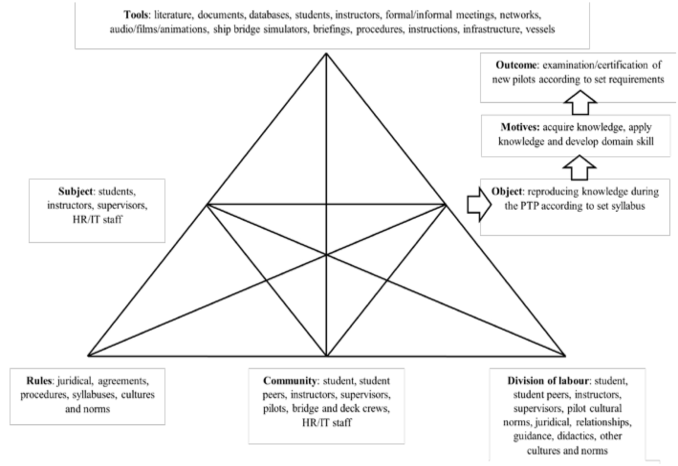
The PTP was analysed as an activity system (Figure 1), aided by observations, interviews, questionnaires and document analyses. The PTP was analysed on the activity level where the outcome was the examination/certification of new pilots to adhere to set SMA requirements. The motives had two dimen- sions: the SMA motive to provide suitable training and the students’ motive to progress towards a new profession. The object of the PTP is to repro- duce pilot-specific skills, using theoretical, non-situated learning in classroom settings combined with situated learning in apprenticeship settings.
The subjects have different roles during the PTP. Students are exposed to knowledge in various ways at various times and at various locations such as pilot stations, pilot vessels, piloted vessels, scale ship-handling facilities, simulators, classrooms and self-studies on or off-site (Table 1). Informal inte- ractions, such as during meals and coffee breaks, during walks, or during free-time activities were important knowledge transfer nodes. These nodes were also important for transferring tacit knowledge, among other things by telling stories from the domain and thus verbalizing tacit knowledge at some level. Instructors provided teaching according to a set syllabus. Howe- ver, this syllabus did not sufficiently describe (in terms of didactics) how the PTP was to be implemented. Tools were predominantly: (1) the ship-bridge simulator, (2) the actual pilot missions during the LTP and (3) creation of the navigation booklet. All three serve as important vehicles for transferring tacit knowledge. Students prepared, performed, evaluated and discussed ship- bridge simulator sessions in an open (non-punitive) environment, interacting with each other and with their instructors. This afforded a foundation for discussions and animations from completed sessions and created a collective learning environment.
Briefings and de-briefings connected to these sessions provided students with (tacit) knowledge emanating from their instructors. This took the form of heuristics, such as golden rules, guidelines, applied experience and know- how. Non-situated theoretical learning, such as ship handling, navigation and stability is provided during the PTP to some degree but is mostly expected to have already been acquired. Students are already experts in their profession as mariners and the PTP may be viewed as a new dimension of that profession. Comprehensive course literature could be a way to review old knowledge and introduce new knowledge in a more organized manner. During the LTP, the students entered a state of apprenticeship. Embedded in actual pilot mis- sions, students progressed towards their new profession in a community of practice. Interacting with their supervisors, students developed trade-specific hands-on knowledge. The LTP exposed students to a substantial amount of tacit knowledge which, in turn, is crystalized in the navigational booklet. This booklet has dual functions: 1) it crystalizes knowledge for the student,
670 Eklund and Osvalder
Figure 1: The pilot training program as an activity system. Adapted from Engestrom (2000).Table 1. Compilation of tacit knowledge transfer locations in the PTP based on observations, interviews, questionnaires and document analyses.
Table available in the original PDF paper.
Peer students
Course literature
Juridical
ICT
Film
Audio
LTP booklet
Informal meetings
Written instructions
Verbal instructions
Briefings
Hands-on
Databases
Ship bridge simulator
Formal meetings
Observations
Reflections in group
Communities of practice INTRO
- - - -
-
BASIC
LTP
-
-
- None
Minor
Medium
Major.
acting as a didactic tool; and 2) it creates knowledge and acts as a personal knowledge basis for future pilot missions.
The use of tacit knowledge transfer tools during the PTP showed a low level of documentation in terms of didactics. Rules consisted of nautical regu- lations, procedures, syllabuses, group briefings/de-briefings solely in cultural settings. These rules play an important role in facilitating tacit knowledge transfer during the PTP. Division of labour in terms of students, student peers, instructors and the didactic prerequisites enabled the transfer of tacit
Transferring Tacit Knowledge During Maritime Pilot Training 671
knowledge. However, consistent with the other elements of the activity system, this interaction was insufficiently documented.
DISCUSSION
We often know more than we can tell or explain to others. Some knowledge is so deeply embedded that we do not think about what we know and what we are doing – we just do it. This is tacit knowledge, expertise, or know-how and will have taken many years to achieve. The results of this study provide insight into how, where and when tacit knowledge is transferred during the PTP run by the Swedish Maritime Administration. Much of the knowledge transfer happens during situated learning environments and is not sufficien- tly documented, either in didactic terms or content. Much of the didactic management is therefore located at individual instructor level, resulting in personal knowledge transfer strategies. A standardised syllabus including specified didactics could help students prepare for their next training ses- sion and identify the level of knowledge required after it. Activity theory may be assessed at different hierarchical levels. The PTP was assessed at acti- vity level as a motive-directed system. At the lower action level, goals direct actions and at the lowest operational level, conditions direct them. Actions carried out via operations may be seen as being executed without full atten- tion to its execution. Such actions resemble the actions of procedural nature, skill and know-how; all of which are tacit-knowledge-based actions. This is consistent with observations during the PTP in which instructors provide know-how, heuristics, or guidelines in tactical terms. The capability to raise actions from an operational level to a conscious level is useful when assessing tacit knowledge transfer. Further assessing the PTP on an operational level can feed data into the suggested standardised syllabus. Developments causing drainage of knowledge in an organization, such as staff movements, may be unexpectedly beneficial for another (receiving) organization. Job rotation, in which experienced, non-instructor pilots act as mentors during designated parts of the PTP, could present a way to increase the transfer of tacit kno- wledge. An alumni function, with former students returning to the PTP as instructors/supervisors might be another way to feed applied experience into the PTP. The PTP has several elements, not all of which could be assessed using the methods in the study. Thus, the study had to rely on triangula- tion to mitigate this problem. Other shortcomings were that the number of observed pilot LTP missions had to be reduced due to Covid restrictions, the scale-model ship handling part could not be observed at all and the activi- ties at the SMA training facility had to be observed over an extended and fragmented time.
CONCLUSION
The PTP is largely dependent on situated learning such as community of practice, apprenticeship, or hands-on training. Learning is therefore mainly located in the relationship between learning and the social situation in the specific environment of that learning. Didactic methods for transferring tacit
672 Eklund and Osvalder
knowledge are furthermore located at individual instructor or supervisor level and are not sufficiently documented in didactic terms.
ACKNOWLEDGMENT
The authors would like to acknowledge the Swedish Transport Administra- tion as well as the Swedish Maritime Administration for their kind support. We are also grateful for the support from all participating pilots, students, instructors and other staff during the study.
REFERENCES
Allen, E.I., & Seaman, C.A., (2007). Likert Scales and Data Analyses. Quality Progress, 40, pp. 64–65. Ambrosini, V., & Bowman, C., (2001). Tacit Knowledge: Some Suggestions for
Operationalization. Journal of management studies, 38(6), pp. 811–829. Argote, L., Lee, S. & Park, J., (2021). Organizational Learning Processes and Outcomes: Major Findings and Future Research Directions. Management science, 67(9), pp. 5399–5429. Blackler, F., & Regan, S., (2009). Intentionality, Agency, change. Management
learning, 40(2), pp. 161–176. Bogdan, R., & Biklen, S.K., (2003). Qualitative research for education: an introduction to theory and methods 4. ed., Boston: Allyn and Bacon. Bowen, G.A., 2009. Document Analysis as a Qualitative Research Method. Quali-
tative research journal, 9(2), pp. 27–40. Braun, V., & Clarke, V., (2006). Using thematic analysis in psychology. Qualitative research in psychology, 3(2), pp.77–101. doi:10.1191/1478088706qp063oa Cho, S.Y., Happa, J. & Creese, S., (2020). Capturing Tacit Knowledge in Security
Operation Centers. IEEE access, 8, pp. 42021–42041. DeWalt, K.M., DeWalt, B.R., & Wayland, C.B., (2010). Participant observation, pp. 259–299. Walnut Creek, CA: AltaMira Press. Edwards, R, & Holland, J., (2013). What is qualitative interviewing? Bloomsbury
Academic. pp. 2–3. Engeström, Y., (1987). Learning by Expanding: An Activity-theoretical Approach to Developmental Research. Orienta-Konsultit Oy. ISBN 9789519593326. Engeström, Y., (1999). Activity theory and individual and social transformation.
In Perspectives on Activity Theory. Cambridge University Press, pp. 19–38. Engeström, Y., (2000). Activity theory as a framework for analyzing and redesigning work. Ergonomics, 43(7), pp. 960–974. doi: 10.1080/001401300409143 Engeström, Y., (2001). Expansive Learning at Work: Toward an activity theoretical
reconceptualization. Journal of education and work, 14(1), pp. 133–156. Haldin-Herrgard, T., (2000). Difficulties in diffusion of tacit knowledge in organizations. Journal of Intellectual Capital, 1(4), 357–365. Hjort af Ornäs, V., (2010). The Significance of Things: Affective User-Artefact Rela-
tions. Diss. Chalmers University of Technology. https://publications.lib.chalmers. se/records/fulltext/129033.pdf Hyttinen, L., & Rintala, N., (2005). The role of tacit knowledge and the challenges in transferring it: a case study at the Finnish NPPs. International journal of nuclear knowledge management, 1(4), pp. 328–335. Jasimuddin, S.M., Klein, J.H. & Connell, C., (2005). The paradox of using tacit and
explicit knowledge. Strategies to face dilemmas. Management decision, 43(1), pp. 102–112.
Transferring Tacit Knowledge During Maritime Pilot Training 673
Kaptelinin, V., (2005). The Object of Activity: Making Sense of the Sens-Maker. Mind, culture and activity, 12(1), pp. 4–18. doi: 10.1207/s15327884mca1201_2 Kaptelinin, V., & Nardi, B.A., (2006). Acting with technology: Activity theory and interaction design. Cambridge, Mass.: MIT Press. Kaptelinin, V., & Uden, L., (2013). Understanding delegated actions: Toward an
activity-theoretical perspective on customer-centered service design. In ServDes. 2012 Conference Proceedings Co-Creating Services; The 3rd Service Design and Service Innovation Conference; 8-10 February; Espoo; Finland. 67, pp. 101–109. Linköping University Electronic Press. Kirsner, K., Speelman, C., Maybery, M., O’Brien-Malone, A., & Anderson, M., (Eds.), (2013). Implicit and explicit mental processes. Psychology Press. Kogut, B., & Zander, U., (1992). Knowledge of the firm, combinative capabilities,
and the replication of technology. Organization science, 3(3), pp. 383–397. Kothari, A., Rudman, D., Dobbins, M., Rouse, M., Sibbald, S., & Edwards, N.,
2012. The use of tacit and explicit knowledge in public health: A qualitative study. Implementation Science: IS, 7(1), 20. Lave, J., & Wenger, E., (1991). Situated learning: Legitimate peripheral participation.
Cambridge: Cambridge University Press. Lee, J., 2000. Knowledge management: The intellectual revolution. IIE solutions, 32(10), pp. 34–37. Leontiev, A., (1978). Activity, Consciousness, and Personality. Englewood Cliffs, NJ:
Prentice-Hall. Leontiev, A., (1981). Problems of the development of the mind. Moscow, Russia: Progress. Moreland, R.L., & Myaskovsky, L., (2000). Exploring the Performance Benefits
of Group Training: Transactive Memory or Improved Communication? Orga- nizational behavior and human decision processes, 82(1), pp.117–133. https: //doi.org/10.1006/obhd.2000.2891 Mwanza, D., (2002). Towards an Activity-Oriented Design Method for HCI Research and Practice. Open University (United Kingdom). Nardi, B.A., (1996). Context and consciousness : activity theory and human-
computer interaction, Cambridge, Mass.: MIT Press. Nelson, R.R., & Winter, S.G., (1982). An evolutionary theory of economic change, Cambridge, MA: Harvard U.P. Nonaka, I., & Takeuchi, H., (1995). The knowledge-creating company : How
Japanese companies create the dynamics of innovation. Polanyi, M., 1966. The tacit dimension. London: Routledge and Kegan Paul. Polanyi, M., 1998. Personal knowledge: towards a post-critical philosophy. Repr.
(with corr.). London: Routledge. Sannino, A.E., Daniels, H.E., & Gutiérrez, K.D., (2009). Learning and expanding with activity theory. Cambridge University Press. doi: 10.1017/CBO9780511809989. Scanlon, E., & Issroff, K., (2005). Activity Theory and Higher Education: evaluating learning technologies. Journal of computer assisted learning, 21(6), pp. 430–439. Smith, E.A., (2001). The role of tacit and explicit knowledge in the workplace. Jour-
nal of knowledge management, 5(4), pp. 311–321. Stanley, J., & Williamson, T., (2001). Knowing How. The Journal of philosophy, 98(8), pp.411–444. doi:10.2307/2678403. Swedish Maritime Administration (SMA), (2022). Beskrivning av lotsyrket. https://www.sjofartsverket.se/Om-oss/Jobba-hos-oss/Om-oss/Lots/ (Retrieved 2022-01-01). Teece, D.J., (1998). Capturing Value from Knowledge Assets: The New Economy,
Markets for Know-How, and Intangible Assets. California management review, 40(3), pp. 55–79.
674 Eklund and Osvalder
Thompson, M.P.A., (2004). Some Proposals for Strengthening Organizational Activity Theory. Organization (London, England), 11(5), pp.579–602. Vygotsky, L.S., & Cole, M., (1978). Mind in society: Development of higher
psychological processes. Harvard university press. Yamagata-Lynch, L.C., (2010). Activity Systems Analysis Methods 1. Aufl., Berlin: Springer Science Business Media.
LISTED IN THE AHFE DIGITAL BOOKSTORE CATALOGUE
Explore the complete digital volume
Human Factors in Transportation
Read this individual research paper free through the original publisher, or explore the full digital proceedings book.
ISBN 978-1-958651-36-0
Explore this ISBN in the AHFE Bookstore ↗Listed in the July 2026 bookstore catalogue; search by ISBN to confirm current availability · Digital book purchase optional