Gholam Reza Emad, Saratkumar Narayanan, Aditi Kataria (2022). On the road to Autonomous Maritime Transport: A conceptual framework to meet training needs for future ship operations. In: Human Factors in Transportation. AHFE Open Access, vol. 60, pp. 640–646. https://doi.org/10.54941/ahfe1002500
Accelerating towards an autonomous future, the maritime transport industry is going through a phase of rapid digitalization and automation. Novel technologies and complex tools, that substitute human functions, are increasingly introduced on board modern ships. However, experiences from other industries show that introducing complex technologies in the workplace without due consideration of the human factors can often lead to disastrous consequences. Traditionally, seafarers developed their competencies through authentic participation in shipboard activities, under the guidance of experienced seniors. However, with digitalization, various tasks are getting internalized, leaving no clues about the inner workings to an onlooker, and this in turn, is adversely affecting their learning opportunities. Studies also show that in a technology-rich workplace, the limited number of human operators overseeing multiple, complex tasks, can cause job intensification, operator’s cognitive overload, error in judgment, and costly accidents. The recent investigation reports of many maritime accidents point to the improper use of technology as among the major causal factors. This underscores the need for re-addressing cognitive human factor and competency development of seafarers, relevant to the use of modern technology and human-machine interactions. In this book chapter, we propose the use of theoretical framework of Quasi-Community (QC) to better understand the context and prepare the seafarers to interact, learn, adapt, and develop new competencies for their technology-rich workplace. With its fluid, dynamic, decentralized hierarchy, and shared expertise as a common resource, we argue that the concept of QC will make an ideal framework that can facilitate the creation of a supportive learning environment for transitioning and future seafarers.
Maritime transportation at the core of the international supply chains, is cru- cial for sustaining global trade and bringing economic prosperity to nations. However, events such as the recent COVID-19 pandemic has brought to light not only the vital importance of this industry but also its susceptibility to any
On the Road to Autonomous Maritime Transport: A Conceptual Framework 641
disruptive changes. In the past few decades, technological innovations have been changing the ways in which ships are designed, built, and operated. Increasing levels of automation onboard is gradually and irreversibly repla- cing the tasks that once were performed by the humans. The outlook painted by researchers and industry experts show that in future, ships will ply com- pletely unmanned and autonomous. However, a complete transition to such a future may still be decades away and until then, the industry faces a long intervening transitional period of increasing automation and decreasing role of human operators onboard ships.
The increasing adaptation of technology in the workplace often raises que- stions on its effects on the workers and their working life. For example, studies have shown that in a technology-rich workplace, when limited num- ber of human operators oversee multiple, complex tasks, it can often lead to job intensification and higher operator cognitive loads. This, if not checked, can further lead to errors in judgement, and at times, to disastrous accidents. Investigation reports of many of the recent maritime accidents point to either users’ insufficient knowledge of the technology or improper utilization of technology as among the causal factors.
Digitalization and increase in the computing powers have led not only to quicker and more complex processes, but also to the merger of few existing and the emergence of a variety of completely new processes. Operating in hi-tech workplaces with complex processes may require higher cognitive and social skills among the operators. The requirements for any such novel skills and competencies may in turn, narrow down the gap between the experienced and inexperienced personnel, and thereby, in some ways democratizing the workplace.
From an educational perspective, one big challenge that needs to be addres- sed is how best the workers can be prepared for the kind of work needed in these highly digitalized future workplaces. To ensure operator readiness, not only is it required to train them in the use of modern technology, but also to develop their abilities to overcome any limitations imposed upon by the human-technology interaction. Moreover, it calls for implementing novel ways of teaching and learning that can help develop technical as well as cognitive human factor requirements within a technology-rich environment.
THE LONG ROAD LEADING TO AUTONOMOUS SHIPS: AN OVERVIEW OF IMO - MASS The International Maritime Organization (IMO) is the apex body with the oversight of shipping-related matters globally. In 2017, IMO introduced the concept of Maritime Autonomous Surface Ships (MASS) as ships which, to varying degrees, can operate independent of human intervention. In the roadmap to autonomous shipping, IMO has defined four levels or ‘degrees’ of MASS. The classification is based on increasing levels of automation and the decreasing roles of human operators onboard. In MASS degrees 1 and 2, seafarers will still be present onboard ships, although in reduced numbers. In MASS degrees 3 and 4 they will shift ashore, and ships will be remotely controlled and/or monitored.
The outlook painted by researchers and industry experts show that ships will ultimately ply unmanned and autonomous. However, there are many hurdles to cross before reaching MASS degree 4 or fully autonomous ships. In fact, a complete transition to that stage may be several decades away. Until then, the industry faces a long intervening transitional period of progressively increasing technological adaptation and automation. To meet the challenges during the transitional period ahead, and to ensure a safe, secure, and envi- ronmentally sound future operation of MASS, the IMO conducted scoping exercise of various instruments (IMO, 2021). Notable among the findings is the need for revisiting and revising the existing curriculum of maritime educa- tion and training. The present curriculum requirements, having been drafted for manned vessels, will render it inadequate for meeting the training needs of seafarers in future digitalized ships.
IMPACT OF DIGITALIZATION AND AUTOMATION ON SEAFARERS’ LEARNING AND COMPETENCE DEVELOPMENT Traditionally, seafarers learned and developed their workplace competencies through authentic participation in shipboard activities, under the watchful guidance of experienced seniors. In fact, their learning process was a traje- ctory of ‘legitimate peripheral participation’ in a ‘Community of Practice’ (CoP) that evolved over a time as they progressed through the ranks to the senior-most positions of Master (in the case of a deck officer) or the Chief Engineer (in the case of engineers) (Lave, 1993; Lave & Wenger, 1991).
However, the recent changes brought about by digitalization and automa- tion onboard ships is challenging the traditional practices. The hierarchical controls and the almost unidirectional flow of competence and expertise, from the senior (master) to the junior (novice), is now being disrupted with much smaller number of officers and crew on board. Onboard workspace is now much more democratized, with the earlier almost autocratic ways of working giving way to concepts such as team building and shared expertise. Many seafarers’ training programs such as the Bridge Resource Manage- ment (BRM) and Engine-room Resource Management (ERM) are adopting such changes and giving more importance to the development of Non- Technical skills such as team building, shared leadership and decision-making (Praetorius, Hult, & Österman, 2020).
Along with digitalization and automation, machines guided by inbuilt pro- grams and algorithms will start organizing the work processes. This in turn, can lead to work and decision-making processes to be internalized (Harteis, 2018) and hidden from an onlooker (Emad, 2017). That can create an adverse impact on the contextual and situated learning opportunities of newcomers onboard ships. Part of the seafarers’ training program requires a minimum period of apprenticeship onboard ships. However, in a digitalized future, the efficacy of traditional apprenticeship learning, and conceptual development will be impacted as hidden systems may leave limited visible trace for the trainees to learn through observation. This calls for revisiting the present- day maritime curriculum and developing some alternative effective learning process for the seafarers.
On the Road to Autonomous Maritime Transport: A Conceptual Framework 643
THE CONCEPT OF QUASI-COMMUNITY (QC) As pointed out by some researchers (Emad & Roth, 2016; Fuller, Hodkin- son, Hodkinson, & Unwin, 2005; Hodkinson & Hodkinson, 2004), notable among the shortcomings of the original concept of Communities of Practice (CoP), is a lack of adequate theorizing of learning that takes place in formal educational settings such as college classrooms. As a solution, Emad and Roth (2016) proposed the alternative conceptual framework of Quasi-Community (QC). A Quasi-Community denotes an occasioned, temporally limited com- munity that lacks the historical spatial-temporal relationships seen in the learning communities studied by Lave and Wenger (See Lave, 1993; Lave & Wenger, 1991). A QC will retain some dimensions of the original concept while rejecting others. In a QC, the flow of competence and expertise is dyna- mic and not unidirectional, as it is from the master to novice. We find this concept to be aligned with the current situation aboard ships. There are a limited number of crew on board modern ships, and those with expertise in specific areas are expected to take the lead and contribute to problem-solving when required. Hence, in this chapter, we propose Quasi-Communities as an ideal conceptual framework that can facilitate the creation of a supportive learning environment for future seafarers.
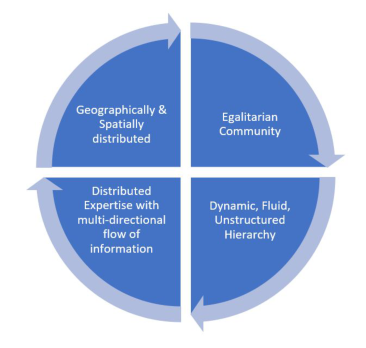
A quasi-community as envisioned by Emad and Roth (2016) is an egali- tarian community with an unstructured, dynamic, and fluid hierarchy. Here the expertise is distributed among the constituent members as opposed to the steep hierarchy from the periphery to the core in a traditional ‘com- munity of practice’ (CoP). Moreover, such a quasi-community need not be geographically/spatially delimited (Emad & Roth, 2016; Kataria & Emad, 2019). Table 1 below compares the salient features of a traditional workplace supported by the concept of a Community of Practice (CoP) and a high- technology workplace that is supported by the concept of Quasi-community (QC) as described by Emad and Roth (2016).
Table 1. Differences between a traditional workplace supported by community of practice and a high-technology workplace supported by quasi community. (Source: Authors).
Table available in the original PDF paper.
A traditional workplace supported by the concept of a ‘Community of Practice’
A high-technology workplace supported by the concept of a ‘Quasi-community’ Rigid hierarchy Dynamic, fluid, unstructured hierarchy Expertise concentrated at the core Distributed expertise Unidirectional flow of information Multi-directional flow of information Unequal; With high ‘power distance’ Egalitarian and democratic; With mini- mal ‘power distance’ Geographically and spatially delimited Can be geographically and spatially distributed Rich history and culture that evolves over time
Temporally limited as a team can be created even for limited duration Thriving community, self-created by experts in a field
Community needs to be created and supported by the organisation
The techno-saturated environment onboard modern ships call for a lear- ning approach that foregrounds technology and collaboration, and QC fulfils this need. Expertise is not a prerogative of hierarchy, particularly in the dyna- mic fast paced modern ship operations. Therefore, the distributed expertise of the egalitarian QC will be a joint resource that the team members can uti- lize to further their learning. Team members’ expertise will be shared as and when the need arises, thus utilizing the inherent agility of QC that supports peer-to-peer learning due to its fluid hierarchy. A team member could be an expert in, and contribute to one task, but a novice in, and ready to learn in the very next. Furthermore, a multi-directional information flow can sup- port open, transparent communication that can clarify and address some of the opacity of work processes introduced by digitalization and automation onboard.
The characteristics of an enduring spatiotemporal hierarchical CoP are unsuitable for modern/future ship operations. In this regard, a QC may not be considered as a true community with a collective memory when compa- red with a CoP. However, it offers several advantages over a CoP for learning and working in techno-saturated work environments (see table 1). A QC is thus, a community that is free from spatiotemporal limitations, that is egalita- rian and democratic, with a fluid dynamic unstructured hierarchy, distributed expertise, and with an open multi-directional flow of information. The ori- ginal notion of QC refers to “an occasioned, temporally limited community within an educational context” (Emad & Roth, 2016, p. 584). However, that lack of spatiotemporal nature of relations within the current maritime work- place on board ships has deprived seafarers the learning opportunities that exist in real communities. Therefore, we propose the QC framework (see Figure 1 below) as a solution for organising jobs and activities onboard that will further create authentic learning opportunities for newcomers.
Figure 1: Characteristics of a Quasi-Community. (Source: Authors).
Foregrounding technology and utilizing QC will provide a solution for community learning in modern/future ship operations wherein team members
On the Road to Autonomous Maritime Transport: A Conceptual Framework 645
are geographically and spatially dispersed. Team members can collaborate and combine their expertise to learn and meet the organizational needs. For example, the possibility of creating a digital twin of the shipboard workplace will be a game changer for future maritime education and training. It will permit the conduct of training and learning in a virtual authentic replica of the shipboard workplace. This may be particularly useful in MASS stages 3 and 4, when no seafarers would be present onboard. This capability to duplicate the virtual representation of the ship affords workplace portability and therefore will also be useful for shore-based, and cloud-based collaborative teamwork and learning. Likewise, freeing the workplace from being tied to a physical tangible asset will support training and learning of future ship operators as training can then be carried out in the digital space instead of the actual shipboard environment.
Organizational management needs to recognize the varied benefits offered by a QC and should aim to consciously create and support it. A QC can be created by uniting the team members over a common objective. Furthermore, the shared history and culture should be drawn upon for building rapport and cohesive team building. A QC is best supported with the creation of an open environment that facilitates information sharing among team members and encourages peer-to-peer learning.
CONCLUSION
The dynamically evolving ships and the changing nature of onboard work across various stages of MASS calls for the implementation of an equally rele- vant maritime education and training (MET). Although, fully autonomous vessel operations may still be decades away, stakeholders in MET are already facing the imminent challenges posed by rapid digitalization and transition of ships from MASS stage 1 to stage 2. The many changes brought about by the proliferation of technology onboard, the decreasing roles of human opera- tors, and the democratization of the workplace is challenging the traditional practices of seafarers’ work, learning, and development of competencies. This calls for a fresh conceptual approach. This chapter builds upon the previ- ous work on QC as presented in Emad and Roth (2016) and highlights its application in techno-saturated work environments such as modern/future ship operations. Hence, we propose Quasi-communities (QC) as an ideal conceptual framework that can facilitate the creation of a supportive learning environment for future ship operators.
REFERENCES
Emad, G. R. (2017). Improving Maritime Education and Training for the sophisticated ships of today. Lloyds List Australia(August 2017). Emad, G. R., & Roth, W.-M. (2016). Quasi-communities: rethinking learning in
formal adult and vocational education. Instructional Science, 44(6), 583–600. Fuller, A., Hodkinson, H., Hodkinson, P., & Unwin, L. (2005). Learning as peripheral participation in communities of practice: a reassessment of key concepts in workplace learning. British Educational Research Journal, 31(1), 49–68.
Harteis, C. (2018). Machines, Change and Work: An Educational View on the Digitalization of Work. In C. Harteis (Ed.), The Impact of Digitalization in the Workplace - An Educational View (Vol. 21, pp. 1–12). Cham Switzerland: Springer International Publishing AG. Hodkinson, H., & Hodkinson, P. (2004). Rethinking the concept of community of
practice in relation to schoolteachers’ workplace learning. International journal of training and development, 8(1), 21–31. IMO. (2021). Maritime Safety (8 Aug 2021). Retrieved from https://www.imo.org/ en/OurWork/Safety/Pages/Default.aspx Kataria, A., & Emad, G. R. (2019). Reimagining engineering education and trai-
ning in a dynamically evolving technoscape-a case of the maritime domain. Paper presented at the World Engineers Convention 2019. Lave, J. (1993). Situated Learning in Communities of Practice. In L. Resnick, J.
Levine, & S. Teasly (Eds.), Perspectives of socially shared cognition. Washington DC: American Psychological Association. Lave, J., & Wenger, E. (1991). Situated Learning: Legitimate Peripheral Participation.
Cambridge: Cambridge University Press. Praetorius, G., Hult, C., & Österman, C. (2020). Maritime resource management: Current training approaches and potential improvements. TransNav, 14(3), 573–584. doi:10.12716/1001.14.03.08
LISTED IN THE AHFE DIGITAL BOOKSTORE CATALOGUE
Explore the complete digital volume
Human Factors in Transportation
Read this individual research paper free through the original publisher, or explore the full digital proceedings book.
ISBN 978-1-958651-36-0
Explore this ISBN in the AHFE Bookstore ↗Listed in the July 2026 bookstore catalogue; search by ISBN to confirm current availability · Digital book purchase optional