Franz Lambrecht, Carsten Sommer (2022). SafeBike - a road safety programme for young adolescent cyclists. In: Human Factors in Transportation. AHFE Open Access, vol. 60, pp. 6–13. https://doi.org/10.54941/ahfe1002428
In 2019, approximately 29,000 children (up to 15 years of age) were involved in road traffic accidents in Germany. The cohorts with the most accident victims are the 11- to 14-year-olds, about half of whom (approx. 6,000 children) were involved in accidents by bicycle. The number of cyclists involved in accidents rises sharply after the transition from primary to secondary school. This is due to a change in driving behavior after the change of school compared to the primary school period. Many pupils start cycling to school after changing to secondary school. Furthermore, extensive behavioral changes occur with the onset of puberty, which, for example, increases the willingness to take risks in road traffic. SafeBike is a road safety program for the particularly vulnerable target group of 11 to 14-year-old cyclists based on observation procedures, self-reflection and personal responsibility. The basic aim of SafeBike is to raise students' awareness of danger perception when cycling, leading to an increased sense of safety in the short term, so that in the long term the number of cycling accidents in the target group will decrease. After participating in the program, students are expected to be more critical of their own behavior, among other things. SafeBike consists of three components: a self-assessment of one's own driving behavior in terms of safety, the treatment of several subject areas in which driving errors and traffic conflicts occur more frequently, and a final re-assessment of one's own driving behavior.The traffic effects of the program were surveyed and evaluated in a pilot test at two different schools in Germany. In the post-surveys, the test group committed about 50% fewer traffic conflicts and driving errors than the control group, which attests to the very high short-term effectiveness of SafeBike. In the control group, who did not complete the program, no significant improvements occurred in comparison to the before survey, in contrast to the subject group. In the test group, there were significant positive effects, especially in the case of driving errors that occurred particularly frequently in the pre-surveys and were correspondingly addressed in the program and discussed by the students. Particularly high positive effects were achieved with conversations while driving, at the pedestrian crossing and using the pavement on the wrong side of the road. Medium effects were achieved with hand signals and looking around. This means that the road safety program can be used in road safety education throughout the country. However, long-term effects are not yet available and must be determined in further studies.
SafeBike - A Road Safety Program for Young Adolescent Cyclists 7
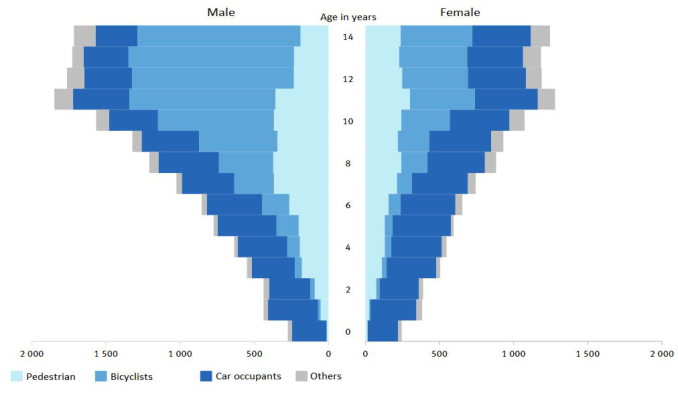
Figure 1: Children injured in accidents 2019 by age, sex and traffic participation in Germany (Statistisches Bundesamt 2020).
INTRODUCTION
The number of children involved in road accidents has fallen sharply in Ger- many since the beginning of the 21st century. In 2000, just under 50,000 children under the age of 15 were still involved in road traffic accidents, of which just under 250 were fatalities. In 2019, according to the Fede- ral Statistical Office (2020), only about 29,000 children under the age of 15 were involved in road traffic accidents in Germany. Of these, 55 died. Despite everything, a child was thus injured in road traffic in Germany every 19 minutes in 2019. The number of cyclists involved in accidents rises sharply after the transi- tion from primary to secondary school (figure 1). This is due to a change in driving behavior after the change of school compared to the primary school period. Many pupils start cycling to school after changing to secondary sch- ool. Since in many cases the secondary school is further away from the place of residence than the elementary school, longer distances are covered, often with new and unknown traffic situations compared to the previous way to school. Furthermore, extensive behavioral changes occur with the onset of puberty, which, for example, increases the willingness to take risks (especi- ally through overestimating oneself) in road traffic (Limbourg et al. 2000). So far, however, there are no nationwide measures for cycling education in lower secondary schools. Therefore, there is a special need for research to pro- mote road safety in this particularly conspicuous group of 11- to 14-year-old cyclists.
The aim of this research was the development of a road safety program for the particularly vulnerable target group of 11 to 14-year-old cyclists based on observation procedures, self-reflection and personal responsibility. The deve- lopment of the program is documented in this paper and the traffic effects
8 Lambrecht and Sommer
of the program are surveyed and evaluated in a pilot test at two schools. The program was designed to be universally applicable in lower secondary schools.
OVERVIEW In order for children to participate safely in road traffic, it is necessary that they know the correct behavior and traffic rules. School-based traffic safety programs are particularly important in this regard, especially since parents often do not pay enough attention to teaching their children rele- vant traffic safety rules (Limbourg 1998). Independent traffic participation is strongly dependent on the children’s level of physical, psychological and social development. Due to their stage of development, they behave diffe- rently in road traffic than adults and are particularly vulnerable and at risk (Schlag et al. 2006). Differential differences are found in the development of perception, attention and concentration as cognitive foundations on the one hand and cognitive processing - such as hazard cognition and risk asses- sments - as well as the development of executive functions on the other (Schlag et al. 2018).
The methodology and pedagogical approach used in a traffic safety program plays a key role in its success (Limbourg 1998). A survey by Weishaupt et al. (2004) shows that teachers as well as students see little bene- fit in traffic education. According to Arndt et al. (2017), this may be because programs do not address the main problems of the age group. A road safety program should therefore be designed in terms of content and methodo- logy to provide more visible benefits to young people in their everyday lives, address their circumstances, and address where this age group needs support. In particular, it is important that learners can make sense of a learning goal or changed behavior (Carle et al. 2018). Also according to Romer (2010), programs that primarily provide knowledge regarding potential hazards and risks are less effective than those that address the individual benefit aspect and are combined with social skills and resistance training. According to Limbourg (2010), road safety programs should aim to teach young people to correctly assess behaviors in terms of their risk potential. To achieve this, pedagogical approaches should aim at concern and insight in young people. This can succeed if feelings are also addressed (emotional learning). However, adolescents are difficult to influence through traffic education. Adolescents tend to be closed to adults. The opinions of their friends and classmates are more important to them than those of other reference groups. A traffic safety program aimed at influencing behavior will only be successful if these deve- lopmental psychological conditions are considered. Furthermore, there need not always be a “correct” behavior; alternatives to desirable behaviors can also be accepted. An accepted “anti-attitude” in one subject matter can have a positive effect on the ability to influence in all other areas, as adolescents are more likely to feel understood and thus become more open to influencing behavior. (Limbourg 1996)
SafeBike - A Road Safety Program for Young Adolescent Cyclists 9
ROAD SAFETY PROGRAMM “SAFEBIKE” In particular, the program aims to raise students’ awareness of danger perce- ption when cycling, leading to an increased sense of safety. To achieve this, the program consists of the basic elements of observation, self-reflection and per- sonal responsibility. After participating in the program, students are expected to, among other things, assess their own behavior more critically than before and now perceiving their riding behavior as more unsafe than they had previ- ously assessed. Afterwards, they strive to regain their previous sense of safety and therefore adjust their driving behavior accordingly. This road safety pro- gram thus aims to achieve conscious behavioral changes in the short term so that, as a result, the number of cycling accidents among the target group will decrease in the long term. The program has been designed in such a way that it can be carried out independently by teachers at schools.
The basic structure of the road safety program is based on various scientific approaches and teaching techniques. The need for self-assessment is a critical skill for a cyclist to have, as without it learning from experience can be a slow and even dangerous process (Engström et al. 2003). The key is to create an environment where students can self-assess. This is accomplished through the use of questions that encourage students to consider their actions from multiple perspectives. For example, asking students questions such as, “Is there anything you could improve?” is not judgmental (Edwards 2011), but encourages thinking in different directions.
For the program, therefore, a graphic design was used with recurring, sympathetic figures who provide explanations of the program instead of the teachers. Students will still never end up perceiving the same as adults, and thus will not always fully understand their intentions in educational situati- ons (Carle et al. 2018). Therefore, there are no direct “right” and “wrong” solutions in the program, but rather students should determine for themselves what feels right. This may mean that some desired behaviors are not reco- gnized or perceived as desirable by students. This is accepted for individual situations if it maintains overall acceptance of the program.
An adapted mirror method in traffic (after Koivisto & Mikkonen 1997) is used as the main teaching technique. Behind the method is the message of a realistic representation of one’s own behavior to the respective target group. For this purpose, a concrete database is necessary about the behavior of the target group in order to be able to deal with the critical issues. This was achie- ved by surveying the target group’s driving behavior using video observation (see Lambrecht & Sommer 2021) and was used to develop the topic sessi- ons for the road safety program. These are: Driving with Friends, Driving on the Sidewalk, Zebra Crossings, Turning, Right of Way, Overtaking, and Bus Stop.
PROGRAM SCHEDULE The program has a duration of 90 minutes. At the beginning, the program is presented to the students and the related work materials are handed out. Self- assessment of their own behavior while riding a bicycle is the first active task for the students. This is done through a comparatively simple task in which
10 Lambrecht and Sommer
the students are asked to think about how safe they feel their own riding is and how they feel they are able to react to various sudden situations that arise. For this assessment, they are asked to choose a number on a scale between zero (completely unsafe) and ten (completely safe). The teacher should then ask individual students for their assessment.
The mirror sessions on different traffic situations while riding a bicycle are the heart of the program. Here, the previously mentioned traffic situations are examined in more detail. The procedure is fundamentally based on Koivisto & Mikkonen’s (1997) traffic safety measure. First, the students are asked to answer three questions on the respective topic, for example, how often they give the hand signal when turning and how they assess their classmates in this regard. These questions are then discussed under the moderation of the teacher. After this discussion, a video follows, which deals with the related topic. In this short sequence (between 15 and 45 seconds), a situation from real road traffic is shown in which one or more conflicts and driving errors occur in connection with the respective topic. For example, this may be a left turn where no hand signal was given. The video has no sound, nor does it convey any other message or draw attention to specific points in any way. First, students write down their impressions on their worksheet, then the class discusses what they have seen again. This procedure is repeated for all subsequent mirror sessions.
After completing the main part of the road safety program, students are again asked to assess their own driving in terms of road safety. The procedure is the same as in the first step. Now the students are asked to think about what has changed in their assessment compared to the beginning of the program and how this has come about. This is then discussed again in the class. Finally, the students write a summary of their impressions and learning experiences.
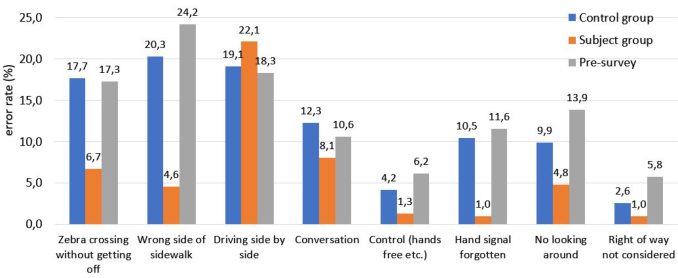
RESULTS OF THE PILOT TEST The traffic safety program developed was carried out in a pilot test at two schools in Germany in the fall of 2020. Almost 500 students from grades five to nine took part. In order to be able to measure the net effects of the road safety program, traffic observations were carried out in the same traffic situa- tions before and after the pilot test, taking into account the subject group and the control group (pupils who did not take part). In the pre-survey (described in detail in Lambrecht & Sommer 2021) 3,096 pupils were observed in 17 different traffic situations. The pupils committed to 0.06 traffic conflicts and 1.27 riding errors per person and situation. There were no significant diffe- rences between boys and girls in terms of the total number of conflicts and driving errors. There was a high number of riding errors in different situa- tions (see figure 3). The most commonly identified riding errors were: using the pavement on the wrong side, riding next to each other, not getting off the bike at zebra crossings, insufficiently looking around when turning and missing hand signals.
In the post-surveys, 4,182 road users (subject and control group) were recorded. In the post-surveys, the test group committed about 50% fewer traffic conflicts and driving errors than the control group, which attests to
SafeBike - A Road Safety Program for Young Adolescent Cyclists 11
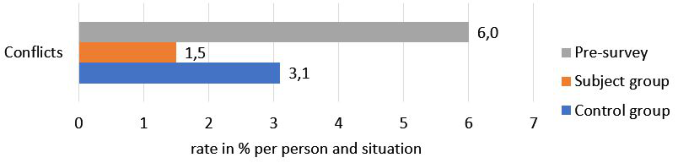
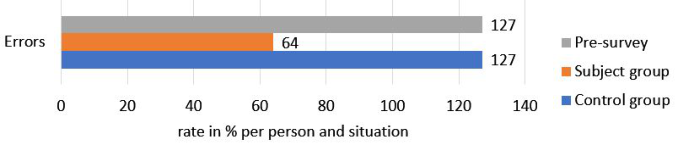
Figure 2: Conflict rate in % per person and situation.Figure 3: Error rate in % per person and situation.Figure 4: Relevant error types.
the very high short-term effectiveness of the developed road safety program (figure 2 & 3). Thus, the subject group committed 0.15 traffic conflicts and 0.64 driving errors per person and situation, while the control group instead committed 0.30 traffic conflicts and 1.27 driving errors per person and situa- tion. In the control group, who did not complete the program, no significant improvements occurred in comparison to the before survey, in contrast to the subject group. In the subject group, there were significant positive effects, especially in the case of driving errors that occurred particularly frequently in the pre-surveys and were correspondingly addressed in the program. Parti- cularly high positive effects were achieved with conversations while driving, at the pedestrian crossing and using the pavement on the wrong side of the road. Medium effects were achieved with hand signals and looking around (figure 4).
12 Lambrecht and Sommer
CONCLUSION
This study presents a new road safety program for the particularly vulnera- ble group of 11- to 14-year-old cyclists. In short term, very positive effects on driving behavior and thus on road safety could be demonstrated (50% fewer traffic conflicts and driving errors in the subject group). This means that the road safety program can be used in road safety education throughout the country. However, long-term effects are not yet available and must be deter- mined in further studies. Transferability of the program with its methodology to different countries is possible. Separate surveys would have to be condu- cted there to find country-specific anomalies and local example situations would have to be used.
ACKNOWLEDGMENT
The German Federal Ministry of Transport and Digital Infrastructure funded this study within the 2020 National Cycling Plan. This study was described in more detail in the doctoral thesis “Development of a Road Safety Program for Cyclists Aged 11-14 with a Focus on Metacognitive Skills” (available in German only).
REFERENCES
Arndt, P.; Ludwig, A.; Fäsche, A.; Wallner, S.; Evers, W. (2017): YOLO – (Selbst)sicher Radfahren. Ein Projekt zur Förderung der Sicherheit jugendlicher Radfahrer durch Stärkung der Selbststeuerungskompetenz”. Ulm. Carle, U.; Metzen, H.; Buchholz, K. (2018): Ganzheitliche Verkehrserziehung für
Kinder und Jugendliche Teil 2: Anforderungen für den Elementarbereich. Berlin: Forschungsbericht GDV e.V, 57. Edwards, I. (2011): Can drivers really teach themselves? A practitioner’s guide to using learner centred and coaching approaches in driver education. Doncaster: EDriving Solutions. Engström, I.; Gregersen, N. P.; Hernetkoski, K.; Keskinen, E.; Nyberg, A. (2003):
Young novice drivers, driver education and training. Literature review. Linköping. VTI Rapport, 491A. Koivisto, I.; Mikkonen, V. (1997): Mirroring method. A traffic safety campaign without authoritative “right answers”. Helsinki, Finland: Liikenneturva (Reports from Liikenneturva, 42/1997). Limbourg, M. (1996): Entwicklungspsychologische Grundlagen der Beeinflussung
des Verhaltens von Jugendlichen. In: Bundesanstalt für Straßenwesen (Ed.): Junge Fahrer und Fahrerinnen, M52.. Bergisch Gladbach, p164–168. Limbourg, M. (1998): Ziele, Aufgaben und Methoden einer zukunftsorientierten Verkehrs- und Mobilitätserziehung. https://www.uni-due.de/~{}qpd402/alt/texte. ml/ADAC.html, 11.02.2021. Limbourg, M. (2010): Mutproben im Kindes- und Jugendalter. In: Sache-Wort-Zahl
(107), S. 35–42. Limbourg, M.; Flade, A.; Schönharting, J. (2000): Mobilität im Kindes-und Jugendalter. Wies-baden: VS Verlag für Sozialwissenschaften. Romer, D. (2010): Reducing adolescent risk. Toward an integrated approach. Thou-
SafeBike - A Road Safety Program for Young Adolescent Cyclists 13
Schlag, B.; Richter, S.; Buchholz, K.; Gehlert, T. (2018): Ganzheitliche Verkehrserziehung für Kinder und Jugendliche. Teil 1: Wissenschaftliche Grundlagen. Berlin: Forschungsbericht GDV e.V, 50. Schlag, B.; Roesner, D.; Zwipp, H.; Richter, S. (2006): Kinderunfälle. Ursachen und
Prävention. Wiesbaden: VS Verl. für Sozialwissenschaften. Sommer, C.; Lambrecht, F. (2021): Critical Behavior of Young Adolescent Cyclists in Germany, in: Ahram, T. Z.; Karwowski, W.; Kalra, J. (ed.), Advances in Arti- ficial Intelligence, Software and Systems Engineering - Proceedings of the AHFE 2021 Virtual Conferences on Human Factors in Software and Systems Enginee- ring, Artificial Intelligence and Social Computing, and Energy, July 25-29, 2021, USA, Springer Statistisches Bundesamt (2020): Kinderunfälle im Straßenverkehr 2019. Hg. v.
Statistisches Bundesamt (5462405-19700-4) Weishaupt, H.; Berger, M.; Saul, B.; Grimm, K.; Plessmann, S.; Zuegenruecker, I.
(2004): Verkehrserziehung in der Sekundarstufe. Bremerhaven: Wirtschaftsverlag NW. Berichte der Bundesanstalt für Straßenwesen M, Mensch und Sicherheit, 157.
LISTED IN THE AHFE DIGITAL BOOKSTORE CATALOGUE
Explore the complete digital volume
Human Factors in Transportation
Read this individual research paper free through the original publisher, or explore the full digital proceedings book.
ISBN 978-1-958651-36-0
Explore this ISBN in the AHFE Bookstore ↗Listed in the July 2026 bookstore catalogue; search by ISBN to confirm current availability · Digital book purchase optional