Kay Fjørtoft, Even Holte (2022). Implementing operational envelopes for improved resilience of autonomous maritime transport. In: Human Factors in Transportation. AHFE Open Access, vol. 60, pp. 698–706. https://doi.org/10.54941/ahfe1002507
A promising potential commonly associated with autonomous ferries is the realisation of low- or unmanned passenger transport. With the ability to provide flexible around the clock services, it can provide new and better mobility solutions for coastal cities around the world, and for cities located along rivers and inland waterways. However, operating an autonomous passenger ferry require that safety functions, today being handled by trained onboard safety crew, are maintained and approved according to current rules and regulations. Since few concrete suggestions so far have been published on how to solve this issue, new safety solutions must be developed, including new technology, processes and operational concepts. This lack of studies and work for developing automated and autonomous safety solutions stands in contrast to – up until now – the strong industry focus on developing systems and solutions enabling safe navigation. As a response, this paper suggests the implementation of operational envelopes for improved safety and resilience of autonomous shipping and ferry operations. Acknowledgements: The authors would like to acknowledge the two Norwegian Research Council projects MARMAN (324726 - FORSKER21) and AutoSafe (302005845).
The research projects’ AutoSafe and MARMAN endeavor is to provide important contributions on how to close the gap from conventional to auto- nomous shipping. AutoSafe by finding solutions to the fundamental problem of ensuring passenger safety with few or no crew onboard, and MARMAN on how to build resilience into an autonomous maritime transport system. As such, these projects complement each other, as AutoSafe has a more ship- centric focus, while MARMAN focus on how automation and autonomy can be integrated in a complex and multi-modal maritime transport system. Also focusing on the operational aspect. For both projects, dynamic planning and management are important aspects for facilitating safe, resilient, and efficient ways of operating. In this regard, the digitalization of the interface betw- een the automated ship and manned remote control/operation centre (ROC), and the related processes, are important. It is vital to improve the quality and availability of data to be exchanged and to harmonize the standards to allow reliable and efficient information exchange between ship and shore
Implementing Operational Envelopes for Improved Resilience 699
systems, it will be especially important when an unwanted or unexpected situation occurs. In such cases, time is critical and real time qualified infor- mation is an absolute necessity for computers and humans to secure a safe way out of an unwanted situation. Hence, planning, integration of key-data, and digital technology supporting decision making by facilitating situatio- nal awareness between humans and technology is key for success. Our focus will be on strengthening the safety element during operations and for the planning stages (Hoem, 2019), also by preparing for the unknown where possible. The commonalities regarding digital requirements as seen by the different actors which can be humans or technology, and processes related to describing the timing and locations for an event, can be addressed in an operational envelope, which is described in detail later.
AUTONOMOUS SHIPPING According to The Oxford Dictionaries (Oxford, 2022), autonomy is the right or condition of self-government, and the freedom from external control or influence. Several researchers (Relling et al., 2018) have discussed that the term is used differently in colloquial language as opposed to the technical definition, and that it is interpreted in different ways across industries. For all transport segments, autonomy is gaining increased interest, introducing auto- nomy is expected to create new possibilities, to increase efficiency and safety. Autonomy could lead to drastic changes in roles and responsibilities for invo- lved agents (both technical systems and humans), and these changes will be important drivers for changing the rules which regulate the responsibilities of the involved actors in the maritime domain (Relling et al., 2018; Hoem, et al., 2021). Rødseth (2018) say’s in the following, the term “autonomous ship” is used to mean a merchant ship that has some ability to operate independently of a human operator. This covers the whole specter from automated sensor integration, via decision support to computer-controlled decision making. We emphasize that autonomy does not necessarily mean absence of human inte- raction. Often there is a strong need to design how humans can make sense of automation failures and enact meaningful human control. It is also impor- tant to note that systems are not necessarily either fully automated or fully autonomous, but often fall somewhere in between (Cummings, 2019; Hoem, et al., 2021), it will also change states from one to another depending on the situation. Sometimes it can be closely operated either by the ROC or a captain/driver, while in open waters with low traffic it can be controlled by the computers or the autonomous system as examples. The Internatio- nal Maritime Organization have pointed to following degrees of autonomy (IMO 2021):
1. Degree One: Ship with automated processes and decision support: Seafa- rers are on board to operate and control shipboard systems and functions. Some operations may be automated and at times be unsupervised but with seafarers on board ready to take control. 2. Degree Two: Remotely controlled ship with seafarers on board: The ship is controlled and operated from another location. Seafarers are available
700 Fjørtoft and Holte
on board to take control and to operate the shipboard systems and functions. 3. Degree Three: Remotely controlled ship without seafarers on board: The ship is operated from another location, no seafarers on board. 4. Degree Four: Fully autonomous ship: The operating system of the ship is able to make decisions and determine actions by itself.
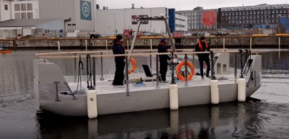
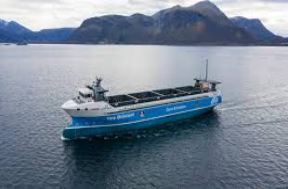
The autonomous shipping sector is still at a early stage, but several ongoing projects are currently developing innovative solutions and technologies. One example of this is the autonomous passenger vessel MilliAmpere-2, which is developed by the Norwegian University of Science and Technology in Norway. MilliAmpere 2 (Figure 1), is currently in a test period and will in the initial stages start sailing across a river with a crew onboard. The deve- lopment of Yara Birkeland (Figure 2), a battery-operated vessel that can take 150 containers and will be sailing between the ports Herøy and Brevik in Norway, will follow same approach. The vessels will have a remote opera- tion period before a fully computer-controlled voyage can take place. The vessels will start by sailing with an autonomy level one, followed by a Degree Two and the scale upwards (IMO, 2021). Autonomous shipping is enabled by several emerging technologies, like advanced sensors, machine learning, Artificial Intelligence, and improved connectivity (Internet of Things), and to use the digital infrastructure in a more advanced way than traditional. It needs approved interaction between technology and different stakeholders and organizations along a value chain, for example with a control room for vessel operation. It is expected that the different steps will identify needs for new technology, needs for new awareness, and we also expect that it will generate new types of accidents or challenges compared with conventional ones.
Figure 1: MilliAmpere 2, Photo: NTNU.Figure 2: Yara Birkeland sailing out of yard. Photo: Vard.
Implementing Operational Envelopes for Improved Resilience 701
HUMANS IN THE LOOP Kaber (2018), discuss different levels of autonomy in the context of human automation interaction (HAI).The paper particularly looks at the use of levels of autonomy as taxonomies to structure and improve analysis of human per- formance, workload, and situation awareness as well as some of the problems that this may cause. The introduction of increasing automation changes the way human and machine interact in many ways that may not always be captured by a given classification, e.g.: a) Complacency: The system ope- rator is satisfied with performance but may lack awareness of other safer or more efficient methods of operation. b) Satisficing: This represents an aver- sion to effort, by accepting a solution that meets minimum requirements, rather than looking for better solutions that are known or suspected to exist. c) Lack of situational awareness, i.e. out of the loop problems: Operator does not fully understand the situation and cannot determine the correct actions when human attention is required.
Defining exactly what an autonomous ship and technology must be able to handle is obviously important. One method to define this is called the “operational envelope”, which defines the interaction and states between the automation or ICT at a vessel and with the ROC as an example. This will be the basis for assigning responsibilities to humans or automation, by designing the human-automation interface. Both for testing and approval of the automation systems, as well as for addressing safety aspects to operati- ons, (Fjørtoft and Rødseth, 2020). An operational envelope’s main purpose is to describe the characteristics of a proposed system. It is used to communi- cate the quantitative and qualitative system characteristics to all stakeholders. Having a human in the loop allows a design where the automation does not have to handle all possible situations the vessel can end up in. It will be possi- ble to share the task responsibilities between the automation system and the human operator and let the human handle the tasks where automation have short comes, or problems to tackle that it is not designed for. This obviously simplifies the design of the automation system. However, it also means that the system design must include an interface between the human and the auto- mation system. This interface must allow the human sufficient time to gain sufficient situational awareness to do the correct actions when needed to. As such, by introducing the “operational envelope” (Rødseth 2018) as a tool it will enable us to describe the interaction between human operators, either onboard the vessel or at a ROC, and the automation system.
Considering the above definitions, this means that the operator onboard or at the ROC needs to change from either monitoring the ship, or even doing completely other tasks, to first achieve situational awareness and then perform the necessary actions to establish control. This will take some time. In this paper, the time interval from when the automation warns about the need for human assistance to the human operator is able to give the correct response, will be called the maximum response time or TMR. This will depend on the operational procedures on the ship and the ROC and from what state the operator starts when his or her actions are required. The other impor- tant time interval is the response deadline or TDL. This is the worst case, i.e.
702 Fjørtoft and Holte
potentially shortest time from a likely problem is detected by the automation to the automation has to activate a fallback procedure and enter an Mini- mum Risk Condition, (MRC), e.g. hold position, return to quay, etc. (Holte and Wennersberg, 2021).
The maximum response time can also apply to the crew on board. A relevant application of autonomy on manned ships is to control the ship, when the crew is sleeping or doing other tasks on board. This has the same constraints in timing: The crew must get back to their control position and then get an overview of the situation to safely regain control. However, the response times for ROC crew and sleeping crew on board is quite different.
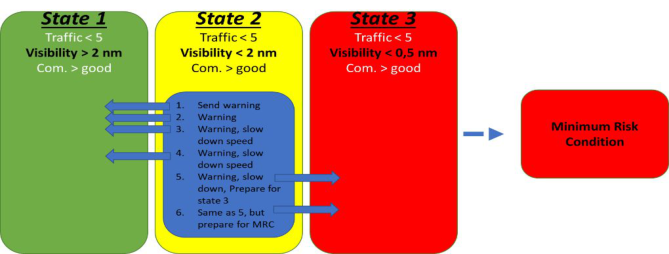
OPERATIONAL ENVELOPE An operational envelope defines precisely what situation the autonomous vessel must be able to handle by assigning responsibilities to the human ope- rators, i.e. to a ROC, and to the automation at a vessel (Fjørtoft and Rødseth, 2020). It defines conditions of operations, describes the characteristics and requirements, and enables the design of HAI, based on specific task analysis, safety-critical tasks and challenges of sensemaking. An operational envelope can be represented in a state diagram, where for instance it changes states depending on the data from sensors connected to the autonomous steering system. This is illustrated in Figure 3 (examples only: traffic = no._of ships, visibility = nautical miles, Communication = low/medium/good):
Figure 3: States in an operational envelope for sailing.
Figure available in the original PDF paper.
In this example the envelope is designed to operate in three different sta- tes, (green, yellow and red), where it normally changes states up and down. State 1 is green, which means the operation is within the operational acce- ptance criteria and the operation can continue as planned. In this case it is an envelope used for sailing a vessel between two destinations. The change of states depends on the sensor data. In our example the visibility is the criteria from changing states. If visibility in State 3 is less than 0.5 nautical miles, the vessel is designed to prepare for an MRC. The cameras at the vessel will be used to identify visibility range. The next possible design criteria could be to start new envelopes if states change to a higher state, sub operatio- nal envelopes. If the automation at the vessel is in State 2, it is likely that an alarm or message should be sent to the ROC, such that they can assist or take control of the vessel if needed. Establishing awareness between the ROC and the ship may take some time, in which must be calculated for. Time criteria’s such as establishing contact, to achieve awareness, and time to man the staff at the ROC must be accounted for. This since it is not always the
Implementing Operational Envelopes for Improved Resilience 703
case that the operator is ready to take over control in seconds – they might be doing something else and will need time to mobilize. Several publications have suggested different ways to define “levels of autonomy”. See Rødseth (2018) for a discussion of this issue for ships and references to some relevant definitions. Most definitions of “levels of autonomy” have a specific applica- tion area in mind, and therefore – the below differentiation in time to regain control (TMR) can also be used to define “levels of autonomy”. In the fol- lowing, a number of such levels are defined. The time parameters applied in the examples are based on experiences from conventional shipping, and only meant as indicative as changes may occur as more research on this issue is performed. T is time, MR is Maximum Response time, DL is latest time to react (DeadLine). Table 1 describes the typical time criteria that are used in the hand-over process between the vessel automation and the ROC:
Table 1. Hand-over time constraints, example only.
Table available in the original PDF paper.
Description TMR TDL
0 0
1 Operator in control: The operator is directly in control of the ship. Hand-over time is not relevant
10 sec
20 sec
2 Operator supervision: Automation is used to assist operator, and operator is overseeing the operation and needs only a short time to gain situational awareness when actions are needed
120 sec
200 sec
3 Operator at site: An operator is at the control position but is working with other tasks and will need time to gain situational awareness.
120 sec
200 sec
4 ROC operator: A remote operator in the ROC is needed to resolve the situation. This could be similar to the ROC operator needs to be mobilised from other tasks.
10 min
12 min
5 Operator available: The operator is available, but is in another location, possibly sleeping, and will need several minutes to reach the control position and to regain safe control.
NN NN
6 No operator: There is no operator and automation must be able to handle all operations by itself (TMR is the duration of the operation or the voyage).
So back to the state diagram example. The time constraints above must be considered when defining the state diagrams. In Figure 4 this can be seen when defining the outcome of being in a state. The example shows that if the vessel is sailing with a 1 to 4 organization, this means the mobilization and awareness to the situation is good enough to continue sailing without doing any changes, it can safely return to state 1. But if the status is 5 or 6, the ROC operators are doing something else and needs time to take control (TMR < 10 min, or No operator) it means the automation at the vessel must prepare to take action, which in our case will be to slow down the vessel speed at the same time as it should prepare to go to a higher state where the response time must be lower than in state 2.
704 Fjørtoft and Holte
Figure 4: Operational envelope State 2.
RESILIENCE In autonomous systems it will be important to build resilience into the system where operational or technological limitations are identified and where safety and criticality should be assessed. Introducing new technology like autonomy will change the way of working. To handle new threats, unfamiliar events, and incident types, planning and management should develop and rely on preventive measures (Fjørtoft and Mørkrid, 2021). New indicators are pro- bably needed in addition to the traditional, including foresight indicators handling both foreseen and unforeseen events (Stene & Fjørtoft, 2020). To address technological issues, it is important to build robustness and redun- dancy, and to introduce options to recover from an unwanted situation. Regarding operational knowledge it will be important to understand the human’s role, and how to utilize the human expertise in decision making. This is relevant when moving the operation from a traditional captain on board a vessel to a ROC. The shore captain will likely be responsible for navigating several vessels in parallel, which is a completely new scenario compared to today’s practices from conventional shipping where the captain’s operatio- nal domain is limited to one ship only. A shore-based captain is not always the best decision maker if the situation requires knowledge other than from the navigational field, for example if technological failures occur this will require an engineer’s knowledge, not a navigator’s knowledge. An engineer will need different information for decision making than a captain. The main philosophy will be that the technology will be capable of making decisions on its own, but there will be situations where the technology will need human intervention and expertise in the sense- and decision-making process. Sense making means that reality is an ongoing accomplishment that emerges from efforts to create order and make retrospective sense of what occurs’ (Weick, 1993). Meaning, with reference to Figure 4, that the operational envelope also must consider resilience that depends on the operational profile descri- bed in Table 1. For example, if the vessel needs operational assistance from the ROC (i.e. situation 4 I table 1), and the ROC operator on duty is not ready to take control – or the communication link is disrupted, a possible solution can be to forward the request to another ROC in the network. This is an example on how resilience can be incorporated into the system.
Implementing Operational Envelopes for Improved Resilience 705
In terms of Woods four principles (2015), the principle of rebound under- lines the importance of analysing different operational scenarios. In which the involved actors can evaluate for future learning and further improvement on how humans and automation should interact for the benefit of improved operational resilience. If the ROC has redundant technology to build awa- reness, this can be used to bounce back to green state if the operator finds the situation within control as example. Robustness can be built into the system by defining certain actions to be performed in situations in which the automation shortfalls. Meaning that the actuating operational scenario goes beyond those who has been pre-defined (e.g. if the navigational challenge is to difficult, the ship enters a MRC and calls for human involvement before normal operation can be commenced), which means having clear procedures for handling the lack of visibility and to achieve awareness within the defined time windows (TMR and TDL). The third principle, opposite of brittleness, is particularly important, considering the difficulty in defining all thinkable - and unthinkable scenarios that automation must cater for. Hence, being able to define the most relevant parameters in the state diagram, along with the required values, becomes critical for defining how the interaction between human an automation should be in situations where system boundaries are challenged. The system should be able to analyses the situation with input from the surrounding traffic and sensors in the infrastructure, and to have clear procedures of going to an MRC state if required. Finally, network arch- itecture may ontribute to secure operational robustness by including specific actions into to the state diagram, but also evaluating the resilience of such networks by evaluating their functions and procedures for communication and sharing of responsibilities. This may prove particularly important in defi- ning situations in which cooperation between the ship and ROC is required. But also, situations where the normal communication links are disrupted, and fall-back opportunities are required. Another example will be to have an extra ROC operator available, either at same operation center or at a colla- borating ROC. Also defined procedures how to exchange information with i.e. a VTS – Vessel Traffic Service to build traffic awareness should be defined.
CONCLUSION
To conclude, the paper introduces operational envelopes as a viable alter- native and approach on how to improve resilience of autonomous maritime transport operations. Thereby representing a more proactive approach tow- ards risk management. This in the context of safeguarding the operation of the ship per se while also assuring safety of the transport system. As depicted by the state diagram, an example is presented on how specific parameters can be defined for shifting between states – how levels of autonomy influ- ence the shift, but also on specific values in which human and automation interfaces are required. In the process of defining these parameters and the related values, we believe that key principles of resilience can play a vital role. Both for the purpose of identifying possible risks for the related operational scenarios, and equally important, also for analysing the interaction between humans and automation.
706 Fjørtoft and Holte
ACKNOWLEDGMENT
The authors would like to acknowledge the two Norwegian Research Council projects MARMAN (324726 - FORSKER21) and AutoSafe (302005845).
REFERENCES
Cummings, M. L. (2019). Lethal Autonomous Weapons: Meaningful human control or meaningful human certification? IEEE Technology and Society. Fjørtoft, K. E., & Rødseth, Ø. J. (2020). Using the operational envelope to make
autonomous ships safer Proceedings of the 30th European Safety and Reliabi- lity Conference and the 15th Probabilistic Safety Assessment and Management Conference Edited by Piero Baraldi, Francesco Di Maio and Enrico Zio. Fjørtoft, K.E, & Mørkrid, O.E. (2021) Resilience in autonomous shipping. Proceedings to the ESREL-21 conference Hoem (2019): TransNAV 2019: Addressing the Accidental Risks of Maritime Tran-
sportation: Could Autonomous Shipping Technology Improve the Statistics? [ Å.S. Hoem, K Fjørtoft, ØJ Rødseth], ISSN 2083-6473, e-ISSN 2083-6481 Hoem, Å, Johnsen, S.O, Fjørtoft, K.E, Moen, T, Rødseth, Ø, Jenssen, G. (2021) Improving Safety by Learning from Automation in Transport Systems with a Focus on Sensemaking and Meaningful Human Control. Book chapter: In book: Sense- making in Safety Critical and Complex Situations - Human Factors and Design, Publisher: Taylor & Francis Holte, E.A., & Wennersberg, L.A.L., (2021), Levels of autonomy – recommendations
for coastal autonomous passenger transport. SINTEF Ocean report OC2021 A- 044, ISBN 978-82-7174-415-1. Report in Norwegian. IMO (2021), IMO - MSC.1/Circ.1638 3 June 2021 - OUTCOME OF THE REGU- LATORY SCOPING EXERCISE FOR THE USE OF MARITIME AUTONO- MOUS SURFACE SHIPS (MASS) Kaber, D.B. (2018). Issues in human–automation interaction modeling: Presumptive
aspects of frameworks of types and levels of automation. Journal of Cognitive Engineering and Decision Making, 12(1). Oxford (2022): Oxford Learner’s Dictionary, https://www.oxfordlearnersdictionari es.com/definition/english/autonomy?q=autonomy, Retrieved 16.02.2022. Relling T, Lützhöft, M, Ostnes, R, Hildre, H. (2018), A Human Perspective on
Maritime Autonomy. NTNU paper. Rødseth, Ø (2018), DEFINING SHIP AUTONOMY BY CHARACTERISTIC FACTORS, Busan, Korea, International Conference on Maritime Autonomous Surface Ships, November 7. 2018 Stene T.M & Fjørtoft K.E (2020): ESREL 2020: Are Safe and Resilient Systems less
Effective and Productive? Weick, K.E., 1993. The collapse of sensemaking in organizations – the Mann Gulch disaster. Administrative Science Quarterly, 38(4), 628–652. Woods, D.D. (2015). Four concepts for resilience and the implications for the future
of resilience engineering. Reliability Engineering and System Safety 141, 5–9.
LISTED IN THE AHFE DIGITAL BOOKSTORE CATALOGUE
Explore the complete digital volume
Human Factors in Transportation
Read this individual research paper free through the original publisher, or explore the full digital proceedings book.
ISBN 978-1-958651-36-0
Explore this ISBN in the AHFE Bookstore ↗Listed in the July 2026 bookstore catalogue; search by ISBN to confirm current availability · Digital book purchase optional