Koki Yoshida, Yohsuke Yoshioka (2024). Effect of Street Light Intervals on Distance to Unknown Approaching Pedestrian that causes Discomfort. In: Ergonomics In Design. AHFE Open Access, vol. 129, pp. 7–13. https://doi.org/10.54941/ahfe1004805
The impression of streets at night affects crime rates and the out-of-house rate. Therefore, it is important in architectural planning to elucidate the factors that contribute to the sense of safety on streets. Street lighting is one of the effective methods for improving the impression of streets at night. Among the some factors that control the effect of street lighting, the intervals between light and light have a significant impact on the impression of streets. However few studies have examined the relationship between street light intervals and sense of safety on streets.In this study, an experiment using virtual environment technology is conducted to verify the effect of street light intervals on the feeling of safety and discomfort of pedestrians at night. Through the quantitative analysis of the experimental results, the objective of this study is to obtain knowledge on the planning and design of street lighting that reduce discomfort and provides sense of safety.Ten college students participated in the experiment. Since characteristics of personal space may vary by gender, the participants consisted of five males and five females. The participants wore a head-mounted display (Vive Pro Eye / Vive) and were asked to stand upright to a street constructed in infinite virtual space. The light bulbs of a street lights in each condition were placed at a height of 5 m and illuminated the ground downward. The street lights were also placed in a straight line 2 m away to the right of the viewpoint of participants. The initial positions of the approaching unknown pedestrian (virtual avatar) were arranged on the point that 20 m straight ahead of the participant’s viewpoint.First, after the participants stand on the instructed position of virtual street, a start signal was called and the virtual avatar as unknown pedestrian started approaching to at 0.8 m/s. The participants had been asked to press the button of the hand controllers when they felt discomfort that they did not want the avatar to approach any closer. When the button was pressed, the avatar stopped approaching immediately and the distance between participants and avatar was measured and outputted. This measurement was repeated on different conditions of street light intervals to determine how the distance that causes discomfort changed. A total of four experimental conditions were generated by arranging rows of street lights at four different intervals: 12.5, 25, 50, and 100 m. Each condition was presented twice in a random order for each subject. All experimental analyses were performed using the mean of the data derived from the two replicate measurements. The statistical analyses of the experiment data determined a significant difference in the distances at which participants stopped the approaching avatar between conditions with street light intervals of 12.5 m and 100 m. Furthermore, significant trends were detected in the distances between conditions with street light intervals of 12.5 m and 50 m, as well as 25 m and 50 m. These results revealed that the wider the street light intervals, the greater the distance at which the participants feel discomfort that they did not want the avatar to approach any closer. The findings suggest that street light intervals exert an influence on the sense of safety on streets at night. Additionally, despite the absence of statistical significance, it is noteworthy that the distance to stop the avatar was greater magnitude for females than for males.
Walking through dark streets at night can evoke discomfort. Previous research, for example, Kinashi et al.’s (2010) study, has suggested that factors such as “distance,” “pedestrian traffic,” “brightness,” and “visibility” sig- nificantly influence pedestrian route choices during nighttime. Among these factors, “brightness” has emerged as particularly influential, as indicated by analysis of pedestrian route choice models.
Street lighting plays a crucial role in illuminating nighttime environments. Adequately lit streets enhance pedestrian visibility and promote safety. How- ever, despite the presence of well-lit thoroughfares in urban areas, several backstreets remain dimly lit and lack sufficient illumination from street lights. This raises the following question: What is the optimal spacing between street lights to ensure pedestrian visibility and mitigate discomfort in poorly lit areas?
This study investigated the effect of street-light spacing on pedestrian dis- comfort levels when approaching individuals. Utilizing virtual environment technology, the experiment assessed the influence of different street-light intervals on the distance at which pedestrians begin to feel uncomfortable. Through a quantitative analysis of the experimental outcomes, this study aims to provide insights for designing street-lighting systems that facilitate safe nighttime pedestrian navigation.
EXPERIMENT
Method
Ten students were recruited as participants for the experiment that was con- ducted at the Virtual Environment Laboratory of Chiba University. The participants were engaged in a task in a virtual environment. Measurements were conducted across various street-light intervals to explore alterations in the discomfort-inducing distance. The participants used a head-mounted dis- play (Vive Pro Eye/Vive) positioned upright within an infinitely generated virtual street environment.
Virtual streets were designed to replicate dimly illuminated back alleys devoid of light sources apart from street lights. Different street-light intervals were implemented across the experimental conditions with a virtual human avatar representing an approaching pedestrian placed at the end of the street. The movement of the avatar toward the participant was controlled by the experimenter. The participants were instructed to press a designated button on the controller upon experiencing discomfort from the approaching avatar. Distance changes between the participant and approaching pedestrian were assessed across varying street-light intervals.
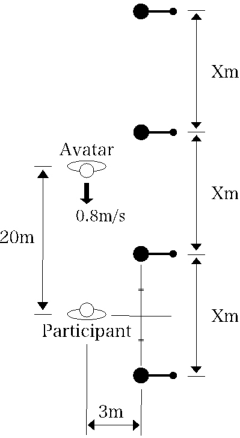
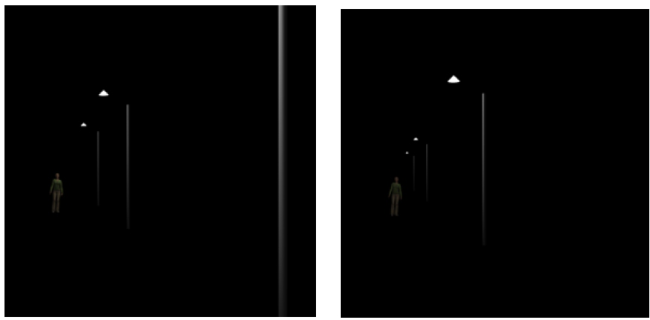
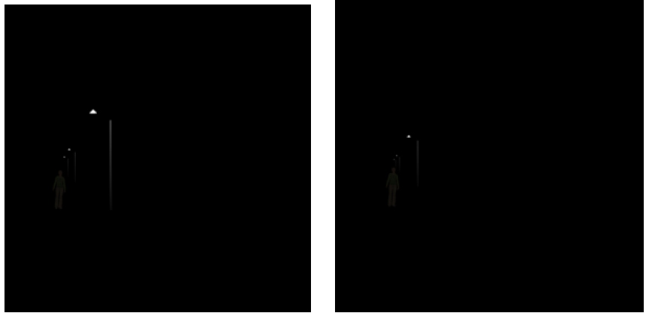
Conditions A schematic of the virtual street layout is demonstrated in Figure 1. Street- light intervals were set to 12.5 m, 25 m, 50 m, and 100 m, as illus- trated in Figures 2 and 3. Four distinct conditions were established by evenly distributing street lights at each interval. Participants observed these streets in a standing position. The height of the street-light pillars and light sources was fixed at 5 m. The light source parameters for the street lights were standardized using the Vizard6 program with the follow- ing settings: intensity, 5; linear attenuation, 0.5; constant attenuation, 1; quadratic attenuation, 0.5; and light color: 1,1,1 (white).
A consistent female avatar was used as the approaching pedestrian under all conditions. The avatar’s initial position was set at 20 m from the partici- pant’s front, approaching a travel speed of 0.8 m/s. This movement speed was intentionally set slower than the average adult walking speed (1.0–1.5 m/s) to facilitate the exploration of the distance at which participants began to feel discomfort when approaching pedestrians.
Effect of Street Light Intervals on Distance to Unknown Approaching Pedestrian 9
Figure 1: Virtual space layout.Figure 2: Virtual space in each condition (left: 12.5 m, right: 25 m).Figure 3: Virtual space in each condition (left: 50 m, right: 100 m).
10 Yoshida and Yoshioka
Measurement Participants received an overview of the experiment prior to commencement. Subsequently, the participants were instructed to use a head-mounted dis- play and hold the controller in one hand. To ensure familiarity with the experimental procedure, participants engaged in a single practice run.
Upon initiation, the participants were presented with a virtual street environment, after which the avatar began walking toward them. If the par- ticipants experienced discomfort owing to the approaching avatar, they were instructed to press the trigger button on the controller, prompting the avatar to halt. Furthermore, the distance between the avatar and participant was recorded for each condition.
In this study, the stopping-distance method was employed as the primary measurement technique. Originating from Hayduk’s (1978) research, the stopping distance method is recognized as a reliable approach for gauging personal spaces. By using this method, we assessed how the participants’ dis- comfort levels varied across different street-light intervals by measuring their personal space.
Two measurements were conducted for each condition; moreover, the aver- age of the two recordings was calculated to determine the ratings for each condition. The conditions were randomized for each participant to miti- gate the potential bias stemming from the sequential presentation of the experimental conditions.
RESULTS
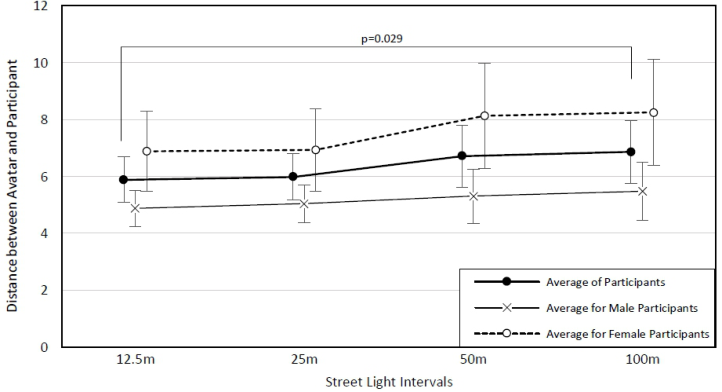
The average outcomes are depicted in Figure 4, revealing notable variations in the stopping positions of the participants relative to the street-light inter- val. To statistically validate these observations, a multiple comparison test was conducted using the Bonferroni method (5% significance level), treat- ing “street-light interval” as a factor. The results of this analysis revealed a significant disparity between the 12.5-m and 100-m conditions (p = 0.029). Additionally, significant trends were observed between the 12.5-m and 50-m conditions, and between the 25-m and 100-m conditions (p = 0.092 and p = 0.080, respectively).
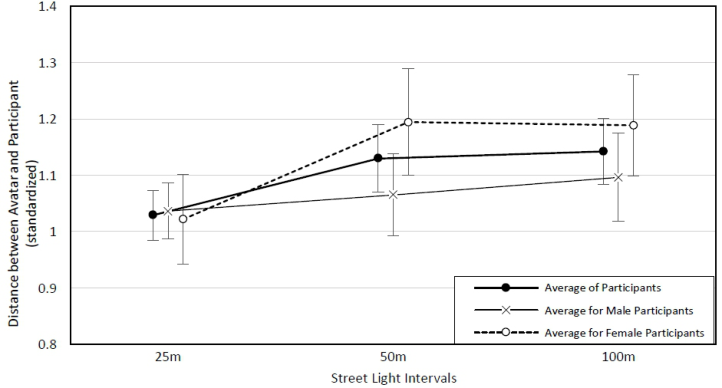
On individual examination, the participants exhibited significant varia- tions in their standard stopping positions. Although some participants halted their avatars approximately 4 m from the approaching pedestrian, others maintained distances exceeding 10 m. To standardize the data, each par- ticipant’s values recorded for the 25-m, 50-m, and 100-m conditions were normalized by dividing them by the corresponding values obtained for the 12.5-m condition (see Figure 5).
Effect of Street Light Intervals on Distance to Unknown Approaching Pedestrian 11
Figure 4: Street-light intervals and avatar stop.Figure 5: Street-light intervals and avatar stop (standardized).
DISCUSSION
Consideration of Street-Light Intervals The distance at which the participants stopped their avatars was significantly greater in the condition with a street-light interval of 100 m than that with a street-light interval of 12.5 m. This may be owing to the fact that the ambient brightness and the way the avatar was illuminated varied with the street-light interval. Similarly, the distance at which participants stopped their avatars, which established a significant trend for the 12.5-m and 50-m, and 25-m and 100-m combinations, could also be owing to changes in the brightness of the environment.
12 Yoshida and Yoshioka
These findings suggest that as nighttime streets become less illuminated, pedestrians experience increased discomfort from approaching individuals. Manipulating street-light intervals could, therefore, be an effective strategy for designing streets where pedestrians feel more at ease. This conclusion underscores the significance of street lighting in mitigating pedestrian discom- fort and highlights the potential of urban planning interventions to enhance pedestrian experience in nighttime environments.
Consideration of the Distance at Which the Participant Stopped the Avatar In our study, although statistical significance was not observed, the partici- pants’ sex may have influenced the distance at which the avatar was stopped. Male participants tended to stop their avatars at distances ranging from 4 to 6 m on average, whereas female participants stopped their avatars at distances averaging 6–9 m. Notably, even under identical street-light inter- vals, female participants maintained greater distances from the approaching avatar.
These findings are consistent with those of Paul et al. (1988), suggest- ing gender-related differences in personal spaces. Although our study did not delve deeply into the underlying mechanisms, it highlights the potential impact of sex on perceived comfort levels in nighttime environments.
Furthermore, sex may have influenced the changes in stopping distances observed. The standardized data transitions in Figure 5 show that as street- light intervals increased, so did the distance at which the avatars were stopped for both sexes. However, while the male average ranged from 1 to 1.1 in stan- dardized values, the female average ranged from 1 to 1.3, suggesting a greater change in females. Post-experiment interviews revealed that many female participants stopped using their avatars because of fear, whereas male partic- ipants reported discomfort. This difference in judgment may have influenced the results.
Consideration of the Causes of Increased Uncomfortable Feelings The ongoing discussion underscores a clear trend: the participants’ dis- comfort with the approaching avatar increased as the street-light inter- val widened. We attribute this trend to variations in how the avatar is illuminated, which are influenced by changes in the street-light interval. Post-experiment interviews revealed that several participants experienced a temporary loss of sight of the avatar when the street-light interval was set to 50 m or 100 m, eliciting a sense of fear upon rediscovery. This anecdotal evidence suggests that longer street-light intervals result in shorter durations of illumination for the avatar, thereby impeding the participants’ ability to accurately perceive their movements. Consequently, the difficulty in tracking the avatar’s movements likely contributed to the heightened discomfort experienced by the participants.
Effect of Street Light Intervals on Distance to Unknown Approaching Pedestrian 13
CONCLUSION
This study explored the impact of varying street-light intervals on pedestrian discomfort levels when approaching an individual. The findings of this study are summarized as follows:
Participants exhibited a significantly greater discomfort-inducing distance with street-light intervals of 100 m compared with 12.5 m.
A clear trend emerged, indicating that as street-light intervals increased, so did the distance at which pedestrians began to feel uncomfortable with approaching individuals.
These findings underscore the crucial role of street-lighting design in shap- ing pedestrian perceptions of safety and comfort in nighttime environments. Further research on the nuanced effects of street lighting on pedestrian expe- rience is warranted to develop evidence-based strategies for urban planning and design.
REFERENCES
Hayduk Leslie A.: Personal space: An evaluative and orienting overview., Psychological Bulletin, 85(1), pp. 117–134, 1978. Machiko Kinashi, Toshiaki Kin: A Study on Pedestrian’s Route-Choice Model
at Nighttime Considered Lighting Environment, Journal of the City Planning Institute of Japan, No. 45–3, 2010. Paul A. Bell, Linda Mannik Kline, Willia A. Barnard: Friendship and Freedom of Movement as Moderators of Sex Differences in Interpersonal Distancing, The Journal of Social Psychology, Vol. 128, No. 3, pp. 305–310, 1988.
LISTED IN THE AHFE DIGITAL BOOKSTORE CATALOGUE
Explore the complete digital volume
Ergonomics In Design
Read this individual research paper free through the original publisher, or explore the full digital proceedings book.
ISBN 978-1-964867-05-2
Explore this ISBN in the AHFE Bookstore ↗Listed in the July 2026 bookstore catalogue; search by ISBN to confirm current availability · Digital book purchase optional