Ryota Ino, Yohsuke Yoshioka (2022). Sense of Time while Perceiving Periodic Visual Stimuli by Peripheral Vision in Virtual Reality. In: Ergonomics In Design. AHFE Open Access, vol. 47, pp. 487–493. https://doi.org/10.54941/ahfe1001974
Humans have a sense of time; however, this sense is subjective. We have all experienced that periods of boredom feel longer, and periods spent in pleasant activities feel shorter. The relationship between humans’ sense of time and visual stimuli has been studied in many research fields, including psychology and informatics. In the field of informatics, there have been attempts to use the relationship between the sense of time and visual stimuli for practical purposes. Studies using visual stimuli on a computer monitor have had some degree of positive results. This research attempts to apply this pertinent knowledge obtained in informatics to architectural spaces and examine whether the presentation of periodic visual stimuli to peripheral vision can act as a spatial element that changes one’s sense of time. This research focuses on the frequency and presentation position of periodic visual stimuli. This research investigates the influence of periodic visual stimuli on the sense of time through two virtual reality experiments. Experiments were conducted in a room of dimensions 4 x 4 x 2.4, created in an immersive virtual environment. The participants were immersed in the virtual environment using a head-mounted display and they remained seated while the experiments were conducted. Light bulbs were set at equal distances of 30 cm on walls of the room in the virtual environment and repeatedly flashed to present periodic visual stimuli to the participants' peripheral vision. The participants evaluated the time in a virtual environment based on a set of conditions. The first experiment examined the frequency of periodic visual stimuli on the participants’ sense of time by setting four frequencies: 0(no stimuli), 30, 60, and 90 times per minute. The participants evaluated time twice at each frequency, and all eight trials were conducted in random order. The first experiment showed that the participants perceived time as significantly longer in the condition wherein the frequency was 90 times per minute as compared to that in conditions wherein the frequencies were 0, 30, 60 times per minute. Thus, the results suggest that a presentation of periodic visual stimuli with a high frequency has the effect of making time feel longer. The second experiment examined the relationship between the presentation position of periodic visual stimuli and the sense of time. The frequency of periodic visual stimuli was set at 90 times per minute, and there were four presentation positions: sidewall, floor-ceiling, sidewall-floor-ceiling, and no stimuli. The participants evaluated time twice at each presentation position, and the order of eight trials was designed in a manner that there was no duplication between the stimuli presented to the participants. The second experiment revealed that the participants perceived time as significantly longer in the condition including the position sidewall-floor-ceiling as compared to that in conditions including the positions sidewall and floor-ceiling. The results suggest that regardless of the presentation position, visual stimuli presented in extensive view make time feel longer. These findings have the potential to create methods to change one’s sense of time in architectural spaces intentionally.
Humans have a sense of time, but the scale of this sense is not always con- stant. For instance, we experience that when we are bored, time feels longer; however, time feels shorter when we are engaged in what makes us feel good. Thus, depending on the situation, the perception of time can vary (Yagawa et al., 1999).
The perception of time has been researched in various fields, including psychology, informatics, and architecture (Fujimoto, 2016). Several studies have shown that there are various factors that influence time perception such as age (Löckenhoff et al., 2015) or emotion (Yamada et al., 2011), and that visual stimuli is one of the key factors.
In psychology, studies have shown that time perception is influenced by the speed of the visual stimuli projected on a screen (Tayama, 2007). These experiments showed that the perception of time was longer with an increase in the speed of the visual stimuli at the center of the screen.
In informatics, some studies have attempted to improve the efficiency of simple tasks performed on a screen by using the relationship between time
perception and visual stimuli. The experiment by Matsui et al. (2017) showed that the sense of time is influenced by the rate of expansion of visual stimuli.
In our previous study (Ino et al., 2021), we examined the effect of periodic visual stimuli on the perception of time. The results of the study showed that the time perception of the participants was longer when the periodicity of the visual stimuli was high, and that it was the longest at a frequency of 60 flashes per minute.
Several studies have shown that visual stimuli can influence perception of time. However, these experiments have used visual stimuli presented in a limited area, such as a computer display, and have not referred to visual stimuli presented in a wide visual angle.
This study examined whether the presentation of periodic visual stimuli in the peripheral vision of the participants can affect time perception. Then, we attempted to apply the knowledge obtained from research in psychology and informatics about time perception to indoor spaces. This study focused on the frequency of the periodic visual stimuli presented. We investigated the influence of periodic visual stimuli on time perception through a virtual reality experiment.
METHODS
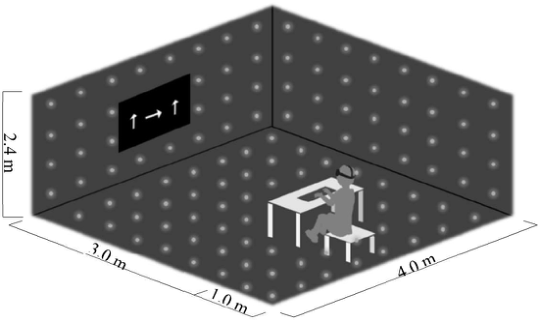
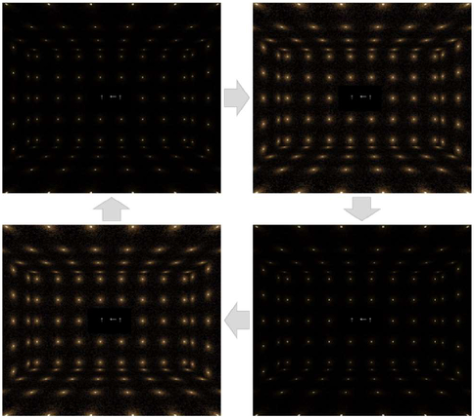
Experimental Environment Experiments were conducted in a virtual reality room of dimensions 4 × 4 × 2.4 m, which was created using a building software (Vizard 6.0: WorldViz, Inc.). The participants were provided an immersive experience in the virtual room by using a head-mounted display (Vive Pro Eye, HTC Cor- poration). The participants sat at a distance of 1.0 m from the center of the room. A screen of 1.0 × 0.6 m for the task was set up on the wall in front of the participants and three arrows were displayed on the screen. Light bulbs were set at equal distances of 50 cm on the walls and flashed periodically under experimental conditions.
Methods
In each condition, participants reproduced 60 seconds (Shinohara, 1996). At the beginning of the reproduction, the participants pressed the space key on the keyboard. Then, when the participants perceived 60 seconds had elapsed, they pressed the space key once more. The time difference between the key presses was defined as the “reproduced duration”(sensory 60 seconds) of the participant, and was used as a measure of the time perception of an indivi- dual. If the reproduced duration was shorter than 60 s, the perceived time of the participant was longer. On the other hand, if the reproduced duration was longer than 60 s, the perceived time of the participant was shorter.
Immediately before each measurement, we conducted the memory phase of the experiment. The participants were presented with periodic visual sti- muli with a frequency of 60 flashes per minute for 60 s. The participants were informed beforehand that the memory phase last 60 s, so they were able to memorize 60 s experientially. The participants were not allowed to
Sense of Time While Perceiving Periodic Visual Stimuli by Peripheral Vision 489
Table 1. Settings of items.
Table available in the original PDF paper.
Item Setting Diameter of bulbs 5 cm Color temperature of bulbs 3000 K Distance between bulbs 50 cm Size of arrows 10 cm Distance between arrows 20 cm
Figure 1: Experimental environment.Figure 2: Virtual environment from the participant’s view.
keep a count of the time during the memory and reproduction phases of the experiment.
The participants were given the task of typing the arrows displayed on the screen using the arrow keys on the keyboard during the memory and
490 Ino and Yoshioka
Table 2. Condition.
Table available in the original PDF paper.
Factor Level Frequency 0 = no stimuli 30 flashes per minute 60 flashes per minute 90 flashes per minute Trials 1st
2nd Flushing bulbs All
reproduction phases of the experiment. Of the three arrows displayed on the screen, the central arrow was the one the participants typed, and the two arrows on either side were the next arrows to be typed. If the participant typed the central arrow correctly, the arrows were switched. If the participant typed incorrectly, the arrow remained until the participant typed correctly. During the task, the participants gazed at the arrows to type, so they could only perceive periodic visual stimuli in their peripheral vision. In addition, the number of types and mistypes during the task were measured and used as an indicator of participants’ concentration on the experiment.
Conditions Ten university students in their twenties (5 males and 5 females) participa- ted in the study. The frequency of periodic visual stimuli was set to four levels: 0 (i.e., no stimuli), 30, 60, and 90 flashes per minute. The participants reproduced the experiments twice at each frequency, and all eight trials were conducted in a random order.
RESULTS AND DISCUSSION
The reproduced duration, average number of types, and average number of mistypes were recorded for each frequency. First, we performed an analysis to verify whether there was any significant difference in the average num- ber of types and mistypes between the conditions. Next, we compared the reproduced duration for all the conditions.
Average Number of Types
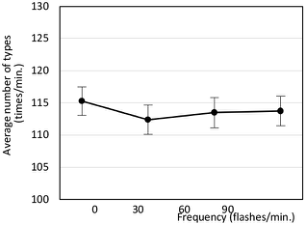
Figure 3 shows the average number of types and the distribution of standard errors for each condition. Using frequency as a factor for Bonferroni’s mul- tiple comparison test (5% level), we observed that there was no significant difference between any of the conditions.
The average number of types observed in the experiment suggested that the processing speed of the typing task did not change when the frequency of the periodic visual stimuli changes. However, we excluded the possibility that an increase or decrease in work speed could have caused a shift in the time perception of the participants.
Sense of Time While Perceiving Periodic Visual Stimuli by Peripheral Vision 491
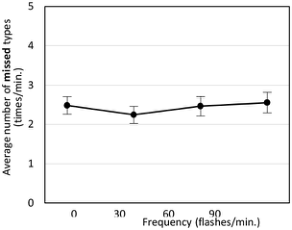
Figure 3: Number of types.Figure 4: Number of mistypes.Figure 5: Reproduced duration.
Average Number of Mistypes The average number of mistypes and the distribution of standard errors for each condition is shown in Figure 4. Using frequency as a factor for Bonfer- roni’s multiple comparison test (5% level), we observed that there was no significant difference between any of the conditions.
The average number of mistypes for the participants was approximately 2.0 to 3.0 times per minute for all the conditions. The average number of mistypes observed in the experiment suggested that periodic visual stimuli in the peripheral vision were not likely to interfere with tasks that relied on information processing in the central vision of the participants.
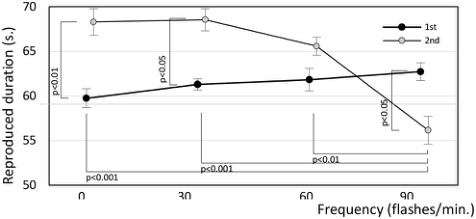
Reproduction Time The trends and standard errors of the reproduced durations for each condi- tion are shown in Figure 5. Using frequency of periodic visual stimuli and the
492 Ino and Yoshioka
number of trials as factors, Bonferroni’s multiple comparison test (5% level) was conducted on the reproduced durations for each condition. In the second trial, significant differences were detected between a frequency of 90 flashes per minute and frequencies of 0, 30, and 60 flashes per minute, respectively.
The reproduced durations at a frequency of 90 flashes per minute were significantly shorter than those at frequencies of 0, 30, and 60 flashes per minute. Since reproduced duration was interpreted as a measure of time perception, we concluded that the time perception of the participants was longer at a frequency of 90 flashes per minute.
These results suggested that the difference in frequency between the refe- rence stimuli and measurements affected the reproduced durations of the participants. In the memory phase of the experiment, the participants were presented with reference stimuli at a frequency of 60 flashes per minute. The reason why there was no difference in the reproduced durations of the par- ticipants between the frequencies of 0, 30, and 60 flashes per minute may be because the number of stimuli was not increased relative to the reference stimuli.
On the other hand, the reproduced duration was shorter, i.e., time perce- ption was longer, when the periodic visual stimuli were at a higher frequency than the reference frequency. On an average, the reproduced duration at 90 flashes per minute was approximately 15–20% shorter than that at other frequency conditions.
One reason for that the reproduced duration at 90 flashes per minute was shorter was that the participants may have reproduced durations by keeping a count of the number of visual stimuli. However, for the condition of 90 flashes per minute, if the participants kept to count the visual stimuli 60 times, the reproduced duration should have been 40 seconds. In addition, the participants were given a typing task and instructed beforehand not to keep a count of the time or the number of visual stimuli. This suggests that there was an effect of the frequency and number of periodic visual stimuli on time perception.
Some participants reported feeling hurried when the frequency of perio- dic visual stimuli was increased. It is possible that the stimuli acted as time pressure (Ban et al., 2016). Periodic visual stimuli are often used to indicate that time is running out, and this bias may have created the time pressure. The increase in the frequency of periodic visual stimuli may have created a psychological load in the form of time pressure, making the time perception longer.
CONCLUSION
In this study, we conducted an experiment to prove that the presentation of periodic visual stimuli in the peripheral visual field affects time perception. We conclude that for periodic visual stimuli with a frequency of 90 flashes per minute, the time perception was longer than when no periodic visual stimuli, or stimuli with a frequency of 30 or 60 flashes per minute was presented. Our results suggest that the presentation of periodic visual stimuli in the peripheral visual field can manipulate time perception without interfering with a task.
Sense of Time While Perceiving Periodic Visual Stimuli by Peripheral Vision 493
REFERENCES
Ban, Y. et al. (2016) “Improving Processing Speed of Simple Tasks by Controlling Time Rate The Virtual Clock Displays,” Transactions of the Virtual Reality Society of Japan. The Virtual Reality Society of Japan, 21(1), pp. 109–120. Fujimoto, M. (2016) “A Fundamental Study on the Interaction of People with Their
Surrounding Space and Sense of Time in a Rest,” Journal of Home Economics of Japan. The Japan Society of Home Economics, 67(7), pp. 382–396. Ino, R., Yoshioka, Y. (2021) “Sense of Time While Perceiving Periodic Visual Stimuli by Peripheral Vision,” Lecture Notes in Networks and Systems. Springer Science and Business Media Deutschland GmbH, 261, pp. 723–728. Irikura, T., Toyofuku, Y., Aoki, Y. (1996) “Borderline between Comfort and Discom-
fort of Flashing Light in the Periphery,” Journal of the Illuminating Engineering Institute of Japan Journal of the Illuminating Engineering Institute of Japan. Illuminating Engineering Society of Japan, 80(2), pp. 76–80. Matsui, K., Nakamura, S. (2017) “Influence on Time Evaluation by Presenting Visual Stimulus in Peripheral Vision,” Transactions of Information Processing Society of Japan, 59(3), pp. 970–978. Shinohara, K. (1996) “Cognitive Processes in Time Estimation: The Role of Wor-
king Memory,” Bulletin of Graduate School of Human Sciences Osaka University. School of Human Sciences Osaka University, (22), pp. 71–94. Tayama, T. (2007) “Time perception during perceiving motion pattern (Mind, Behavior, and Time, Symposium 1 at the 25th Annual Meeting),” The Japanese journal of Psychonomic science. The Japanese Psychological Association, 25(2), pp. 212–220. Yagawa, M., Tamura, A. (1999) “Human’s Sense of Time: As an Index of the Sym-
pathy between Man and Environment,” AIJ Journal of Technology and Design. Architectural Institute of Japan, 5(8), pp. 155–158.
LISTED IN THE AHFE DIGITAL BOOKSTORE CATALOGUE
Explore the complete digital volume
Ergonomics In Design
Read this individual research paper free through the original publisher, or explore the full digital proceedings book.
ISBN 978-1-958651-23-0
Explore this ISBN in the AHFE Bookstore ↗Listed in the July 2026 bookstore catalogue; search by ISBN to confirm current availability · Digital book purchase optional