Ayano Naoi, Yohsuke Yoshioka (2023). Effect of Colorfulness of Texture arranged on Sidewall of Pathway on Walking Speed. In: Ergonomics In Design. AHFE Open Access, vol. 77, pp. 651–657. https://doi.org/10.54941/ahfe1003425
Controlling human walking speed is an important topic in architectural planning. Understanding the factors that cause changes in walking speed can contribute to the crowd manipulation and the improvement of street attractiveness. Visual information is one of the most important factors for changing the walking speed, and a lot of study has been conducted on it. However, few studies have examined the relationship between walking speed and visual stimuli by color.Therefore, this study conducted an experiment using virtual environment technology to evaluate the effect of the colorfulness of the texture on the sidewall of the pathway on walking speed. The main purpose of this study is to obtain useful knowledge for the design of attractive street through quantitative analysis of the experimental results.Ten university students as the participants were asked to wear a wide view head-mounted display (Star VR one/ Star VR Co. /Horizontal angle of Field of View: 210°) in the experiment. Since the size of the real experimental room was large enough (9,680 mm x 15,600 mm) and the HMD’s position has been fully captured with in the area, the participants could walk around in a virtual environment with their own feet. The participants were asked to walk 6 m along through each of pathways in eight different conditions presented within this virtual environment, and their walking speed was measured. In common setting with each condition, the width of pathway was set at 6m wide and height of sidewalls were also set at 6m on both sides. The entire length of pathway were set at 200 m, so that the end of the pathway was not visible for the participants in walking.The texture of the sidewalls of the pathway consisted of small square tiles joined together. Two levels of the size of the tiles (500mm square or 1000mm square) and two levels of the colorfulness of the tiles (Colored or Non-Colored) were combined to form the different experimental conditions. For each of these four conditions, adding a case in which the participant was asked to gaze at any location and a case in which he was instructed to gaze the point floated 30 m ahead in the travel direction to continue, we made a total of eight conditions. The participants examined these eight conditions in random order.The results of the experiment showed that the average walking speed were significantly higher in the Colored condition than in the Non-colored condition, especially in the case of participants gazing point was not fixed on travel direction. And these significant differences were also found regardless of the tile size level. This result indicates that walking speed was accelerated when walking in the richly "colorfulness" environment than when walking in the less "colorfulness" environment.In addition, in the case of the participant's gaze position was fixed, this significant difference in colorfulness could not be confirmed. This may be due to the ability of peripheral visual field. The peripheral visual field has lower ability to discriminate colors than the central visual field. While the gaze position was fixed to travel direction, the sidewalls were perceived mainly in this peripheral visual field. Therefore, it is considered that the effect of the colorfulness was difficult to appear.
Walking speed is currently being studied in a wide range of fields, including architecture, management engineering, rehabilitation medicine, and biome- chanics. In terms of internal factors of pedestrians, it has been found that walking speed slows down with increasing age, and muscle weakness due to aging is said to be the main cause (Busch 2015) (Bendall MJ 1989). In terms of external factors, background music(Guang Zeng 2018), “width of walking space,” “side height,” “cross-sectional shape,” and “road installations” were found to affect walking speed (Matsuki 2009). In terms of walking space width, it was suggested that people walk faster in narrower spaces, and in terms of emotional evaluation of the environment, walking speed was shown to be slower in places that indicated positive emotions (Franˇek, M 2013). Thus, both internal and external factors are related to pedestrians’ walking speed, which is also related to their impression of space. In this experiment,
we will focus on vision among the external factors that can be manipulated independently of the subject, and conduct a walking speed experiment.
METHOD
Experimental Environment The participants of the experiment, ten university students, were asked to wear a wide-field head-mounted display (Star VR one/Star VR Corporation/210
horizontal viewing angle). The actual experimental room was large enough (9.68 m x 15.6 m) to allow the participants to walk around within the virtual environment on their own feet, as the HMD was perfectly positioned within its range.
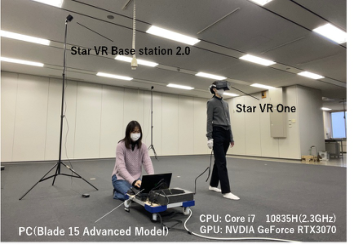
Figure 1 shows how the experiment was conducted. The participants were asked to walk 6 meters each along a corridor in eight conditions presented within this virtual environment, and their walking speed was measured. The common settings for each condition were as follows: the width of the passa- geway was 6 m, and the height of the side walls was 6 m on both the left and right sides. The total length of the corridor was set to 200 m so that the end of the corridor would not be visible while the participants were walking.
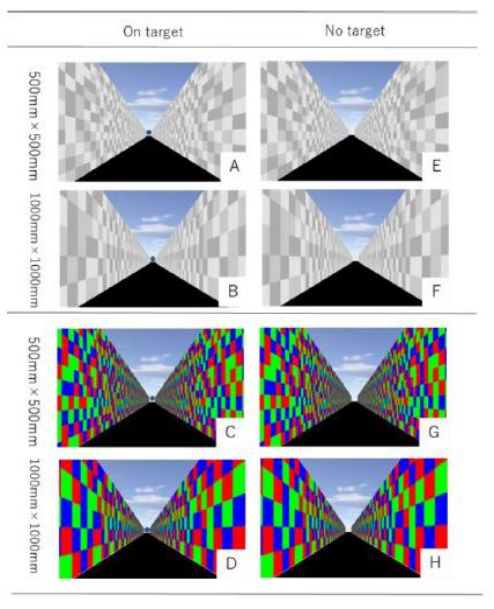
The texture of the side walls of the aisle was made of small square tiles joined together. Two tile sizes (500 mm square and 1000 mm square) and two tile color depths (colored and non-colored) were combined to form different experimental conditions. To each of these four conditions, we created a total of eight conditions, including one in which participants were asked to gaze at an arbitrary location and one in which they were instructed to continue gazing at a point floating 30 m away in the direction of travel. Participants examined these eight conditions in a random order.
Methods
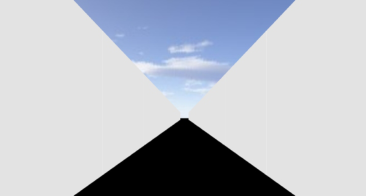
At the beginning and end of the eight conditions, the individual subjects’ wal- king speeds were measured in a reference space shown in Fig. 2 with white walls and no tiles. Each subject then walked through each of the eight conditi- ons shown in Fig. 3 once and their walking speed and gaze point coordinates were recorded for each condition. The coordinates of the subject’s gaze points
Figure 1: Experimental environment.
Effect of Colorfulness of Texture Arranged on Sidewall of Pathway on Walking Speed 653
during the experiment were recorded by the eye movement tracker built into the head-mounted display. By analyzing these eye movements, it is believed that the subjects’ gaze points during walking may affect their walking speed.
Calculation of Walking Speed The walking speed was calculated using the subject’s head coordinates obtained from the head-mounted display every 0.1 second. The depth displa- cement of the head coordinates was converted to velocity and the walking speed obtained under the reference conditions is referred to as the reference walking speed. In order to account for differences in walking speed among
654 Naoi and Yoshioka
subjects, the difference between this value and the walking speed obtained under each condition is used in the analysis and compared using the following equation. This value is defined as the amount of change.
variation = walking speed for each condition −standard walking speed When the entire measurement period is compared, the data encompasses the acceleration portion of the start of walking. In this study, 4.5 m was used for analysis, excluding 1.5 m from the start, in order to compare speeds in constant walking motion
RESULTS AND DISCUSSION
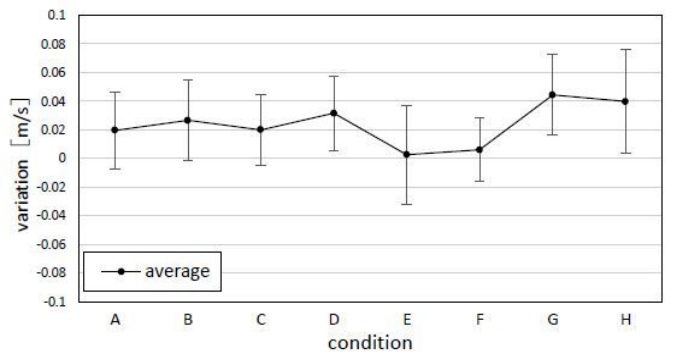
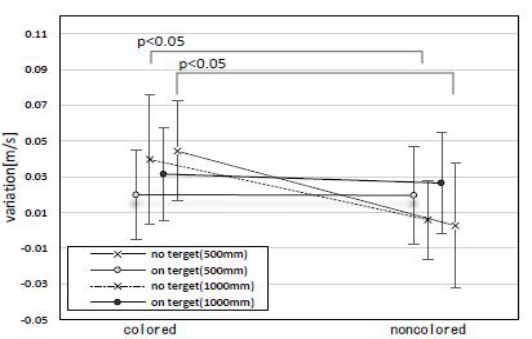
Walking Speed An analysis of variance of the walking speed data obtained in the experiment revealed no main effects or interactions among the experimental conditions, as shown in Figure 4. Next, an analysis of variance was conducted for the factors of wall tile size, saturation, and gazing point coordinates. The results showed a simple main effect (at the 5% level) of “color” in the “no target” condition. When two of the three factors were combined to perform a mul- tiple comparison test using the Bonferroni method (5% level), a change of 0.042 and 0.0043 was found for the ‘no goal’ and ‘color’ in Figure 5, and a large difference in the amount of change was found in the analysis using gazing point coordinates and saturation as factors. This means that signifi- cant differences in walking speed were detected in conditions E and F and conditions G and H.
Gazing Point Condition C and Condition G show a large difference in walking speed with and without targets. These two will be compared to analyze the difference in eye movement affected by the presence or absence of a target. The ball was placed at X = 0 and the wall at X = ±3.0. Analysis of the X coordinate
Figure 4: Variation of all condition.
Effect of Colorfulness of Texture Arranged on Sidewall of Pathway on Walking Speed 655
Figure 5: Variation of change in saturation.
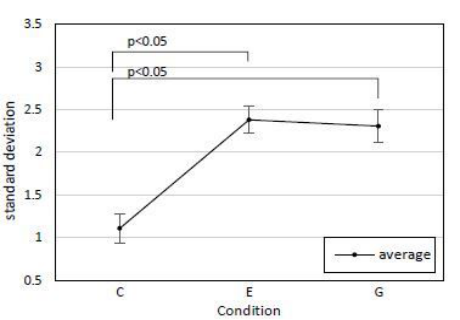
showed no significant difference between the means of conditions G and C. However, in Figure 6 and Table 1, a multiple comparison test of standard deviations with the target as a factor (level 1%) detected a significant diffe- rence. In the presence of a target, subjects’ gaze was mostly directed toward the target, while in the absence of a target, subjects were found to be looking around. In the former case, the wall surface was perceived mainly in the peri- pheral vision, while in the latter case, the wall surface was perceived more
Figure 6: SD of condition C, E and G.Table 1. Average and SD of X coordinate.
Table available in the original PDF paper.
X coordinate of gaze point condition average SD
C 0.314 1.107 E −0.245 2.379 G 0.381 2.304
656 Naoi and Yoshioka
often in the central vision. In other words, when the wall surface pattern was perceived in the peripheral vision, it was difficult to distinguish the different colors of the wall surface, suggesting that there was no effect on walking speed.
In conditions E and G, differences in walking speed were observed due to differences in color. Comparing these two conditions, we will analyze the influence of the presence or absence of a target on eye movement. In these cases, no difference was found in the analysis of X-coordinates. Therefore, an analysis of the Y-axis coordinates of the vertical vibration was conducted. For comparison, a 6m high wall was divided into lower (0 m ∼1.5 m) and upper (1.5 m ∼6 m) sections based on the subject’s eye level. The gazing rate during walking for each area was calculated. Table 2 Y coordinate shows that the subjects gazed at the lower part 27.40% and 75.90% for condition E and 24.10% and 75.90% for condition G, indicating that the subjects gazed at the upper part more frequently in both conditions. The mean values were 1.87 for condition E and 2.07 for condition G. This suggests that a high percentage of subjects looked up at the walls of the experimental space, especially around 2 m from the wall, which may have some effect on walking speed.
Table 2. Y coordinate analysis.
Table available in the original PDF paper.
Y coordinate of gaze point condition average SD ratio of gaze
E 1.867 1.306 0m ∼1.5m 27.40 1.5m ∼6.0m 72.60 G 2.067 1.131 0m ∼1.5m 24.10 1.5m ∼1.5m 75.90
CONCLUSION
The analysis showed that the average walking speed was significantly higher in the coloring condition than in the noncoloring condition, especially when the gazing point was not fixed in the direction of travel. When the parti- cipant’s gaze position was fixed, this significant difference in “colorfulness” could not be confirmed. This may be due to the ability of the peripheral visual field. The peripheral visual field has a lower color discrimination ability than the central visual field. While the gaze position was fixed in the direction of travel, side walls were perceived primarily in this peripheral vision. Therefore, it is thought that the effect of color was less apparent. Analysis of gazing point coordinates revealed that the effect on walking speed may be related to the texture and color of the lower part of the wall surface.
REFERENCES
Bendall MJ, Bassey EJ, Pearson MB (1989) “Factors affecting walking speed of elderly people”, Age Ageing, 18(5): 327–32.
Effect of Colorfulness of Texture Arranged on Sidewall of Pathway on Walking Speed 657
Busch, T.d. A., Duarte, Y. A., Pires Nunes, D. et al. (2015) “Factors associated with lower gait speed among the elderly living in a developing country”, a cross-sectional population-based study. BMC Geriatr. Franˇek, M. (2013). “Environmental Factors Influencing Pedestrian Walking Speed”,
Perceptual and Motor Skills, 116(3), 992–1019. Guang Zeng, Andreas Schadschneider, Jun Zhang, Weiguo Song (2018) “Experimental study on the influence of background music on pedestrian movement in high densities”, the 9th International Conference on Pedestrian and Evacuation Dynamics (PED2018) Lund, Sweden. Matsuki, N, Kiyota, S, Ito, M (2009) “Relationship between the characteristics
of streetscape and walking speed” Architectural Institute of Japan, Journal of Architecture and Planning transactions of AIJ, Vol. 74 No. 640, 1371–1377. Tanizaki, M, Matsumoto, K, Narumi, T, Kuzuoka, H, Amemiya, T (2021) “Modulation of walking speed by the change in motion and shape of the virtual avatar moving alongside”, the Virtual Reality Society of Japan Conference, 26(3C1-5). Tanizaki, M, Matsumoto, K. et al (2020) “Relationship between speed manipulation
of visual stimuli and change in walking speed in real space walking”, the Virtual Reality Society of Japan Conference, 25(3C1-5).
LISTED IN THE AHFE DIGITAL BOOKSTORE CATALOGUE
Explore the complete digital volume
Ergonomics In Design
Read this individual research paper free through the original publisher, or explore the full digital proceedings book.
ISBN 978-1-958651-53-7
Explore this ISBN in the AHFE Bookstore ↗Listed in the July 2026 bookstore catalogue; search by ISBN to confirm current availability · Digital book purchase optional