Pia Wald, Niklas Henreich, Martin Albert, Johannes Ossig, Klaus Bengler (2022). Different feedback strategies: Evaluation of active vehicle motions in a multi-level system. In: Human Factors in Transportation. AHFE Open Access, vol. 60, pp. 367–375. https://doi.org/10.54941/ahfe1002468
Different levels of automation require distinct tasks of the driver. During partially automated driving, the driver has to supervise the system and the environment, whereas the driver can engage in non-driving related tasks during highly automated driving. With more aspects of the driving task being automated, the driver’s role becomes more passive. In the future, automated driving systems may combine several levels of automation. Thus, the driver’s tasks and responsibilities vary in a multi-level automated driving vehicle. To support drivers in their tasks, the automated vehicle should provide comprehensible and perceptible feedback. In addition, automated driving systems should provide information about the system’s state, its intentions and transitions transparently to assist the drivers´ mode awareness. Prior research has mainly focused on information that is presented visually. However, previous studies found that vestibular feedback also has a positive effect on mode awareness. Thus, based on multiple resource theory, we examined the effect of different feedback strategies including vestibular feedback on mode awareness and system comprehension in the context of automated driving.A real driving study was conducted on a German highway, covering approximately 130 km per participant. Therefore, a prototype was used, which performed lateral and longitudinal vehicle guidance. In a between-design, a total of N = 36 participants were randomly assigned to one of two feedback strategies. Both strategies consisted of visual-auditory feedback, with one concept including additional active vehicle motions in partially automated driving. The vestibular feedback consisted of pitch and roll motions. Pitch motions indicated a detected preceding vehicle, whereas roll motions announced lane changes. Participants experienced manual, partially and highly automated driving as well as transitions between these levels. In two thirds of the cases the automated vehicle decelerated slowly at the end of the test drive, simulating a system failure. Finally, trust, acceptance and mode awareness were collected through several questionnaires.Statistical analysis revealed that the strategy with vestibular feedback in partially automated driving generated significantly more trust and was perceived more reliable. Although no significant differences between the strategies were found for acceptability, both were assessed as highly acceptable and acceptance ratings increased over time. Concerning mode awareness, no group differences were found for function awareness and monitoring behavior. However, a significant effect indicated that additional active vehicle motions were perceived as more supportive in complex situations. Further results exhibited that regardless of the strategy, highly automated driving led to significantly more function awareness than partially automated driving.In summary, these results show that the feedback strategy with different designs for partially and highly automated driving can increase the reliability of the automated vehicle. Consistent with the literature, results also indicate that a feedback strategy with additional active vehicle motions in partially automated driving increases trust in automation. Thus, this study suggests that different designs for partially and highly automated driving, including additional vestibular feedback, opens upa new possibility to support drivers in their tasks.
In recent years, there has been an increasing interest in developing adva- nced driver assistance systems (ADAS). The Society of Automated Engineers’ taxonomy for driving automation (SAE international, 2021) defined dif- ferent levels of automation (LoA) differing in terms of assignment of the vehicle guidance and driver’s responsibilities. During partially automated dri- ving (Level 2), the automated vehicle can perform lateral and longitudinal guidance, but the driver has to supervise the vehicle and environment per- manently. In higher LoA, the driver is allowed to deflect from supervision and perform a non-driving related task (NDRT). Future vehicles may com- bine several LoA to a multi-level system with different responsibilities of the driver. The co-existence of multiple assisted and automated modes might lead to a lack of awareness of the currently active mode (Feldhütter et al.,
2018; Lassmann et al., 2020; Sarter and Woods, 1995). A potential risk may be that the driver behaves inappropriately (deflecting from the supervising task although Level 2 is active) or does not respond to take-over requests (Gold et al., 2013). Incomplete communication about functionalities, limita- tions of the system and capabilities can reinforce the lack of mode awareness (Sarter and Woods, 1995; Wickens et al., 2013). As a result, feedback pro- vided by the automated vehicle should be comprehensible and support the driver in perceiving the automated system state, intentions, and abilities (Beggiato et al., 2015; Wickens et al., 2013).
Since the driving task or supervising the system is mainly visual and thus stresses the visual channel, feedback should be designed multimo- dally (Burke et al., 2016; Lee and Spence, 2008). Research in this domain (Bengler et al., 2020) focused particularly on visual (Albert et al., 2015; Beggiato et al., 2015), auditory (Beattie et al., 2015; Forster et al., 2017) or haptic (Petermeijer et al., 2017) feedback. Another modality for communi- cating system intentions is the vestibular one (Cramer, 2019; Lange et al., 2015). The existing body of research on vestibular feedback suggests that vehicle pitch motions should announce detecting a slower preceding vehicle (Cramer et al., 2017a; Cramer et al., 2017b) and roll motions should notify lane changes in the direction of its movement (Cramer and Klohr, 2019).
Although research has been carried out on feedback, Özkan et al. (2021) highlight the need for further investigations of different feedback modalities for communicating automation modes. Based on this, there is still uncer- tainty about the use of various modalities at different LoA. Furthermore, to date little attention has been paid to the role of vestibular feedback in a multimodal concept for multi-level automated vehicles. Thus, this study set out to examine the effect of two feedback strategies, of which one included active vehicle motions in a multi-level system on mode awareness. In addi- tion, the impact on trust in and acceptance of the automated vehicle was assessed.
METHOD
Sample The initial sample consisted of 38 participants, two of whom had to be excluded from data analysis due to bad weather conditions and traffic jam. Consequently, N = 36 drivers, comprising 14 females and 22 males, with a mean age of 27.92 years (SD = 8.24, min = 20, max = 55) were available for this study. The median mileage per year was 14,243 km (SD = 8,139) before and 10,343 km (SD = 5,083) during the COVID-19 situation with on average 45% highway driving. All participants had to have experience using adaptive cruise control. This restriction was made to exclude effects on the evaluation of higher automated systems due to first impressions with ADAS. Moreover, 86% of the participants had experience with lane keeping assi- stance and 69% with partially automated driving systems (e.g., traffic jam assistance) before.
Different Feedback Strategies: Evaluation of Active Vehicle Motions 369
Feedback Strategies Both feedback strategies included the same visual information in the instru- ment cluster and auditory signals. However, one feedback strategy comprised additional active vehicle motions during the partially automated driving parts. This vestibular feedback consisted of pitch and roll motions. Pitch motions indicated a detected slower preceding vehicle, whereas roll moti- ons announced lane changes. Visual information consisted of system’s status, future and current maneuvers, current velocity, and a preceding vehicle, according to literature recommendations (Beggiato et al., 2015). The detailed design of visual elements, auditory signals and the active vehicle motions is described in Wald et al. (2021). For this study, adjustments of the feedback were implemented: In highly automated driving the color of the visual infor- mation was changed from blue to green. Furthermore, a visual hint and a sound for the transitions from one LoA to another were added.
Study Design and Procedure The study took place on the three-lane German highway A9 between the exits Greding and Manching, covering approximately 130 km per partici- pant. An Audi A5 (year of construction: 2012) was used, which performed lateral and longitudinal vehicle guidance. The driver sat in the driver’s seat. Moreover, two experimenters accompanied the participants. The experimen- ter in the passenger seat acted as a safety driver and used a gaming controller to trigger lane changes, transitions, HMI elements as well as pitch and roll motions (Cramer et al., 2018; Wald et al., 2021). The second experimenter, seating in the back row, was responsible for questionnaires and introduced the participants. Due to the increasing severity of the COVID-19 pande- mic, eight participants were only accompanied by the safety driver during data collection period. Further hygiene provisions are similar to Wald et al. (2021).
The procedure is presented in Fig. 1. Participants were randomly assigned to one of two feedback strategies (VA: visual-auditory, VAV: visual-auditory- vestibular). After receiving the verbal instruction on the research topic and their responsibilities during different LoA, participants filled out questionnai- res on acceptance of the automated vehicle as baseline measure. Subsequently, a vehicle instruction and the settling-in drive followed. Thereupon, the test drive consisting of two consecutive rides with transitions (cf. Fig. 1) between partially automated driving (L2) and highly automated driving (L4) ensued. Participants had to monitor the environment and the system permanently in L2 and could play a game on a tablet in L4. After each transition, partici- pants rated their awareness of the automated vehicle functions verbally. At the end of the test drive, questionnaires on acceptance, trust and mode awa- reness were filled out. Subsequently, the return run including a system failure took place. The system failure consisted of a slow deceleration on the right lane when it was free. Due to various traffic conditions, only 25 participants experienced the failure and again filled out the questionnaires on acceptance and trust.
Figure 1: Experimental procedure including transitions and the system failure.
Dependent Variables and Data Evaluation To measure mode awareness, the questionnaire by Othersen (2016) was applied after the test drive. It consists of seven statements such as ‘Even in complex situations, I was aware of what the system was doing and was able to follow the system’s actions well’. The statements were rated on a fifteen-point scale consisting of five categories from “very little” to “very strong”. More- over, participants were asked to validate their task awareness for the three LoA (L0, L2 and L4) with the statement “I was always aware which tasks I had and which ones the system had” (Othersen, 2016). Trust was asses- sed after the test drive and the system failure with the German translation of the questionnaire of Körber (2019) using the subscales Reliability/Com- petence, Understanding/Predictability, and Trust in Automation. Participants rated the subscales on a five-point Likert scale ranging from 1 (“strongly disa- gree”) to 5 (“strongly agree”). Acceptance was evaluated with the German version of the acceptance scale by van der Laan et al. (1997) consisting of the subscales usefulness and satisfying. Participants rated nine pairs of adjectives on a five-point rating scale. Both scales were assessed after the instruction, after the test drive and after the system failure.
Data was analyzed and visualized with R. To investigate the effect of the feedback strategy after the test drive, a t-test for independent samples was used. If the normal distribution was violated (indicated by Shapiro- Wilk test), the nonparametric Mann-Whitney U test was used. Concerning the system failure, a mixed analysis of variance (ANOVA) with time of measurement as the within-subject factor and feedback strategy as the between-subject factor was conducted. Analysis was performed and inter- preted despite normal distribution violation, as ANOVA is robust against a violation (Blanca et al., 2017). Greenhouse–Geisser corrected degrees of fre- edom are reported when Mauchly’s test for sphericity showed significance. False discovery rate for posthoc comparisons was controlled with Benjamini- Hochberg corrected p-values (Benjamini and Hochberg, 1995). A significance level of α = 0.05 was applied.
RESULTS
Mode Awareness Statistical analysis of the statements after the test drive revealed no signifi- cant differences of the feedback strategies for system awareness (U = 173, p = .701, r = 0.09), monitoring behavior (U = 153.5, p = .785, r = 0.13), task awareness (U = 168, p = .837, r = 0.16), awareness to intervene
Different Feedback Strategies: Evaluation of Active Vehicle Motions 371
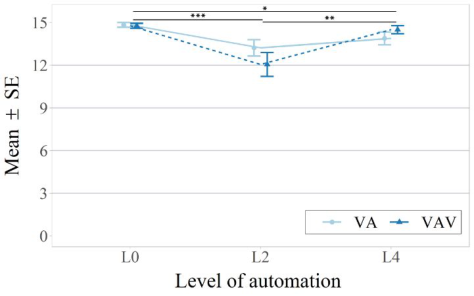
Figure 2: Ratings of the task awareness at different LoA depending on the feedback strategy with VA = visual-auditory, VAV =visual-auditory-vestibular.
(U = 127.5, p = .265, r = 0.1), surrender control (U = 139, p = .444, r = 0.02) and temporal monitoring (t(34) = −0.46, p = .648, r = 0.06). How- ever, the strategy with additional vestibular feedback in partially automated driving generated significantly more system comprehension (VA: M = 9.83, SD = 3.7, VAV: M = 12.67, SD = 2.11, U = 81, p = .009, r = 0.39).
Concerning the task awareness for each LoA, results are depicted in Fig. 2. Analysis of variance yielded a significant main effect for level of automation (F(1.4,47.71) = 12.68, p < .001, η2
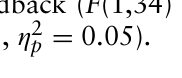
p = 0.27). Post-hoc Benjamini-Hochberg comparisons revealed that manual driving (M = 14.81, SD = 0.71) generated significantly more task awareness than partially automated driving (M = 12.64, SD = 3.08, p < .001) and highly automated driving (M = 14.19, SD = 1.6, p = .027). Furthermore, the post- hoc tests showed significant differences between highly automated driving and partially automated driving (p = .009). However, ANOVA did neither yield a significant main effect for feedback (F(1,34) < 1) nor an interaction effect (F(1.4, 47.71) = 2.05, p = .153, η2
Equation reproduced from the original PDF.
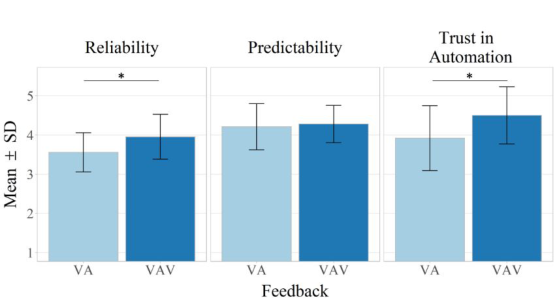
Trust Overall, both strategies were perceived as reliable, predictable, and generated high trust in automation. The results are presented in Fig. 3. The feedback strategy with vestibular feedback in partially automated driving was percei- ved as significantly more reliable (VA: M = 3.56, SE = 0.12, VAV: M = 3.95, SE = 0.14, t(34) = -2.23, p = .033, r = 0.31) and generated more trust in automation (VA: M = 3.92, SE = 0.19, VAV: M = 4.5, SE = 0.17, U = 86, p = .013, r = 0.37). Predictability indicated no significant difference betw- een both strategies (VA: M = 4.21, SE = 0.14, VAV: M = 4.28, SE = 0.11, t(34) = -0.39, p = .07, r = 0.13).
Concerning the system failure (N = 25), ANOVAs for each subscale indicated neither significant differences between the feedback strategies nor significant interaction effects for either subscale (p > .05). The perceived reliability of the system, independent of the feedback strategy, decreased
Figure 3: Results of the trust questionnaire for the feedback strategies with VA = visual- auditory and VAV = visual-auditory-vestibular.
significantly after the system failure (after test drive: M = 3.85, SE = 0.11, after system failure: M = 3.64, SE = 0.14, F(1,23) = 9.41, p = .005, η2
p = 0.3). However, the analysis yielded no significant main effect for time of measurement for predictability and trust in automation.
Acceptance The ANOVAs for usefulness and satisfying yielded neither a main effect nor an interaction effect (p > .05). Regarding the system failure (N = 25), analysis of variance for usefulness did not reveal an effect of feed- back (F(1,23) = 2.32, p = .141, η2
p = 0.09) nor an interaction effect (F(2,46) < 1). However, it yielded a significant effect for time of measure- ment (F(2,46) = 8.03, p < .001, η2
p = 0.26). Following post-hoc analysis using Benjamini-Hochberg correction revealed that the usefulness increased from baseline (M = 0.42, SE = 0.06) to after the test drive (M = 0.57, SE = 0.06, p = .028), and after the system failure (M = 0.66, SE = 0.07, p = .008). The ANOVA for satisfying also yielded a significant effect for time of measure- ment (F(2,46) = 4.03, p = .025, η2
p = 0.15) but post-hoc Benjamini-Hochberg tests represented no significant differences. Moreover, inferential statistics did neither yield a significant main effect for feedback (F(1,23) < 1) nor an interaction effect (F(2,46) < 1).
CONCLUSION
This study set out with the aim of assessing the effect of different feedback strategies on driver’s mode awareness in a multi-level system with partially and highly automated highway driving. Furthermore, the influence on trust in and acceptance of the automated vehicle was investigated. For that pur- pose, two different feedback strategies, one involving additional active vehicle motions in partially automated driving were evaluated.
Different Feedback Strategies: Evaluation of Active Vehicle Motions 373
Findings of the study indicated that the strategy with vestibular feedback resulted in better system comprehension than the visual-auditory strategy. However, neither significant differences between the strategies for the other subscales of mode awareness nor for task awareness for each LoA were found. Indeed, results revealed that partially automated driving generates less task awareness than manual and highly automated driving. These results reflect those of recent studies (Feldhütter et al., 2018; Petermann-Stock, 2015) indicating that either the driver or the vehicle should be fully responsi- ble for driving since shared vehicle guidance makes task comprehension more difficult.
As suggested by previous studies (Cramer, 2019; Wald et al., 2021), both strategies were rated as trustworthy, useful and satisfying. On closer consi- deration of trust, the visual-auditory-vestibular feedback strategy was rated as more reliable and generated more trust in automation. These results dif- fer from data obtained in Wald et al. (2021), but they are consistent with findings of Cramer (2019). Concerning the system failure, no group differe- nces for trust and acceptance were found. This result may be explained by the fact that only 25 participants experienced the failure. The smaller group size could have affected the result in a negative way. However, the reliability decreased and the usefulness of the automated vehicle increased over time, regardless of the feedback strategy. Thus, it can be assumed that increasing experience with an automated vehicle improves its assessment. These results need to be interpreted with caution due to the small group size.
The generalizability of these results is subject to certain limitations. Due to the real-world scenario, standardization is difficult since the surrounding traffic and the weather cannot be manipulated. However, to ensure similar conditions, the study took place at the same times of the day for all parti- cipants. Moreover, due to a self-selection bias, mainly persons interested in automated driving might have taken part in this study, which could have affected subjective ratings. Thus, future studies also could include partici- pants with less interest in automated driving. In addition, further research should be undertaken to investigate long-term effects of different feedback strategies with vestibular feedback.
Overall, the present study contributes to the existing knowledge of feed- back concepts in automated driving. The findings of this investigation com- plement those of earlier studies and suggest that a feedback strategy with different designs for partially and highly automated including vestibular feed- back seem to have the possibility to enhance task awareness and trust in automated vehicles.
ACKNOWLEDGMENT
This research was supported by Audi AG. We would like to thank Stephan Bültjes and Stephanie Cramer for their support with the test vehicle. Furthermore, a thank-you goes to Sophie Feinauer who supported us in the data analysis. The Ethics Board of the Technical University Munich provided ethical approval for the hygiene concept and this study, the corresponding ethical approval code is 650/21 S.
REFERENCES
Albert, M., Lange, A., Schmidt, A., Wimmer, M., & Bengler, K. (2015). Automated Driving – Assessment of Interaction Concepts Under Real Driving Conditions. Procedia Manufacturing 3:2832–9. Beattie, D., Baillie, L., & Halvey, M. (2015). A comparison of artificial driving sounds
for automated vehicles. Proceedings of the 2015 ACM International Joint Confe- rence on Pervasive and Ubiquitous Computing - UbiComp ‘15. New York, USA: ACM Press. p. 451–62; Osaka, Japan. Beggiato, M., Hartwich, F., Schleinitz, K., Krems, J., Othersen, I., & Petermann- Stock, I. (2015). What would drivers like to know during automated driving? Information needs at different levels of automation. In: 7. Tagung Fahrerassi- stenzsysteme. Bengler, K., Rettenmaier, M., Fritz, N., & Feierle, A. (2020). From HMI to HMIs:
Towards an HMI Framework for Automated Driving. Information 11(2):61. Benjamini, Y., & Hochberg, Y. (1995). Controlling the False Discovery Rate: A Practical and Powerful Approach to Multiple Testing. Journal of the Royal Statistical Society: Series B (Methodological) 57(1):289–300. Blanca, M.J., Alarcón, R., Arnau, J., Bono, R., & Bendayan, R. (2017). Non-normal
data: Is ANOVA still a valid option? Psicothema 29(4):552–7. Burke, J.L., Prewett, M.S., Gray, A.A., Yang, L., Stilson, F.R.B., Coovert, M.D., & . Redden, E. (2016). Comparing the effects of visual-auditory and visual- tactile feedback on user performance: A meta-analysis. Proceedings of the 8th
international conference on Multimodal interfaces:108–17. Cramer, S. (2019). Design of Active Vehicle Pitch and Roll Motions as Feedback for the Driver During Automated Driving [Dissertation]: Technische Universität München. Cramer, S., Kaup, I., & Siedersberger, K.-H. (2018). Comprehensibility and Perce-
ptibility of Vehicle Pitch Motions as Feedback for the Driver During Partially Automated Driving. IEEE Trans. Intell. Veh. 4(1):3–13. Cramer, S., & Klohr, J. (2019). Announcing Automated Lane Changes: Active Vehicle Roll Motions as Feedback for the Driver. International Journal of Human– Computer Interaction 35(11):980–95. Cramer, S., Miller, B., Siedersberger, K.-H., & Bengler, K. (2017a). Perceive the diffe-
rence: Vehicle pitch motions as feedback for the driver. Paper presented at: 2017 IEEE International Conference on Systems, Man and Cybernetics (SMC). 2017 IEEE International Conference on Systems, Man, and Cybernetics (SMC): IEEE. p. 1699–704; 05.10.2017 - 08.10.2017; Banff, AB. Cramer, S., Siedersberger, K.-H., & Bengler, K. (2017b). Active Vehicle Pitch Motions as Feedback-Channel for the Driver during Partially Automated Driving. 11. Workshop Fahrerassistenz und automatisiertes Fahren, Uni-DAS e. V.:74–83. Feldhütter, A., Härtwig, N., Kurpiers, C., Hernandez, J.M., & Bengler, K. (2018).
Effect on Mode Awareness When Changing from Conditionally to Partially Automated Driving. In: Proceedings of the 20th Congress of the International Ergonomics Association (IEA 2018). p. 314–24. Forster, Y., Naujoks, F., & Neukum, A. (2017). Increasing anthropomorphism and trust in automated driving functions by adding speech output. Paper presented at: 2017 IEEE Intelligent Vehicles Symposium (IV). 2017 IEEE Intelligent Vehicles Symposium (IV): IEEE. p. 365–72; 11.06.2017 - 14.06.2017; Los Angeles, CA, USA. Gold, C., Damböck, D., Bengler, K., & Lorenz, L. (2013). Partially Automated Dri-
ving as a Fallback Level of High Automation. 6. Tagung Fahrerassistenzsysteme; München.
Different Feedback Strategies: Evaluation of Active Vehicle Motions 375
Körber, M. (2019). Theoretical Considerations and Development of a Questionnaire to Measure Trust in Automation. In: Bagnara S, Tartaglia R, Albolino S, Alexander T, Fujita Y, editors. Proceedings of the 20th Congress of the International Ergono- mics Association (IEA 2018), Vol. 823. Cham: Springer International Publishing. p. 13–30. Lange, A., Albert, M., Siedersberger, K.-H., & Bengler, K. (2015). Ergonomic Design
of the Vehicle Motion in an Automated Driving Car. 6th International Confere- nce on Applied Human Factors and Ergonomics (AHFE 2015) and the Affiliated 3:2761–8. Lassmann, P., Othersen, I., Fischer, M.S., Reichelt, F., Jenke, M., Tüzün, G.-J., Bauerfeind, K., Mührmann, L., & Maier, T. (2020). Driver’s Experience and Mode Awareness in between and during Transitions of different Levels of Car Automa- tion. Proceedings of the Human Factors and Ergonomics Society Europe Chapter 2019 Annual Conference. Lee, J.H., & Spence, C. (2008). Assessing the Benefits of Multimodal Feedback
on Dual-Task Performance under Demanding Conditions. Proceedings of the 22nd British HCI Group Annual Conference on People and Computers: Culture, Creativity, Interaction-Volume 1. p. 185–92. Othersen, I. (2016). Vom Fahrer zum Denker und Teilzeitlenker. Wiesbaden: Springer Fachmedien Wiesbaden. Özkan, Y.D., Mirnig, A.G., Meschtscherjakov, A., Demir, C., & Tscheligi, M. (2021).
Mode Awareness Interfaces in Automated Vehicles, Robotics, and Aviation: A Literature Review. Paper presented at: AutomotiveUI ‘21: 13th International Con- ference on Automotive User Interfaces and Interactive Vehicular Applications. 13th International Conference on Automotive User Interfaces and Interactive Veh- icular Applications. New York, NY, USA: ACM. p. 147–58; 09 09 2021 14 09 2021; Leeds United Kingdom. Petermann-Stock, I. (2015). Nutzerzentrierte Gestaltung von Übergabe- und Übernahmesituationen innerhalb eines mehrstufigen Automationsansatzes [Doctoral thesis]: Technische Universität Braunschweig. Petermeijer, S.M., Cieler, S., & Winter, J.C.F. de (2017). Comparing spatially static
and dynamic vibrotactile take-over requests in the driver seat. Accident; analysis and prevention 99(Pt A):218–27. SAE international, 2021. Taxonomy and definitions for terms related to driving automation systems for on-road motor vehicles(J3016). Sarter, N.B., & Woods, D.D. (1995). How in the World Did We Ever Get into
That Mode? Mode Error and Awareness in Supervisory Control. Human Factors 37(1):5–19. van der Laan, J.D., Heino, A., & Waard, D. de (1997). A Simple Procedure for the Assessment of Acceptance of Advanced Transport Telematics. Transportation Research Part C: Emerging Technologies 5(1):1–10. Wald, P., Haentjes, J., Albert, M., Cramer, S., & Bengler, K. (2021). Active Vehicle
Motion as Feedback during Different Levels of Automation. Paper presented at: 2021 IEEE International Intelligent Transportation Systems Conference (ITSC). 2021 IEEE International Intelligent Transportation Systems Conference (ITSC): IEEE. p. 1713–20; 19.09.2021 - 22.09.2021; Indianapolis, IN, USA. Wickens, C.D., Hollands, J.G., & Parasuraman, R. (2013). Engineering Psychology and Human Performance. 4th ed. London, New York: Routledge Taylor & Francis Group.
LISTED IN THE AHFE DIGITAL BOOKSTORE CATALOGUE
Explore the complete digital volume
Human Factors in Transportation
Read this individual research paper free through the original publisher, or explore the full digital proceedings book.
ISBN 978-1-958651-36-0
Explore this ISBN in the AHFE Bookstore ↗Listed in the July 2026 bookstore catalogue; search by ISBN to confirm current availability · Digital book purchase optional