Pia Sophie Charlotte Dautzenberg, Gudrun Mechthild Irmgard Voß (2022). A theoretical framework for trust in automation considering its relationship to technology acceptance and its influencing factors. In: Human Factors in Transportation. AHFE Open Access, vol. 60, pp. 313–319. https://doi.org/10.54941/ahfe1002462
Automated cars are about to bring substantial changes in future mobility as the advantages regarding safety, comfort, and mobility independence are manifold. However, despite the many advantages, there are some factors which could affect the breakthrough of this technology. On the one hand, for automated driving to be viable, meeting technical and legal requirements is a fundamental and equally challenging prerequisite. On the other hand, user acceptance is a mandatory premise for technology adoption. But which factors are decisive for whether a technology is accepted or not? We propose that trust in automation (TiA) is a key influencing factor in terms of acceptance as the impact of trust on the acceptance of automated systems seems to be empirically proven. Nevertheless, acceptance models often either do not consider the concept of trust or seem to disagree as to whether trust has a direct and/or indirect influence on acceptance. Furthermore, influencing factors of trust are often neglected in such models. To provide a more holistic perspective on these issues, we conducted a structured literature review and analysis. Scientific papers which consider the relationship between TiA and acceptance as well as factors influencing trust in the context of automated driving were included. Based on the identified literature, we propose a theoretically derived framework on the relationship between TiA and technology acceptance as well as on influencing factors of TiA for the application context of automated driving. The framework is intended to serve as a complement to existing sound acceptance and trust models as well as a starting point for empirical verification of the theoretical assumptions in the course of further research.
Automated cars are about to bring substantial changes in mobility (Milakis, 2018). While functions and systems of lower automation levels have already become part of series production, the implementation of higher automation levels such as SAE Level 4 and 5 is still in its infancy (Milakis, 2018). The advantages of automated vehicles, e.g. improved safety (National Highway Traffic Safety Administration, 2018) and increased convenience (Endsley, 2019), are supposed to be manifold. However, there are some factors, which could affect the breakthrough of this technology. Especially user acceptance is a mandatory premise for technology adoption (Davis, 1989). If a technical system is not accepted by potential users, it will most likely not be used. But which factors are decisive for whether a technology is accepted or not?
Technology acceptance models usually equate acceptance with technology usage or the intention to use it. Looking at Davis’s Technology Accepta- nce Model (TAM, 1989) two factors seem to be decisive for the acceptance: perceived usefulness and perceived ease of use. Both factors lead to usage
intention, which predicts actual system usage. Although well elaborated, it is important to consider that the TAM was developed for the context of infor- mation systems. Since its publication, the TAM has been further developed, adopted to new contexts, and extended to include additional influencing factors. Particularly relevant for the context of the present work is, for exam- ple, the car technology acceptance model (CTAM) by Osswald, Wurhofer, Trösterer, Beck, and Tscheligi (2012). Osswald et al. (2012) identified varia- bles influencing acceptance in the vehicle information context. These include the TAM factors as well as perceived safety, anxiety, self-efficacy, and attitude towards using technology. Another relevant model for the present work is the autonomous vehicle acceptance model (AVAM) developed by Hewitt, Politis, Amanatidis, and Sarkar (2019) which includes all factors of the Unified The- ory of Acceptance and Use of Technology (UTAUT; Venkatesh, Morris, Davis, & Davis, 2003), another extension of the original TAM, as well as the factor perceived safety of the CTAM.
Interestingly, one factor not considered in the aforementioned models relevant to the application context of automated driving is trust. This is remarkable since the relationship between trust and acceptance has been demonstrated (see e.g., Choi & Ji, 2015; Kaur & Rampersad, 2018; Lee & See, 2004; Pavlou, 2003; Tussyadiah et al., 2017) and is taken into account in acceptance models of rather generic application contexts, e.g. in the Automation Acceptance Model (AAM; Ghazizadeh, Lee, & Boyle, 2012).
Taken together, it could be worthwhile to review, analyse, and expand pre- vious models for the automated driving context. We assume that trust has a particularly relevant, but so far neglected, role in acceptance models for auto- mated vehicles. Therefore, we strive to provide a theoretical framework that focuses on trust in this context and its relationship to acceptance. In models such as the AAM, trust is considered, but the factors influencing trust are not further described or are roughly grouped under external variables. However, we assume that to meaningfully discuss and understand the interplay between trust and acceptance or implement it for research, it is additionally important to understand the factors influencing trust. The latter will, therefore, also be considered in this paper to broaden our understanding of trust in automa- tion. In a nutshell, the goal of the present paper is to derive a theoretical framework on TiA regarding its relationship to technology acceptance and its influencing factors in the automated driving context. The added value of the framework is that existing theoretical and empirical work on both sides of TiA (influencing and influenced) are summarised while TiA is in the focus of consideration.
METHODOLOGY AND PROCEDURE In developing the framework, literature on the relationship between trust and acceptance was researched during the months of January and February of 2021. Theoretical acceptance models and/or empirical work, which include trust as a factor or have been developed for the application context driving and/or automation and/or automated driving, were selected. Google Scho- lar, PubMed, PubPsych, and Web of Science were accessed for the research.
A Theoretical Framework for Trust in Automation Considering its Relationship 315
Search terms were e.g., the following keywords or combinations of these: trust in automation, (technology) acceptance models, perceived safety, (auto- mated) driving context, influencing factors, driverless cars, TAM, (empirical) correlation model, determinants, influencing factors. N = 35 papers were deemed relevant and considered for the elaboration of the framework.
RESULTS
Relationship Between TiA and Acceptance In the context of automated systems, one often refers not only to trust, but to trust in automation (TiA). Lee and See (2004; p. 54) define TiA as “[…] the attitude that an agent will help achieve an individual’s goals in a situation characterised by uncertainty and vulnerability”. A somewhat more recent but very similar definition characterises TiA as “[…] the attitude of a user to be willing to be vulnerable to the actions of an automation based on the expecta- tion that it will perform a particular action important to the user, irrespective of the ability to monitor or to intervene” (Körber, Baseler, & Bengler, 2018; p. 2). In the further course of this paper we follow and combine these defini- tions and similarly understand TiA as a subjective attitude of the user that an automated system will act in a desirable manner in situations characterised by uncertainty for and/or vulnerability of the user. The relevance of TiA as a key determinant for the acceptance of automation/automated technology is often postulated (see e.g., Kaur & Rampersad, 2018; Lee & See, 2004; Pavlou, 2003; Tussyadiah et al., 2017). However, there is no clear agree- ment on the direction of the relationship and there is few literature which has considered TiA as a component of acceptance models. Of these, some are introduced in the following.
As described beforehand, Ghazizadeh et al. (2012a) postulate a theoreti- cally derived model (AAM) in which trust is related to the components of the TAM. They hypothesise that trust has both a direct influence on behaviou- ral intention to use and acts on perceived usefulness thereby also influencing behavioural intention to use indirectly. In a subsequent study, Ghazizadeh et al. (2012b) empirically tested some of their hypothesised correlations and showed that trust has a direct influence on behavioural intention. Howe- ver, the predicted indirect influence could not be shown. Further evidence on the relationship between TiA and acceptance is provided by Choi and Ji (2015). By means of an online study on the acceptance of autonomous dri- ving, they investigated the relationship between trust, the TAM factors, and the additional factors perceived risk, external locus of control, and sensation seeking. Unlike Ghazizadeh et al. (2012b) they found that trust has both a direct influence on behavioural intention and an indirect effect on acceptance via perceived usefulness and perceived risk. This finding replicates results of Numan (1998) and Pavlou (2003). A similar pattern on the relationship betw- een trust and acceptance is shown by Hegner, Beldad, and Brunswick (2019). They proved an empirical relationship between trust and the TAM factors in an online study on fully automated vehicles. Their results likewise demon- strated the direct effect of trust on acceptance, as well as the indirect effect of trust on acceptance via perceived usefulness. Finally, Montamedi et al. (2020)
316 Dautzenberg and Voß
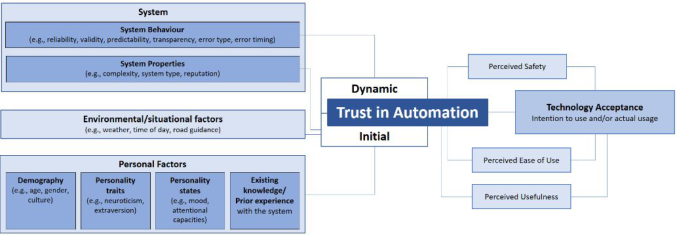
Figure 1: Theoretically developed framework on the influencing factors on and the relationship between TiA and technology acceptance. Note: (Potential) interdepende- ncies between the (acceptance-relevant or trust influencing) factors as well as feedback loops or directions are not considered in this figure.
could not show a direct influence of trust on acceptance, but they also found an indirect effect of trust on acceptance via the factor perceived safety.
Based on this literature, our understanding of the relationship between TiA and technology acceptance expands as follows: there appears to be both a direct and indirect relationship between TiA and acceptance of automation technology (see Figure 1). With regard to the indirect relationship, the TAM components perceived usefulness and perceived ease of use (see e.g., Gha- zizadeh et al., 2012a; Ghazizadeh et al., 2012b; Hegner et al., 2019; Choi & Ji, 2015; Montamedi et al., 2020) but also the factor perceived safety (see e.g., Montamedi et al., 2020; Choi & Ji; 2015) seem to be of particular importance.
Factors Influencing TiA When researching the influencing factors of trust, particular consideration was given to those that seemingly have relevance to the automated dri- ving context. A particularly relevant work in this context is the model of Hoff & Bashir (2015), who conducted a literature review on TiA and interdependencies with it.
Like many other researchers, Hoff and Bashir (2015) identified individual personal factors such as gender, age, culture, and personality traits (see e.g., Lee & See, 2004; Chien et al., 2014; Sanchez, Rogers, Fisk, & Rovira, 2014; Schaefer et al., 2014) as relevant determinants that primarily contribute to one facet of TiA, dispositional trust. Dispositional trust thereby means the enduring overall tendency of a person to trust automation, independent of context or a specific system. Besides these rather stable personal traits and characteristics influencing trust, Hoff and Bashir (2015) list other internal but rather variable personal factors, such as self-confidence, subjective exper- tise, mood, and attentional capacities, which influence trust dependent on the context. While Hoff and Bashir (2015) differ between dispositional and situ- ative personal factors, we propose a more detailed subdivision into the rather dispositional categories demographics and personality traits and the rather
A Theoretical Framework for Trust in Automation Considering its Relationship 317
situative categories personality states and existing knowledge/prior experie- nce. All four categories are subsumed under the term personal factors (see Figure 1).
In addition to personal factors, there are also external factors influencing TiA, including system properties, system performance, and environmental factors (Perkins et al., 2010; Rajaonah et al., 2008; Hoff & Bashir, 2015). System properties include characteristics such as type of system, design, or system complexity. System performance can be described by e.g., the reli- ability, validity and predictability of a system, as well as by the timing of potential errors and their nature (false alarms vs. misses). While Hoff and Bashir (2015) suggest to assign system properties to situational factors and consider system performance separately, we propose to subsume them for simplification purposes under the term system factors (see Figure 1). By envi- ronmental factors, we summarise factors external to the vehicle and the user, e.g., weather, time of day and road guidance (Dautzenberg et al., 2021). Envi- ronmental factors often receive little detailed consideration and are assigned to general situational factor groups, similar to Hoff and Bashir (2015). In contrast, we would consider the environmental factors as a third separate source of influence alongside the personal and system factors (see Figure 1).
Another distinction that Hoff and Bashir (2015) made based on their lite- rature review, which we adopt for our theoretical framework, is that between initial and dynamic trust (see Figure 1). In accordance with Hoff and Bashir (2015), we hypothesise that especially the personal and environmental factors as well as users’ evaluation of system properties determine an initial trust level towards an automated system. Is a potential user open to new things or rather neurotic? Is the driving situation rather complex or manageable? Is the system considered reliable based on previous experience or reputation? Actual system performance determines whether and how trust dynamically adapts or evolves. Does the system act comprehensibly, transparently and/or according to previous expectations?
CONCLUSION AND FUTURE WORK In this paper, we developed a theoretical framework for the interaction between TiA and acceptance of automated driving (SAE Level4/5), inclu- ding further relevant influencing factors related to trust and acceptance. The framework proposed here goes beyond existing models, by providing a more holistic picture of the interrelationships between trust and accepta- nce. Nevertheless, the framework presented in this paper has been developed theoretically. A validation of the relationships is pending and indispensable. Of particular interest are correlation directions and potentially existing feed- back loops between the framework components. Moreover, some surveys that assess TiA, such as the Trust in Automation Scale (TAS; Jian, Bisantz, & Drury, 2000), assess not only trust but also distrust. Therefore, the subdi- vision of trust and distrust could be interesting - both with regard to the correlations with acceptance and with regard to the mode of action of the postulated influencing factors.
318 Dautzenberg and Voß
ACKNOWLEDGMENT
This research was funded by the German Federal Ministry for Economic Affairs and Climate Action (BMWK) within the EmmI project (funding code 19A20008F). Therefore, we would like to thank the BMWK for supporting this research. Furthermore, we would like to thank Dr. phil. Stefan Ladwig for his valuable input.
REFERENCES
Beggiato, M., Hartwich, F., Roßner, P., Dettmann, A., Enhuber, S., Pech, T., Beggiato, M., Hartwich, F., Roßner, P., Dettmann, A., Enhuber, S., Pech, T., Gesmann-Nuissl, D., Mößner, K., Bullinger, A.C., and Krems, J. (2020), “KomfoPilot – Comfortable Automated Driving.” In G. Meixner (ed.), Smart Automotive Mobility. Cham: Springer, 71–154. Chien, S.Y, Semnani-Azad, Z., Lewis, M., and Sycara, K. (2014), “Towards the Deve-
lopment of an Inter-cultural Scale to Measure Trust in Automation.” In P.L.P. Rau (ed.), Cross-Cultural Design. Cham: Springer, 35–46. Choi, J.K., and Ji, Y.G. (2015), “Investigating the importance of trust on adopting an autonomous vehicle.” International Journal of Human-Computer Interaction, 31(10), 692–702. Dautzenberg, P.S.C., Voß, G.M.I., Ruß, F., Oetermann, T., Brockmeier, C., Ladwig,
S., and Eckstein, L. (2021), “Identification and evaluation of trust-relevant dri- ving situation factors for automated driving (SAE Level4/5).” Proceedings of 30th Aachen Colloquium Sustainable Mobility 2021, Aachen, 04. – 06.10.202 Davis, F.D. (1989), “Perceived usefulness, perceived ease of use, and user acceptance of information technology.” MIS Quarterly, 13(3), 319–340. Endsley, M.R. (2019), “The limits of highly autonomous vehicles: an uncertain
future.” Ergonomics, 62(4), 496–499. Ghazizadeh, M., Lee, J.D., and Boyle, L.N. (2012a), “Extending the technology acceptance model to assess automation.” Cognition, Technology & Work, 14(1), 39–49. Ghazizadeh, M., Peng, Y., Lee, J.D., and Boyle, L.N. (2012b), “Augmenting the
technology acceptance model with trust: Commercial drivers’ attitudes towards monitoring and feedback.” Proceedings of the Human Factors and Ergonomics Society, 56(1), 2286–2290. Hegner, S.M., Beldad, A.D., and Brunswick, G.J. (2019), “In automatic we trust: Investigating the impact of trust, control, personality, characteristics, and extrinsic and intrinsic motivations on the acceptance of autonomous vehicles.” Internatio- nal Journal of Human-Computer Interaction, 35(19), 1769–1780. Hewitt, C., Politis, I., Amanatidis, T., and Sarkar, A. (2019, March), “Assessing
public perception of self-driving cars: The autonomous vehicle acceptance model.” IUI ‘19: Proceedings of the 24th International Conference on Intelligent User Interfaces, 518–527. Hoff, K.A., and Bashir, M. (2015), “Trust in automation: Integrating empirical evidence on factors that influence trust.” Human Factors and Ergonomics Society, 57(3), 407–434. Jian, J. Y., Bisantz, A. M., & Drury, C. G. (2000). Foundations for an empirically
determined scale of trust in automated systems. International journal of cognitive ergonomics, 4(1), 53–71.
A Theoretical Framework for Trust in Automation Considering its Relationship 319
Kaur, K., and Rampersad, G. (2018), “Trust in driverless cars: Investigating key factors influencing the adoption of driverless cars.” Journal of Engineering and Technology Management, 48, 87–96. Körber, M., Baseler, E., and Bengler, K. (2018), “Introduction matters: Manipulating
trust in automation and reliance in automated driving.” Applied Ergonomics, 66, 18–31. Lee, J.D., and See, K.A. (2004), “Trust in automation: Designing for appropriate reliance.” Human Factors, 46(1), 50–80. Milakis, D. (2019), “Long-term implications of automated vehicles: an introdu-
ction”, Transport Reviews, 39(1), 1–8. Montamedi, S., Wang, P., Zhang, T., and Chan, C.-Y. (2020), “Acceptance of full driving automation: Personally owned and shared-use concepts.” Human Factors, 62(2), 288–309. National Highway Traffic Safety Administration (2018), “Automated vehicles for
safety.” https://www.nhtsa.gov/technology-innovation/automated-vehicles-safety Numan, J.H. (1998), “Knowledge-based systems as companions: Trust, human computer interaction and complex systems.” [Doctoral dissertation, University of Groningen]. http://irs.ub.rug.nl/ppn/169106586 Osswald, S., Wurhofer, D., Trösterer, S., Beck, E., and Tscheligi, M. (2012),
“Predicting information technology usage in the car: Towards a car technology acceptance model.” AutomotiveUI’ 12: Proceedings of the 4th International Con- ference on Automotive User Interfaces and Interactive Vehicular Applications, 51–58. Pavlou, P.A. (2003), “Consumer acceptance of electronic commerce: Integrating trust and risk with the technology acceptance model.” International Journal of Electronic Commerce, 7(3), 101–134. Perkins, L., Miller, J.E., Hashemi, A., and Burns, G. (2010), “Designing for human-
centered systems: Situational risk as a factor of trust in automation.” Human Factors and Ergonomics Society Annual Meeting, 54(25), 2130–2134. Rajaonah, B., Tricot, N., Anceaux, F., and Millot, P. (2008), “The role of intervening variables in driver–ACC cooperation.” International Journal of Human-Computer Studies, 66(3), 185–197. Sanchez, J., Rogers, W.A., Fisk, A.D., and Rovira, E. (2014), “Understanding relia-
nce on automation: effects of error type, error distribution, age and experience.” Theoretical Issues in Ergonomics Science, 15(2), 134–160. Schaefer, K.E., Billings, D.R., Szalma, J.L., Adams, J.K., Sanders, T.L., Chen, J.Y., and Hancock, P.A. (2016), “A meta-analysis of factors influencing the development of trust in automation: Implications for human-robot interaction.” Human Factors, 58(3), 377–400. Tussyadiah, I.P., Zach, F., and Wang, J. (2017), “Attitudes toward autonomous on
demand mobility system: The case of self-driving taxi.” In R. Schegg, and B. Stangl (eds.), Information & communication technologies in tourism. Cham: Springer, 755–766. Venkatesh, V., Morris, M.G., Davis, G.B., and Davis, F.D. (2003), “User acceptance of information technology: Toward a unified view.” MIS Quarterly, 27(3), 425–478.
LISTED IN THE AHFE DIGITAL BOOKSTORE CATALOGUE
Explore the complete digital volume
Human Factors in Transportation
Read this individual research paper free through the original publisher, or explore the full digital proceedings book.
ISBN 978-1-958651-36-0
Explore this ISBN in the AHFE Bookstore ↗Listed in the July 2026 bookstore catalogue; search by ISBN to confirm current availability · Digital book purchase optional