Zhong Jianwen, Jun Zhang (2025). Exploring the Impact of European Green Policy on Sustainable Product Design. In: Human Factors in Architecture, Sustainable Urban Planning and Infrastructure. AHFE Open Access, vol. 191, pp. 125–133. https://doi.org/10.54941/ahfe1006616
This study takes sustainable product design as the research object based on the European green policy perspective. It discusses the closely related requirements of the European Green Deal on product life cycle design. It suggests that designers enhance the use of sustainable design methods to cope with the impact of the regulations. This will help enterprises comply with the wave of green development and break the green trade barriers.
As global climate change becomes increasingly severe, green policies have become a critical concern and focus for the international community. Major economies have established green policy frameworks to drive economic and social transformation toward a low-carbon and sustainable development model in response to the climate crisis. Notably, the European Green Deal (EGD) proposed by the European Union plays a vital role in the current wave of global green transition (Yao, 2023). In this context, businesses that fail to adapt may risk being eliminated from the market. Therefore, how should enterprises respond to the implementation of these policies?
Over the past 50 years, academics, social activists, and visionary enterprises have increasingly promoted the idea of sustainable design. This concept has gradually developed into a significant strategy for businesses to strengthen their core competitiveness (Papanek, 1971). Regardless of the industry—supply chain, manufacturing or services—companies’ products are subject to constraints imposed by green policies. To address the challenges stemming from a lack of awareness about green development and adaptability to these policies, design plays a crucial role in the product value chain. It is responsible for ensuring that products comply with relevant policy standards. Design is not merely a phase in the product value chain; it is a vital stage that influences the entire life cycle of a product. Therefore, it has become a key issue to clarify the specific requirements and challenges of European green policies on design practice, especially the logic of evolution during the implementation of the policies and their impact on the design process. This paper seeks to thoughtfully review European policies regarding
the green transformation of industries and to analyse their implementation within the sustainable design framework.
Sustainability and Life Cycle Design Sustainable development has become a global consensus. The United Nations report Our Common Future, issued in 1987, explains sustainable development as “Development that meets the needs of the present without compromising the ability of future generations to meet their own needs” (World Commission on Environment and Development, 1987). This definition emphasises the balance between present and future generations regarding resource use and environmental protection (United Nations, 2015). On this basis, the Sustainable Development Goals formulated by the United Nations provide the world with a blueprint for sustainable development from 2015 to 2030, addressing global challenges in the three dimensions of society, the economy, and the environment through integrated means. These goals cover many aspects, including economic growth, social inclusion and environmental protection, and embody the principle of maximising financial and social benefits under the premise of rational use and protection of resources and the environment. Sustainable development does not mean sacrificing economic efficiency.
To realise the sustainable development of enterprises, it is necessary to comprehensively consider the environmental, economic and social impacts of products throughout their life cycle. Incorporating sustainable concepts in the early design stages of business operations is critical. From a financial perspective, approximately 70% to 80% of product costs are finalised during the design phase (Ongbali et al., 2024), so design decisions directly impact a company’s profitability. From an environmental perspective, the design industry has long recognised the importance of ecological issues, and decisions made during the design phase can significantly impact a product’s ecological sustainability (Asiedu & Gu, 1998), such as reducing greenhouse gas emissions (Go et al., 2015).
As an essential paradigm in the field of modern design, Life Cycle Design (LCD), also known as “product green design” or “product eco-design”, is a systematic design methodology for the whole life cycle of products. The methodology emphasises the time dimension of the product’s design. The method emphasises the overall consideration of the product from the time dimension and realises the goal of sustainable development through multi- dimensional design strategies (Zhang et al., 2020). Its core value lies in the product being designed so that it can be used sustainably. The core value of the approach is to bring environmental awareness to the initial design stage, aiming to identify and assess the potential impacts of products on the environment at the design stage. This design philosophy requires linking the design of a product to a broader perspective of preparation, production, distribution, use and disposal to maximise resource conservation, pollution control and recycling. This forward-looking design thinking has significant environmental benefits and economic advantages compared to
Exploring the Impact of European Green Policy on Sustainable Product Design 127
using time, health and money to rectify the damage done at the final stage.
From the methodological level, LCPD applies a series of design principles, guidelines, and tools and is a collection of design strategies to improve a product’s sustainability through different design solutions (He et al., 2020), such as modular design (Sonego et al., 2018) and sustainability assessment tools (Kleinekorte et al., 2020).
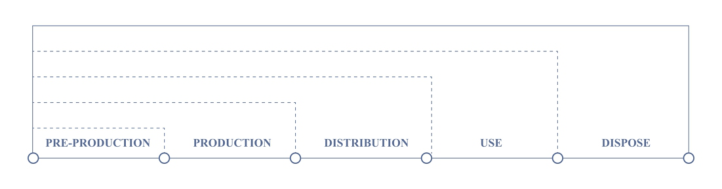
The production process of various products is complex and involves multiple design stages. Therefore, this paper adopts a streamlined product lifecycle, which is divided into five phases: production preparation, manufacturing, packaging and transportation, use and final disposal (see Figure 1). This sustainable product life cycle design process breaks through the limitations of traditional design in the single dimension of functionality, cost-effectiveness and market demand, breaks the linear economic model of “production-consumption-disuse”, and builds an environmentally friendly product development system from the source, realising the closure of resource flow. It breaks the linear economic model of “production-consumption- disposal”, builds an environmentally friendly product development system from the source, realises the closed-loop cycle of resource flow, and guides designers to develop high-quality, sustainable products.
Figure 1: Product life cycle.
In summary, product lifecycle design serves as a positive response from the design discipline to the concept of sustainable development. This approach showcases the design community’s comprehensive consideration of ecological and environmental issues. It offers businesses, organisations, and individuals concrete and actionable paths for implementing and assessing environmental, economic, and social (EES) strategies. When policies mandate product sustainability—whether through incentives or constraints—the perspective of product lifecycle design allows for a detailed analysis of how these policies affect the EES requirements of a product. It also enables the adoption of principles, guidelines, and tools to meet those requirements effectively.
European Green Policy and Sustainable Product Design Under the guidance of sustainable development, environmental regulations have been gradually strengthened to promote sustainable economic and social development. In this context, green policy is a series of policies implemented
128 Zhong and Zhang
by the government to guide the green transformation of the economy and enhance the environmental friendliness of the economy (Zhu, 2020).
As an active climate action advocate, the EU has always occupied the forefront of global green and sustainable development (Qian et al., 2020). Therefore, in-depth research on European green policies to achieve synergistic development of economy, society, and environment at macro, meso, and micro levels has crucial theoretical value and practical significance. At present, the research on EGD mainly focuses on the following aspects.
First, the research focuses on the interpretation and revelation of EGD, which focuses on the content-based elaboration of the EU’s green policies (Ma, 2023), the inductive analysis of the policy tools (Popova, 2021), and the critical evaluation of the policies (Hereu-Morales et al., 2024; Pianta & Lucchese, 2020). Among them, the policies of Europe are compared from the Chinese perspective (Cao, 2023), and their implications and lessons for China are discussed (Kang et al., 2020).
Second, the impact of European green policies is studied from the macro and micro levels. Policy interpretation explores the positive and negative effects of European green policies in ecological construction, economy, agriculture, and industry from a macro perspective; on the other hand, it cuts in from a more micro perspective to study the impacts of related policies on power (Pietzcker et al., 2021), energy (Ciechanowska, 2020), and other industries.
The final focus is on analysing responses and countermeasures. This includes exploring the positive roles and pathways various industries can take to support the implementation of green policies (Hainsch et al., 2022), including design (Zhong & Wang, 2021), photovoltaics (Jäger- Waldau et al., 2020) waste management (Bucea-Manea-¸toni¸s & Zecheru, 2022), and education (Sadowski, 2021). Additionally, perspectives on ‘green’ industrial policy support and digital technology (Sharma et al., 2022) are also considered.
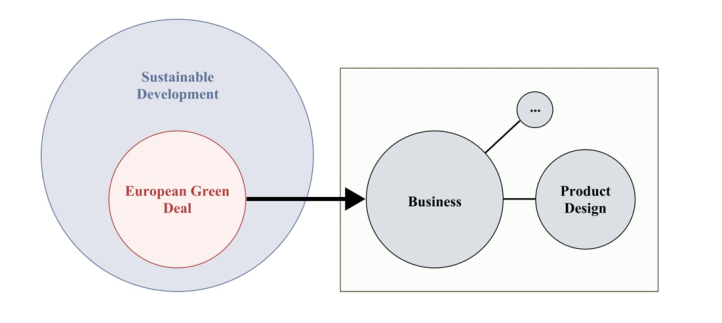
The government and enterprises are two major stakeholders (see Figure 2). The government uses legislation and market mechanisms to restrain and incentivise enterprises for sustainable development. While Enterprises promote green product development through design and innovation, aiming to meet consumer needs while fulfilling social responsibilities and generating profits. From the perspective of enterprise employees, particularly designers, product design is shaped by government policies, consumer preferences, and market competition to achieve optimal profits while fulfilling corporate social responsibility.
Current studies overlook the examination of green policies through a design lens and fail to provide concrete recommendations for enhancing these policies. This gap highlights a critical need for more focused research in this area. In particular, there is a lack of research on how China’s maritime products can proactively adapt to emerging changes, resulting in seafaring enterprises being overwhelmed by the need to respond quickly to various trade barrier policies and regulations. Ultimately, they were unable to develop effective and sustainable response strategies.
Exploring the Impact of European Green Policy on Sustainable Product Design 129
Figure 2: The relationships between EGD, business and design.
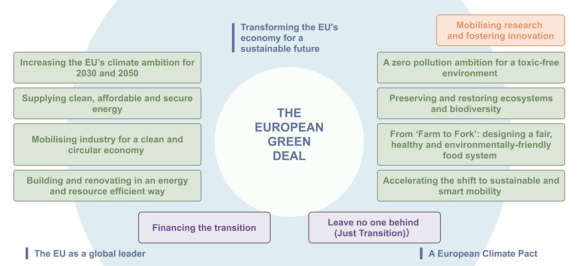
In December 2019, the European Commission published the European Green Deal, which aims to combat climate change and achieve sustainable development in the region. The deal sets out the core objective and vision to “transform the EU into a fair and prosperous society, with a modern, resource-efficient and competitive economy where there are no net emissions of greenhouse gases in 2050 and where economic growth is decoupled from resource use”. A policy framework for the “green” transition of the EU economy has been constructed. A policy framework for the ‘green’ transition of the EU economy has been established. A comprehensive and transformative set of policies will be developed to achieve the objectives of the European Green Deal (see Figure 3). The agreement covers all economic sectors, including energy, industry, buildings, transportation, food, ecology, and the environment, and proposes a series of concrete action programs. At the same time, the mainstreaming of sustainability in European policy is supported and guaranteed through green financing, budgetary taxes and subsidies, research and development and innovation, education and training, and regulatory assessment.
Figure 3: The European Green Deal.
130 Zhong and Zhang
Adopted in February 2023, the European Climate Law writes into law the goal set out in the European Green Deal for Europe’s economy and society to become climate-neutral by 2050. The law also sets the intermediate target of reducing net greenhouse gas emissions by at least 55% by 2030, compared to 1990 levels. It also specifies the Legislation on climate-neutral targets, action pathways, member state facilitation measures, assessment, public participation, mandates and so on. For example, regarding the green transformation of European industry, the EU has launched a series of new policies, such as the Net-Zero Industry Act, the Critical Raw Materials Act, and the New Batteries Regulation, which have comprehensively impacted Chinese enterprises. The New Batteries Regulation, which will come into effect in January 2027, aims to set uniform standards for battery sustainability and safety, with specific requirements on battery durability, safety, removability and replaceability, and the obligation to disclose carbon footprints.
Life Cycle Design Requirements in the European Green Policy Perspective The analysis of European green policies concerning product design primarily concentrates on examining the regulations from the Green New Deal in China and Europe, totalling 21 items for data analysis. The study examines how green policies influence product life by assessing whether the policies explicitly highlight requirements related to the product life cycle—such as product design, life cycle management, incentives or constraints on corporate behaviour, and their integration with market mechanisms. European green policies can be categorised based on product life cycle stages.
Pre-Production Green policies require designers to choose renewable resources and low- carbon raw materials (e.g. Land Use, Land Use Change and Forestry Regulation & Renewable Energy Directive). The ecodesign for Sustainable Products Regulation (ESPR) aims to make the EU product design phase more eco-friendly, focusing on product durability, recyclability, reusability, upgradability, repairability, ease of remanufacturing and recycling, energy efficiency, and carbon footprint. In particular, the ESPR proposes the Digital Product Passport (DPP), which is a digital identity card for products, components and materials. DPP will store information to support the sustainability of a product, promote its recyclability and enhance legal compliance. This information may include the product’s performance, material sources, remediation activities, recyclability, and life cycle environmental impact. Designers need to incorporate considerations such as the product’s carbon footprint and Life Cycle Assessment (LCA) into their design thinking and find appropriate design strategies to ensure that the product is sustainable and competitive in the marketplace. At the same time, companies need to strengthen supply chain management, select suppliers that meet environmental standards, and ensure that the production process of raw materials meets the requirements of green policies.
Exploring the Impact of European Green Policy on Sustainable Product Design 131
Production In the production stage, the requirements of EGD are more stringent, especially in terms of energy consumption, pollutant emissions, and optimisation of production processes. The policy encourages enterprises to adopt cleaner production technologies and promote energy saving and emission reduction measures. T Energy Efficiency Directive and EU Emissions Trading System reform (EU ETS) set strict standards for energy consumption and emissions, and promote the application of energy-efficient and environmentally friendly technologies in product design and production processes. In this process, designers should utilise digital technology and smart manufacturing technology to improve production efficiency while choosing green technology to reduce carbon emissions in production and ensure that products are environmentally friendly in the production process.
Distribution At the distribution stage, the EGD promotes the development of low- carbon transportation means and green logistics infrastructure through a series of policies. In the process of product transportation, low-carbon means of transportation should be chosen as far as possible. In the external sales of products, attention should be paid to product traders’ relevant tax policy requirements to reduce costs as far as possible. For example, products exported to Europe need to pay attention to the Carbon Border Adjustment Mechanism (CBAM), which restricts the carbon footprint of imported products.
Use Policies promote the energy efficiency of products, and the use of renewable energy technologies, such as CO2 emission standards for new cars and vans requires vehicles to reduce greenhouse gas emissions. In the use phase, the concept of green consumption can be promoted to consumers through design, such as encouraging users to choose low-emission vehicles, and the value of green products can be enhanced through the demonstration of green products (e.g., transparent disclosure of carbon footprints) to widen the gap with competing products.
Dispose In the Disposal phase, the EGD promotes waste recycling and remanufacturing through regulations such as ESPR, the Packaging Waste Directive, and NBR to reduce the burden of waste on the environment. These regulations require products to be designed with recyclability, disassembly, and reuse of components in mind. Green policies require that products have high recyclability and manufacturability at the end of their life cycle. Designers need to consider the ease of disassembly of products to promote economic recycling through waste management and the reuse of resources.
132 Zhong and Zhang
CONCLUSION
This study provides insights into the impact of the European Green New Deal on product lifecycle design, filling a gap in green policy research in the design field and guiding designers to achieve sustainability goals. Through regulations, the European Green Policy directly affects designers’ decision- making process in product design, facilitating the transition of design practice towards low-carbon, energy-efficient and sustainable directions. Specifically, they range from resource selection in the design phase to energy use in the production process, low-carbon logistics in the transportation link, energy efficiency optimization in the use phase, and recycling and reuse in the disposal phase. Under these policy requirements, product design should not only comply with environmental protection standards but also maximize the use of resources and reduce environmental burdens.
Although this study analyzes European green policies and their impact on product life cycle design in a more systematic way, there are certain limitations. For example, there is a relative lack of practical case studies of micro-design on how enterprises specifically implement these policy requirements, resulting in the actual operational strategies of some industries and enterprises not being fully explored and explored.
ACKNOWLEDGMENT
I would like to express my deepest gratitude to all those who have supported and guided me throughout this research process. I would also like to extend my appreciation to my academic advisor, Jun Zhang, whose invaluable guidance, insightful feedback, and constant encouragement have been instrumental in shaping this work. Special thanks go to my family and friends, whose love, patience, and understanding have been a source of strength throughout my academic journey.
REFERENCES
Asiedu, Y., & Gu, P. (1998). Product life cycle cost analysis: State of the art review.
International Journal of Production Research, 36(4), 883–908. Bucea-Manea-¸toni¸s, R., & Zecheru, T. (2022). Untapped aspects of waste management versus green deal objectives. Sustainability, 14(18), 11474. Cao, P. (2023). A Study on the Evolution of Green Policies and Cooperation between China and Europe. Ciechanowska, M. (2020). European Green Deal - a challenge for the transformation
of the Polish oil and gas industry. Nafta-Gaz(10), 757–761. https://doi.org/ 10.18668/ng.2020.10.12 Go, T. F., Wahab, D. A., & Hisharnuddin, H. (2015). Multiple generation life-cycles for product sustainability: The way forward. Journal of Cleaner Production, 95, 16–29. https://doi.org/10.1016/j.jclepro.2015.02.065 Hainsch, K., Löffler, K., Burandt, T., Auer, H., Del Granado, P. C., Pisciella, P., &
Zwickl-Bernhard, S. (2022). Energy transition scenarios: What policies, societal attitudes, and technology developments will realize the EU Green Deal? Energy, 239, 122067.
Exploring the Impact of European Green Policy on Sustainable Product Design 133
He, B., Li, F., Cao, X., & Li, T. (2020). Product sustainable design: A review from the environmental, economic, and social aspects. Journal of Computing and Information Science in Engineering, 20(4), 040801. Hereu-Morales, J., Vinardell, S., & Valderrama, C. (2024). Towards climate
neutrality in the Spanish N-fertilizer sector: A study based on radiative forcing. Science of the Total Environment, 946, 174131. Jäger-Waldau, A., Kougias, I., Taylor, N., & Thiel, C. (2020). How photovoltaics can contribute to GHG emission reductions of 55% in the EU by 2030. Renewable and Sustainable Energy Reviews, 126, 109836. Kang, Y., Xiong, X., & Zhao, M. (2020). Key Points of the EU Green New Deal and
its Implications for China. China Development Observations(Z5), 114–117. Kleinekorte, J., Fleitmann, L., Bachmann, M., Kätelhön, A., Barbosa-Póvoa, A., von der Assen, N., & Bardow, A. (2020). Life cycle assessment for the design of chemical processes, products, and supply chains. Annual Review of Chemical and Biomolecular Engineering, 11(1), 203–233. Ma, H. (2023). The Origins, Implementation, and Evaluation of the European Green
Deal. Ongbali, S. O., Okwilagwe, O. O., Yekini, E. S., Afolalu, S. A., & Somefun, T. (2024).
The Role of Value Engineering in Product Design and Profitability Improvement in Manufacturing Setting-A Review. 2024 International Conference on Science, Engineering and Business for Driving Sustainable Development Goals (SEB4SDG). Pianta, M., & Lucchese, M. (2020). Rethinking the European Green Deal: An industrial policy for a just transition in Europe. Review of Radical Political Economics, 52(4), 633–641. Pietzcker, R. C., Osorio, S., & Rodrigues, R. (2021). Tightening EU ETS targets in
line with the European Green Deal: Impacts on the decarbonization of the EU power sector. Applied Energy, 293, 116914. Popova, I. (2021). Systematization and Classification of the European Union’s policy Instruments for the Implementation of the Green Deal. International Organisations Research Journal, 16(4), 1–31. Qian, L., Fang, Q., & Lu, Z. (2020). Implications of the EU Green New Deal for
China. Financial Expo(05), 56–58. Sadowski, K. (2021). Implementation of the new european bauhaus principles as a context for teaching sustainable architecture. Sustainability, 13(19), 10715. Sharma, R., Lopes de Sousa Jabbour, A. B., Jain, V., & Shishodia, A. (2022).
The role of digital technologies to unleash a green recovery: Pathways and pitfalls to achieve the European Green Deal. Journal of Enterprise Information Management, 35(1), 266–294. Sonego, M., Echeveste, M. E. S., & Debarba, H. G. (2018). The role of modularity in sustainable design: A systematic review. Journal of Cleaner Production, 176, 196–209. Yao, L. (2023). Comparative Study of Green Transition Policies and Pathways
between China and Europe, and Relevant Cooperation Suggestions. Foreign Economic and Trade Practice (12), 4–11. Zhang, X., Zhang, L., Fung, K. Y., Bakshi, B. R., & Ng, K. M. (2020). Sustainable product design: A life-cycle approach. Chemical Engineering Science, 217, 115508. Zhong, Y., & Wang, Q. (2021). Ecodesign strategy for demand-oriented electrical
and electronic products. Sustainability, 14(1), 24. Zhu, L. (2020). Research on the Impact of Green Policies on Financing Constraints of Polluting Enterprises.
LISTED IN THE AHFE DIGITAL BOOKSTORE CATALOGUE
Explore the complete digital volume
Human Factors in Architecture, Sustainable Urban Planning and Infrastructure
Read this individual research paper free through the original publisher, or explore the full digital proceedings book.
ISBN 978-1-964867-67-0
Explore this ISBN in the AHFE Bookstore ↗Listed in the July 2026 bookstore catalogue; search by ISBN to confirm current availability · Digital book purchase optional