Ruixin Liang, Frances Wan, Xiaolu Li, Jun Zhang, Joanne Yip (2024). Exploring Lower Body Asymmetry in Female Fencers: Implications for Enhanced Legging Design and Performance. In: Human Factors for Apparel and Textile Engineering. AHFE Open Access, vol. 134, pp. 124–129. https://doi.org/10.54941/ahfe1004921
1 School of Fashion and Textiles, The Hong Kong Polytechnic University, Hung Hom, Hong Kong, China ↗
2 Laboratory for Artificial Intelligence in Design, Hong Kong Science Park, New Territories, Hong Kong, China
3 School of Fashion and Textiles, The Hong Kong Polytechnic University, Hung Hom Hong Kong, China; Laboratory for Artificial Intelligence in Design, Hong Kong Science Park New Territories, Hong Kong, China ↗
Fencing is a sport that places unique demands on the body due to its asymmetrical movements. As a result of long-term training, the body shapes of female fencers can differ from those of non-athlete women, leading to specific requirements for sportswear design. However, there is a lack of research focusing on the anthropometry of female fencers and their lower limb asymmetry, particularly in comparison with non-athlete females. This study aims to fill this research gap by examining and analyzing the body shapes of female fencers and non-athlete women using three-dimensional scanning technology. To achieve this goal, seven professional fencers and eight non-athlete women were invited to participate in a scanning experiment in a standard "A" pose. Cross-sectional circumferences of the lower body at eight separate positions were computed and compared between the left and right side, as well as between fencers and non-athletes. In addition, the performances of three commercial leggings were evaluated for fencers. The results revealed a clear asymmetry in the fencers' bodies. This finding could provide valuable insights into the physical attributes that contribute to the unique requirements for legging design, potentially enhancing the performance of fencers. Further research in this area could lead to the development of more effective and comfortable sportswear for fencers, ultimately improving their performance and reducing the risk of injury.
As one of the few sports that have been featured in every modern Olympic Games, fencing has gotten widespread international attention (Turner et al., 2014). It is characterized by its asymmetrical movements presenting unique physical demands on its athletes (Chen et al., 2017). While performing this exercise, the movement of the upper limb is followed by a robust extension of the dominant front leg and a vigorous lengthening of the non-dominant back leg during lunges. The non-dominant leg primarily generates power and
Exploring Lower Body Asymmetry in Female Fencers 125
force, while the dominant leg is responsible for braking and stabilization. This leads to significant bilateral asymmetry between the two legs (Drak- oulaki et al., 2021). Therefore, the long-term training involved in this sport often results in distinctive body shapes among female fencers, differing signif- icantly from those of non-athlete women (Roi & Bianchedi, 2008; Tsolaks, Bogdanis & Vagenas, 2006). This divergence in body shape necessitates spe- cific considerations in the design of sportswear to accommodate the unique physical requirements of female fencers. Despite this, there is a notable lack of research focusing on the anthropometry of female fencers (Chen et al., 2017), particularly in relation to lower body asymmetry, when compared to non-athlete females.
This study seeks to address this research gap by analysis of the lower body shapes of female fencers and non-athlete women. Utilizing three-dimensional scanning technology, this research aims to provide a comprehensive under- standing of the physical attributes and asymmetries that characterize female fencers. This understanding is crucial in informing the design of leggings that cater to the specific needs of these athletes, potentially enhancing their performance and comfort during competition. The findings of this research could pave the way for the development of more effective and comfortable sportswear for female fencers.
PARTICIPANTS The participants of this study were two groups of women (n = 15). The first group consisted of 7 female fencers, aged 20–27 years old (average age: 23.7 years old, SD: 2.87); And the second group included 8 non-athlete women, aged 26–42 years old (average age: 30.5 years old, SD: 5.29). The basic characteristics of the participants are listed in Table 1. All participants did not have physical injuries or other diseases that may affect body shape. The details of the research work were explained to all the participants, and they gave written informed consent prior to the start of the experiment. The research was given ethical approval by the Hong Kong Polytechnic University (Reference number HSEARS20231102003).
Table 1. Characteristics of the participants.
Table available in the original PDF paper.
Group Fencers Non-Athlete Women Subject No. S01 S02 S03 S04 S05 S06 S07 S08 S09 S10 S11 S12 S13 S14 S15 Age/ years 27 22 22 26 20 27 22 31 31 26 42 30 26 26 32 Height/ cm 167 164 162 158 173 162 169 162 172 162 160 163 170 171 174 Weight/ kg 57 52 53 51 59 62 67 69 60 46 54 50 60 56 60 BMI 20.4 19.3 20.2 20.4 19.7 23.6 23.4 26.3 20.3 17.5 21.1 18.8 20.7 19.2 19.8 Dominant side R R R R L R L R R R R R R R R
EXPERIMENTAL PROCEDURE The participants underwent scanning with a three-dimensional (3D) laser body scanner (Vitus, Human Solutions, Germany) which was set to scan at a high resolution of 300 pixels/cm2. 3D scanning technology ensured consistent positioning when comparing the left and right legs and avoided
human errors, such as the issue of varying tension when using a tape measure. They were asked to stand straight in the standard “A” pose without any leg- gings or pants, with their arms open and feet apart at shoulder-width distance. The requirements during scanning were to hold still, look straightforward, breathe steadily, and relax.
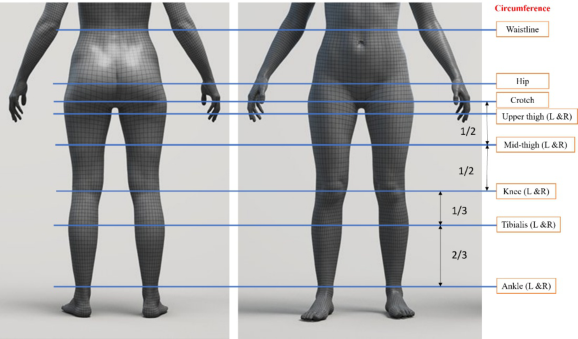
RESULTS AND DISCUSSIONS After 3D scanning experiments, the circumference of thirteen body posi- tions (Figure 1) were measured using reverse engineering software (Geomagic Studio 12, USA). For the Body Mass Index (BMI) from Table 1, all of the fencers’ BMI were within the healthy range, while among the non-athletes, two were not within the healthy range, one being too high and the other too low. In addition, fencers had more uniform BMI values than non-athletes. The standard deviation (SD) for the fencers’ BMI was 1.75, while for the non-athletes’ BMI, it was 2.62. However, BMI is a simple healthy indica- tor, which cannot distinguish between body fat and muscle, and it does not consider variations in body composition (Nemeth, Park & Mendle, 2020). Therefore, waist circumference and waist/hip ratio were also measured in this study (Table 2). Based on the previous research, waist circumference of 77cm was the optimal cutoff value to detect multiple risk components for females (Miyawaki et al., 2005). According to this standard, one fencer and one non-athlete each fall outside the healthy range. Moreover, the waist/hip ratio below 0.85 is considered another healthy indicator for women (Circum- ference & Ratio, 2008). Surprisingly, most of the fencers had higher waist/hip ratio. It may be because long-term training has altered the body shape. This speculation is due to the fact that the average waist circumference of fencers was larger than that of non-athletes, but the hip circumference was smaller than that of non-athletes, resulting in a high waist/hip ratio. This difference should be considered when designing a legging pattern for fencing to ensure a closer fit.
Figure 1: The measured body positions.
Exploring Lower Body Asymmetry in Female Fencers 127
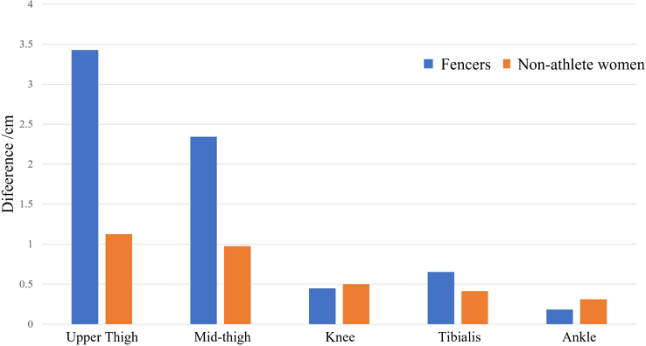
To evaluate the asymmetry of the two legs for female fencers, the average differences between right and left thigh, knee, tibialis and ankle are shown in Figure 2 and Table 3. It is quite evident from the comparison that the asym- metry in the fencer’s thighs is quite noticeable, while there is no significant difference in the lower leg portion compared to non-athletes. Even in terms of knee and ankle dimensions, the asymmetry is slightly more obvious in non- athletes. Therefore, when designing leggings, a unique asymmetrical design can be considered for the thigh portion, making it slightly looser on the side of the dominant leg.
Figure 2: The comparison of left and right lower body.Table 3. The measurements of the lower body.
Table available in the original PDF paper.
Measurements Group Fencers (Average Value ± SD)/cm
Non-Athlete Women (Average Value ± SD)/cm Left upper thigh 58.35 ± 4.75 55.56 ± 4.50 Right upper thigh 59.43 ± 3.17 56.29 ± 5.01 Left mid-thigh 48.72 ± 3.66 47.80 ± 4.46 Right mid-thigh 49.15 ± 3.25 48.35 ± 4.73 Left knee 33.48 ± 1.45 35.80 ± 2.23 Right knee 33.56 ± 1.48 36.28 ± 2.42 Left tibialis 35.33 ± 2.22 35.18 ± 2.96 Right tibialis 35.69 ± 2.55 35.21 ± 2.81 Left ankle 21.29 ± 1.18 21.78 ± 0.95 Right ankle 21.44 ± 1.23 21.89 ± 0.80
This study has a limitation in that the overall age of the non-athletes is higher than that of the fencers. Age can also affect body shape, which may result in inaccurate comparisons. Additionally, the small number of partic- ipants may make the suggestions less convincing. Future research should recruit more participants to obtain more reliable conclusions.
CONCLUSION
This study has provided valuable insights into the unique physical attributes and asymmetries of female fencers, particularly in comparison to non-athlete women. The results clearly indicate a significant asymmetry in the body shapes of fencers, especially in the thigh region. This asymmetry is likely a result of the unique demands of fencing, which involves asymmetrical move- ments and places different demands on the dominant and non-dominant legs. The findings of this study have important implications for the design of sportswear for female fencers. Specifically, the observed asymmetry in the thigh region suggests that leggings designed for fencers should consider an asymmetrical design, with a slightly looser fit on the side of the dominant leg. This could potentially enhance the comfort and performance of fencers during competition.
However, it is important to note that this study involved a relatively small sample size, and further research with a larger sample size is needed to confirm these findings. Future research could also explore other aspects of sportswear design for fencers, such as the material and cut of the garments, to further improve their performance and reduce the risk of injury.
In conclusion, this study has made a significant contribution to the limited body of research on the anthropometry of female fencers, and has highlighted the need for sportswear that is specifically designed to accommodate their unique physical attributes and asymmetries.
Exploring Lower Body Asymmetry in Female Fencers 129
ACKNOWLEDGMENT
This work is supported by the RGC General Research Fund [15602123], titled “3D Biomechanical Model with Soft Tissue Deformation for Leggings Design and Evaluation”. We would like to express our appreciation to the Laboratory for Artificial Intelligence in Design (Project Code: RP1-4), under the InnoHK Research Clusters, Hong Kong Special Administrative Region.
REFERENCES
Chen, T. L. W., Wong, D. W. C., Wang, Y., Ren, S., Yan, F., & Zhang, M. (2017).
Biomechanics of fencing sport: A scoping review. PloS One, 12(2), e0171578. Circumference, W. W., & Ratio, W. H. (2008). Report of a WHO expert consultation. Drakoulaki, V., Kontochristopoulos, N., Methenitis, S., Simeonidis, T., Cherouveim, E., Koulouvaris, P.,... & Tsolakis, C. (2021). Bilateral asymmetries in male and female young elite fencers in relation to fencing performance. Isokinetics and Exercise Science, 29(2), 113–121. Miyawaki, T., Hirata, M., Moriyama, K., Sasaki, Y., Aono, H., Saito, N., & Nakao,
K. (2005). Metabolic syndrome in Japanese diagnosed with visceral fat measure- ment by computed tomography. Proceedings of the Japan Academy, Series B, 81(10), 471–479. Nemeth, M. C., Park, H., & Mendle, J. (2020). Collegiate female athletes’ body image and clothing behaviors. Fashion and Textiles, 7(1), 1–17. Roi, G. S., & Bianchedi, D. (2008). The science of fencing: implications for
performance and injury prevention. Sports Medicine, 38, 465–481. Tsolaks, C., Bogdanis, G. A., & Vagenas, G. A. (2006). Anthropometric profile and limb asymmetries in young male and female fencers. Journal of Human Movement Studies, 50(3), 201–215. Turner, A., James, N., Dimitriou, L., Greenhalgh, A., Moody, J., Fulcher, D.,... &
Kilduff, L. (2014). Determinants of olympic fencing performance and implications for strength and conditioning training. The Journal of Strength & Conditioning Research, 28(10), 3001–3011.
LISTED IN THE AHFE DIGITAL BOOKSTORE CATALOGUE
Explore the complete digital volume
Human Factors for Apparel and Textile Engineering
Read this individual research paper free through the original publisher, or explore the full digital proceedings book.
ISBN 978-1-964867-10-6
Explore this ISBN in the AHFE Bookstore ↗Listed in the July 2026 bookstore catalogue; search by ISBN to confirm current availability · Digital book purchase optional