Xiaolu Li, Joanne Yip, Ruixin Liang, Jun Zhang (2023). Inclusive design for older adult with degenerative scoliosis: The integration of monitoring sensors and functional garment. In: Healthcare and Medical Devices. AHFE Open Access, vol. 79, pp. 224–232. https://doi.org/10.54941/ahfe1003491
Adult Degenerative Scoliosis (ADS) is an aging population condition that occurs as a result of a degenerative change with an abnormal lateral curve greater than 10. Increased concerns over the health effects of ADS have been raised due to its increasing prevalence. Thus, inclusive design products, such as smart monitoring functional garments, are recommended for ADS, which integrate smart monitoring sensors with garments that help ADS to rebalance the spine through active self-correction. However, present research on smart monitoring clothing for ADS focuses more on intelligent monitoring components and systems. There is insufficient research on the integration design process of smart sensors with garments. Hence, this study aims to establish a scientific integration design framework for inclusive smart monitoring functional garments for ADS.Mixed research methods that combined qualitative and quantitative methods were used in this study. Specifically, the qualitative study, including a case study of a previous prototype and practical research of developing an iteration prototype, was conducted to investigate the integration design of smart monitoring functional garments for ADS. Then quantitative data of detailed anthropometric measurements, patterns, and characteristics of electronic accessories and fabric were collected and analysed using 3D modelling and fitting by CLO3D software. The quantitative result was then combined with the qualitative result to build an integration design framework for inclusive smart monitoring functional garments for ADS.The results showed that the development of smart monitoring functional garments for ADS is based on both the body factors of ADS and intelligent monitoring component factors. Furthermore, our findings suggested that the internal garment structure, combining positions, combining techniques, and fabric selection interact with each other under the spiral iteration design process. Finally, the proposed integration design framework and the iteration smart monitoring functional garment for ADS were established. Our findings established a thorough scientific basis for the knowledge on the integration design approach of smart monitoring functional garments for ADS.
Inclusive Design for Older Adult With Degenerative Scoliosis 225
INTRODUCTION
Adult Degenerative Scoliosis (ADS) is an aging population condition that occurs as a result of a degenerative change without pre-existing vertebral distortion (Graham et al. 2016), with an abnormal lateral curve greater than 10 in accordance with the Cobb method (Silva et al. 2010). With the acceleration of the population aging process, the problem of degenera- tive disorders of the vertebral column in the elderly becomes striking (Chen et al. 2020). Non-surgical treatment is the first stage in the management of symptomatic ADS (Birknes et al. 2008), considering the immediate risks and potential long-term consequences of surgical correction of symptoma- tic ADS (Schoutens et al. 2019). Thus inclusive design products for ADS, such as bracing and posture training brace wear, are recommended for older adults to offer both passive support therapy and active muscle training (Fusco et al.2011). In particular, the bracing method would cause weakness in the trunk muscles(Urrutia et al. 2011). Researchers have strongly suggested bracing combined with exercise programs (Romano et al. 2015).
Therefore, there is growing research on smart monitoring functional gar- ments for ADS to provide daily muscle training. Sit, Yip and Kwan (2020) designed and developed an active posture training brace wear using novel design components and actively training posture through a vibrotactile feed- back (VTF) system. Specifically, active posture training consists of real-time monitoring of posture alignment and instant feedback to encourage self- correction to rebalance the spine (Sit et al., 2021). Chung, Yip, Yick and Ng (2021) studied the physical, mechanical and thermal properties of diffe- rent textiles and accessories to formulate a biomechanical model that was used to identify the most suitable combination of textiles and accessories that provide optimum corrective forces and support for ADS (Chung et al. 2021). As mentioned above, smart monitoring functional garments for ADS are designed based on the integration of smart monitoring sensors with gar- ments that helps ADS to rebalance the spine through active self-correction by monitoring feedback through wearing the garment with sensors. Thus, the appropriate integration of smart monitoring sensors with the garment to make it an aesthetical pleasure and functional effect are essential for the popu- larisation and application of smart monitoring functional garments (Ju and Lee. 2020), especially for ADS. However, the present research trend of deve- loping intelligent monitoring clothing for ADS is more focused on the design, implementation and optimisation of the functionality of intelligent monito- ring components and systems (Li et al. 2017). There is insufficient research on the integration design process of smart sensors with garments under the context of smart functional garments for ADS. Specifically, the embedding of functional monitoring sensors has many implications for fabrics and garment construction and combining processes (Shi et al. 2019), but there is a lack of systematic research.
Thus, in this context, this study aims to address the inadequacies of the existing integration design of smart sensors with garments by establishing a scientific integration design framework for inclusive smart monitoring functi- onal garments for ADS.The framework is based on an analysis of the function
and physical characteristics of the embedded garment components about the garment structure, fabrics, the combination technique and the combination position. This framework aims to advance the knowledge of the integration design approach of smart functional garments for ADS. Furthermore, the framework could further develop the current design process of integrating smart monitoring sensors with functional garments to develop more sophi- sticated research for smart garments for ADS, which may aid researchers and designers in developing higher-quality smart functional garments for ADS.
METHODOLOGY
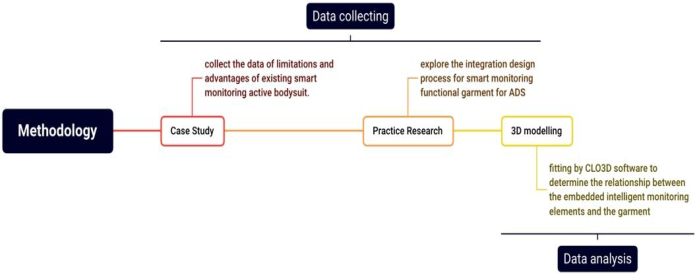
The methodology for this study is shown below (see Figure 1). The qualita- tive method was mainly used in this design research. Specifically, a case study of the previous prototype developed by Sit et al. (2020) was conducted to col- lect the data of limitations and advantages of existing smart monitoring active bodysuits. Then practice research of designing and developing the array pro- totype was conducted for data collecting to explore the integration design process for smart monitoring functional garments for ADS. Finally, the data were analysed using 3D modelling and fitting by CLO3D software to deter- mine the relationship between the embedded intelligent monitoring elements and the garment under the context of inclusive smart garments for ADS.
Figure 1: Overview of methodology.
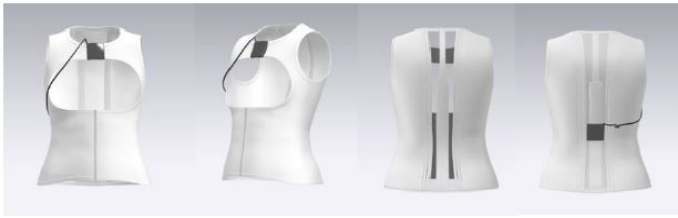
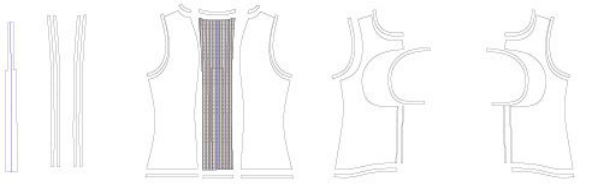
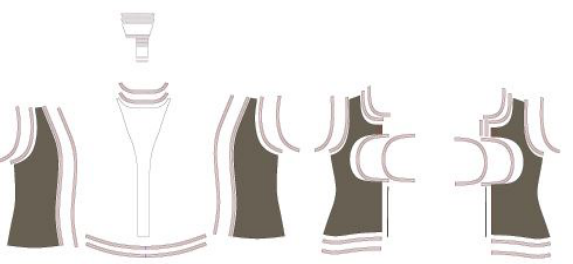
CASE STUDY The smart monitoring functional garment for active muscle training for ADS developed by Sit et al. (2020) is a tight-fitting tank top with an open chest design for breathing expansion and a fastening system consisting of a magne- tic zipper and Velcro. The vibrotactile feedback (VTF) system consisting of connection wires and three sensors is placed along the spine at designated positions. In contrast, the wire vibrator is placed under the shoulder (see Figure 2 and 3). The sensors would track ADS posture and transfer the data to the database via Bluetooth. If the posture is out of tolerance, the vibrating board will vibrate to alert the ADS until the posture is corrected.
Inclusive Design for Older Adult With Degenerative Scoliosis 227
Figure 2: VTF system of the of active smart monitoring functional tank for ADS.Figure 3: The patterns of active smart monitoring functional tank developed by Sit et al. (2020).
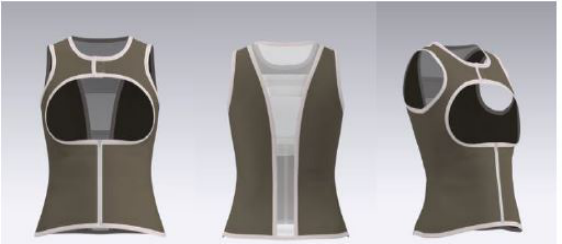
DESIGN AND DEVELOPMENT OF THE SMART MONITORING FUNCTIONAL GARMENT FOR ADS The proposed iterative prototype is a tightly fitting compression top vest inte- grating inertial motion unit sensors for active muscle training for ADS (see Figure 4). The iterative design maintained an open chest style for breathing expansion and retained the zipper and Velcro. The zipper and Velcro were sewn onto the front of the top, allowing the older adult to put on and take off flexibly. The inertial motion unit sensors for monitoring ADS posture data were arranged in specific locations in the spinal region, and integrated into the garment with pockets design. They were easy to withdraw for garment daily washing.
Figure 4: Iterative design of the active smart monitoring functional garment for ADS.
Moreover, the pattern design was adapted to the body characteristics of older adults. The inter structure line at the back, which is used to inte- grate sensors, has been redesigned to be more close fit for older adults (see Figure 5). In conclusion, the practice research of designing and developing the iterative prototype was conducted to explore the integration design process for smart monitoring functional garments for ADS.
Figure 5: The pattern design of iterative active smart monitoring functional garment for ADS.
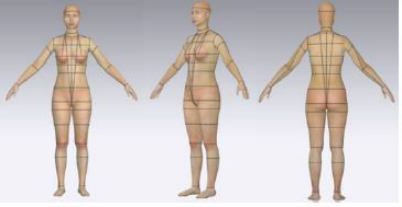
3D MODELING AND FITTING ANALYSIS Using the older female adult standard size to build the three-dimensional mannequin. The data of key anthropometric measurements, including girth measurements, vertical measurements, and width and length measurements (see Figure 6 and Table 1). The previous prototype and proposed iterative prototype were fitted and evaluated on the established three-dimensional model by CLO3D software with data including stress map, strain map and pressure points analysed from the fabric selection, combination position, combination technique and structure pattern, respectively (see Table 2). The data was analysed using 3D modelling and fitting by CLO3D software to determine the relationship between the embedded intelligent monitoring ele- ments and the garment under the context of inclusive smart garments for ADS.
Figure 6: 3D modeling of the standard size older female adult.
Inclusive Design for Older Adult With Degenerative Scoliosis 229
Table 1. Anthropometric measurements of the standard size older female adult.
Table available in the original PDF paper.
Positions Data Girth Measurements (cm) Bust 90.00 Waist 71.73 High Hip 88.76 Low Hip 97.92 Hip Arc 48.94 Vertical Measurements (cm) Height 162.00 Cervical Height 138.73 Waist Height Back 104.00 Abdominal Height 91.48 Waist to High Hip 12.48 Waist to Low Hip 24.80 Width and Length Measurements (cm)
Cross Back Shoulder 37.20 Back Width 36.50 Chest Width 37.26 Shoulder Length 11.27
Table 2. Fitting and evaluation between previous prototype and proposed iterative prototype.
Table available in the original PDF paper.
Previous prototype Iterative prototype
Stress Map
Strain Map
Pressure Points
RESULTS
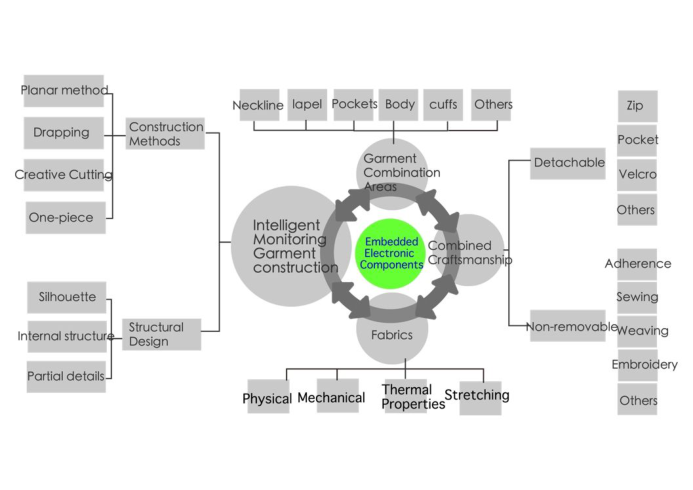
The findings can be divided into four parts, eventually forming a spiral ite- ration design process. First, the integration relationship between embedded sensors and garment structure mainly deals with the combination of various components with different physical characteristics. Therefore, the internal structure plays a vital role, mainly through the dividing lines design and distribution to fit sensors, garments, and the human body. Second, when it comes to the integration relationship between embedded sensors and combi- nation position, the positions are the correspondence between human body
parts and garments. Taking into account the impact of the smart compo- nents implanted on human activities, the appropriate integration position for smart clothing needs to be selected. Following this is the integration relation- ship between embedded sensors and the combination technique. Embedding smart components into garments is the key to the combination technique. Specifically, the combination technique is divided into a detachable and non- detachable method. Detachable types, such as zippers and pockets, are easy to withdraw, while non-detachable types, such as sewing and paste for washable smart components. Another is the integration relationship between embed- ded sensors and fabrics. The combination of the embedded hard, smart components and the garment determines the fabric selection, such as stre- tch strength, thickness, fiber density, fiber structure, warp and weft direction and the friction coefficient of the fabric.
In summary, the internal structure occupies an important position. More importantly, the structure and combination potions, combination techni- que, and fabric selection, the four influence each other, complement each other, and interact with each other to foster a spiral iteration design pro- cess. Consequently, the integration design framework for inclusive smart monitoring functional garments for ADS has been established (see Figure 7).
Figure 7: The integration design framework for developing smart monitoring functio- nal garments for ADS.
CONCLUSION
This paper presented an integration design framework for developing smart monitoring functional garments for older adults with degenerative scoliosis. The design framework proposes a spiral iteration design process, which
Inclusive Design for Older Adult With Degenerative Scoliosis 231
mainly deals with the relationship between the embedded intelligent moni- toring elements and the garment under the context of an inclusive smart garment for ADS. A qualitative method was used in this study. Specifically, the case study of the previous prototype and practice research of the array prototype was used for data collecting, and the data were analysed using 3D modelling by CLO3D software. It is found that the smart monitoring functi- onal garment design for ADS is based on the body factor of ADS and the intelligent monitoring components factor.
Furthermore, our findings suggest that the internal garment structure design, combination positions, combination process, and fabric selection interact with each other under the spiral iteration design process. With the fin- dings, our study makes several theoretical and practical contributions. Firstly, the present research findings establish a thorough scientific basis for the kno- wledge of the integration design approach of smart functional garments for ADS. More importantly, this study’s findings may enable further development of the current design process of integrating smart monitoring sensors with functional garments to develop more sophisticated research for smart gar- ments for ADS. Additionally, the proposed integration design framework may aid researchers and designers in developing higher-quality smart functional garments for ADS. Since the proposed design framework provided insuffi- cient details because this study is based on qualitative research approaches, further studies should be carried out on quantitative methods to enrich the proposed design model.
ACKNOWLEDGMENT
This research is funded by the Laboratory for Artificial Intelligence in Design (Project Code: RP1-4) under the InnoHK Research Clusters, Hong Kong Special Administrative Region Government.
REFERENCES
Birknes, J. K., White, A. P., Albert, T. J., Shaffrey CI, Harrop, J. S. (2008). Adult Degenerative Scoliosis: A Review. Neurosurgery 63, 94–103. Chen, K., Zhao, J., Yang, Y., Wei, X., Chen, Z., Li, M., Zhai, X. (2020). Global
Research Trends of Adult Degenerative Scoliosis in This Decade (2010–2019): A Bibliometric Study. European Spine Journal 29, 2970–2979. Chung, W. Y. C., Yip, J., Yick, K. L., & Ng, S. P. (2021). Active Training Bodysuits for Adult Degenerative Scoliosis. Postgraduate Conference on Interdisciplinary Learning, Lingnan University, Hong Kong, 27–28 March. Fusco, C., Zaina, F., Atanasio, S., Romano, M., Negrini, A., Negrini, S. (2011).
Physical exercises in the treatment of adolescent idiopathic scoliosis: An updated systematic review. Physiotherapy Theory and Practice 27, 80–114. Graham, R. B., Sugrue, P. A., Koski, T. R. (2016). Adult Degenerative Scoliosis.
Clinical Spine Surgery: A Spine Publication 29, 95–107. Ju, N., Lee, K. H. (2020). Consumer resistance to innovation: smart clothing. Fashion and Textiles 7. Li, B. H., Hou, B. C., Yu, W. T., Lu, X. B., Yang, C. W. (2017). Applications of
artificial intelligence in intelligent manufacturing: a review. Frontiers Inf Technol Electronic Eng 18, 86–96.
Romano, M., Negrini, A., Parzini, S., Tavernaro, M., Zaina, F., Donzelli, S., Negrini, S. (2015). SEAS (Scientific Exercises Approach to Scoliosis): A Modern and Effe- ctive Evidence Based Approach to Physiotherapic Specific Scoliosis Exercises. Scoliosis Spinal Disord 10: E1–E19. Schoutens, C., Cushman, D. M., McCormick, Z. L., Conger, A., van Royen, B. J.,
Spiker, W. R. (2019). Outcomes of Nonsurgical Treatments for Symptomatic Adult Degenerative Scoliosis: A Systematic Review. Pain Medicine 21, 1263–1275. Shi, J., Liu, S., Zhang, L., Yang, B., Shu, L., Yang, Y., Ren, M., Wang, Y., Chen, J., Chen, W., Chai, Y., Tao, X. (2019). Smart Textile-Integrated Microelectronic Systems for Wearable Applications. Advanced Materials 32, 1901958. Silva, F. E., Lenke, L. G. (2010). Adult Degenerative Scoliosis: Evaluation and
Management. Neurosurgical Focus 28, E1. Sit, L. Y. L., Yip, J., Kwan, K. Y. H. (2021). Preliminary Wear Trial of Posture Training Bracewear for Older Adults with Degenerative Scoliosis (ADS), in: Advances in Human Factors and Ergonomics in Healthcare and Medical Devices. Springer International Publishing, 81–87. Urrutia, J., Espinosa, J., Diaz-Ledezma, C., Cabello, C. (2011). The Impact
of Lumbar Scoliosis on Pain, Function and Health-related Quality of Life in Postmenopausal Women. Eur Spine Journal 20(12):2223–7.
LISTED IN THE AHFE DIGITAL BOOKSTORE CATALOGUE
Explore the complete digital volume
Healthcare and Medical Devices
Read this individual research paper free through the original publisher, or explore the full digital proceedings book.
ISBN 978-1-958651-55-1
Explore this ISBN in the AHFE Bookstore ↗Listed in the July 2026 bookstore catalogue; search by ISBN to confirm current availability · Digital book purchase optional