Cheng-Li Liu, Kuo-Wei Su (2023). A virtual training system based on human information processing model for improving mild cognitive impairment (MCI). In: Healthcare and Medical Devices. AHFE Open Access, vol. 79, pp. 95–102. https://doi.org/10.54941/ahfe1003477
In recent years, the incidence of age-related diseases has increased dramatically due to the increase in the average human lifespan. The most common age-related symptom is Mild Cognitive Impairment (MCI), which often represents the transition from healthy aging to dementia, a neurodegenerative disease that has hitherto been incurable. When people detect suspected cognitive decline, how should they respond in advance? Past studies have reported that short-term memory loss is the most predictive of dementia in neuropsychological tests, so strengthening memory training and encouraging consistent self-practice can slow the rate of cognitive deterioration into dementia. Maintaining memory is nothing more than exercising, learning new skills, cultivating interests, and participating in educational activities. However, people with cognitive degeneration often feel indifferent to activities and miss the critical period for cognitive recovery. With the advancement of technology and the upsurge of games driven by virtual reality (VR), it is hoped that this group of people will be willing to receive rehabilitation training under the appropriate situational design. There were some relevant research reports on applying VR game training to restore cognitive function degradation in the past. Still, the development and training of the overall game were rarely carried out in the cognitive model. In addition, the training effectiveness was mainly re-tested with a test questionnaire. Nevertheless, each detection tool has a "reasonable suspicion interval for cognitive deterioration" that will increase the precise assessment of training effectiveness. Therefore, this study aims to design a VR game training system based on the cognitive model. The significant differences between this training model and the game training developed in previous studies are:(1) The training system is built based on the four aspects of perception, cognition, action, and heuristics, not only emphasizing memory training or action response training.(2) The training required for the complete establishment of human information processing: Unlike other game training, it may only be a fragment of training and lacks the training of human message processing sequentially and coherently, thus limiting the effectiveness of the training.The study also applied the Receiver Operating Characteristic (ROC) evaluation method to evaluate the effect of training on cognitive function enhancement more accurately. The results show that if the traditional detection tool Mini-Mental State Examination (MMSE) is used for evaluation, the sensitivity is low, and the training effect cannot be specifically illustrated. However, when the ROC evaluation method is used, the indicator: AUC (Area Under Curve) analysis and Accuracy analysis have high sensitivity for training effect evaluation. In terms of the effectiveness of VR game training: if the participant's cognitive function is suspected to be degraded (but not dementia), the response effect is significantly improved after training, which has a particular effect on delaying dementia.
The earliest signs of memory deterioration in healthy older adults and those with dementia are often due to episodic memory deficits (Vallet et al., 2017). Because of the high correlation between perception and episodic memory, the decline in perceptual ability due to aging will directly reduce the ability to encode and retrieve episodic memory. In addition, if there is a deficit in integrating multiple perceptions, it will lead to more severe episodic memory impairment. Some researchers believe that this is because episodic memory covers the widest range and requires intensive memory use. When brain function begins to degrade due to aging, episodic memory ability is the first to be hit (Chen et al., 2019). According to a recent meta-analysis of studies on cognitive decline, memory activation practices or multifaceted cognitive trai- ning measures for multiple domains have been proven effective in enhancing recovery performance from cognitive decline (Sherman et al., 2017).
With the advancement of technology, computer games combined with vir- tual reality (VR) technology have become an increasingly popular method of neuroscience treatment in recent years (Coyle et al., 2015). The computer
simulation method provided by VR allows training in a controlled environ- ment, and during the training process, the patient’s motor, cognitive, and other observational activities are monitored (García-Betances et al., 2015a). In fact, research on the use of VR for neurological rehabilitation has recently flourished; findings have shown its increasing efficacy (Tieri et al., 2018).
For people with suspected symptoms of dementia, the initial diagnosis is made by neuropsychological examinations. If the test results are abnormal, medical imaging scans are supplemented for further confirmation. Psycho- logical screening instruments include the Mini-Cog and the Short Portable Mental Status Questionnaire (SPMSQ). For neuropsychological screening tests, the Mini-Mental Status Examination (MMSE), Saint Louis University Mental Status Examination (SLUMS), Clinical Dementia Rating (CDR), and Cognitive Abilities Screening Instrument (CASI) are used. The Mental Status Examination (SLUMS), Clinical Dementia Rating (CDR), and Cognitive Abi- lities Screening Instrument (CASI) are also applied. Studies have found that both instruments can assess the presence of dementia (Chan et al., 2019; Kim et al., 2017). However, these instruments have a vague margin of suspicion for dementia, which increases the diagnostic difficulty. In addition, subtle cognitive gains or losses can be difficult to detect effectively. This study aims to design a VR game training system based on a cognitive model and to evalu- ate the overall training effectiveness through the proposed training model and precise detection method for people with suspected cognitive degeneration.
RESEARCH METHODOLOGY Design Framework of Virtual Reality Cognitive Function Training System
According to past research, when cognitive function degradation occurs, the subjects mainly experience a decline in episodic memory (Chen et al., 2019). On the other hand, cognitive function will significantly improve if we can promote the activation of neural pathways and neuronal reorganiza- tion (Sherman et al., 2017). Thus, if memory information can be established from visual image coding or auditory sound coding and connected to con- textual or procedural coding, it will help people activate memory nerves and enhance memory strength even more. Hence, this virtual reality cognitive function training system is constructed with not just the basic single-purpose game training. Instead, it is built with multi-purpose training of perception, memory, action, and respective links with attention. It also used the heuristic game training method to help people with cognitive degeneration stimulate their memory nerves. The virtual reality cognitive training system develo- ped in this project is mainly based on the concept of the human information processing model. The process of information processing can be divided into three stages, which means that external stimuli must pass through the “perception” stage before entering the information processing system. In the “cognition” stage, the information transmitted from the “perception” stage is analyzed, compared, judged, and processed to make an appropriate deci- sion. Then, the decision is transmitted to the “action” stage to execute the
A Virtual Training System Based on Human Information Processing Model 97
action of the reaction. Each of the three stages can be subdivided into several different parts.
Game Training Design In this study, a virtual reality cognitive training center was established accor- ding to the training system framework, which contains four types of game training rooms: perceptual training room, cognitive training room, action training room, and heuristic training room.
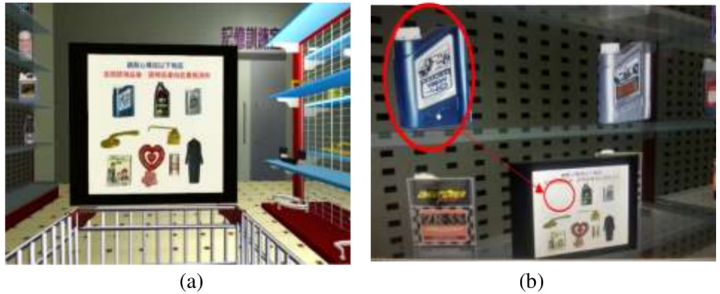
Perceptual Training Room This stage’s main focus is perceptual training, while memory, movement, and attention training are supplementary. The entire virtual training room was designed as a small shopping mall with six types of products: toiletries, motor oil, books, decorations, beverages, and apparel, total 82 items. When the trai- nee enters this store, he/she will first receive a shopping instruction list, which is built on a shopping cart (Figure 1(a)). Trainees find the related product, click on the product with the cursor, and the product will disappear from the shopping list of the shopping cart (Figure 1(b)).
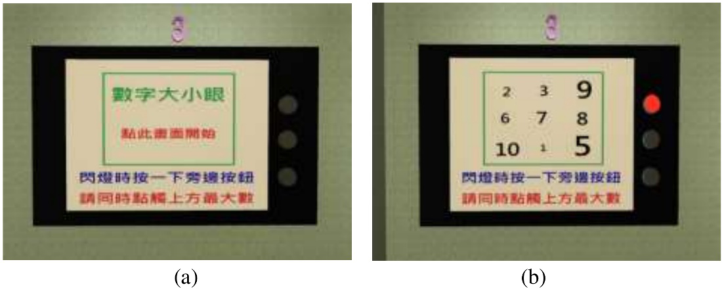
Cognitive Training Room This stage of training belongs to the cognitive stage, emphasizing the training of memory, attention, operation, and judgment. Karbach and Verhaeghen (2014) found that game training can increase some short-term memory functions in older adults; secondly, Ballesteros et al. (2014) also found that inactive video game training has positive effects on cognitive functions in older adults, with immediate and delayed visual recognition memory, pro- cessing speed and attention. The training is divided into three stages: Instant Memory, Digital Eyes, and Distinguish and Calculate. For example, Digi- tal Eyes Training (Figure 2(a)), which focuses on number recognition and
Figure 1: (a) Shopping cart as clue to shopping items; (b) trainees find the related product, click on the product with the cursor, and the product will disappear from the shopping list of the shopping cart.
98 Liu and Su
Figure 2: Cognitive training - Digital Eyes: (a) training instructions; (b) Arabic nume- rals in different sizes will appear on the screen and the trainee should follow the instructions to choose the answer. After you answer correctly, the next question will automatically appear.
judgment supplemented by attention. This training focused on number reco- gnition and judgment and was supplemented by attention training, as shown in Figure 2(b), with three types of games appearing randomly each time.
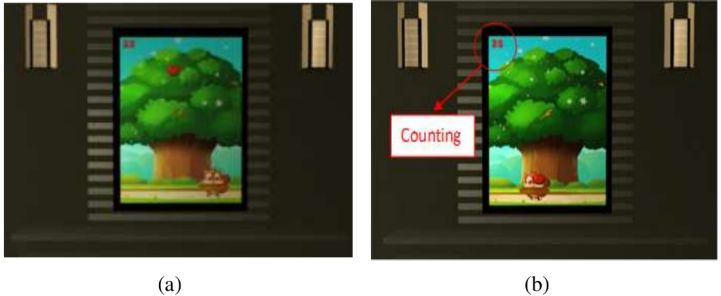
Action Training Room This training phase focuses on action execution skills, supplemented by perception, memory, and attention training. The action stage of informa- tion processing mainly emphasizes the action stage in which people make response selection and response execution after decision-making and jud- gment. Related research pointed out that moderate exercise can increase the brain’s serotonin, making the mood better and less likely to fall into depres- sion. At the same time, exercise is also beneficial for cognitive function, and regular physical activity can slow down memory loss and prevent dementia (Meng et al., 2020). Therefore, the training is divided into three stages: the first part, “No Apple Left Behind,” the second part, “A Feast of Art,” and the third part, “Get Your Body Moving. For example,” “No Apple Left Behind,” the training emphasizes response selection and response execution; the trai- nee uses the finger to control the mouse to move the squirrel’s left and right position to catch the falling apples, and the number of apples is reduced by one for each apple received, for a total of 30 apples (Figure 3(a), (b)).
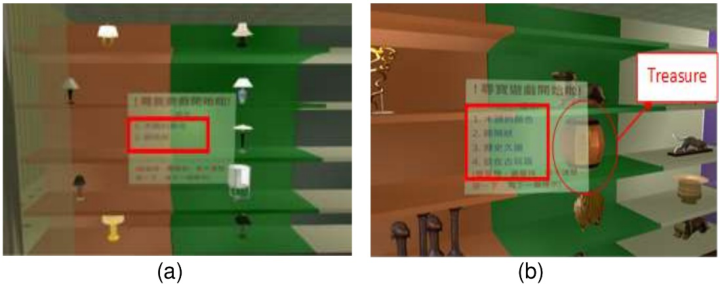
Heuristic Training Room In this stage, the scavenger hunt game encourages the trainee from perception (recognition and confirmation) and cognition (memory, attention, calcula- tion, and judgment). It also inspires through action (control and operation) and conducts comprehensive training in language recognition, picture rea- ding, interpretation, and logical reasoning. This training room is designed with 66 pieces of daily life items (e.g., lamps, mirrors, pots and pans, clocks, oils, antiques, and drinks). The training is divided into two phases. The first phase is a “Single Treasure Hunt,” and the second involves a “Continuous
A Virtual Training System Based on Human Information Processing Model 99
Figure 3: Action training-No Apple Left Behind: (a) the apple appears; (d) the finger controls the mouse and moves the squirrel to the left and right to catch the falling apple.
Treasure Hunt.” For example, “Single Treasure Hunt,” is to find the characte- ristics of treasures through clusters, trainees need to comprehend the content first and find the target treasures through puzzle solving to train their ability to identify, confirm, attention, judge, and operate (Figure 4(a), (b)).
Figure 4: (a) Clue board displays the clue content; (b) all four clues are presented. After confirming the treasure, click on the treasure, and the "Ding Dong-Ding Dong" sound will appear.
Experimental Design Training Settings
1. Training intensity: Previous research has found that training intensity is an essential factor in training effectiveness. Lampit et al. (2014) reported that computerized cognitive training could improve cognitive perfor- mance in older adults, but training more than three times per week is ineffective. This may be because older adults get tired and lose motiva- tion after multiple training sessions. Therefore, this study will be based on the principle of two training sessions per week.
100 Liu and Su
2. Training period: The results of Mrakic-Sposta et al. (2018), who con- ducted a cognitive function training trial over six weeks, showed that participants exhibited a trend of improvement in the MMSE (Brief Mental Scale) on the visual construct test of attention and the visual- spatial test; they also showed improvements in executive tests, memory function, and verbal fluency. Thapa et al. (2020) conducted virtual rea- lity cognitive training for eight weeks, and the results showed that the participants improved their attention, memory, and processing speed.
Subjects There are twelve people between 50 and 65 years old, who are predicted by the early warning system to have early cognitive deterioration, are invited to participate. According to the design of the experimental variables: there are two independent variables and a total of four treatments, so the twelve parti- cipants are randomly assigned to the four treatments, with three participants in each treatment.
RESULTS AND DISCUSSION
The ROC (Receiver Operation Curve) curve analysis is a direct coordinate diagram showing the variability of participants’ responses to the test signals. AUC (Area Under Curve) analysis is a commonly used statistic of the partici- pant’s ability to detect and identify the size of the area under the ROC curve. Therefore, the larger the area under the ROC curve, the better the partici- pant’s ability to detect and identify. Related studies have also reported that applying AUC analysis is more accurate than judging by ROC curves alone (Wu, 2020). Accuracy analysis (P(A)) is the value of the number of correct signal responses (including correct responses to “answer signals” and “non- answer signals”) divided by the total number of signals. This value can be compared to the change in the overall identification ability of the participants. Basically, the higher the accuracy, the better.
As for the MMSE (Mini-Mental Status Examination, a traditional diagno- stic tool for dementia.) assessment results, the results show that the difference between the MMSE scores before and after training is not significant. That is, the sensitivity is worse than that of AUC and Accuracy. Since the deterio- ration or improvement of cognitive function is not a short-term change but a gradual change over time, this study applied virtual reality to conduct cogni- tive function training. The training lasted 8 weeks, a moderately short period. However, because the subjects’ cognitive function gradually changes, it is not easy to see the effect of traditional MMSE testing. Nevertheless, evaluating AUC and Accuracy can accurately estimate the effect of virtual reality cogni- tive function training, which is critical for the trainer or the trainee. Moreover, based on the results, the content and pace of the training can be adjusted to obtain the best training effect. The AUC and Accuracy evaluations confirmed the effectiveness of this study’s virtual reality training system. The results were also consistent with previous research that virtual reality cognitive training over an 8-week period benefits participants’ cognitive performance (Thapa et al., 2020).
A Virtual Training System Based on Human Information Processing Model 101
CONCLUSION
Using the indicators in the ROC evaluation method: AUC (Area Under Curve) analysis and Accuracy analysis have a higher sensitivity to evaluating training effectiveness. When a patient is initially diagnosed with suspected mild cogni- tive impairment (MCI), the deterioration of the condition can be delayed with some assistance (e.g., cognitive game training using virtual reality). The rese- arch results showed that in terms of the effectiveness of VR game training: the cognitive function is suspected to be degraded (but not dementia), and the response effect is significantly improved after training, which has a particular effect on delaying dementia.
ACKNOWLEDGMENT
The authors would like to thank the National Science and Technology Cou- ncil of the Republic of China for financially supporting this work under Contract No. MOST-110-2221-E-992-085-MY2.
REFERENCES
Chan, C. C. H., Fage, B. A., Burton, J. K., Smailagic, N., Gill, S. S., Herrmann, N., Nikolaou, V., Quinn, T. J., Noel-Storr, A. H., Seitz, D. P. (2019). Mini-Cog for the diagnosis of Alzheimer’s disease dementia and other dementias within a secondary care setting. Cochrane Database of Systematic Reviews 2019, Issue 9. Art. No.: CD011414. doi: 10.1002/14651858.CD011414.pub2. Chen, J. K., Liu, C., Peng, C. K., Fuh, O. L., Hou, F. Z. Yang, A. C. (2019). Topologi-
cal reorganization of EEG functional network is associated with the severity and cognitive impairment in Alzheimer’s disease. Physica A-Statistical Mechanics and Its Applications, 513, 588–597. Coyle, H., Traynor, V., Solowij, N. (2015). Computerized and virtual reality cognitive training for individuals at high risk of cognitive decline: systematic review of the literature. Am. J. Geriatr. Psychiatry 23, 335–359. García-Betances, R. I., Arredondo Waldmeyer, M. T., Fico, G., Cabrera-Umpiérrez,
M. F. (2015a). A succinct overview of virtual reality technology use in Alzheimer’s disease. Front. Aging Neurosci. 7:235. doi: 10.3389/fnagi.2015.00235. Karbach, J., Verhaeghen, P. (2014). Making working memory work: a meta-analysis of executive-control and working memory training in older adults. Psychol. Sci. 25, 2027–2037. Kim, J. W., Byun, M. S., Sohn, B. K., Yi, D., Seo, E. H., Choe, Y. M., Kim, S. G.,
Choi, H.j., Lee, J. H., Chee, I. S., Woo, J. I., Lee, D. Y. (2017). Clinical dementia rating orientation score as an excellent predictor of the progression to alzheimer’s disease in mild cognitive impairment. Psychiatry Investing, 14(4), 420–426. Lampit, A., Hallock, H., Valenzuela, M. (2014). Computerized cognitive training in cognitively healthy older adults: a systematic review and meta-analysis of effect modifiers. PLoS Med. 11: e1001756. doi: 10.1371/journal.pmed.1001756. Meng, Q., Lin, M. S., Tzeng, I. S. (2020). Relationship Between Exercise and Alzhei-
mer’s Disease: A Narrative Literature Review. Frontiers in neuroscience, 14, 131. Mrakic-Sposta1, S., Di Santo, S. G., Franchini, F., Arlati, S., Zangiacomi, A., Greci, L., Moretti, S., Jesuthasan, N., Marzorati1, M., Rizzo, G., Sacco, M., Vez- zoli, A. (2018). Effects of combined physical and cognitive virtual reality-based training on cognitive impairment and oxidative stress in MCI patients: A pilot study. Frontiers in Aging Neuroscience, 10. doi: 10.3389/fnagi.2018.00282.
102 Liu and Su
Sherman, D. S., Mauser, J., Nuno, M., Sherzai, D. (2017). The efficacy of cognitive intervention in mild cognitive impairment (MCI): a meta-analysis of outcomes on neuropsychological measures. Neuropsychol. Rev. 27, 440–484. Thapa, N., Park, H. J., Yang, J. G., Son, H., Jang, M., Lee, J., Kang, S. W., Park,
K. W., Park, H. (2020). The effect of a virtual reality-based intervention program on cognition in older adults with mild cognitive impairment: a randomized control trial. J. Clin. Med., 1283. doi: 10.3390/jcm9051283. Tieri, G., Morone, G., Paolucci, S., Iosa, M. (2018). Virtual reality in cognitive and motor rehabilitation: facts, fiction and fallacies. Expert Rev. Med. Devices 15, 107–117. Vallet, G. T., Hudon, C., Bier, N., Macoir, J., Versace, R. Simard, M. (2017). A
semantic and episodic memory test (semep) developed within the embodied cogni- tion framework: application to normal aging, alzheimer’s disease and semantic dementia. Frontiers in Psychology, 8. doi: 10.3389/fpsyg.2017.01493. Wu, Y. (2020). Optimal nonparametric estimator of the area under ROC curve based on clustered data. Communications In Statistics-Theory And Methods, 49(6), 1446–1461.
LISTED IN THE AHFE DIGITAL BOOKSTORE CATALOGUE
Explore the complete digital volume
Healthcare and Medical Devices
Read this individual research paper free through the original publisher, or explore the full digital proceedings book.
ISBN 978-1-958651-55-1
Explore this ISBN in the AHFE Bookstore ↗Listed in the July 2026 bookstore catalogue; search by ISBN to confirm current availability · Digital book purchase optional