Cheng-Li Liu (2026). A spatial language abilities assessment model for diagnosing Chinese speakers in the prodromal stage of dementia. In: Healthcare and Medical Devices. AHFE Open Access, vol. 211, pp. 185–196. https://doi.org/10.54941/ahfe1007481
This study investigates spatial language as a clinical biomarker for prodromal dementia in Chinese-speaking populations. A Virtual Reality (VR) assessment model was developed to evaluate spatial fluency, reference frame naming, and spatial memory in individuals with Mild Cognitive Impairment (MCI) versus healthy controls. The results demonstrate an exceptionally high correlation (r = 0.9431) between spatial language performance and the MoCA scale, validating the model’s diagnostic accuracy. Key findings indicate that while Static Spatial Relationship Expression (SRE-S) is a reliable indicator of overall cognitive stability, Allocentric Spatial Language Memorability (ASLM) exhibits the largest performance gap between groups. It confirms that the inability to linguistically encode environmental maps from a non-self perspective is a primary hallmark of early neurodegeneration. By establishing clear scoring norms, this research provides a non-invasive method for early detection and clinical intervention in dementia care among Chinese-speaking populations.
The Relationship Between Spatial Language and Nonverbal Spatial Representations Many studies have examined the neural correlates of nonverbal spatial representations, such as spatial representation and mental rotation, in patients with dementia, yielding considerable empirical support. In contrast, spatial language has received relatively limited attention. Neuropsychological evidence indicates that lesions in the left frontal or temporoparietal regions are associated with impaired lexical retrieval of words used to describe static or dynamic spatial relations between objects. In contrast, damage to the inferior frontal cortex is linked to deficits in spatial descriptive judgment (Göksun et al., 2013).
Spatial language constitutes a natural bridge between the semantic and perceptual worlds. Consequently, the ability to express spatial relations through language is inherently and closely related to nonverbal spatial representations. Indeed, spatial cognitive ability is a prerequisite for the linguistic conceptualization and communication of spatial information.
186 Liu Wallentin et al. (2005) demonstrated a close association between spatial language and spatial representations. Their experiments showed that memory for object locations described using spatial demonstratives is influenced by factors such as distance, visibility, and familiarity, indicating that linguistic expressions of space reflect underlying nonverbal spatial cognition.
In a functional magnetic resonance imaging (fMRI) study, Noordzij et al. (2008) employed matching tasks involving static left/right spatial relations presented in either pictorial or sentential formats to compare spatial prepositions with visual or verbal descriptions. These findings indicate that spatial information represented in the brain’s frontoparietal network enables the flexible use and expression of spatial knowledge across both linguistic and perceptual domains.
Spatial Reference Frames Spatial language is a mental construct that requires the coordination of perception and language. A spatial reference frame serves as a coordinate system for specifying an object’s location. Conventionally, three primary types are identified based on their distinct informational sources: (1) the relative (or egocentric) frame, defined by the orientation of the observer or speaker; (2) the object-centered (allocentric) frame, based on the orientation of a reference object within the scene; and (3) the absolute frame, grounded in salient environmental or geographic features. In a relative frame, spatial directions are derived from the speaker’s bodily axes, reflecting an egocentric encoding mode where environmental coordinates are processed through bodily movement. Conversely, object-centered frames utilize stable environmental elements, often structured around horizontal and vertical axes to form a grid-like framework. Finally, absolute reference frames operate independently of the speaker’s orientation, employing geographic or abstract coordinates to establish consistent relations among objects.
Some neuropathological progressions suggest that degeneration in the neocortex and posterior cortical areas serves as a prodromal indicator of dementia, manifested behaviorally as impairments in both egocentric and allocentric spatial representations (Malpetti et al., 2023; Laczó et al., 2022). Notably, allocentric reference frames appear to be more severely affected. Thus, abnormalities in spatial reference frame performance during the prodromal stage may disrupt spatial language expression. Such behavioral manifestations may constitute critical early markers for detecting dementia during its prodromal phase.
Developmental Trajectory of Spatial Language and the Expression of Specific Spatial Relations Over the past several decades, the relationship between spatial language and spatial cognition has been widely debated. Early psychological theories proposed that the development of spatial concepts depends on independent
A Spatial Language Abilities Assessment Model 187 nonverbal perceptual and cognitive abilities, which subsequently facilitate language development (Slobin, 1985). More recent research, however, suggests that spatial language itself plays a facilitative role in shaping spatial relations (Simms & Gentner, 2019). Spatial relations are often expressed through topological relations in spatial language. In early childhood, children initially map spatial prepositions directly onto basic topological concepts such as containment and proximity. For example, the term “in” may refer broadly to inclusion or adjacency (e.g., “The cat is there” may imply that the cat is inside a house, on a tree, or near a gutter). As cognitive abilities mature and spatial vocabulary expands, children gradually acquire more complex projective prepositional phrases, such as in front of, behind, to the left of, to the right of, above, and below. These expressions involve additional directional coordination processes and may require different spatial viewpoints or reference frames. Indeed, projective terms such as front and back are initially used by children to describe objects relative to their own bodies. With cognitive maturation, these terms are extended to objects with intrinsic fronts and backs (e.g., the back of a car). Consequently, some scholars propose that spatial language development serves as an indicator of neural and cognitive maturation, with spatial reference frames becoming increasingly complex over time (from relative to object-centered to absolute). Conversely, when neural or cognitive degeneration occurs, the complexity of spatial reference frame usage diminishes, eventually reverting to predominantly egocentric expressions (Kuliga et al., 2021).
Studies on spatial language acquisition have further shown that familiarity with spatial prepositions (e.g., in English) facilitates infants’ ability to form abstract categorical representations of spatial relations, such as containment (Casasola, 2005). Similarly, the Chinese preposition “在” conveys meanings of containment (e.g., “在家” means at home, “在冰箱” means in the refrigerator). Pruden et al. (2011) reported that young children’s ability to produce spatial prepositions predicts their performance on nonverbal spatial tasks. Landau (2016) argued that spatial prepositions describing geometric relations must be expressed within relatively short temporal windows to establish effective spatial-linguistic mappings. Dobnik (2018) further demonstrated that geometric properties, object-specific knowledge, and typical functional relations influence the use of spatial prepositions. Conversely, proficient use of spatial prepositions reflects individuals’ cognitive understanding of geometry, object knowledge, and functional relations. Therefore, the precision and maturity of spatial preposition usage can predict performance on nonverbal spatial tasks.
Objectives The primary objective of this study is to investigate the behavioural characteristics of spatial language processing and communication in Chinese- speaking individuals at the prodromal stage of dementia. We aim to design spatial language assessment tasks under different spatial reference frames to
188 Liu evaluate spatial language abilities and to analyse deficits in spatial language fluency, spatial system naming, and spatial language memory. Based on these findings, a spatial language ability assessment model will be constructed and validated using the Montreal Cognitive Assessment (MoCA). By facilitating earlier detection of prodromal dementia in Chinese-speaking populations through identifiable spatial language deficits, thereby enabling timely clinical intervention and treatment.
RESEARCH METHODOLOGY Integrated Spatial Language Ability Assessment Model
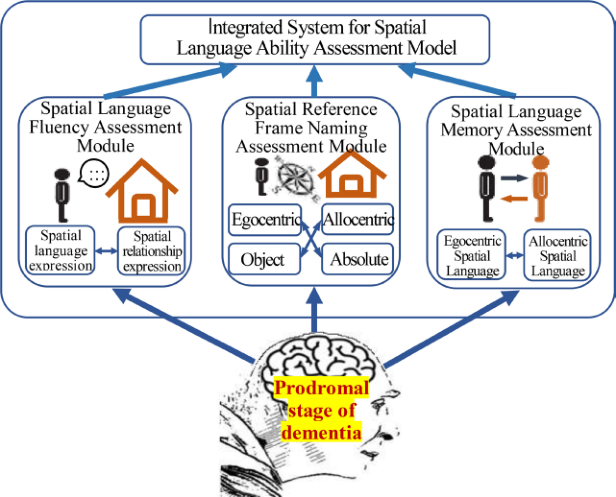
To fully understand the ability of patients in the prodromal stage of dementia to interpret spatial relationships through the use of spatial prepositions, this study employs virtual reality (VR) to construct an Integrated Spatial Language Ability Assessment Model (as shown in Figure 1). This system comprises:
Spatial Language Fluency Assessment Module: Including both Spatial Language Expression and Spatial Relationship Expression tests.
Spatial Frame of Reference (FoR) Naming Assessment Module.
Spatial Language Memory Assessment Module.
This integration aims to achieve an evaluative synergy between spatial linguistic and non-linguistic measurements for a comprehensive assessment.
Figure 1: The framework of integrated spatial language ability assessment model.
1. Spatial Language Fluency Assessment Module
Spatial Language Expression Traditional assessments of verbal expression typically require subjects to freely generate various semantic combinations within a limited timeframe, guided by semantic and phonemic cues. The spatial language expression assessment constructed in this study focuses specifically on evaluating the subjects’ generative fluency of spatial prepositions. These prepositions are primarily used to describe directional spatial relationships (e.g., “The cat is on the tree” or “The car is in the garage”).
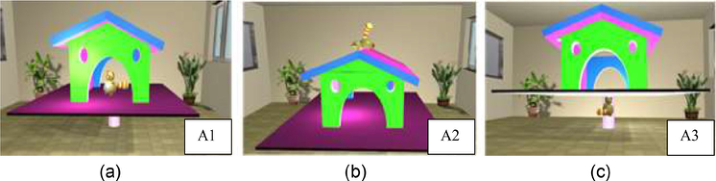
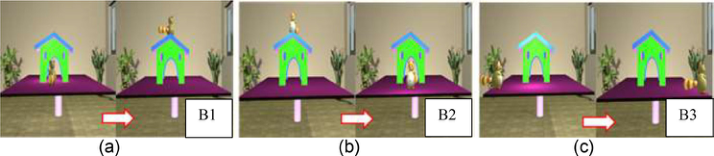
Spatial Relationship Expression The spatial relationship expression assessment is conducted in a 3D virtual environment using a raccoon as the target object; the assessment proceeds through the movement of the raccoon’s position. It is categorized into two assessments: (1) Static Spatial Relationships: These primarily denote the directional position of the target object (protagonist: raccoon) relative to a reference object (stimulus: cottage), carrying directional meaning (e.g., “The raccoon is above the cottage”) (see Figure 2); (2) Dynamic Spatial Relationships: These primarily denote positional sequences and carry path implications, specifically, changes in position (e.g., “The raccoon walks toward the front of the cottage”), carrying directional significance (see Figure 3). Qualified directional prepositions (or prepositional phrases) for static tests and positional sequence prepositions for dynamic tests are listed in Table 1.
Figure 2: Static spatial relationships: (a) The raccoon is inside the cottage; (b) The raccoon is on top of the cottage; (c) The raccoon is under the cottage.Figure 3: Dynamic spatial relationships: (a) The raccoon goes to the upper side of the cottage; (b) The raccoon goes to the lower side of the roof of the cottage; (c) The raccoon goes to the right side of the cottage.Table 1: Evaluation standards for spatial relationship expression.
裡面;中間 Inside; In the middle 上面;上方;上側 On top; Above; Upper side 下面;下方;下側 Under; Below; Lower side 左側;左邊;左方;左 Left side; To the left; Leftward 右側;右邊;右方;右 Right side; To the right; Rightward 後面;後方;後側 Behind; Back; Rear side 前面;前方;前側 In front; Front; Front side 上方;上面 Above; On top 下方;下面 Below; Under 左方;左側;左邊 Leftward; Left side; To the left 右方;右側;右邊 Rightward; Right side; To the right 中間;之間 In the middle; Between 之間;之內 Between; Within 之間 Between 遠方;遠處;前方 Far away; Distant; Ahead
This assessment is designed to evaluate the subjects’ ability to process descriptions of spatial relationships within different spatial frames of reference (FoR). The design of this module includes two primary assessment methods:
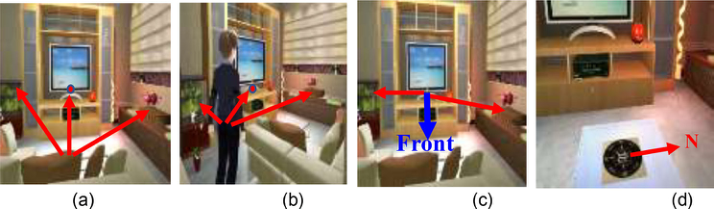
Correctness of the statement Assessment: Evaluating whether the subject can correctly state the spatial relationship between the target and reference objects (see Figure 4).
Correctness of the interpretation Assessment: Evaluating whether the subject can correctly interpret the spatial relationship between the target and reference objects (see Figure 5).
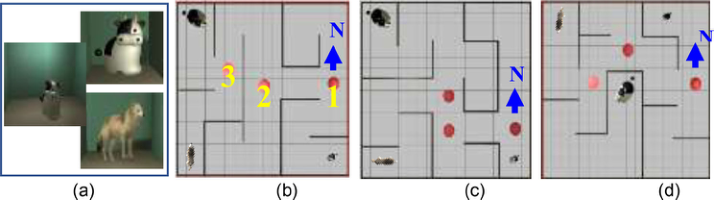
Figure 4: 3D Virtual scenarios for production comprehension assessment in spatial FoR: (a) Subject tested using an egocentric relative FoR; (b) Subject tested using an allocentric relative FoR; (c) Subject tested using the object-centered FoR of the reference object (the TV); (d) Subject tested using an absolute FoR.Figure 5: 3D virtual scenarios for reception comprehension assessment in Spatial FoR: (a) The subject must move the calf (left) to find the mother cow (top right) without being detected by the wolf (bottom right); (b)(c)(d) Subjects undergo three different scenarios. Each scenario provides three directional signal cues: 1st Signal: The system provides the location via a geographical absolute FoR (North is up) (e.g., “The mother cow is to your northwest”). 2nd Signal: The system provides the location via an egocentric relative FoR (e.g., “The mother cow is to your front-right”). 3rd Signal: The system provides the location via an object-centered FoR (centered on the wolf) (e.g., “The wolf is facing north; the mother cow is in front of the wolf”).
3. Spatial Language Memory Assessment Module
The purpose of the spatial language memory assessment is to evaluate episodic memory regarding spatial directional relationships described from two distinct perspectives: egocentric coordinates and external coordinates. To effectively test spatial language memory, this study references the design concepts of the Wechsler Memory Scale (WMS):
Egocentric Spatial Language Memorability Assessment: Evaluates memory of spatial relationships from the perspective of an individual moving through an environment.
Allocentric Spatial Language Memorability Assessment: Provides an overview of spatial positions using the external environment as a frame of reference.
The contents of these two assessments are detailed in Table 2.
Table 2: Text content and free recall prompts for spatial language memorability testing.
Table available in the original PDF paper.
Testing Mode Text Content Free Recall Prompts Egocentric Spatial Language Memorability Assessment
1. Where in the park did Xiao Ming arrive? 2. Toward which part of the park did Xiao Ming walk along the path? 3. At which location did Xiao Ming turn left? 4. In which direction did Xiao Ming turn at the tulip area? 5. After the poplar tree, which direction did Xiao Ming go to reach the vending machine?
Xiao Ming arrived in front of the campground entrance and passed through it, following the path toward the centre of the site. When he reached the lounge seating, he turned left; upon reaching the tulip area, he turned right. He took a short rest under a poplar tree, then continued along the path to the vending machine. 。(The text will be synchronized with a Virtual Reality (VR) spatial path navigation, as illustrated in the figure below.)
Allocentric Spatial Language Memorability Assessment
1. Where is the train station located in the town? 2. Where is the department store in relation to the train station? 3. In front of which building is the post office? 4. Where is the bus station in relation to the train station? 5. Where is the town hall in relation to the train station?
The train station is located in the centre of town. Exiting the station, the department store is to the left, the post office is in front, and the bus station is to the right. The town hall is located in front of the station and to the left of the museum. The park is behind the town hall. Across the park is the night market; there is a parking lot to the right of the park and a movie theatre to its left.
Participants Participants were assigned to either the experimental group or the control group. The inclusion of these two groups aims to evaluate the assessment efficacy of the proposed system.
Experimental Group: 12 participants aged 45–65 will be recruited. These individuals have MoCA (Montreal Cognitive Assessment) scores ranging from 23 to 25, categorized pathologically as suspected cases of early- onset Mild Cognitive Impairment (MCI).
Control Group: 12 participants aged 19–30 will be recruited. These individuals have MoCA scores of 29 or higher, categorized pathologically as having no cognitive impairment.
RESULTS AND DISCUSSION
Correlation Analysis Between the Spatial Language Abilities Assessment Model and the MoCA Scale This study focuses on constructing a highly sensitive spatial language assessment model specifically for patients in the prodromal stages of dementia within a Chinese-speaking linguistic context. The theoretical cornerstone of this model is the premise that spatial cognitive decline often precedes generalized memory loss, and language serves as the most effective window into these subtle neurocognitive shifts. By identifying specific phenotypes of spatial language deficits, clinicians can detect Mild Cognitive Impairment (MCI) at an earlier stage. The model developed in this research is not a monolithic test but a comprehensive evaluation framework composed of seven complementary sub-items, covering the entire cognitive trajectory from basic linguistic expression to high-level spatial representation. These seven indicators include: Spatial Language Expression (SLE); Spatial Relationship Expression-Static (SRE-S) and Dynamic (SRE-D); Spatial Reference Frame Naming - Correctness of the Statement (SRFN-CoS) and Correctness of the Interpretation (SRFN- CoI); and finally, two critical memory indicators: Egocentric Spatial Language Memorability (ESLM) and Allocentric Spatial Language Memorability (ASLM). This systematic framework addresses the limitations of current clinical scales in describing spatial-linguistic functions. In the empirical analysis phase, the total spatial language assessment scores were subjected to a rigorous correlation analysis with the Montreal Cognitive Assessment (MoCA), the current clinical gold standard. The statistical results revealed an exceptionally high positive correlation, with a Pearson coefficient (r) of 0.9431. This data carries significant clinical weight: it not only validates that the spatial language assessment items are highly consistent with the MoCA in terms of measurement dimensions but also demonstrates that the degree of spatial language impairment can accurately reflect overall cognitive degradation. In other words, when a subject encounters obstacles in the structured expression of spatial language, it often signals that the underlying neural systems are already exhibiting pathological signs during high- level cognitive tasks. Consequently, this model possesses immense potential as a core reference index for evaluating individuals suspected of early-onset MCI. Furthermore, an in-depth exploration of individual indicators revealed more nuanced findings. The study shows that Spatial Relationship Expression-Static (SRE-S) exhibits a striking correlation with MoCA scores (r = 0.9722). This nearly perfect linear correlation suggests that an individual’s cognitive encoding of static spatial positions serves as an “anchor” for overall cognitive stability. When patients begin to lose the ability to accurately use directional terms to describe the relative positions of static objects, it is often the most representative functional decline of MCI. Therefore, in future clinical screenings, performance in the SRE-S category should be prioritized as a critical early warning signal.
Differential Analysis of Spatial Language Abilities Assessment Results In the practical application of distinguishing MCI subjects from healthy controls, the study demonstrated powerful statistical discriminative strength. The data indicated a significant difference in total spatial language assessment
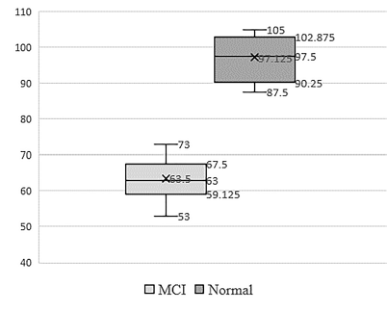
194 Liu scores between the two groups (t(22) = −13.3012, p < .0001). This significance is more than just a numerical gap; it reveals a systematic decline in neuro- circuit efficiency within the MCI population when transforming spatial information into linguistic logic. According to the distribution in the quartile plot (Figure 6), scores for healthy subjects are highly concentrated in the high-performance range, while MCI patients are distributed in a significantly lower interval. This result establishes a clear linear evaluative logic: the higher the subject’s total spatial language score, the lower the probability of having dementia or being in a prodromal stage. Based on the sample data, this study defines preliminary clinical screening norms:
High-Functioning Group (Above 102.875): Represents excellent spatial logic, lexical retrieval, and memory conversion, indicating strong cognitive reserve.
Normal Status (Above 90.25): Subjects in this range experience no significant difficulty in daily spatial navigation or verbal description, with stable cognitive function.
Suspected MCI Status (59.125 - 67.5): This score range is a critical “red zone” for clinical observation. Subjects here exhibit marked spatial vocabulary poverty, viewpoint-switching errors, or memory retrieval delays and should be considered a high-risk group for MCI.
Severe Decline Warning (Below 59.125): Scores below this threshold suggest that cognitive impairment may have progressed beyond the mild stage toward clinical dementia, necessitating immediate neuropsychological intervention and follow-up.
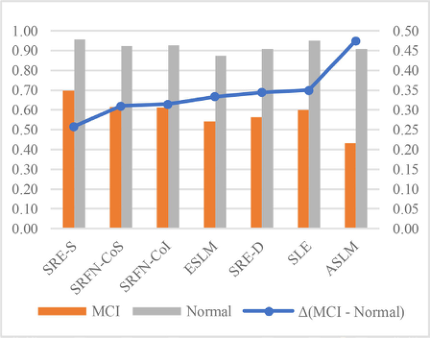
To more precisely clarify the specific impairment characteristics of MCI patients across different spatial language dimensions, the seven indicators were normalized (Average Value / Full Score) to compare the differential values between the MCI and normal groups (Figure 7). The analysis uncovered a phenomenon of high diagnostic value: the Allocentric Spatial Language Memorability (ASLM) indicator showed the largest performance gap between the two groups. This reflects the immense cognitive challenge MCI patients face when processing spatial information from a “non-self” perspective, they struggle to construct an objective environmental map in their minds and store it linguistically. The high variance exhibited by ASLM makes it the most sensitive “specificity indicator” for detecting early MCI. Conversely, while SRE-S is highly correlated with the MoCA, the standardized difference between the two groups was the smallest. This finding implies that while SRE-S scores fluctuate synchronously with overall cognitive ability in all subjects, ASLM is more effective at “amplifying” the chasm between healthy individuals and patients. In summary, the ASLM indicator provides high sensitivity for early diagnosis, while SRE-S offers high reliability for overall disease progression tracking. The combination of these two elements provides a dual-layer safeguard for the clinical application of this assessment model.
Figure 6: Distribution quartile plot of spatial language assessment scores in MCI and normal.Figure 7: The differential values between the MCI and normal in the seven indicators.
CONCLUSION
This study establishes spatial language deficits as a highly sensitive diagnostic marker for prodromal dementia. By integrating linguistic theory with neuropsychological assessment, this research confirms that the inability to coordinate spatial prepositions and reference frames reflects a systematic decline in neural circuits that transform perception into logic. The spatial language abilities assessment model shows a powerful correlation (r = 0.9431) with the MoCA. Static Spatial Relationship Expression (SRE-S) proved to be a reliable anchor for cognitive stability and a critical early-warning signal for MCI, as failure to describe static positions serves. A pivotal finding is the significance of Allocentric Spatial Language Memorability (ASLM). While egocentric processing is more resilient, the “allocentric-to-egocentric” shift, in the failure to linguistically encode an objective environmental map, exhibited the largest performance gap between healthy controls and MCI. By establishing scoring norms via a VR-based assessment, this study provides
196 Liu a standardized, non-invasive framework for clinical screening, enabling the early detection and intervention necessary to improve outcomes for Chinese- speaking patients in the prodromal phase of dementia.
ACKNOWLEDGMENT
The author would like to thank the National Science and Technology Council of Taiwan for financially supporting this work under Contract No. NSTC-114-2221-E-238-001.
REFERENCES
Casasola, M. (2005). Can language do the driving? The effect of linguistic input on infants’ categorization of support spatial relations. Developmental Psychology, 41(1), 183–192. Dobnik, S., Ghanimifard, M. & Kelleher, J. (2018). Exploring the functional and
geometric bias of spatial relations using neural language models. In Proceedings of the First International Workshop on Spatial Language Understanding (SpLU-2018) at the 2018 Conference of the NAACL-HLT, New Orleans, Louisiana, USA. Göksun, T., Lehet, M., Malykhina, K., & Chatterjee, A. (2013). Naming and gesturing spatial relations: Evidence from focal-brain injured individuals. Neuropsychologia, 51(8), 1518–1527. Kuliga, S., Berwig, M. & Roes, M. (2021). Wayfinding in people with Alzheimer’s
Disease: perspective taking and architectural Cognition—A vision paper on future dementia care research opportunities. Sustainability, 13, 1084. https://doi. org/10.3390/ su13031084 Laczó, M., Martinkolvic, L., Lerch, O., Wiener, J.M., Kalinova, J., Matuskova, V., Nedelska, Z., Vyhnalek, M., Hort, J. & Laczó, J. (2022). Different profiles of spatial navigation deficits in Alzheimer’s disease biomarker- positive versus biomarker- negative older adults with amnestic mild cognitive impairment. Frontiers in Aging Neuroscience, 14: 886778. Landau, B., Johannes, K., Skordos, D., & Papafragou, A. (2016). Containment and
support: Core and complexity in spatial language learning. Cognitive Science, doi: 10.1111/cogs.12389. Malpetti, M., Cope, T. E., Street, D., Jones, P. S., …, O’Brien, J. T. & Rowe, J. B.
(2023). Microglial activation in the frontal cortex predicts cognitive decline in frontotemporal dementia, Brain, 146(8), 3221–3231. Noordzij, M. L., Neggers, S, F. W., Ramsey, N. F., & Postma, A. (2008). Neural correlates of locative prepositions. Neuropsychologia, 46, 1576–1580. Pruden, S. M., Levine, S. C., & Huttenlocher, J. (2011). Children’s spatial thinking:
Does talk about the spatial world matter? Developmental Science, 14(6), 1417–1430. Simms, N. K. & Gentner, D. (2019). Finding the middle: Spatial language and spatial reasoning. Cognitive Development, 50, 177–194. Slobin, D. I. (1985). Crosslinguistic evidence for the language-making capacity.
In Slobin, D. I. (Ed.), The crosslinguistic study of language acquisition: Vol. 2. Theoretical issues (pp. 1157–1256). Hillsdale: Erlbaum. Wallentin, M., Østergaard, S., Lund, T. E., Østergaard, L., & Roepstorff, A. (2005).
Concrete spatial language: See what I mean? Brain and Language, 92, 221–233.
LISTED IN THE AHFE DIGITAL BOOKSTORE CATALOGUE
Explore the complete digital volume
Healthcare and Medical Devices
Read this individual research paper free through the original publisher, or explore the full digital proceedings book.
ISBN 978-1-964867-87-8
Explore this ISBN in the AHFE Bookstore ↗Listed in the July 2026 bookstore catalogue; search by ISBN to confirm current availability · Digital book purchase optional