Alina Bola, Niels Hinricher, Chris Schröer, Claus Backhaus (2026). Effects of an Electric Drive Wheel on Hand Force, Body Posture and Perceived Exertion During Hospital Bed Transport by Nursing. In: Healthcare and Medical Devices. AHFE Open Access, vol. 211, pp. 126–132. https://doi.org/10.54941/ahfe1007475
Studies show a high prevalence of back, shoulder and neck pain among nurses. Moving hospital beds is one of the most demanding tasks for healthcare workers, especially due to heavy weights and long distances. To reduce the physical burden on healthcare workers during bed transport, a novel electric drive wheel has been developed. This electric drive wheel replaces one of the four outer castors of a hospital bed. Existing hospital beds can be retrofitted using a plug-and-play approach. The aim of this study was to investigate its impact on the action force, body posture and perceived exertion when moving hospital beds. 13 nurses (5 male, 8 female) moved a standardised hospital bed through a realistic course that included ramps, curves, corridors and an elevator. The bed was moved with and without the drive wheel. Hand action forces were measured using 3D force measurement grips. Body posture was recorded using a Xsens motion analysis system. The subjective perception of strain was analysed using the Borg CR10 scale. In addition, t-tests and Wilcoxon tests were performed to analyse significant differences in peak and mean values between the bed configurations (manual, assist).The drive wheel significantly reduced physical load, lowering hand forces by 22% and trunk inclination by 18%. The highest reductions up to 45% occurred during start phase and when pushing the beds on ramps. Test participants rated the physical workload as “severe” to “very severe”. With the powered castor the physical workload decreased by 69% as “slight”. Hospital beds equipped with electric drive wheels can help reduce physical strain in everyday clinical care during pushing and pulling, especially in high-strain situations such as navigating ramps. However, not all recommended ergonomic limits were met, even with driving assistance.
Keywords: Hospital bed mobility, Hand force, Health care application, Nursing
INTRODUCTION
Nursing staff are regularly required to move hospital beds (Poole Wilson et al., 2015), which places a considerable strain on the musculoskeletal system because of heavy weights and considerable distances (Zhou and Wiggermann, 2017). Nursing staff show high 12-month prevalences of back (55%) and shoulder (44%) complaints (Davis and Kotowski, 2015). About a quarter of sick-leave days in Germany are attributed to musculoskeletal disorders (BMAS and BAuA, 2019). Activities requiring pushing and pulling are linked to higher risk of upper extremity (back, shoulder) symptoms (Hoozemans et al., 2014).
Effects of an Electric Drive Wheel on Hand Forces 127 To reduce nurses’ physical workload, the companies TENTE (TENTE- ROLLEN GmbH, Wermelskirchen, Germany) and LINAK (LINAK A/S, Nordborg, Denmark) developed an electrically driven wheel. It is a drive system directly integrated into the hospital bed and replaces one of the four outer castors. Following a plug-and-play concept, this castor can be installed on hospital beds without special tools. This allows even older hospital beds to be retrofitted. Sensors integrated into the castor detect when a nurse moves the bed, brakes, or pushes the bed up or down a ramp. The integrated software recognizes these movements and automatically activates an electric motor housed in the castor unit. In contrast to earlier powered systems, this assistance is controlled without additional operating elements such as throttles or switches. Nurses move the powered bed in the same way as a conventional bed.
This study examines the extent to which the electric drive wheel effect hand force, body posture and perceived exertion, in typical hospital transport situations.
METHODS
Sample and Setup A total of 13 nursing professionals participated in the study (5 male, 8 female). The average age of the participants was 31 ± 5 years, with an average body weight of 77 ± 16 kg, and an average height of 172 ± 10 cm. The participants had 10 ± 6 years of professional experience. Ten reported that they moved hospital beds daily, while three did so weekly. At the time of data collection, none of the participants reported any musculoskeletal complaints. Participants signed an informed consent form and received financial compensation for their participation. The measurements were conducted using a hospital bed from Völker (S 962-2, Völker GmbH, Witten, Germany). The bed measured 220 × 90 cm and was loaded with an additional 107 kg. The total weight was 260 kg. The electric castor was mounted on the front left foot end of the bed and was also the steering wheel. To investigate the effect of the electric castor on physical load, nursing staff moved the identical bed both without assistance and with the electric castor.
Procedure The test participants completed a test course in a German hospital. The test track was 240 m long and included three 90° right turns, one 90° left turn, and a 12 m ramp with a 7% incline. Five intervals were examined, including start phase, turn, push up ramp, push down ramp and rolling phase. Each participant completed the course three times with and three times without the electric drive wheel. The starting configuration was randomized. All participants performed a practice run in both configurations (manual, assist) to familiarize themselves with the course and bed maneuvering. Participants were instructed to move the bed at a typical working speed. After completing each configuration, participants filled out questionnaires assessing perceived physical exertion using the Borg CR10 scale (see Measures).
Measures Three-dimensional force measurement handles (type 9809A, Kistler Instruments AG, Switzerland) were used to determine hand forces that a participant exerts when moving the hospital bed with and without assistance. The force measurement handles were attached to the bed. The height of the force measurement handles was individually adjusted to the body height of the test participants and corresponded to the midpoint between the wrist and elbow when standing upright with arms extended downward (Brütting et al., 2017). The measurement frequency was 50 Hz. For each of the five intervals, the mean and peak force that the participants exerted to move the two different bed configurations (manual, assist) were calculated. First, the mean values from each of the three trials were calculated for each participant. Then, the overall mean and peak values, including standard deviation (SD), were determined by taking the arithmetic average of the individual mean and peak values of all participants. The measured average and peak forces were compared with the limit values of the EN 60601-2- 52: 2016-04 (IEC 60601-2-52:2009) standard. According to this standard, the starting force must not exceed 160 N and the force required to maintain movement must not exceed 85 N. The peak forces were compared with the limit value of 160 N, and the mean forces with the limit value of 85 N.
When pushing beds, individuals often lean their upper body forward to apply force. According to DIN EN 1005-4:2009-01, trunk flexion poses a significant risk for musculoskeletal disorders. Therefore, sagittal trunk inclination was measured quantitatively using a motion capture system (Xsens MVN Awinda, Movella Inc., USA). Sensors were attached to relevant body segments using elastic straps and medical adhesive tape. Data were collected in real time at a sampling rate of 60 Hz. Peak and mean trunk inclination angles were calculated, including SD, using the same procedure as for hand forces and analyzed separately for each interval. Results were compared to reference values from DIN EN 1005-4:2009-01, which considers trunk flexion angles up to 20° as ergonomically acceptable even for frequent and prolonged tasks.
A laptop (Precision 7540, Dell Technologies Inc., USA) was used for data acquisition. Two cameras (GoPro Hero 11, GoPro Inc., USA) recorded the test procedure, one at the foot of the bed and one at the head of the bed facing the test subject.
In addition to objective measurements, subjective perceived exertion was assessed using the Borg CR10 scale, a validated instrument for rating physical effort (Borg, 1998). The scale ranges from 0 (“no exertion”) to 10 (“very, very strong exertion, almost maximal”). For analysis, Borg scores were averaged across all participants separately for each bed configuration, and SDs were calculated.
Statistical Analysis The peak and mean values of hand forces and trunk inclination were tested for normal distribution using the Shapiro-Wilk test (α = 0.05). If data were normally distributed, a paired t-test was applied. If normality was violated,
Effects of an Electric Drive Wheel on Hand Forces 129 the non-parametric Wilcoxon signed-rank test was used (also α = 0.05). For subjective perceived exertion, the Wilcoxon signed-rank test was applied. The aim of the analysis was to determine whether significant differences existed between the two configurations (manual, assist).
RESULTS
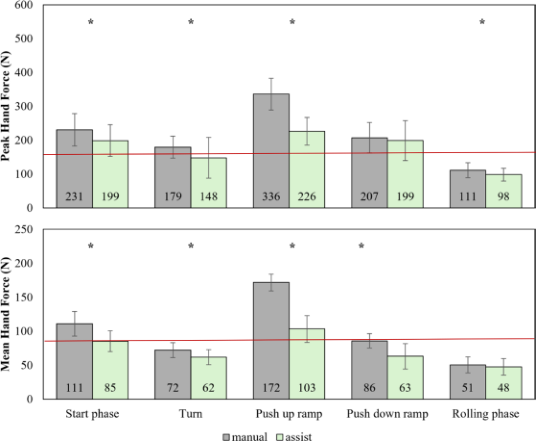
Figure 1 shows the peak and mean hand forces averaged across all participants and broken down by the intervals of the course investigated. Except for the interval push down ramp the assistance significantly reduced the peak hand forces in the remaining four intervals (p < 0.05). A significant reduction in mean forces was observed in all intervals except the rolling phase (p < 0.05). Across all intervals, powered assistance resulted in an average reduction of 16% in peak forces and 22% in mean forces. The largest reductions occurred in the ramp interval: when pushing up the ramp, peak hand force decreased by 33% when using the electric castor; the mean hand force decreased by 40%.
Comparing the three interval sections (start phase, push up ramp, push down ramp) in which the hospital bed was accelerated from standstill with the limit value of 160 N specified in EN 60601-2-52:2016-04 shows that this limit was exceeded in all cases, both during manual pushing and with powered assistance. In contrast, the limit for the force required to maintain motion (85 N) was exceeded far less frequently: during manual pushing in 3 of 5 intervals, and with powered assistance in only one interval (push up ramp).
Figure 1: Averaged peak (top) and mean hand forces (bottom) across the intervals. Gray bars show manual pushing, green bars powered assistance. * show significant differences. Red lines show threshold values according to EN 60601-2-52:2016, 160 N for acceleration phase (top), 85 N for maintaining motion (bottom). (Adapted from Hinricher et al., 2026).
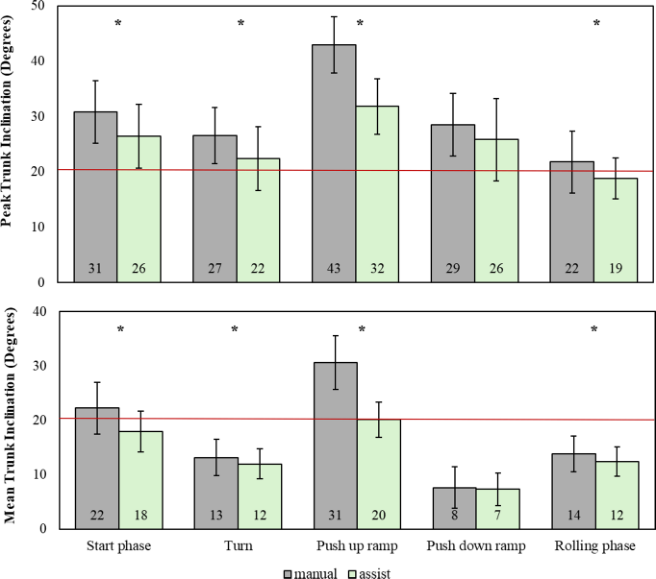
Figure 2 shows the peak and mean sagittal trunk inclinations when moving the hospital bed with and without assistance. In the four intervals in which the bed was primarily pushed, the electric castor significantly reduced peak and mean trunk inclination (p < 0.05). In intervals involving braking maneuvers (push down ramp) no significant effect was observed.
In line with the force measurements, the largest reduction in peak and average trunk inclination was observed in the ramp interval when pushing up the ramp, peak trunk inclination decreased by 26% and mean trunk inclination by 35% with assistance.
Without assistance, the peak trunk inclination exceeded the recommended limit of 20° in all intervals. With assistance the peak values exceeded the limit in four intervals. Without assistance, average angles between 8° (push down ramp) and 31° (push up ramp) were recorded. With assistance, these ranged from 7° (push down ramp) to 20° (push up ramp). With assistance the limit was not exceeded for mean trunk inclination.
Figure 2: Averaged peak (top) and mean trunk inclination (bottom) across the intervals. Gray bars show manual pushing, green bars powered assistance. * show significant differences. Red lines show threshold according to DIN EN 1005-4:2009 (20°). (Adapted from Hinricher et al., 2026).
Across all intervals, the electric castor led to an average reduction in peak and mean trunk inclination of 16%.
The difference between average ratings of subjectively perceived physical effort required to move the hospital bed with and without powered assistance
Effects of an Electric Drive Wheel on Hand Forces 131 was statistically significant (p < 0.001). Manual pushing was rated at 6.4 ± 2.0 on average and was therefore perceived as “severe to very severe”. With powered assistance, the rating decreased to 2.0 ± 0.9, corresponding to “slight” exertion.
CONCLUSION
The results show that the powered electric significantly reduced hand forces. The reductions were particularly pronounced in ramp intervals with up to 40%. A comparison with EN 60601-2-52:2016-04 indicates that the limit value of 160 N for accelerating a bed from a standstill was exceeded in all relevant intervals (start phase, ramp up, ramp down), both with and without assistance. Falling below this limit would only be possible either through stronger support from the electric drive wheel or by nursing staff starting off at a slower speed. Because the wheel is mounted laterally at the foot end, stronger powered assistance would cause the bed to pull more strongly to one side. An alternative solution would be to place the electric drive wheel centrally as a “fifth castor” beneath the bed. The study by Wiggermann (2017) shows that a centrally positioned powered wheel can achieve relief of up to 65% when ascending a ramp and 94% when descending a ramp. In the present study, the peak reduction on ramps provided by the electric castor was 40%. However, because most hospital beds currently in use do not have a fifth castor, retrofitting in this position is only possible with considerable effort.
Hoozemans et al. (2002) suggested that the link between pushing and pulling loads and the occurrence of lower back disorders is primarily attributable to flexed and twisted body postures. In this study, the use of the electric drive wheel reduced peak sagittal trunk inclination up to 26% and mean sagittal trunk inclination up to 35%. Critical postures occurred mainly during ramp intervals and start phases. Without powered assistance, peak trunk inclinations in these sections ranged from 29° to 43°, whereas with powered assistance, they ranged from 26° to 32°. Brütting et al. (2017) also reported trunk inclinations exceeding 20° during the start phases, whereas Glitsch et al. (2007) documented an increase in trunk flexion with rising surface gradient angles. The results indicate that, with assistance, the beds were pushed in a more upright posture than without.
The electric drive wheel significantly reduced perceived physical exertion, with Borg scale ratings decreasing from 6.4 ± 2.0 to 2.0 ± 0.9. Similar findings were also reported by Wiggermann (2017), who assessed perceived exertion across specific route segments (hallway, ramp, elevator, unplanned stop). In that study, Borg ratings for manual pushing ranged from 3.6 to 6.9, whereas the use of an electric fifth wheel resulted in scores between 1.3 and 1.8.
Overall, the results indicate that the use of the electric drive wheel has a particularly pronounced effect on hand forces, body posture and subjective perceived exertion in ramp intervals and acceleration phases, that is, when increased force is required.
This study has some limitations. Walking speed was not standardized to preserve realistic working conditions. Only one bed model was tested, limiting generalizability. The electric drive wheel was examined under a single
loading condition, future studies should include unloaded and bariatric loads. Because participants were aware of the experimental condition (manual vs. assist), perceived exertion may have been biased. Finally, the study was limited to short, standardized test course. Future research should investigate forces and body posture over full work shifts to better capture cumulative physical workload.
REFERENCES
Brütting, M., Hermanns, I., Nienhaus, A., Ellegast, R. (2017). Musculoskeletal loads during pushing and pulling of hospital beds and wheelchairs (Musculoskeletal stresses from pushing and pulling hospital beds and wheelchairs). Zbl. Arbeitsmed. 67, 64–77. https://doi.org/10.1007/s40664-016-0150-4. BMAS, BAuA. (2019). Safety and health at work—Reporting year 2018 [Safety and health
at work – Reporting year 2018]. https://doi.org/10.21934/baua:bericht20191115. Davis, K.G., Kotowski, S.E. (2015). Prevalence of musculoskeletal disorders for nurses in hospitals, long-term care facilities, and home health care: A comprehensive review. Hum. Factors. 57, 754–792. https://doi.org/10.1177/0018720815581933. DIN EN 1005-4. (2009). Safety of machinery – Human physical performance – Part
4: Evaluation of working postures and movements in relation to machinery. DIN Deutsches Institut für Normung. https://doi.org/10.31030/1474814. DIN EN 60601-2-52. (2016). Medical electrical equipment - Part 2-52: Particular requirements for the basic safety and essential performance of medical beds. DIN Deutsches Institut für Normung. Glitsch, U., Ottersbach, H.J., Ellegast, R., Schaub, K., Franz, G., Jäger, M. (2007).
Physical workload of flight attendants when pushing and pulling trolleys aboard aircraft. Int. J. Ind. Ergon. 37, 845–854. https://doi.org/10.1016/j. ergon.2007.07.004. Hinricher, N., Bola, A., Schroeer, C., Ludewig, H., Backhaus, C. (2026) Effects of an electric drive wheel on hand forces, muscle activity, spinal load, perceived exertion and usability during hospital bed transport by nursing staff. Appl. Ergon. 133, https://doi.org/10.1016/j.apergo.2025.104712. Hoozemans, M.J., van der Beek, A.J., Frings-Dresen, M.H., van der Woude, L.H.,
van Dijk, F.J. (2002). Pushing and pulling in association with low back and shoulder complaints. Occup. Environ. Med. 59, 696–702. https://doi.org/10.1136/ oem.59.10.696. Hoozemans, M.J., Knelange, E.B., Frings-Dresen, M.H., Veeger, H.E., Kujer, P.P.
(2014) Are pushing and pulling work-related risk factors for upper extremity symptoms? A systematic review of observational studies. Occup. Environ. Med., 71 (11), 788-795. https://doi.org/10.1136/oemed-2013-101837. Poole Wilson, T., Davis, K.G., Kotowski, S.E., Daraiseh, N. (2015). Quantification of patient and equipment handling for nurses through direct observation and subjective perceptions. Adv. Nurs. 2015. https://doi.org/10.1155/2015/928538. Wiggermann, N. (2017). Effect of a powered drive on pushing and pulling forces
when transporting bariatric hospital beds. Appl. Ergon. 58, 59–65. https://doi. org/10.1016/j.apergo.2016.05.015. Zhou, J., Wiggermann, N. (2017). Ergonomic evaluation of brake pedal and push handle locations on hospital beds. Appl. Ergon. 60, 305–312. https://doi. org/10.1016/j.apergo.2016.12.012.
LISTED IN THE AHFE DIGITAL BOOKSTORE CATALOGUE
Explore the complete digital volume
Healthcare and Medical Devices
Read this individual research paper free through the original publisher, or explore the full digital proceedings book.
ISBN 978-1-964867-87-8
Explore this ISBN in the AHFE Bookstore ↗Listed in the July 2026 bookstore catalogue; search by ISBN to confirm current availability · Digital book purchase optional