Lorenz Müller, Niels Hinricher, Janina Gersie, Claus Backhaus (2022). Prototype of a piece of clothing for patients for quick and easy patient mobilizations in healthcare facilities. In: Healthcare and Medical Devices. AHFE Open Access, vol. 51, pp. 230–238. https://doi.org/10.54941/ahfe1002122
Caregivers are exposed to musculoskeletal strains during patient mobilizations. Especially for patient transfers, hoists were developed, but hoists have a low acceptance and when used incorrectly strains are still high. This paper develops a user-centered prototype to increase the use of hoists. The developed prototype is based on a market comparison, workflow analyses (n = 88), semi-structured interviews (n = 10) and a usability test with caregivers (n = 12). Instead of slings, the prototype lifts patients directly by their clothing. This reduces the transfer time and the steps required to lift a patient. The usability and the caregiver acceptance is high. Improvements address patients' comfort.
Patients require frequent positioning, lifting and transferring by caregivers (Nelson and Baptiste 2006). Musculoskeletal strains occurring in these pro- cesses as well as the link to musculoskeletal disorders are widely studied (Choi and Brings 2015; Davis and Kotowski 2015). To reduce these strains non-technical and technical aids are available. Even though there is a deficit of evidence that technical aids reduce musculoskeletal disorders (Hegewald et al. 2018), the positive effect of technical aids to reduce the physical load during transfers could be shown (Garg and Kapellusch 2012). In particu- lar, hoists are associated with reduced musculoskeletal load (Vinstrup et al. 2020). Hoists are designed to transfer patients using a sling. The daily use requires a universal sling and a hygiene sling (Alexander 2009).
However, hoists have a low caregiver acceptance because of their hand- ling, the perceived additional effort and the lack of user training (Evanoff et al. 2003; Lee and Lee 2017; Curran and Fray 2019; Kucera et al. 2019; Schoenfisch et al. 2019). Getting the equipment takes too long. In addition, slings are not often enough provided in different sizes (Evanoff et al. 2003; Alexander 2009). Furthermore, the application of the slings requires pati- ent positioning. Thereby, caregivers can exceed the NIOSH limit of 3400 N
Prototype of a Piece of Clothing for Patients for Quick and Easy Patient Mobilizations 231
(Dutta et al. 2012; Nagavarapu et al. 2017). Hoist devices already exist that reduce the positioning of the patient before lifting. The “SureHands®Body Support” is a sling bar that can be used for seated transfers without a caregi- ver (Handimove 2018). The research concept “Elevon”is a semi-autonomous hoist. The patient is lifted together with a mat (Fraunhofer 2019). The una- vailable “SlingSerter” shoots slings under the patient without repositioning by using compressed air. The patient is lifted in a horizontal position (Dutta 2014). All in all, current solutions do not adequately cover care processes. To increase hoist use, a highly accepted solution is needed which integrates easy use in caregivers’ workflows.
METHODS
To achieve a high caregiver acceptance, the development of the prototype is based on a user-centered design process. After a market comparison, an observational study and semi-structured interviews were conducted to deve- lop prototypes. At the end, the prototype was evaluated in a usability test (see Figure 1).
Workflow analysis: A workflow analysis was carried out by analyzing video recordings of 88 transfers of a patient dummy (167 cm, 47 kg). The video sequences are from a comparative usability test of floor hoists (Mül- ler et al. 2019). The transfers were performed in a simulated environment by 25 caregivers. The three observed transfers were 1: bed to wheelchair, 2: wheelchair to toilet and 3: surface to care bed. The caregivers used three different floor hoists from one manufacturer with the same slings. The work steps, use errors and times for applying and removing the slings were noted. Organizational processes like equipment pickup were not analyzed.
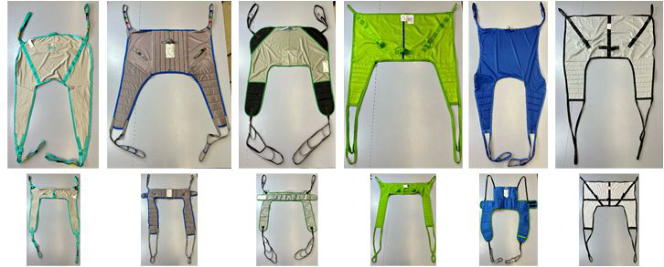
Market comparison: Six currently available standard slings and hygiene slings from six different hoist manufacturers were analyzed and state of the art requirements were derived (see Figure 2). Searches were carried out in the operating instructions and on the internet. The attributes analyzed were the maximum load, material, cleaning and user-supporting features.
Semi-structured interviews: To understand the user requirements, semi- structured telephone interviews with 10 caregivers (w = 4, m = 6) were conducted. The designed guideline included questions about disturbing and stressing work steps with hoists using a scale from 1 (not disturbing/straining) to 10 (very disturbing/straining). Furthermore, the caregivers were intervie- wed on how the problems can be solved. Responses were gathered using inductive category development (Mayring 2000).
Prototyping: The lifting process was broken down into sub-functions. For each sub-function, solutions were collected in a morphological box and evaluated according to the identified requirements. After the solution evaluations, prototypes were iteratively developed.
Usability testing: The developed prototype was tested in a usability test by 12 caregivers (w = 7, m = 5, 26–45 years, M = 32 years, SD = 7) with an average of 10 years of work experience (SD = 7 years). Eleven caregivers (92 %) were experienced hoist users. The test subjects performed a transfer
Figure 1: Prototype development process.Figure 2: Analyzed standard slings (above) and hygiene slings from six different manufacturers.
of a patient dummy (167 cm, 47 kg) using the developed prototype and a floor hoist. The use scenario replicated Transfer 1: Bed to wheelchair of the workflow analysis. The test took place in a usability lab with audiovisual equipment and a one-way mirror for observation. For the effectiveness, the investigator rated the fulfilment of 8 work steps for applying and removing the prototype from good to bad using a 3-point scale. Based on the ratings, a success rate from 0 to 100 % was calculated. The user acceptance from 0–100 was determined using a standardized questionnaire. The questionnaire rates 16 statements by a 5-point rating scale (Müller and Backhaus 2019). Afte- rwards, the caregivers were interviewed. The responses were gathered into categories using qualitative content analysis to identify positive and negative aspects (Mayring 2000).
Sling and prototype comparison: The times and work steps as well as the effectiveness for applying and removing the prototype were compared with conventional slings. The application of the devices in bed was examined. The means were compared using the Student’s t-test for independent samples (p <0.05).
RESULTS
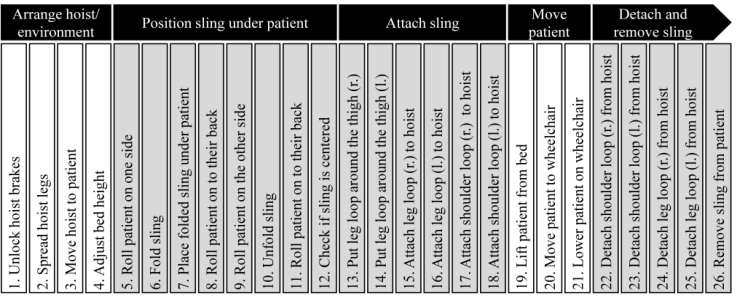
Workflow analysis: Regardless of the transfer type, a lifting procedure consi- sts of arranging the hoist and the work environment, applying the sling under the patient, attaching the sling to the hoist, moving the patient, detaching the sling, and removing the sling from the patient. Figure 3 shows the process of transferring a patient from a bed to a wheelchair. The process includes 26 steps. Of these, 19 steps (73 %) are needed to apply and remove the sling. The number of steps depends on the start and end position of the patient. If
Prototype of a Piece of Clothing for Patients for Quick and Easy Patient Mobilizations 233
Figure 3: Work steps for the transport from a care bed to a wheelchair. Sling-related steps in gray.
the start/end position is horizontal, more steps are necessary than in a seated position due to the patient’s repositioning.
Transfer 1 Bed to wheelchair (time: 09:00 minutes, SD = 01:57, n = 29): The caregivers needed 02:07 minutes (SD = 00:50 minutes) to apply the sling (Figure 3, steps 5–18). Removing the sling (Figure 3, steps 22–26) took 00:51 minutes (SD = 00:23). Overall, applying and removing the sling required 36 % (SD = 8 %, n = 29) of the total time. Transfer 2 Wheelchair to toilet (time: 06:22 minutes, SD = 01:32, n = 30): Putting on the sling in the wheelchair was done in 01:17 minutes (SD = 00:40 minutes), which was 25 % of the total time (SD = 10 %). Transfer 3 Surface to care bed (time: 07:25 minu- tes, SD = 01:43, n = 29): Applying the sling on the dummy on the surface took 01:17 minutes (SD = 0:22). The caregivers removed the sling in 00:37 min (SD = 00:13). Both processes together represent 26 % of the total time (SD = 6 %). Across all transfers, applying and removing the sling took 29 % of the time (SD = 9 %, n = 88).
In the observed transfers, 56 % (n = 88) were done with crossed leg loops. The arms of the dummy were incorrectly placed in 69 % (n = 88). For hygiene slings, the error was 77 % (n = 30). Also, the slings were placed inside out by 52 % of the subjects in 31 % of the transfers.
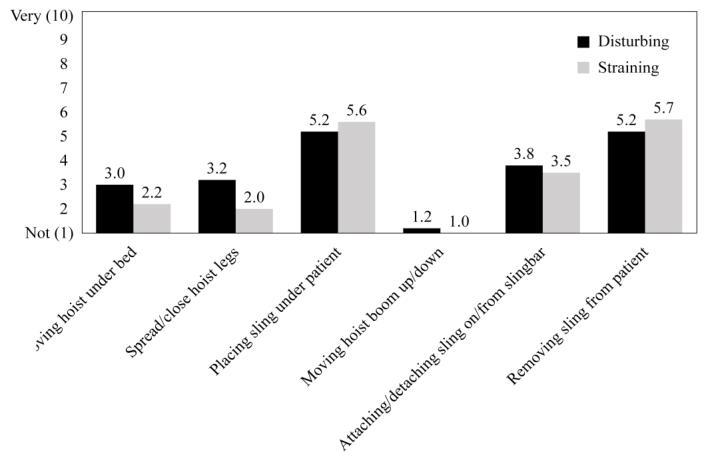
Market comparison: Table 1 shows the analyzed state of the art requi- rements of six universal slings. In addition to tear-resistant materials and durability, they include adjustable shoulder and leg lengths, color-coded and padded slings. Furthermore, the slings should be washable at between 40–95 °C and have a guide loop for maneuvering the lifted patient. Semi-structured interviews: During the work with hoists, placing the sling under the patient and removing the sling from the patient are the most distur- bing and straining work steps (see Figure 4). Two caregivers mentioned that they perform these steps only with a co-worker. The second most straining steps are attaching and detaching the slings on the sling bar, followed by moving the hoist under the bed and spreading/closing the hoist legs.
Table 1. Attributes of the six universal slings. aaaaaaaa Attribute Sling A B C D E F Max. load in kg 250 200 275 200 250 160 Material Polyester Polyester Nylon Polyester Polyester Nylon Cleaning in °C 60 95 95 60-80 40 60 Padding Legs Legs/back Legs/shoulder Legs Legs Legs Shoulder/leg lengths 3/3 4/3 3/4 1/2 3/3 1/2 Color coding Yes Yes Yes Yes No No Guide loops 1 3 1 3 1 3 Center marking No Yes No Yes No Yes
Table available in the original PDF paper.
Figure 4: Disturbing and straining work steps with hoists (n = 10).
The issues mentioned with lift slings include that the slings are not quickly at hand. In particular, there is a lack of suitable sizes. As a result, patients may be transferred in a sling that is undersized. Cleaning the slings is time- consuming and inconvenient, because it must be done before each patient change. If a patient is mobilized into a chair, the sling often remains under the patient. This can cause pressure points. As a solution to the issues with hoists, caregivers indicated that uncertainty with hoists could be reduced if there were more space in patient rooms, more slings available and more trai- ning. New ideas included solutions to help placing the sling under patients or to eliminate these steps. Also mentioned were bed sheets that allow mobiliza- tions or a piece of clothing that is suitable for lifting. Improving the efficiency of the lifting process with hoistable clothing is also suggested by Curran and Fray (2019).
Prototyping: In the interviews, the 71 answers could be gathered into eight categories. Combined with the requirements from the market comparison,
Prototype of a Piece of Clothing for Patients for Quick and Easy Patient Mobilizations 235
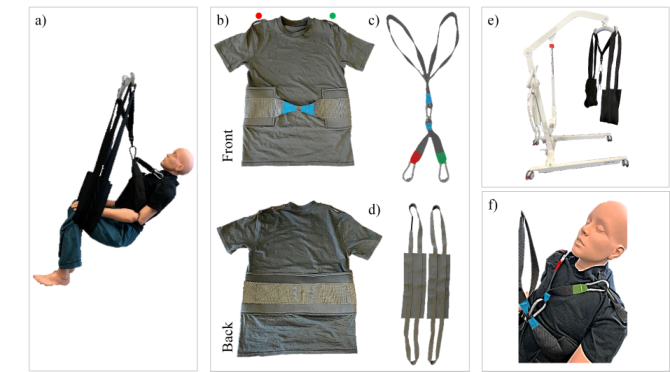
Figure 5: a) Dummy lifted in prototype, b) Color-coded shoulder, back and belly sta- bilization, c) Shoulder and belly strap, d) Leg straps, e) Equipped hoist, f) Attached shoulder and belly strap.
47 requirements could be grouped into eight categories. The categories are technical requirements, patient- and user safety, functionality, usabi- lity, cleanability, material characteristics, individualizability and costs. The requirements were considered and evaluated during the development of the prototypes. In addition, the prototype had to be compatible with conventi- onal floor hoists and ceiling hoists and be usable for transfers from bed to chair, transport to the toilet and for fallen patients. The developed prototype is a piece of clothing for patients. Instead of slings, patients are lifted directly by their clothing. Figure 5 (a) depicts the developed prototype. The clothing is supported at the shoulders as well as at the abdominal and back areas (see Figure 5, b). The connection to the sling bar is made through color-coded carabiners and loops that hang from the hoist’s sling bar. Additionally, the legs are secured using slings (see Figure 5, c, d, e).
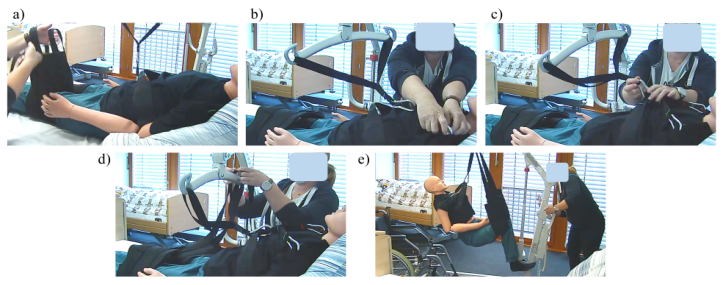
The application of the prototype requires 7 steps (see Figure 6). To remove the prototype, the steps must be performed in reverse order.
Usability testing: The subjects needed 07:28 minutes (SD = 01:23) to tran- sfer the dummy from bed to wheelchair. The prototype was applied in 01:39 minutes (SD = 0:47) and removed in 00:38 minutes (SD = 00:14). After being used by 12 caregivers, the overall success rate of the prototype is 97 %. With a success rate of 88 %, the only use problems occurred when applying and removing the blue coded belly carabiner. One time this carabiner was forgotten. At other times there was an applying issue (n = 1) or the carabi- ner was twisted (n = 2). The user acceptance scored an excellent value of 87 (Min = 63, Max = 97, SD = 9, n = 12) (Müller and Backhaus 2019). The best rated statement was the ease of learning and the quick operational readi- ness of the prototype. The least, but not negatively, rated statements referred to the position of the lifted patient and the disinfection capability of the pro- totype. In the following interviews, each caregiver stated that the developed
Figure 6: a) Place leg loops under thighs (right and left), b) Attach shoulder carabiners (right and left), c) Attach belly carabiner, d) Attach leg loops (right and left), e) Move patient.Table 2. Performance comparison of prototype with current slings.
Table available in the original PDF paper.
Equation reproduced from the original PDF.Equation reproduced from the original PDF.
Apply sling on patient in bed [mm:ss] 01:39 00:47 02:07 00:50 .107 Remove sling in wheelchair [mm:ss] 00:38 00:14 00:51 00:23 .095 Transfer: bed to wheelchair [mm:ss] 07:28 01:23 09:00 01:57 .203 Steps to apply sling on patient in bed 7 - 14 - -
prototype fits their workflow. The caregivers particularly liked that the pro- totype was quick to operate (n = 12), easy to use (n = 12), and fast to use (n = 12). Four subjects each indicated that the prototype reduces the barriers to use and that it is more back-friendly. Points of criticism were related to a possible risk of pressure ulcers (n = 3), concerns about patients’ personal rights (n = 3), patient comfort (n = 2) and the sitting position (n = 2) during lifting. Another optimization point concerned the disinfection of the leg loops (n = 1).
Comparison with conventional slings: The prototype reduces the number of work steps for applying the sling to a patient (see Figure 3, steps 5–18) by 50 %, because the positioning of the patient is eliminated. The time for application is reduced by 00:28 minutes (22 %). The success rate for applying and reattaching current slings is lowest 76 %, 87 % on average, and 93 % at its highest (Müller et al. 2019). Compared with a success rate of 97 %, the efficiency of the prototype is higher (see Table 2).
CONCLUSION
This study describes an approach for future patient mobilizations. The pro- totype provides solutions for issues related to the application and availability
Prototype of a Piece of Clothing for Patients for Quick and Easy Patient Mobilizations 237
of slings. The time saving of 01:32 minutes for the transfer from bed to whe- elchair does not seem much when considered alone and it is not statistically significant. It is important to note, however, that the time savings do not include the search for a suitable sling. Thus, in practice, a much greater time saving is conceivable with the prototype. In addition, the barriers to use are also lower due to less repositioning, the one-person handling and the elimi- nation of searching for slings, which makes a greater willingness to use the hoist more likely, even for activities for which a hoist might not usually be considered. A first indication of this is the excellent user acceptance.
However, the authors want to caution that this approach radically places the needs of caregivers above others in order to generate new solutions. The development makes no claim to be used in the complex multidisciplinary environment of nursing. The patient has not yet been sufficiently included in the development process. For this reason, the prototype must be further developed from the patient’s point of view in subsequent steps. Suitable mate- rials must be selected that ensure a high level of patient comfort combined with high tear resistance and durability. A detailed investigation must then be carried out to determine whether the wearable patient sling poses a risk of pressure ulcers. In the context of these investigations, possible work locations and purposes of use should be precisely defined.
ACKNOWLEDGMENT
The authors thank the participating caregivers.
REFERENCES
Alexander, P. (2009). Hoists and slings: the correct procedures for moving a patient.
British Journal of Healthcare Assistants, 3(2), pp.58–60. Choi, S.D. and Brings, K. (2015). Work-related musculoskeletal risks associated with nurses and nursing assistants handling overweight and obese patients: A literature review. Work. 53(2), pp. 439–448. Curran, J. and Fray, M. (2019). An Efficiency Evaluation of Different Hoisting Devi-
ces to Complete Three Frequent Patient Transfers. In: T.P. Cotrim et al. (eds). Health and Social Care Systems of the Future: Demographic Changes, Digital Age and Human Factors, Proceedings of the Healthcare Ergonomics and Patient Safety, HEPS, 3–5 July, 2019 Lisbon, Portugal, HEPS, 3–5 July, pp. 82–89. Davis, K.G. and Kotowski, S.E. (2015). Prevalence of Musculoskeletal Disorders for Nurses in Hospitals, Long-Term Care Facilities, and Home Health Care: A Comprehensive Review. Human Factors, 57(5), pp. 754–792. Dutta, T., Holliday, P.J., Gorski, S.M., Baharvandy, M.S., Fernie, G.R. (2012). A
biomechanical assessment of floor and overhead lifts using one or two caregivers for patient transfers. Applied Ergonomics, 43(3), pp. 521–531. Dutta (2014). Slingserter: Effortless Patient Handling [online], Available from: https: //www.youtube.com/watch?v=9ntFRIu3EWo [accessed 31 January 2022]. Evanoff, B., Wolf, L., Aton, E., Canos, J., Collins, J. (2003). Reduction in injury rates
in nursing personnel through introduction of mechanical lifts in the workplace. American Journal of Industrial Medicine, 44(5), pp. 451–457. Fraunhofer (2019). Elevon [online]. Available from: https://www.aal.fraunhofer.de/ en/projekte/elevon.html [accessed 31 January 2022].
Garg, A. and Kapellusch, J.M. (2012). Long-term efficacy of an ergonomics program that includes patient-handling devices on reducing musculoskeletal injuries to nursing personnel. Human Factors, 54(4), pp. 608–625. Handimove (2018). Handi-Move Hebebügel: Der Hebebügel ermöglicht selbständi-
ges Wohnen [online]. Available from: https://www.handimove.de/assets/pdf/prod uctsheet/PSH_1030-1035_de.pdf [accessed 31 January 2022]. Hegewald, J., Berge, W., Heinrich, P., Staudte, R., Freiberg, A., Scharfe, J., Girbig, M., Nienhaus, A., Seidler, A. (2018). Do Technical Aids for Patient Handling Prevent Musculoskeletal Complaints in Health Care Workers?-A Systematic Review of Intervention Studies. International Journal of Environmental Research and Public Health, 15(3). Kucera, K.L., Schoenfisch, A.L., McIlvaine, J., Becherer, L., James, T., Yeung, Y.L.,
Avent, S., Lipscomb, H.J. (2019). Factors associated with lift equipment use during patient lifts and transfers by hospital nurses and nursing care assistants: A pros- pective observational cohort study. International Journal of Nursing Studies, 91, pp .35–46. Lee, S.J. and Lee, J.H. (2017). Safe patient handling behaviors and lift use among hospital nurses: A cross-sectional study. International Journal of Nursing Studies, 74, pp. 53–60. Mayring, P. (2000). Qualitative Content Analysis. Forum Qualitative Sozialforschun-
g/Forum: Qualitative Social Research, Vol. 1, No. 2 (2000): Qualitative Methods in Various Disciplines I: Psychology. Müller, L., Sobkowicz, S., Ibenthal, E., Backhaus, C. (2019). Usability assessment of patient hoists as a purchasing guide for health facilities. Current Directions in Biomedical Engineering, 5(1), pp. 141–144. Müller, L. and Backhaus, C. (2019). Entwicklung eines Fragebogens zur ergono-
mischen Bewertung von Medizinprodukten innerhalb des Beschaffungsprozesses in Ge-sundheitseinrichtungen. In: Arbeit interdisziplinär: Analysieren, bewerten, gestalten: 65. Kongress der Gesellschaft für Arbeitswissenschaft, 27 February–1 March 2019. Dortmund: GfA-Press. Nagavarapu, S., Lavender, S.A. and Marras, W.S. (2017). Spine loading during the application and removal of lifting slings: the effects of patient weight, bed height and work method. Ergonomics, 60(5), pp.636–648. Nelson, A. and Baptiste, A.S. (2006). Evidence-based practices for safe patient
handling and movement. Orthopedic Nursing, 25(6), pp. 366–379. Schoenfisch, A.L., Kucera, K.L., Lipscomb, H.J., McIlvaine, J., Becherer, L., James, T., Avent, S. (2019). Use of Assistive Devices to Lift, Transfer, and Reposition Hospital Patients. Nursing Research, 68(1), pp. 3–12. Vinstrup, J., Jakobsen M.D., Madeleine, P., Andersen, L.L. (2020). Biomecha-
nical load during patient transfer with assistive devices: Cross-sectional study. Ergonomics, 63(9), pp. 1164–1174.
LISTED IN THE AHFE DIGITAL BOOKSTORE CATALOGUE
Explore the complete digital volume
Healthcare and Medical Devices
Read this individual research paper free through the original publisher, or explore the full digital proceedings book.
ISBN 978-1-958651-27-8
Explore this ISBN in the AHFE Bookstore ↗Listed in the July 2026 bookstore catalogue; search by ISBN to confirm current availability · Digital book purchase optional