Mehdi Boukhechba, Mingyue Tang, Brendan Bowman, Jamie Zoellner, Emaad Abdel-Rahman (2022). A Smartwatch Based system for Monitoring Fluid Consumption of End Stage Kidney Patients. In: Healthcare and Medical Devices. AHFE Open Access, vol. 51, pp. 76–82. https://doi.org/10.54941/ahfe1002101
Background:End Stage Kidney disease (ESKD) patients must follow unique dietary restrictions. The most onerous of these is the need to restrict fluid intake. The ramifications of poor fluid control include increased mortality and morbidities, frequent hospitalizations with diagnoses of heart failure and pulmonary edema, increased hospital length of stay, and increased total cost of care. Fluid intake control is a bedrock component of treatment for ESKD Patients, but continues to be a major challenge for patients, healthcare providers, and organizations. The ramifications of poor fluid control include increased mortality and morbidities, frequent hospitalizations and increased total cost of care. The goal of this work is to investigate the feasibility of leveraging smartwatch technology to monitor fluid consumption of ESKD patients outside of the clinic. Adequate assessment of fluid intake of patients with ESKD on HD and offering timely feedback to patients and clinicians has the potential of curbing the extra fluid intake, hence reduce mortality and morbidity, and hopefully cut the costs of the need of frequent hospitalizations and/or extra dialysis treatments.Methods:We have designed a smartwatch app called Fluisense (available on Android play store,, https://play.google.com/store/apps/details?id=com.mob.fluisense) to help ESKD patients monitor their fluid intake. Fluisense helps patients record Fluid intake logs in an intuitive manner. Fluisense also collects sensor data such as mobility, acceleration, and heart rate to investigate biomarkers indicative of fluid overload. To the best of our knowledge, this is the first work leveraging smartwatches to monitor fluid accumulation of ESKD patients.N=15 ESKD patients were given an Android smartwatch with Fluisense pre-installed and were asked to log their fluid intake through the app by choosing from a list of predefined volumes each time they consume any liquid. The app computed and displayed the self-reported daily volume intake to help patients monitor their own fluid consumption. Patients received text messages twice a day (9am and 8pm) to remind them to use the watch. We also recorded patients’ weights before and after each of the thrice weekly dialysis sessions. The sum of self-reported interdialytic fluid intake was computed and compared against the interdialytic weight gain recorded in the clinic.Results: Patients recorded Fluids in 214 days out of 259 total days (i.e., 83% compliance rate). The average self-reported interdyalitic fluid consumption is 51 oz +/-64, and the average interdialytic weight gain is 2.67 kg +/- 1.56. We found a moderate but significant correlation between the self-reported fluid volumes and the interdialytic weight gain (r=0.363, P<0.001, r2=0.06). A deep learning method has also been designed to predict the interdialyctic weight gain from sensor data. Results validated through leave one subject out cross validation show an F1 score of 91 at predicting the level of weight change.Conclusion: Leveraging smartwatch-based sensing technology is a promising solution for fluid monitoring of ESKD patients. This can be related to the ease of utilization of this technology and the ecological validity of its measurements given they are collected close to when they happen, reducing recall biases.
Approximately 37 million Americans have chronic kidney disease (CKD) – a decrease in the ability of the kidneys to cleanse toxins from the blood and balance fluid volumes within the body. Millions of others are at increased risk. 750,000 Americans suffer from the most severe form of CKD called end stage kidney disease (ESKD); generally diagnosed when kidney function falls below 15% of normal. While some receive optimal therapy in the form of kidney transplants, another 500,000 patients require mechanical blood cle- ansing known as hemodialysis (HD) (“ESRD Quarterly Update,” 2021). In addition, ESKD patients must follow unique dietary restrictions. The most onerous of these is the need to restrict fluid intake. The ramifications of poor fluid control include increased mortality and morbidities, frequent hospita- lizations with diagnoses of heart failure and pulmonary edema, increased hospital length of stay, and increased total cost of care. Fluid intake control is a bedrock component of treatment for ESKD Patients, but continues to be a major challenge for patients, healthcare providers, and organizations. The
A Smartwatch Based System to Monitor Fluid Consumption of End Stage Kidney Patients 77
ramifications of poor fluid control include increased mortality and morbidi- ties, frequent hospitalizations and increased total cost of care (Dekker et al., 2017; Ponce et al., 2013). There are different methods to measure volume overload with each method having its strengths and limitations. These methods consist of clinical eva- luation followed by objective non-clinical/instrumental methods such as evaluation of biomarkers (e.g., brain natriuretic peptide (BNP)), ultrasono- graphic monitoring (e.g., lung ultrasonography (LUS), carotid artery Doppler, relative blood volume (RBV)), and in-clinic BIA (single-/multiple-frequency and segmental/whole body approaches) (Ekinci et al., 2018; Kushner et al., 1996; Raimann et al., 2014). BIA stands out as one of the most accurate and noninvasive methods. While there are multiple studies investigating the use of bio-impedance to detect body composition for ESKD patients (Ekinci et al., 2018; Kushner et al., 1996), those methods are only administered in-clinic, and to date there is no ubiquitous method to monitor fluid accumulation of ESKD patients passively, continuously and everywhere. Consequently, clini- cians lose sight of their patients when outside of the clinic and where most complications and mortalities happen.
Recent advancements in mobile technology and computational methods for processing sensor signals provide novel opportunities to address these gaps (Almzayyen et al., 2022; Boukhechba and Barnes, 2020). For example, wrist-worn digital devices now: (1) run the same powerful operating systems that power our smartphones; (2) contain built-in motion and physiological sensors (e.g., heart rate, respiration, and bioimpedance [BI] sensors); (3) have powerful processors capable of analyzing sensor signals; and (4) wireless con- nectivity for transmitting data to remote endpoints for further analyses. They have shown tremendous potential at understanding human health and well- being. We see tremendous opportunities to leverage this method to estimate fluid accumulation outside of the clinic by designing and testing Fluisense; a first of its kind multimodal fluid accumulation monitoring system for ESKD patients.
The goal of this work is to investigate the feasibility of leveraging smar- twatch technology to monitor fluid consumption of ESKD patients outside of the clinic. Adequate assessment of fluid intake of patients with ESKD on HD and offering timely feedback to patients and clinicians has the potential of curbing the extra fluid intake, hence reduce mortality and morbidity, and ultimately cut the costs of the need of frequent hospitalizations and/or extra dialysis treatments. This work presents the first smartwatch-based system for monitoring fluid accumulation of ESKD patients in their natural environment using both subjective (i.e., self-reports) and objective (i.e., sensors) measures.
OUR PROPOSED FLUISENSE SYSTEM The Fluisense runtime controls multiple components needed to collect data from ESKD patients. First, the runtime manages data probing. Table 1 pre- sents the various data that can be probed within Android watches. Probes for most hardware-based sensors (e.g., accelerometer and compass heading) fol- low the observer pattern and are activated upon value changes. Probes have
Table 1. Types of data collected through the Fluisense smartwatch app.
Table available in the original PDF paper.
Probe Description Movement Accelerometer Acceleration in three dimensions Gyroscope Change in orientation in three dimensions Compass heading The orientation to the earth magnetic pole Gravity Force of gravity Magnetometer The magnetic field intensity GPS locations Longitude and latitude of the GPS location Pedometer Number of steps Watch on/off body Detects when the watch is off body Environment Light level Ambient light intensity in Lux Sounds level Ambient noise amplitude in decibels Audio recording Audio waves captured from the microphone Temperature Skin temperature Device/Network Battery level Remaining battery percentage Bluetooth Nearby Bluetooth signals Screen on/off Detects when the screen is on or off WLAN Nearby WIFI networks User Self-report Survey Self-reported fluid consumption Heart rate Number of heart beats per minute Photoplethysmography Blood volume changes Sleep Sleep quality Respiration Respiration rates Human activities Performed activities through activity recognition APIs Body composition Body composition through bio-impedance analysis
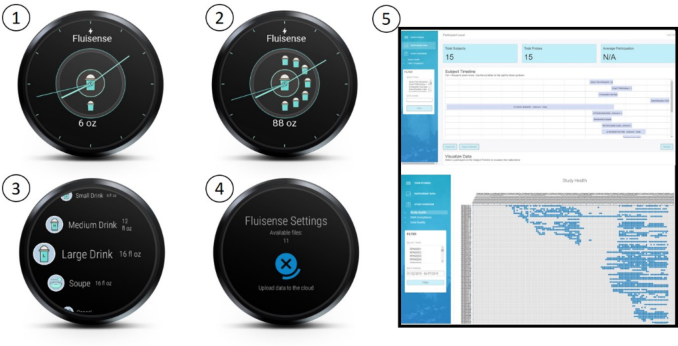
Figure 1: The User interface of the Fluisense smartwatch app (1-4) and the associated dashboard designed to monitor patients’ data on the cloud (5).
configurable data storage rates and several offer continuous (higher power consumption) and periodic (lower power consumption) sensing modes.
Second, the runtime administers fluid consumption surveys. Surveys are user-initiated by clicking on the center of the screen. Participants can choose from a list of pre-defined fluid volumes (e.g., 8oz) and the number of logs
A Smartwatch Based System to Monitor Fluid Consumption of End Stage Kidney Patients 79
and total daily fluid is automatically computed and displayed on the screen (see 1, 2, and 3 in Figure 1). The app has also a quick log mode that adds 2oz by clicking on the top right button of the watch. This is useful for those patients who prefer to have minimal interactions with the system.
Third, the runtime handles data storage. All probed data are temporarily stored locally in an encrypted JSON format then synced to an Amazon data store, and purges the local data store. This happen without necessarily being paired to the participants’ smartphones as most of recent smartwatches have on-board Wi-Fi and/or LTE connections. Energy- and data-efficient transmis- sion strategies are supported by limiting remote data storage to occasions when the device is plugged in and/or connected to a Wi-Fi network. We have also designed a web dashboard to monitor the data collected from Fluisense in real time (see 5 in Figure 1). This is particularly useful for monitoring adherence and connecting with patients in need of help or coaching. The dashboard displays the data collected from each participant, summarizes key metrics indicative of adherence (e.g., active users per day) and includes various querying and data export tools needed for monitoring adherence.
VALIDATION Study Design
After getting approval from Institutional Review Board at the University of Virginia, N = 15 ESKD patients were recruited in a 4-week study to inve- stigate the feasibility and usability of Fluisense. Participants were aged as follows: 26-40: 21.42%, 41-55: 35.71%, 56-65: 28.57%, 66+: 14.29%, with 64.29% female, 28.57% male, and 7.14% trans-gender. Participants belong to 4 different ethnic groups: 57.14% are Caucasian, 14.29% are Afri- can, 21.43% are African American, and 7.14% are Asian. Majority of them (92.86%) are right-handed.
Participants were given an Android smartwatch (Fossil Gen 5) with Flui- sense pre-installed and were asked to log their fluid intake through the app by choosing from a list of predefined volumes each time they consume any liquid. The app computed and displayed the self-reported daily volume intake to help patients monitor their own fluid consumption. Patients received text messages twice a day (9am and 8pm) to remind them to use the watch. We also recorded patients’ weights before and after each of the thrice weekly dialysis sessions. Participants were compensated up to $100 for completing the study.
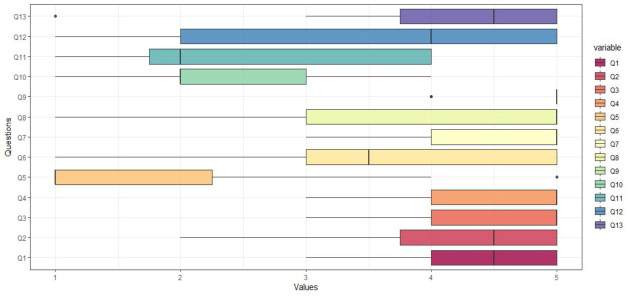
Subjective Data Participants responded to follow-up questionnaires at the end of the study to collect initial qualitative assessment of the feasibility and usability of the system. Questions were asked as follows: Q1: How satisfied are you with the Fluisense program in general? Q2: How much did you like the way the Fluisense app looked? Q3: How much did the program keep your interest and attention? Q4: How good of a fit was the program for you? Q5: How
Figure 2: Results of a qualitative assessment of the Fluisense smartwatch system to measure patients’ self-reported feasibility and usability of the system. (1): not at all, (4) very.
worried were you about your privacy in using Fluisense? Q6: How likely would you continue to use the program on your own?
Q7: How useful was the fluid tracking feature in using the app? Q8: How useful were the text message reminders in using the app? Q9: How much do you think the Fluisense program meets a need for dialysis patients? Q10: How much burden you felt when charging the watch on a daily basis? Q11: How difficult you think it is to remember adding fluid logs to the app. Q12: How much comfort you felt when wearing the? Q13: How interested are you in wearing a band that can automatically measure fluid accumulation?
Results presented in Figure 2 suggest that participants were satisfied with the appearance of the smartwatch app (mean Q1=4.41+/−0.64) and the features implemented in the system (mean Q2=4.08+/−1.11). They felt that Fluisense helped them stay focused on their dialysis tre- atment (mean Q3=4.58+/−0.64) and most patients showed interest in using this technology beyond this trial (mean Q6=3.66+/−1.17). Partici- pants did not report privacy concerns about the data collected by Fluisense (mean Q5=1.91+/−1.32) and reported that the watch was comfortable to wear (mean Q12=3.5 +/−1.44). However, participants felt that self- reporting fluids in moderately burdensome (mean Q10=2.33+/−0.94) and that it is moderately difficult to remember adding fluid logs (mean Q11=2.5+/−1.19).
Participants also preferred having notification reminders to help them keep track of logging fluids (mean Q8=3.9+/−1.44) and expressed interest in passive sensing of fluid accumulation (mean Q13=4.08+/−1.18) Objective Data
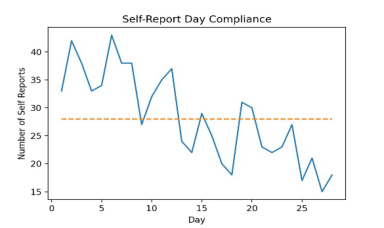
The sum of self-reported interdialytic fluid intake collected through the watch was computed and compared against the interdialytic weight gain recorded in the clinic. Patients recorded Fluids in 214 days out of 259 total days. As seen in Figure 3, there seem to have a decline in adherence as measured by the number of daily self-reports. This aligns with the reported burden recorded
A Smartwatch Based System to Monitor Fluid Consumption of End Stage Kidney Patients 81
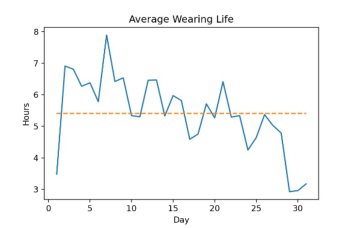
Figure 3: Total number of daily self-reported fluid intake over the course of the study. Horizontal line represents average daily self-reports for all participants.Figure 4: Average daily smartwatch wearing time over the course of the study. Horizontal line represents average wearing time per participant on a daily basis.
in the follow-up interviews in which patients reported difficulty to remember to add the fluid logs. Similar trends were found in Figure 4 that depicts the daily smartwatch wearing time (5.5 hours/day on average) that was found to decline over time. The average battery life was 15.5 hours.
The average self-reported interdyalitic fluid consumption is 51 oz +/−64, and the average interdialytic weight gain is 2.67 kg +/−1.56. We found mode- rate correlation between the self-reported fluid volumes and the interdialytic weight gain (r = 0.363, P<0.001, r2=0.06) that was measured in the clinic. We believe that this is due to missing data and the drop in adherence starting from the third week.
CONCLUSION
Leveraging smartwatch-based sensing technology is a promising solution for fluid monitoring of ESKD patients. This can be related to the ease of utiliza- tion of this technology and the ecological validity of its measurements given they are collected close to when they happen, reducing recall biases.
Nevertheless, patients reported the need for more low burden and pas- sive methods of monitoring fluid accumulation such as passive sensing to automatically estimate fluid overload over time. Patients also reported the need for methods to keep them engaged and help them stay connected with their dialysis treatment. This aligns with the objective measures that recor- ded a decline in adherence over time. These findings speak to the potential of this technology at providing more granular interdyalitic data that could
be used to monitor ESKD patients and help those in risk of fluid overload. This appears to be successful only if coupled with efficient engagement strate- gies to help patients stay adherent. As reported by patients, it also important to investigate more passive methods that allow the estimation of fluid accu- mulation without patients’ input. Thus, we plan to leverage the sensor data collected in this pilot to investigate signals indicative of fluid accumulation and build predictive models that can estimate fluid overload in the future. It is also worth noting that this work can also scale to other applications in which fluid monitoring is important such as general fitness, heart disease and hyponatremia.
ACKNOWLEDGMENT
This work was funded by the Engineering in Medicine seed funding program at the University of Virginia.
REFERENCES
Almzayyen, A., Evia, A.V. de la G., Coronato, N., Boukhechba, M., 2022. Voice- Based Conversational Agents for self-reporting fluid consumption and sleep quality. arXiv:2202.02186 [cs]. Boukhechba, M., Barnes, L.E., 2020. SWear: Sensing Using WEARables. Generalized
Human Crowdsensing on Smartwatches, in: Ahram, T., Falcão, C. (Eds.), Adva- nces in Usability, User Experience, Wearable and Assistive Technology, Advances in Intelligent Systems and Computing. Springer International Publishing, Cham, pp. 510–516. https://doi.org/10.1007/978-3-030-51828-8_67 Dekker, M.J.E., Marcelli, D., Canaud, B.J., Carioni, P., Wang, Y., Grassmann, A., Konings, C.J.A.M., Kotanko, P., Leunissen, K.M., Levin, N.W., van der Sande, F.M., Ye, X., Maheshwari, V., Usvyat, L.A., Kooman, J.P., 2017. Impact of fluid status and inflammation and their interaction on survival: a study in an international hemodialysis patient cohort. Kidney International 91, 1214–1223. https://doi.org/10.1016/j.kint.2016.12.008 Ekinci, C., Karabork, M., Siriopol, D., Dincer, N., Covic, A., Kanbay, M., 2018.
Effects of Volume Overload and Current Techniques for the Assessment of Fluid Status in Patients with Renal Disease. BPU 46, 34–47. https://doi.org/10.1159/ 000487702 ESRD Quarterly Update [WWW Document], 2021. . The end-stage renal disease (ESRD) quarterly update. URL https://www.usrds.org/esrd-quarterly-update/ (accessed 2.13.22). Kushner, R.F., de Vries, P.M., Gudivaka, R., 1996. Use of bioelectrical impedance
analysis measurements in the clinical management of patients undergoing dialysis. The American Journal of Clinical Nutrition 64, 503S-509S. https://doi.org/10. 1093/ajcn/64.3.503S Ponce, D., Abrão, J.M.G., Albino, B.B., Balbi, A.L., 2013. Extended Daily Dialysis in Acute Kidney Injury Patients: Metabolic and Fluid Control and Risk Factors for Death. PLOS ONE 8, e81697. https://doi.org/10.1371/journal.pone.0081697 Raimann, J.G., Zhu, F., Wang, J., Thijssen, S., Kuhlmann, M.K., Kotanko, P., Levin,
N.W., Kaysen, G.A., 2014. Comparison of fluid volume estimates in chronic hemodialysis patients by bioimpedance, direct isotopic, and dilution methods. Kidney International 85, 898–908. https://doi.org/10.1038/ki.2013.358
LISTED IN THE AHFE DIGITAL BOOKSTORE CATALOGUE
Explore the complete digital volume
Healthcare and Medical Devices
Read this individual research paper free through the original publisher, or explore the full digital proceedings book.
ISBN 978-1-958651-27-8
Explore this ISBN in the AHFE Bookstore ↗Listed in the July 2026 bookstore catalogue; search by ISBN to confirm current availability · Digital book purchase optional