Pak Yiu Liu, Joanne Yip, Brian Chen, Lifang He, Jason Cheung, Kit Lun Yick, Sun Pui Ng (2022). Immediate Effects of Posture Correction Girdle on Adolescents with Early Scoliosis. In: Healthcare and Medical Devices. AHFE Open Access, vol. 51, pp. 100–107. https://doi.org/10.54941/ahfe1002104
1 Institute of Textiles and Clothing, The Hong Kong Polytechnic University, Hong Kong ↗
2 Department of Computer Science and Engineering, Lehigh University, USA ↗
3 Department of Orthopaedics and Traumatology, The University of Hong Kong, Hong Kong ↗
4 Division of Science, Engineering and Health Studies, School of Professional Education and Executive Development, The Hong Kong Polytechnic University, Hong Kong ↗
Adolescent idiopathic scoliosis (AIS) is the complex three-dimensional deformity of the spine. AIS is commonly accompanied by postural alterations and imbalance problems. Adolescents with a spinal curvature between 6-20 degrees are defined as being in the early stages of scoliosis. Generally, bracing treatment with a hard brace is only recommended for adolescents with a spinal curvature between 21-40 degrees, while observation with periodical re-examination of the spine is suggested for cases of early scoliosis. Nevertheless, more treatment options could be provided to adolescents with early scoliosis as opposed to only observation. Therefore, a posture correction girdle has been developed with the aim to reduce posture imbalance problems and the possibility of spinal curve progression. In this study, the immediate effects of the posture correction girdle on four adolescents with early scoliosis are reported. Each subject undergoes a 2-hour trial of the girdle. Data collection is carried out before and after the trial by using radiographic imaging and three-dimensional body scanning. To evaluate the immediate effects of the posture correction girdle, comparisons are made pre and post results. Apart from the radiographic analysis, the changes of the postural angles in the frontal, horizontal, and sagittal planes during standing are also considered. The evaluation results show that the girdle has positive effects on the subjects. Two of them show a significant reduction in their spinal curve, while all of them reduce their postural imbalance during the time that the posture correction girdle is worn.
Adolescent idiopathic scoliosis (AIS) is known as the three-dimensional defor- mity of the spine and rib cage. This condition affects posture by changing the body segment to body segment relationship (Masso et al., 2000). The posture imbalance problems related to the head, shoulders, scapula and pelvis may
Immediate Effects of Posture Correction Girdle on Adolescents with Early Scoliosis 101
be found in the frontal, horizontal and sagittal planes (Nault et al., 2002). Posture changes and asymmetry commonly found in AIS patients are rela- ted to the risk of scoliosis progression (Kouwenhoven and Castelein, 2008; Fortin et al., 2021). Researchers believe that spinal deformities and the related painful symptoms of patients who suffer from spinal disorders might fur- ther worsen with bad posture and poor posture stability control (Wong and Wong, 2008; Chen et al., 1998). However, adolescents with early scoliosis, i.e., Cobb angle between 6 and 20 degrees, are generally and traditionally sub- jected to observation with periodical re-examination of the spine instead of undergoing bracing treatment (USC Center for Spinal Surgery, 2022; Dolan et al., 2007). Hence, using a training device as a “posture reminder” is one of the possible and acceptable prophylaxes (Wong and Wong, 2008; Lenssinck et al., 2005). Since there is only a limited number of posture correction pro- ducts in the market specifically for adolescents with early scoliosis, Liu et al. (2014) developed a posture correction girdle to address the gap. The posture correction girdle is a flexible ergonomic undergarment designed and develo- ped for adolescents with early scoliosis that aims to improve their posture and thus reduce the possibility of progression of their spinal curvature (Liu et al., 2014; 2015). Although previous studies on this posture correction girdle sho- wed positive effects in correcting posture and controlling the progression of spinal curvature, they mainly focus on evaluating the relatively longer term effectiveness of this garment through wear trials with 3 to 6 months of wear (Liu et al., 2015; Yip et al., 2016; Fok et al., 2018). An evaluation of the immediate effect on the spinal curvature is lacking. Therefore, the immediate effects of the posture correction girdle in terms of correcting the posture and controlling the progression of the spinal curvature of adolescents with early scoliosis are investigated in this study based on a 2-hour wear trial as the intervention mode. The pre wear and post wear trial data are subsequently compared and reported.
METHODOLOGY
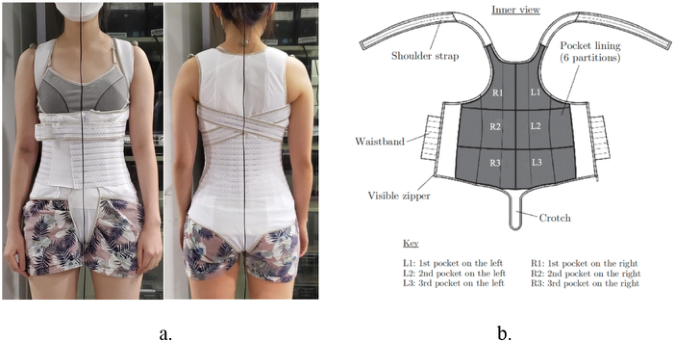
Posture Correction Girdle. Liu et al. (2014, 2015) designed and developed a posture correction girdle comprised a tightly fitting vest much like a girdle that covers the shoulder to the pelvis area. The girdle is mainly constructed of fabric with high strength and recovery, high breathability, and a good hand feel. Semi-rigid resin bones are inserted in the sides and back of the girdle to provide primary support to the torso, while ethylene vinyl acetate (EVA) foam paddings are inserted in the pocket lining to provide corrective points of pressure that accommodate the spinal curvature condition. The length of the shoulder straps and waistband of the girdle can be adjusted to fit different needs and bodies. In this study, two more pieces of hook tape are added to the bottom side of the shoulder strap and waistband to improve the balance control of the straps. Figure 1a shows the front and back views of the posture correction girdle design and Figure 1b shows the inside of the girdle and the pocket lining partitions.
Subjects. Four subjects were invited to participate in the study. The sub- ject inclusion criteria are female between 10-13 years old with early scoliosis,
Figure 1: Posture correction girdle: a. Front and back views and b. inside view and pocket lining partitions.Table 1. Demographic data and basic information of the recruited subjects.
Table available in the original PDF paper.
BMI
Subject Age Risser sign
Curve type
Cobb’s angle
)
Height (cm)
Weight (kg) 1 12 2 S 16.1 150 45.2 20 2 12 3 C 12 156 44.7 18.08 3 13 3 C 17 162.5 52.5 19.81 4 12 3 S 18 164 55.1 20.45 Mean 15.78 158.13 49.38 19.59 SD 2.63 6.43 5.22 1.04
i.e., those who have a Cobb’s angle between 6-20 degrees. They are classi- fied as ≤3 under the Risser sign system. They should not have received any other type of spinal treatment previously. Also, the subjects should have the ability to adhere to the wear trial protocol physically and mentally, and com- municate effectively in English or Chinese. The demographic data and basic information of the recruited subjects are summarized in Table 1. Prior to data collection and the 2-hour wear trial, inform consent was obtained from the subjects and their parents.
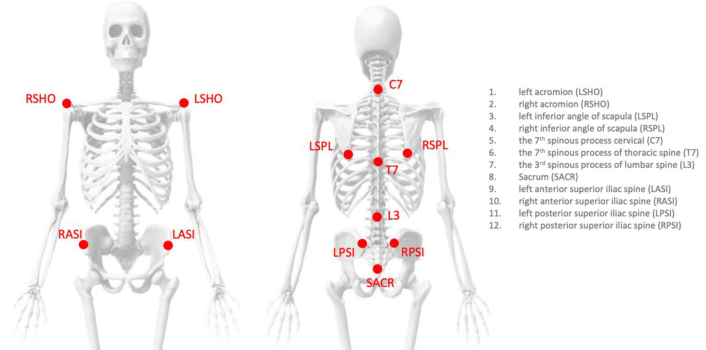
Data Collection Instrument and Wear Trial. Three-dimensional body scan- ning was conducted before (pre) and after (post) the 2-hour wear trial of the posture correction girdle for posture comparison. The 3D body scanning process was conducted by using the Anthroscan body scanning system to capture the physical dimensions of the subjects during their habitual standing posture. Twelve (12) markers of 15 mm in diameter were adhered onto their body as landmarks to calculate the posture angle. The landmarks include the left acromion (LSHO), right acromion (RSHO), left inferior angle of the scapula (LSPL), right inferior angle of the scapula (RSPL), the 7th cervical ver- tebra (C7), 7th thoracic vertebra (T7), 3rd lumbar spine vertebra (L3), sacrum
Immediate Effects of Posture Correction Girdle on Adolescents with Early Scoliosis 103
Figure 2: Body landmarks for posture parameter analysis.
(SACR), left anterior superior iliac spine (LASI), right anterior superior iliac spine (RASI), left posterior superior iliac spine (LPSI), and right posterior superior iliac spine (RPSI), see Figure 2. During the 3D body scanning pro- cess, the subjects were asked to stand up straight as they naturally would with shoulders back and feet apart according to the footprint marker placed on the floor with eyes open and looking forward. After collecting the pre wear trial data, the subjects were asked to put on the posture correction girdle with the recommended EVA foam padding inserted for point pressure creation. The EVA foam paddings were inserted into the pocket lining of the girdle accor- ding to the spinal curvature apex. During the 2-hour wear trial, the subjects were instructed to stand, walk and sit for 10 minutes each, which were repe- ated 4 times in a temperature conditioned room at 25°C. Then, after the 2-hour wear trial and during the time that the posture correction girdle was donned, post wear trial data were collected, and post wear trial radiographic imaging was also carried out.
Posture and Radiographic Evaluation. The posture angles during habitual standing were considered during the posture evaluation for the “pre-wear trial (no girdle)” and “post wear trial (with girdle donned)”. The angles were calculated by using Geomagic Design X Version 2019.0.2 on the 3D scanned images. The posture angles in the frontal, sagittal and horizontal planes were evaluated, which include the acromion, acromion/pelvis, and pelvis angles in the frontal plane, acromion, pelvis, scapula, and acromion/scapula in the horizontal plane, and thoracic and lumbar angles in the sagittal plane (see Table 2). Regarding the radiographic evaluation, the Cobb angles were mea- sured on the “pre-wear trial (no girdle)” and the “post wear trial (with girdle donned)”X-rays for comparison of the spinal curvatures. The immediate effe- cts imposed by the posture correction girdle on posture balance and changes in spinal curvature could be thus determined accordingly.
Statistical Analysis. The data were analyzed by using IBM SPSS Statistic Version 20 to compare the pre-wear and post wear trial posture parameters via a paired t-test. The confidence interval was set at 95% (p<0.05).
Table 2. Posture angles.
Table available in the original PDF paper.
RESULTS
Posture Angles. The analyzed results of the posture parameters are listed in Table 3. For the posture parameters of the frontal and the horizontal pla- nes during habitual standing, smaller angles mean a more balanced posture. The results show that the angle measurements of the acromion, pelvis, and acromion/pelvis in the frontal plane, and those of the acromion, pelvis, sca- pula, acromion/scapula, and acromion/ pelvis in the horizontal plane are generally reduced. Significant differences are found with the acromion/pe- lvis in the frontal plane with p = 0.05 (d=1.58) and acromion/pelvis in the horizontal plane with p = 0.05 (d=0.42). This indicates that the posture correction girdle can generally reduce posture imbalance in the frontal and the horizontal planes. The corrective effect is especially obvious in reducing the imbalance of the frontal alignment between the shoulder and pelvis, and the rotation between the shoulders and pelvis. For the posture parameters of the sagittal plane, an increase of the thoracic angle is found, which indicates less tendency of the upper back to bend forward when the posture corre- ction girdle is donned. Besides, an increase of the lumbar angle is found with
Immediate Effects of Posture Correction Girdle on Adolescents with Early Scoliosis 105
Table 3. Analyzed results of the posture parameters.
Table available in the original PDF paper.
Pre-Wear Trial (Without Girdle Worn)
Post-Wear Trial (With Girdle Worn) Mean±SD Mean±SD p Value (Effect Size)
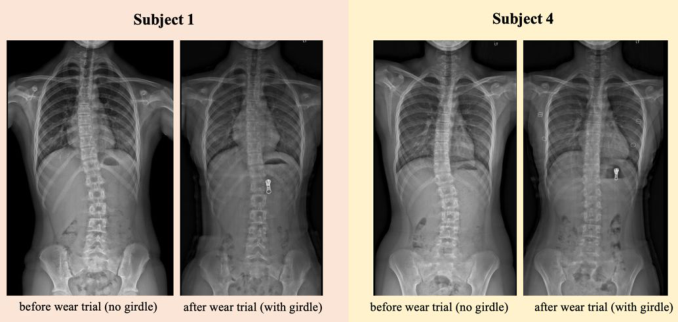
Figure 3: Radiographic results of Subjects 1 and 4.
a significant difference; that is, p = 0.03(d=−1.55), which may indicate a reduction of an exaggerated lumbar curve.
Spinal Curvature. According to the pre-wear trial (no girdle) and post wear trial (with girdle) radiographic imaging results of the four subjects, two of them have a substantial decrease of the Cobb angle while the other two show no changes. The Cobb angle of Subject 1 shows a decrease from 16.1° to 8° and Subject 4 from 18° to 7° (see Figure 3). The subjects who reduced their spinal curve the most have been diagnosed with an S curve, while the other two subjects are diagnosed with a C curve.
CONCLUSION
In this study, the posture correction girdle developed in Liu et al. (2014, 2015) has demonstrated positive immediate effects on correcting posture and con- trolling the progression of spinal curvature. After a 2-hour wear trial, the posture imbalance during habitual standing is reduced in general for all of the subjects when the girdle is donned. The posture improvements are specifi- cally found in the acromion/pelvis angle in the frontal plane, acromion/pelvis angle in the horizontal plane, and lumbar angle in the sagittal plane. Regar- ding controlling the spinal curvature, a substantial reduction in the Cobb angle is found on the two subjects with an S curve, even though they only wore the girdle for 2 hours. Although the girdle is mainly made of soft fabric and assembled with a small amount of semi-rigid materials like the plastic resin bones for primary support and EVA foam paddings for point pressure creation, the garment can still exert a high degree of corrective force to reduce the spinal curvature. However, the Cobb angle of the subjects with a C curve remains unchanged after the wear trial. This may imply that the corrective mechanism of the posture correction girdle is more effective for S curves. Since the sample size in this study is small, further studies should be carried out to compare the effectiveness of the posture correction girdle on both S and C curves.
ACKNOWLEDGMENT
This research is funded by the Laboratory for Artificial Intelligence in Design Limited (AiDLab) (Project Code: RP1-4), Hong Kong Special Administrative Region.
REFERENCES
Chen, P. Q., Wang, J. L., Tsuang, Y. H., Liao, T. L., Huang, P. I., and Hang, Y. S.
(1998). The postural stability control and gait pattern of idiopathic scoliosis adolescents. Clinical biomechanics, 13(1), pp. S52–S58. Dolan, L. A., Donnelly, M. J., Spratt, K. F., and Weinstein, S. L. (2007). Professional opinion concerning the effectiveness of bracing relative to observation in adolescent idiopathic scoliosis. Journal of pediatric orthopedics, 27(3), p. 270. Fok, Q., Yip, J., Yick, K. L., Ng, S. P., and Tse, C. Y. (2018). Effectiveness of posture
correction girdle as conservative treatment for adolescent idiopathic scoliosis: a preliminary study. Ortho. Res. Online J., 1, pp. 1–3. Fortin, C., Feldman, D. E., Cheriet, F., Gravel, D., Gauthier, F., and Labelle, H. (2012).
Reliability of a quantitative clinical posture assessment tool among persons with idiopathic scoliosis. Physiotherapy, 98(1), pp. 64–75. Kouwenhoven, J. W. M., and Castelein, R. M. (2008). The pathogenesis of adolescent idiopathic scoliosis: review of the literature. Spine, 33(26), pp. 2898–2908. Lenssinck M.L.B., Frijlink A.C., Berger M.Y., Bierma-Zeinstra S. MA, Verkerk K.,
and Verhagen A.P. Effect of bracing and other conservative interventions in the treatment of idiopathic scoliosis in adolescents: A systematic review of clinical trials. Physical Therapy 2005, 85(12), pp. 1329–39. Liu, P. Y., Yip, J., Yick, K. L., Yuen, C. W. M., Ng, S. P., Tse, C. Y., and Law, D.
(2014). An ergonomic flexible girdle design for preteen and teenage girls with early scoliosis. Journal of fiber bioengineering and informatics, 7(2), pp. 233–246.
Immediate Effects of Posture Correction Girdle on Adolescents with Early Scoliosis 107
Liu, P. Y., Yip, J., Yick, K. L., Yuen, C. W. M., Tse, C. Y., Ng, S. P., and Law, D. (2015).
Effects of a tailor-made girdle on posture of adolescents with early scoliosis. Textile Research Journal, 85(12), pp. 1234–1246. Masso, P. D., and Gorton III, G. E. (2000). Quantifying changes in standing body segment alignment following spinal instrumentation and fusion in idiopathic scoliosis using an optoelectronic measurement system. Spine, 25(4), pp. 457–462. Nault, M. L., Allard, P., Hinse, S., Le Blanc, R., Caron, O., Labelle, H., and Sadeghi,
H. (2002). Relations between standing stability and body posture parameters in adolescent idiopathic scoliosis. Spine, 27(17), pp. 1911–1917. Penha, P. J., Penha, N. L. J., De Carvalho, B. K. G., Andrade, R. M., Schmitt, A. C. B., and João, S. M. A. (2017). Posture alignment of adolescent idiopathic scolio- sis: photogrammetry in scoliosis school screening. Journal of manipulative and physiological therapeutics, 40(6), pp. 441–451. USC Center for Spinal Surgery. (2022). Scoliosis, Children’s spine surgery [online].
USC Center for Spinal Surgery. Available from: http://www.uscspine.com/conditi ons/childrens-scoliosis.cfm [accessed 2 Feb 2022]. Wong, W. Y., & Wong, M. S. (2008). Smart garment for trunk posture monitoring: A preliminary study. Scoliosis, 3(1), pp. 1–9. Wong, W. Y., Wong, M. S. Smart garment for trunk posture monitoring: A
preliminary study. Scoliosis 2008, 3(7), pp. 1–9. Yip, J., Liu, P. Y., Yick, K. L., Cheung, M. C., Tse, C. Y., and Ng, S. P. (2016). Effect of a Functional Garment on Postural Control for Adolescents with Early Scoliosis: A Six-Month Wear Trial Study. In Advances in Physical Ergonomics and Human Factors, pp. 143–154.
LISTED IN THE AHFE DIGITAL BOOKSTORE CATALOGUE
Explore the complete digital volume
Healthcare and Medical Devices
Read this individual research paper free through the original publisher, or explore the full digital proceedings book.
ISBN 978-1-958651-27-8
Explore this ISBN in the AHFE Bookstore ↗Listed in the July 2026 bookstore catalogue; search by ISBN to confirm current availability · Digital book purchase optional