Qiwen Emma Lei, Zhaolong Chen, Man Chee Kenneth Cheung, Kai-yu Tong, Mei-chun Cheung, Kit Lun Yick, Chi Yung Tse, Joanne Yip (2024). Development of Intelligent Nighttime Brace with Smart Padding to Treat Adolescent Idiopathic Scoliosis. In: Human Factors in Design, Engineering, and Computing. AHFE Open Access, vol. 159, pp. 1351–1359. https://doi.org/10.54941/ahfe1005702
Adolescent idiopathic scoliosis (AIS) is a three-dimensional spinal deformity affecting children aged 10 to 16, with up to 4 in 100 adolescents potentially having this condition. AIS is characterized by asymmetrical shoulders, bulging ribs, or a tilted torso, though patients typically do not experience pain or neurological issues. Treatment varies based on the severity of the spinal curvature and bone maturity, ranging from observation and bracing to surgery and Schroth exercises. Full-day brace wear (18 hours/day) is often recommended but challenging for adolescents, leading to low compliance rates and associated psychological stress for both patients and parents (Vicente., et al, 2021).To address these issues, nighttime braces have been developed to reduce wear time to a minimum of 8 hours per night by overcorrecting the major scoliotic curve during sleep. However, existing nighttime braces, such as the Charleston brace, can cause compensatory curves and permanent overcorrected spinal curvatures, as well as skin issues like rashes and redness (Yrjönen., et al, 2006).This study aims to improve nighttime brace design and material selection to enhance patient compliance and treatment outcomes. The design process will integrate clinical studies, material science, garment design and wearable technologies. The primary function of the proposed brace is to control spinal deformity during sleep.Key features of the new brace include the careful selection of sweat-wicking and breathable textiles to ensure comfort. The brace will incorporate a smart padding system that automatically adjusts corrective forces and positions. Preliminary clinical trials will be conducted with a diverse group of subjects to refine and optimize the intelligent brace. These trials aim to ensure the brace's effectiveness across various cases. The intelligent brace is designed to enhance patient compliance and treatment efficiency while reducing the risk of skin problems through automatic adjustments and a comfortable wearing experience, ultimately improving overall patient outcomes.ReferencesVicente, L. G., Barrios, M. J., González-Santos, J., Santamaría-Peláez, M., Soto-Cámara, R., Mielgo-Ayuso, J., Fernández-Lázaro D. & González-Bernal, J. J. (2021). The ISJ 3D brace, a providence brace evolution, as a surgery prevention method in idiopathic scoliosis. Journal of Clinical Medicine, 10(17), 3915. Yrjönen, T., Ylikoski, M., Schlenzka, D., Kinnunen, R., & Poussa, M. (2006). Effectiveness of the Providence nighttime bracing in adolescent idiopathic scoliosis: a comparative study of 36 female patients. European Spine Journal, 15(7), 1139-1143.
Adolescent idiopathic scoliosis (AIS) is a three-dimensional spinal curvature often linked with intervertebral rotation, occurring typically during the adolescent years (Masso, 2000). The treatment of scoliosis is primarily categorized into surgical and non-surgical methods (Yang et al., 2020). The goal of non-surgical treatment for scoliosis patients is to offer a conservative solution that treats their condition while promoting higher compliance by minimizing disruption to their daily activities (Romano & Negrini, 2008). To address this, nighttime braces have been developed, designed to be worn only during sleep. The principle behind their design is to overcorrect the major scoliotic curve, thereby reducing the brace wear time to a minimum of 8 hours each night (Sattout et al., 2016). However, despite the shorter usage time, nighttime braces carry the risk of overcorrection and skin issues. Additionally, it has been observed that the Charleston nighttime brace may lead to an increase in compensatory curves due to the potential for uneven loads on the vertebrae, resulting in unintended corrective forces (Wong, 2021). Overcorrecting spinal curvatures can pose significant and permanent issues with negative consequences (Roussouly & Nnadi, 2010). Therefore, the design direction for this brace is to develop a real-time intelligent monitoring and adjustable silent pneumatic system, ensuring safety, wearability, and effectiveness for AIS patients.
METHODOLOGY
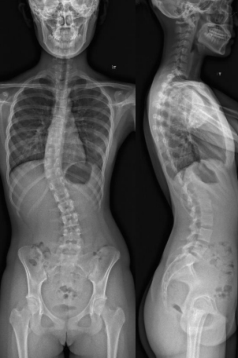
Radiographic and MRI Scan Evaluation. The prospective candidates will use the EOS system (EOS Imaging, Paris, France) for full-spine coronal and sagittal X-ray imaging (Figure 1). This technique minimizes radiation exposure while capturing frontal and lateral body X-rays simultaneously with the patient in an upright position (Melhem et al., 2016). To perform a standing radiograph, the patient needs to be calm and upright, with their hands slightly fisted on their clavicles. A doctor will use the X-ray scans to evaluate the Cobb angle in the coronal plane, as well as other sagittal plane characteristics such as pelvic tilt, sacral slope, and lumbar lordosis.
Subjects who meet the criteria will be selected for the development phase of the nighttime brace following the radiological assessment. Spinal flexibility is one of the most crucial components of the evaluation process for new participants, and it can be assessed with the patients in the supine position. For supine radiography, the patients will recline comfortably on a radiolucent table. However magnetic resonance imaging (MRI) will be used to evaluate how well the bracing reduces the patients’ radiation exposure.
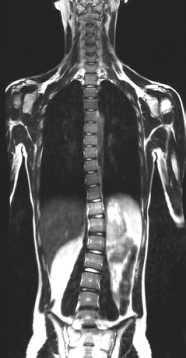
A non-invasive medical process called an MRI scan (Figure 2) creates images of the body’s soft tissues, including muscles and organs (Huber et al., 2020). The images are produced by radio waves, a computer, and a magnetic field. An MRI does not require radiation, in contrast to CT or X-ray scans. Therefore, it is a safe option for imaging, especially for people who need regular imaging exams to address long-term health difficulties.
To assess the effectiveness of the bracing, radiographic assessment and magnetic resonance imaging (MRI) are required.
Development of Intelligent Nighttime Brace With Smart Padding 1353
Figure 1: Domains radiological assessment of AIS patients: full spine coronal and sagittal x-ray.Figure 2: MRI scan imaging.
Fabric test standards and conditions. The fabrication of the proposed intelligent nighttime brace should provide sensorial, thermo-physiological, and ergonomic wear comfort. Several material tests, such as those measuring air permeability, surface properties, and dimensional changes in fabrics after home laundry, should be conducted before choosing a fabric. As per the suggested design, various kinds of textiles are required for constructing the prototype. The fundamental needs will be for materials with good moisture- wicking, breathability, elasticity, and recovery in addition to a smooth hand feel. Ten fabric samples were put through three fabric tests based on the fabric selection criteria.
Air permeability. To assess breathability, the KES-F8 air permeability test gauges the pace at which air passes through a specific section of the material (Yang et al., 2022). The specimens were held with their right side facing
up beneath the protecting plate. The typical ventilation area is 2π cm2, with an airflow rate of 8π cm3/s and a piston speed of 2π cm/s. Then, a pressure detector was used to monitor the resistance of the exhaust and air intake. Higher breathability is implied by a smaller figure since less pressure is required for air to move through the cloth. The following equation was used to calculate the results kPa·s/m.
Stretch and recovery. To ascertain the fabric’s stretchability and recovery, ASTM D6614 was used (Khan, 2024). The chosen materials were cut to dimensions of 50 ± 0.5 mm × 300 ± 0.5 mm in both the warp and weft orientations. The specimens were clamped between two jaws spaced 20 cm apart and pulled with a tension of 4.0 ± 0.02 pounds. The specimens’ lengths were measured for 5 ± 0.1 minutes both with and without strain (Function 1&2).
Fabric Stretch% = (Length of extension – Original length)/ Original length x 100 Function 1 Fabric recovery% = (Length of extension –Length of extension after relaxation)/ (Length of extension – Original length) x 100 Function 2
Surface properties. To assess the surface qualities, the surface mean friction coefficient, mean friction coefficient fluctuation, and roughness value will be measured using the KESFB4-A surface tester (Moria, 2011). For the primary fabrics, materials with lower related values are considered superior options. Surface characteristics such as roughness, smoothness, and unevenness can directly impact the hand feel and wear comfort of the designed brace. The terminology used by the friction tester to describe the physical qualities is explained below. The material’s surface roughness was determined using the MMD data (Function 3).
MMD Represent the fluctuation of the mean frictional coefficient. The higher value of MMD means the fabric surface is rougher and less smooth and soft. Function 3.
Human Subjects. To participate in the study, three human individuals were invited. The inclusion criteria required subjects between the ages of 10 and 13 with early scoliosis, defined as a Cobb angle between 10 and 25 degrees. According to the Risser sign system, they must fall under category ≤3. They should not have received any prior spinal treatments. Additionally, participants must be able to follow the wear trial protocol both cognitively and physically and be proficient in either English or Mandarin. Table 1 provides a summary of the recruited respondents’ demographic characteristics and basic information. Informed consent was obtained from both the parents and the human subjects before data collection and the one- hour wear experiment. This study was conducted according to the guidelines of the Declaration of Helsinki and was approved by the Human Subjects Ethics Sub-committee of The Hong Kong Polytechnic University (protocol code: HSEARS20240306005).
Development of Intelligent Nighttime Brace With Smart Padding 1355
Table 1. Demographic data and basic information of the recruited subjects.
Table available in the original PDF paper.
BMI
Subject Age Risser Sign
Curve Type (S/C)
Cobb’s Angle(
) Height (cm)
Weight (kg) 1 11 2 C 13.2
(T) 158 50.2 20.1 2 12 2 S 14.9
(T), 14.7
(L) 158 46 18.4 3 11 0 C 20
(L) 152 45.1 19.5
Data Collection Instrument and Wear Trial. The anisotropic nighttime brace will be developed for each recruited subject based on their X-ray images (standing position) and MRI scan images (supine position). These images will serve as the framework for the development of the nighttime brace. A pneumatic padding system, which includes one or two paddings, will be properly attached according to the wearer’s spine curve. A wear trial experiment will then be conducted for each subject.
First, each subject will undergo an X-ray before starting the experiment. MRI scans are also required to assess the subjects’ spinal flexibility. Following this, brace wear trial assessments and corrective force evaluations will be carried out using MRI scans. Air paddings will be inserted according to the subjects’ spine curves. The MRI scan will then be used to observe the optimal effect of the spine being corrected by the nighttime brace.
During this process, the pressure that maximizes the correction of the spinal deformities for each experimental subject will be determined, and the effectiveness of the nighttime bracing for each subject will be evaluated.
RESULTS AND DISCUSSION
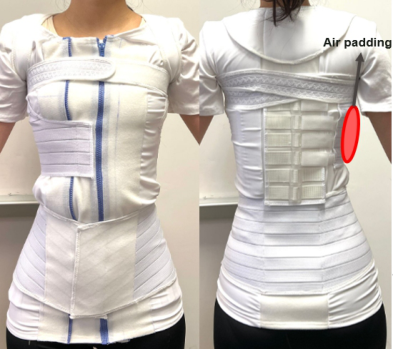
The intelligent nighttime brace. The intelligent nighttime brace with intelligent paddings is designed for adolescent idiopathic scoliosis (Figure 3). It consists of a short-sleeved undergarment with two fixing panels, several separate woven elastic band panels, a pelvis belt, and wide shoulder straps. The short-sleeved undergarment is a one-piece garment with zipper openings, made of cotton blends (cotton spandex). It features short sleeves, a crew neck, and a length that covers the hips. For stabilization purposes, there are three bones on both sides of the front panel and two bones on both sides of the back panel. Two fixing panels are sewn onto the front and back of the undergarment, respectively. The front fixing panel is made of Velcro in the center front, while the back fixing panel is made of spacer fabric, Velcro, fixing bones, and an adjustable piece in the center back.
Several separate woven elastic band panels are designed for scoliosis patients with different curves in various locations of the spine. Each separate woven elastic panel consists of woven elastic bands, 2-way tricot or Powernet, and several hook-and-loop fasteners. These panels are designed as pockets to accommodate the padding inside (as shown in Figure 3). The pelvis belt is a one-piece design that attaches to the center back of the short-sleeved undergarment with Velcro and wraps around the body to the center front, where the two sides are secured together with Velcro. The wide shoulder
straps are made of spacer and woven elastic bands, which are integrated into the short-sleeved undergarment.
Figure 3: Design of intelligent nighttime brace.
Fabric selection. High air permeability indicates the material’s ability to maintain suitable dryness and evaporate heat, thereby ensuring comfort. The average air permeability of the specimens is listed in Table 2. Among them, T1, S2, N3, C2, and V3 exhibit the best performance comparatively. Stretch and recovery are crucial properties. High stretchability and good recovery significantly impact the fit, flexibility, and durability of the material. In this test, both the outer and inner layers of the brace were evaluated, as the project specifically targets the interface pressure between the body and the designed brace during stretching, as well as the material’s resistance to deformation under intensive force. This test helps in selecting materials with high modulus, low force decay, and high recoverability. The average percentage of stretch and recovery of the specimens in the warp direction is also listed in Table 2, with T2 and N1 showing the highest modulus and recoverability. A good fabric hand feel is significant since the wearer needs to wear the brace throughout the night, in direct contact with the skin. It is essential to test the fabric’s comfort to prevent skin irritation. A higher MMD value indicates a rougher, less smooth, and less soft fabric surface. According to the results listed in Table 2, T2, S1, N1, C2, and V3 have the best results relatively.
Based on the fabric test results, T2 and S1 have been selected for the inner layer due to their smoothness, which is crucial as they come into direct contact with the skin. N1 and C2 have been chosen for the outer layer because of their superior performance. V2 is also selected for the outer layer due to its excellent water vapor permeability and thermal conductivity, outperforming the other two options. Although V2 has slightly higher roughness and kPa.s/m values compared to V3, breathability is more important for the outer layer than fabric smoothness. All selected fabrics T2, S1, N1, C2, and V2 meet the basic requirements.
Development of Intelligent Nighttime Brace With Smart Padding 1357
Table 2. Fabric test results of the rested specimens.
Table available in the original PDF paper.
Air Permeability Stretch and Recovery (Warp) Surface Properties Specimen No.
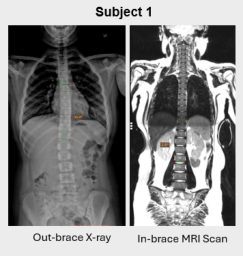
Clinical Trial Result. The enrolled subjects will be invited to undergo full- spine coronal, sagittal, and MRI scans to assess their scoliosis curves and spinal flexibility. The in-brace correction during the wear trial is calculated by determining the difference between the Cobb angles with and without the brace. Three subjects were recruited for the long-term wear trial. Figure 4 shows the subjects’ information and preliminary wear trial results. These subjects are currently in the long-term trial stage. More patients will be gradually recruited to participate in long-term trials of the nighttime brace. A three-month follow-up will be conducted to classify and evaluate the results of the experimental subjects.
Figure 4: Radiographic results of subjects 1, 2, & 3.
CONCLUSION
In this study, the intelligent nighttime brace demonstrated positive immediate effects on spinal curve control. After applying corrective force by adding pressure through the padding system during the wear trial, the spinal correction outcome was observed in the supine position using MRI scans.
The spinal deformity generally improved for all subjects when the nighttime brace was worn. Regarding spinal curve control, impressive Cobb angle reductions were found in the three human subjects, even though they wore the nighttime brace for only around one hour. Although the nighttime brace is primarily made of soft fabrics and assembled with a small proportion of semi-rigid materials, such as plastic bones for primary support and air paddings for point pressure creation, it can still exert significant corrective forces to improve the spinal curve. However, the Cobb angle of subjects with a C-curve or S-curve type at the thoracic area remained unchanged after the wear trial. This may imply that the corrective mechanism of the intelligent nighttime brace is more effective on the lumbar area in terms of spinal curve control. Since the sample size in this study is small, further research should be conducted to compare the effectiveness of the intelligent nighttime brace on different curve types.
ACKNOWLEDGMENT
This work is supported by funding from the Innovation and Technology Fund – Innovation and Technology Support Programme. Granted to the Hong Kong Polytechnic University (ITS/007/22).
REFERENCES
Huber, F. A., Del Grande, F., Rizzo, S., Guglielmi, G., & Guggenberger, R. (2020).
MRI in the assessment of adipose tissues and muscle composition: how to use it. Quantitative Imaging in Medicine and Surgery, 10(8), p. 1636. Khan, M. I., Zaman, S. U., Baitab, D. M., Hamdani, S. T. A., Nawab, Y., & Umair, M. (2024). Stretch and recovery properties of combined and combination twill based woven fabrics. Textile Research Journal, 00405175241263314. Masso, P. D., and Gorton III, G. E. (2000). Quantifying changes in standing body
segment alignment following spinal instrumentation and fusion in idiopathic scoliosis using an optoelectronic measurement system. Spine, 25(4), pp. 457–462. Melhem, E., Assi, A., El Rachkidi, R., & Ghanem, I. (2016). EOS® biplanar X-ray imaging: concept, developments, benefits, and limitations. Journal of Children’s Orthopaedics, 10(1), pp. 1–14. Moria, H., Chowdhury, H., Alam, F., & Subic, A. (2011). Aerodynamic behaviour
of stretchable sports fabrics. Sports Technology, 4(3-4), pp. 171–177. Romano, M., & Negrini, S. (2008). Manual therapy as a conservative treatment for adolescent idiopathic scoliosis: a systematic review. Scoliosis, 3, pp. 1–5. Sattout, A., Clin, J., Cobetto, N., Labelle, H., & Aubin, C. E. (2016). Biomechanical
assessment of providence nighttime brace for the treatment of adolescent idiopathic scoliosis. Spine Deformity, 4(4), pp. 253–260. Vicente, L. G., Barrios, M. J., González-Santos, J., Santamaría-Peláez, M., Soto- Cámara, R., Mielgo-Ayuso, J., Fernández-Lázaro, D. & González-Bernal, J. J. (2021). The ISJ 3D brace, a providence brace evolution, as a surgery prevention method in idiopathic scoliosis. Journal of Clinical Medicine, 10(17), 3915. Wong, S. H. (2021). Design and development of anisotropic textile brace for
adolescent idiopathic scoliosis (AIS). Yang, J. H., Kim, K. S., Lee, G. H., & Kim, H. S. (2020). Comparison of survival analysis between surgical and non-surgical treatments in Duchenne muscular dystrophy scoliosis. The Spine Journal, 20(11), pp. 1840–1849.
Development of Intelligent Nighttime Brace With Smart Padding 1359
Yang, T., Hu, L., Petr˚u, M., Wang, X., Xiong, X., Yu, D.,... & Militký, J. (2022).
Determination of the permeability coefficient and airflow resistivity of nonwoven materials. Textile Research Journal, 92(1-2), pp. 126–142. Yrjönen, T., Ylikoski, M., Schlenzka, D., Kinnunen, R., & Poussa, M. (2006).
Effectiveness of the Providence nighttime bracing in adolescent idiopathic scoliosis: a comparative study of 36 female patients. European Spine Journal, 15(7), pp. 1139–1143.
LISTED IN THE AHFE DIGITAL BOOKSTORE CATALOGUE
Explore the complete digital volume
Human Factors in Design, Engineering, and Computing
Read this individual research paper free through the original publisher, or explore the full digital proceedings book.
ISBN 978-1-964867-35-9
Explore this ISBN in the AHFE Bookstore ↗Listed in the July 2026 bookstore catalogue; search by ISBN to confirm current availability · Digital book purchase optional